Most watches that get worn skydiving have not been engineered for skydiving. Skydiving is one of the rare activities where the watch is genuinely subject to forces it wasn't designed for: opening shock at canopy deployment can hit 4-6G in a fraction of a second; the wrist is at terminal velocity (~200 km/h) for 60 seconds before that; the temperature delta from ground to 4,000m can be 20-30°C. A standard automatic on a leather strap is going to come back to earth with the rotor de-coupled and the strap one stitch-tear short of failure.
What you actually need is closer to military pilot-watch spec: a movement rated for impact, a crown that operates with thick gloves (or that screws down so it isn't accidentally pulled), a strap with a robust attachment (NATO with double pass-through, or an integrated bracelet you trust), and dial legibility under direct sun, cloud cover, and the moment of orientation when the canopy first opens and you're checking the altimeter. The watch is a backup to the wrist altimeter (which you'll be wearing anyway, on the other arm), but it's also the timepiece for tracking the dive plan, the pickup, and the landing-zone check.
Bremont is the brand that takes this brief most seriously. The MBIII (Martin-Baker III) is ejection-seat tested by Martin-Baker, the company that makes the seats fighter pilots actually eject in - which is the closest a wristwatch comes to a real-world skydive certification. Breitling, Bell & Ross, and IWC all have aviation pedigrees and oversized-crown cases designed for glove operation; the Hamilton Khaki Aviation X-Wind has a slide-rule bezel for the actual pilot math (heading vs. crosswind drift) that's still relevant if you're a hop-and-pop solo at altitude.
What doesn't work for skydiving: any leather strap (the wind is brutal on stitching, and sweat gets into the leather under the jumpsuit), any vintage piece (the gaskets and shock-resistance aren't rated for a 4G opening hit), any chronograph with delicate pushers (something to catch on a harness), any dress watch, and any smartwatch with notifications on (the haptic at canopy-deployment is the wrong stimulus). Five aviation-grade picks below, from a sub-€2,000 entry to a €5,500 flagship.
Bremont
MBIII
MBIII-WH - 43mm - automatic
The watch ejection-seat-tested by Martin-Baker. The closest thing to a skydiving certification that exists.

The Bremont MBIII (Martin-Baker III) is the watch actually issued to pilots who have ejected from their aircraft - Bremont and Martin-Baker run a programme where pilots who survive an ejection are gifted an MB-series watch with a mission-specific case-back engraving. Around €5,500. The case is built around Bremont's anti-shock movement mount, the Trip-Tick three-piece case (with hardened-steel bezel and Faraday-cage anti-magnetic inner case), and a chronometer-grade Sellita SW300-1 movement. 43mm steel case at 14mm thick. The reason this is the #1 skydiving watch isn't marketing - it's the only watch on the list certified to survive the kind of sudden deceleration a skydive's canopy opening produces.
Breitling
A17319101 - 42mm - automatic
The brand designed around 'a watch you can use with gloves on.'
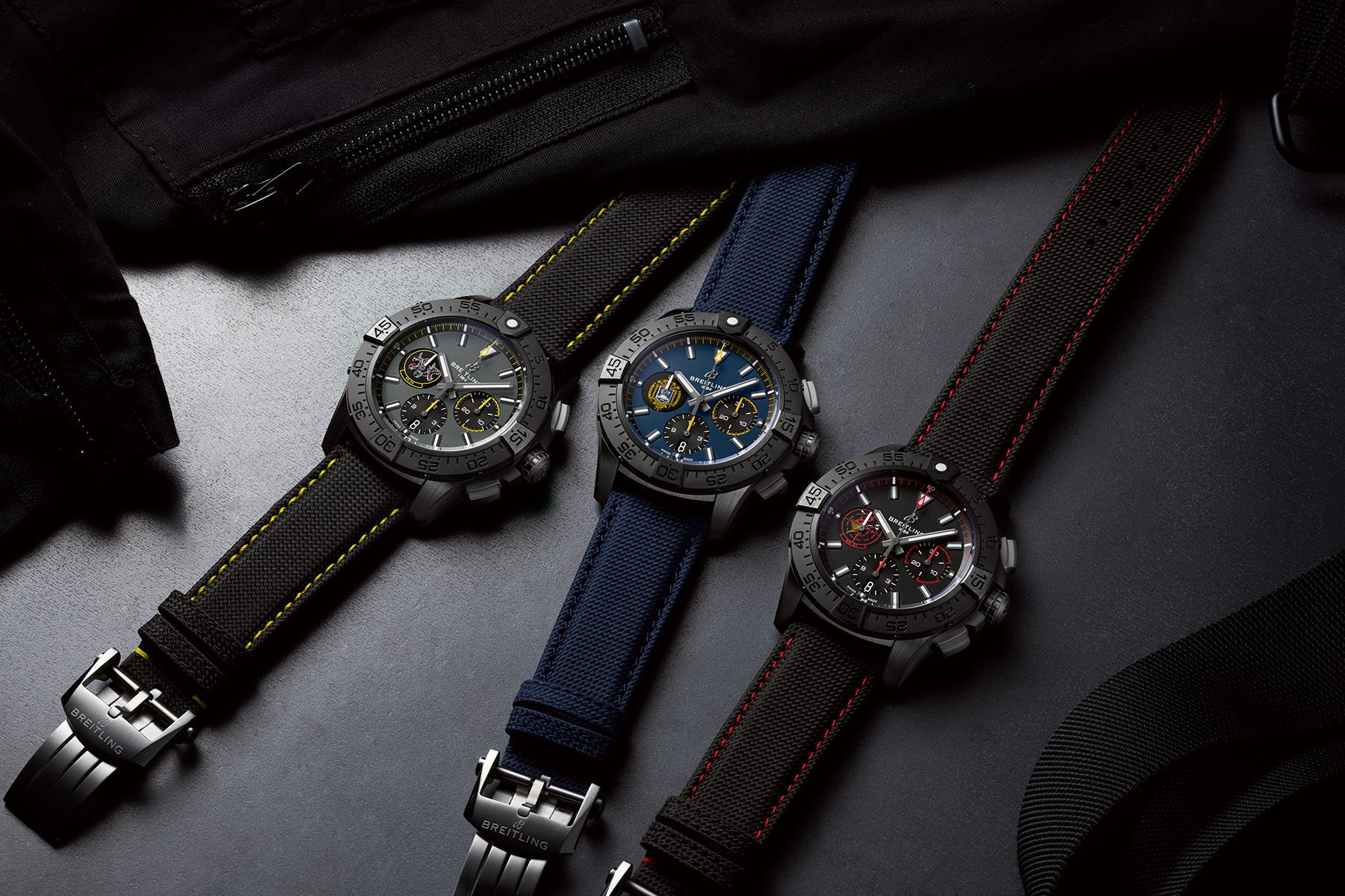
Breitling's Avenger line was specifically designed for military aviation use in the 1980s, and the modern Avenger Automatic 42 keeps the brief: oversized crown and pushers for glove operation, 300m water resistance, anti-magnetic case, and a sandwich-construction dial that's legible from any angle. Around €4,200. The tactical (matte black) and military (olive green) variants are the right colour-ways for the brief; the polished steel reads more dressy. On a Breitling rubber strap or a NATO; the steel bracelet is overkill for skydiving but works fine. The COSC-certified Caliber 17 is anti-shock rated. As a #2 pick after the Bremont MBIII, the Avenger gives you most of the same engineering at a meaningful price discount.
Bell & Ross
BR 03-92 Black Matte
BR03-92 - 42mm square - automatic
The cockpit-instrument square-case watch you can read with goggles on.

Bell & Ross designed the BR 03 around cockpit instrument layouts - the square case, oversized white-on-black indices, and short hour/minute hands are direct copies of military aircraft instrument panels. Around €3,200. 42mm square case in steel or matte ceramic, Sellita SW300 caliber, 100m water resistance, on a black rubber or fabric strap. The reason this works for skydiving is the dial legibility - the contrast and proportions are designed to read in peripheral vision, which is the only kind of vision you have during the 60 seconds of freefall when your full attention is on the altimeter and the LZ. Crown is screw-down so accidental pulls during a pack-job don't release it.
Hamilton
H77755435 - 45mm - automatic
The €1,800 pilot watch with a slide rule that's still useful.
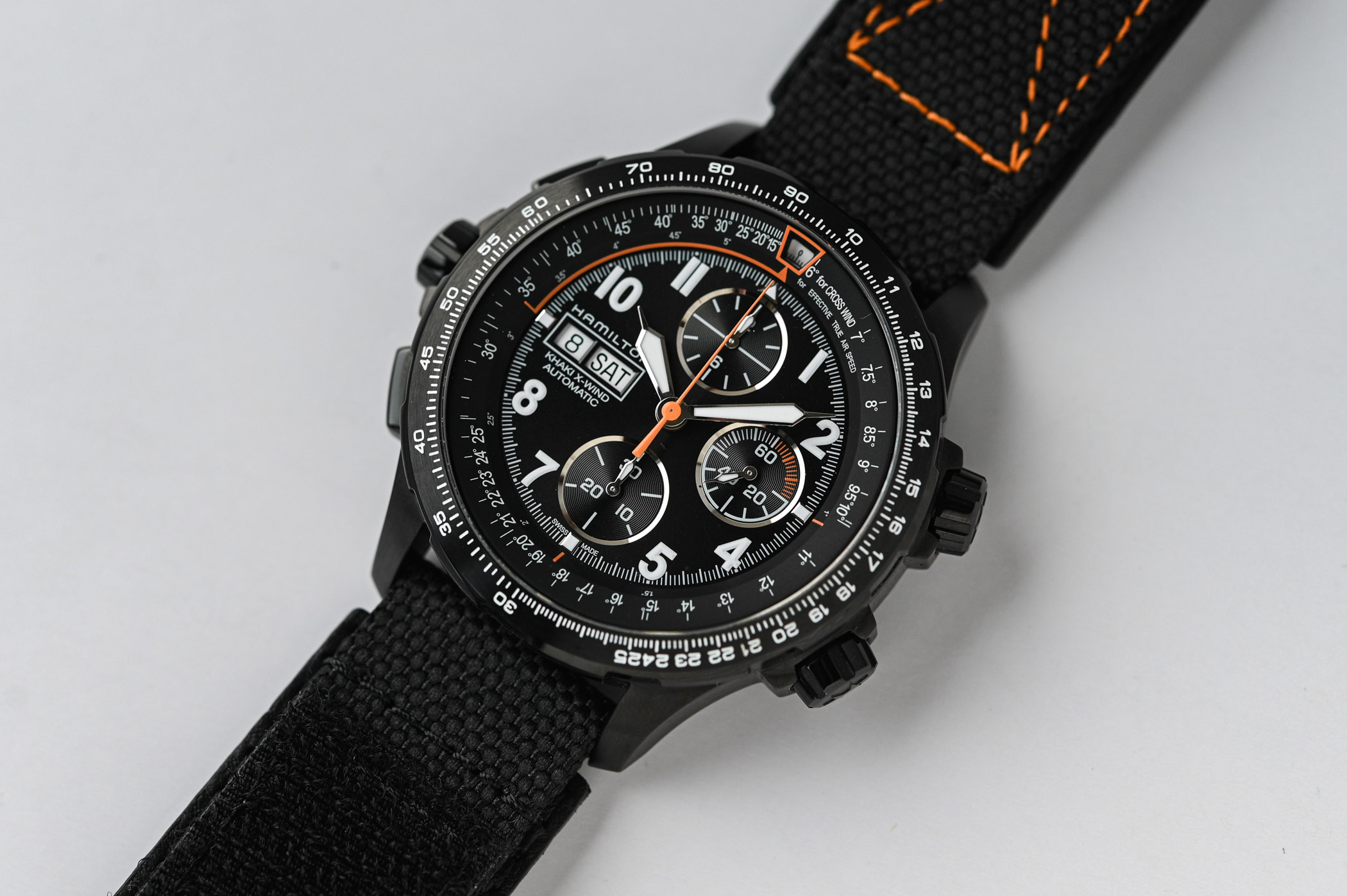
The Khaki Aviation X-Wind is Hamilton's most aviation-specific watch - the dial carries an angle of crosswind calculator that lets a pilot work out heading correction from groundspeed and wind. Around €1,800. 45mm steel case (large for the wrist, but proportional under a flight glove), Hamilton H-21-Si caliber with 60-hour reserve, on a green or black NATO. As a skydiving watch the slide rule is conversational rather than essential - but the case shock-resistance, the size, and the dial legibility under sun all sit at the right level for a non-flagship aviation piece. Best entry-point on this list.
IWC
IW329301 - 43mm - automatic
The pilot-watch lineage that goes back to the 1940 B-Uhr.
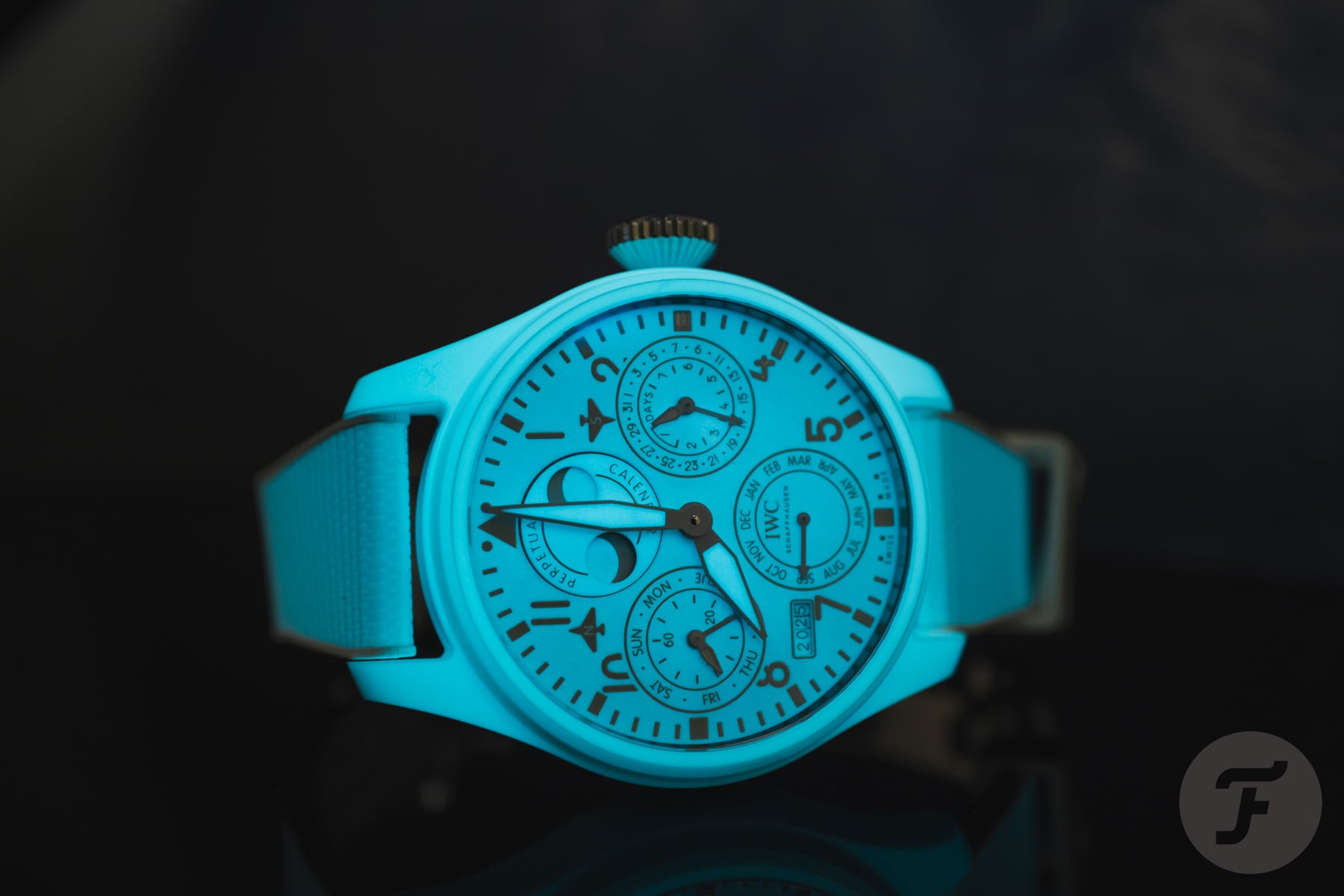
IWC's Big Pilot lineage traces directly to the 1940 Beobachtungs-Uhr issued to Luftwaffe navigators - a 55mm pocket-watch-sized wristwatch with massive crown, sandwich dial, and oversized indices. The modern Big Pilot 43 is the wearable descendant: 43mm case, IWC's 82100 caliber with 60-hour reserve, conical onion crown that operates through gloves, 100m water resistance. Around €9,800. As a skydiving watch the Big Pilot 43 is the luxe answer - more horological than the Bremont, less utilitarian than the Bell & Ross. The leather strap that comes on it should be swapped for a NATO before any actual jumping; the steel bracelet variant is appropriate as-is.
A note on what NOT to wear
Don't wear an automatic without anti-shock movement mounting. Don't wear a leather strap (the wind eats stitching faster than you'd expect; sweat under the jumpsuit kills it inside a season). Don't wear any vintage piece - the gaskets and shock spec aren't rated for canopy deployment. Don't wear a chronograph with delicate pushers that catch on a harness. Don't wear a smartwatch (haptics at deployment, screen flash on canopy check, battery anxiety on long jumps). And don't wear a watch you'd be sad to lose, because despite all the engineering, sometimes a strap fails on opening and the watch goes back to earth on its own time. Wear the Bremont; if it survives a Martin-Baker ejection seat, it'll survive your jump.
Frequently asked questions
What watch can handle a parachute opening shock?
A Bremont MBIII, Breitling Avenger Automatic 42 Seawolf or Bell & Ross BR 03-92 are all designed for the 4G shock at canopy deployment. The Bremont is the only one built specifically for ejection-seat qualification and remains the standard for military jump programs.
Will canopy shock break a normal watch?
It can. A 4-6G jerk at deployment breaks weak balance staffs and can dislodge rotor bearings on a standard automatic. A Rolex Submariner survives most jumps because the Oyster case dissipates shock well, but the balance wheel is not certified for it. Use a purpose-built watch instead.
Is a G-Shock enough for skydiving?
Yes, and many jumpers actually wear a Casio G-Shock DW-5600 or Frogman as their real skydive watch. Quartz movements handle shock better than mechanical, and the timer is useful under canopy. The Bremont MBIII is the collector answer; the G-Shock is the working jumper's answer.
Do I need a watch for skydiving at all?
No, altimeters do the actual work. The watch is a backup and a wrist-piece for the descent. Most experienced jumpers wear the G-Shock or Bremont for the seconds between deployment and landing, when you want confirmation of a normal descent rate. It's redundancy, not primary.
Comments 2
Hahahahahaha nice!