
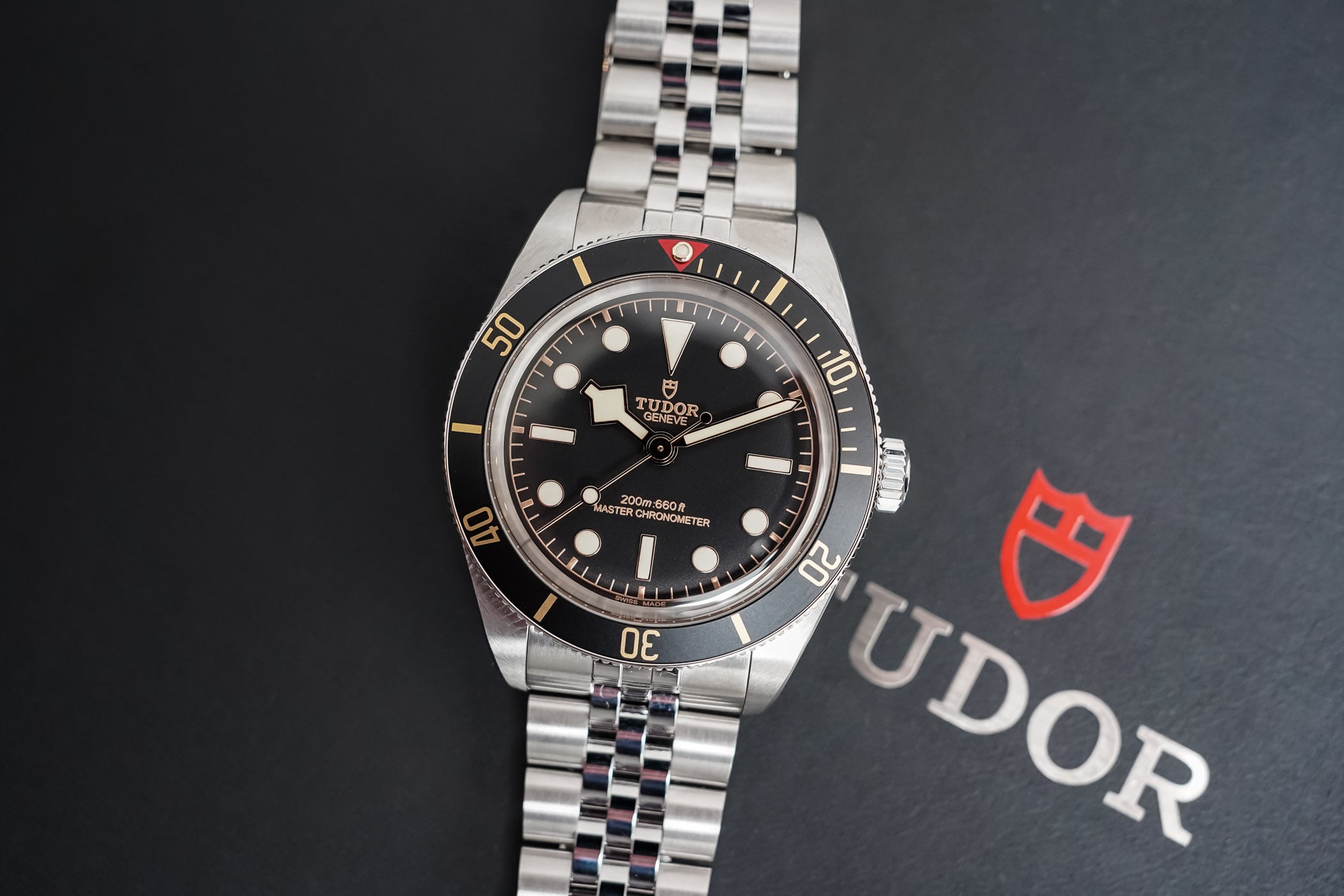
Same crown, different price tier
Tudor was founded in 1926 by Hans Wilsdorf (the Rolex founder) as the more accessible-tier of the Rolex Group. For 50+ years it was a workhorse, supplying military divers (the Marine Nationale-issued Tudor Submariner is one of the most-cited military watches), but the brand drifted in the 1990s-2000s. The 2012 Black Bay revival reset Tudor back to its current position: a serious watchmaking brand at half the Rolex price, with shared service infrastructure and increasingly its own in-house movement architecture.
The decision hinges on what you're actually paying for at the Rolex price tier. Service network, brand recognition, and resale value are real Rolex advantages. Movement engineering, day-to-day spec, and basic finishing are competitive on the Tudor side.
Spec sheet
| Attribute | Rolex Submariner / Datejust line | Tudor Black Bay / Pelagos line |
|---|---|---|
| Reference watches | Submariner Date 126610LN, Datejust 36 126200 | Black Bay 58 M79030N, Pelagos 39 M25407N |
| Movement | In-house Cal. 3235, 3230 (perpetual) | In-house MT5400/MT5402 (Master Chronometer-grade) |
| Reserve | 70 hours | 70 hours |
| Certification | Superlative Chronometer (-2/+2 sec/day) | COSC (-4/+6 sec/day) |
| Hairspring | Parachrom blue (Rolex proprietary) | Standard alloy |
| Bracelet construction | Oyster, Glidelock micro-adjust | Riveted (BB58) or T-fit (Pelagos 39) |
| Service interval | 10 years | 10 years |
| Service network | Rolex global; multi-month wait acceptable | Tudor uses same network in some regions |
| Allocation | Allocation-only on sport refs | Most refs at retail |
| Retail starting | ~€7,800 (OP 36) | ~€2,200 (1926 36mm) |
| Resale (1 year) | ~95-110% of retail | ~85-95% of retail |
The 2012 Black Bay reset
Pre-2012, Tudor was a quiet supplier of military and budget-tier watches, mostly invisible to North American collectors after the brand was withdrawn from the US market in 2004. The 2012 launch of the Black Bay revived Tudor decisively: the watch cited the 1958 Tudor Submariner ref. 7924 with gilt-printed dial, snowflake hands, and a 41mm case (later, the 39mm Black Bay 58 became the more-recommended version). By 2017 Tudor was launching its own in-house Cal. MT5612, ending the Sellita-base era for the brand's flagship references.
Movement engineering tier
Rolex Cal. 3235 is the modern Submariner movement (also used in Datejust 41, GMT-Master II, Sea-Dweller). 70-hour reserve, Chronergy escapement, Parachrom blue hairspring. Superlative Chronometer rated to -2/+2 sec/day after casing, tighter than COSC.
Tudor Cal. MT5402 (Black Bay 58) and MT5612 (larger BB) are full in-house movements, COSC-certified to -4/+6 sec/day. Same 70-hour reserve. The Tudor Master Chronometer (MT5602-1U in the Black Bay Ceramic) hits 15,000-gauss antimagnetic spec equivalent to Omega's Master Chronometer.
The Rolex movements are tighter on certification spec; the Tudor movements are conceptually equivalent at the engineering level.
Service network and resale
Rolex's global service network is unmatched in luxury watchmaking; you can hand a 30-year-old Submariner to almost any Rolex AD anywhere in the world and have it serviced. Tudor uses the same physical service infrastructure in many regions. Resale: a Rolex sport reference returns ~100% of retail in the first year and often more on allocation-restricted models; a Tudor returns ~85-95% of retail in the same window. Both retain value better than essentially any other watchmaker's catalogue.
Pros and cons
Submariner / Datejust line · Pros
- Brand permanence and resale strength
- Tighter chronometer spec (-2/+2 sec/day)
- Parachrom blue hairspring
- Global service network at Rolex AD anywhere
Submariner / Datejust line · Cons
- 2-3x the price of the equivalent Tudor
- Sport refs allocation-only
- Limited dial-design experimentation
Black Bay / Pelagos line · Pros
- Half the price, in-house movement
- Available at retail (no allocation lottery)
- Wider dial / colour / case-material range
- Master Chronometer-grade variants exist
Black Bay / Pelagos line · Cons
- Resale ~85-95% of retail (vs Rolex's 100%+)
- Less brand status
- Slightly looser chronometer spec
Verdict: which one?
If you can afford only one: Black Bay 58 at €3,800. It's the most-recommended one-watch in modern watchmaking. Tudor.
If brand-as-asset is the actual buying motivation: Rolex Datejust 36 or Submariner. Resale, status, and global service. The price tier is the cost.
If you already have a Rolex sport reference and want a second watch: a Tudor lets you actually wear something without the allocation-anxiety of risking the Sub on a beach.
Both brands respect each other's market position; the question is rarely "which one is better" and almost always "which one fits the buyer's price point and risk tolerance."
Common questions
Do Rolex and Tudor share the same factory and movements?
They are the same group - Tudor was founded in 1926 by Rolex founder Hans Wilsdorf and uses shared service infrastructure in many regions. They no longer share movements: since 2017 Tudor flagship references run its own in-house MT-series calibers (COSC, 70-hour reserve), and one Master Chronometer variant matches Omega 15,000-gauss antimagnetic spec. Rolex Cal. 3235 family is rated tighter at -2/+2 sec/day with a proprietary Parachrom hairspring.
Is Tudor "Rolex quality" at half the price?
Engineering-wise, close - Tudor in-house movements are conceptually equivalent, and the case and bracelet construction is serious. What the Rolex premium buys is a tighter chronometer spec, the Parachrom hairspring, the global service network, far stronger resale, and the brand recognition. For a one-watch buyer, the Tudor Black Bay 58 at around €3,800 is the most-recommended pick in modern watchmaking; for "brand as asset", Rolex.
Which holds its value better, Rolex or Tudor?
Both retain value better than essentially any other watchmaker catalogue. A Rolex sport reference typically returns around 100 to 110 percent of retail in the first year, more on allocation-restricted models; a Tudor returns around 85 to 95 percent in the same window. The Rolex catch is that buying at retail is gated and grey-market entry is at a premium.
Can I buy a Rolex at retail more easily than a Tudor?
No - it is the reverse. Most Tudor references are at-retail at authorised dealers, while Rolex sport models (Submariner, GMT-Master, Daytona) are allocation-only with multi-year waits. If you want to walk in and walk out with a watch, Tudor is the answer.
Comments 1