Paul Leonard Newman won an Oscar for The Color of Money (1986), became one of Hollywood's most-respected character actors across Cool Hand Luke, Butch Cassidy and the Sundance Kid, The Hustler, and The Verdict, and founded Newman's Own, a food company that has donated more than $600M to charity to date.
He raced semi-professionally well into his 70s, finishing second at Le Mans in 1979 with the Porsche 935 K3 and winning multiple SCCA national championships in the IMSA GTO and Trans-Am series. The mix of Hollywood credentials and authentic motorsport bona fides is the cultural foundation that made his Daytona iconic.
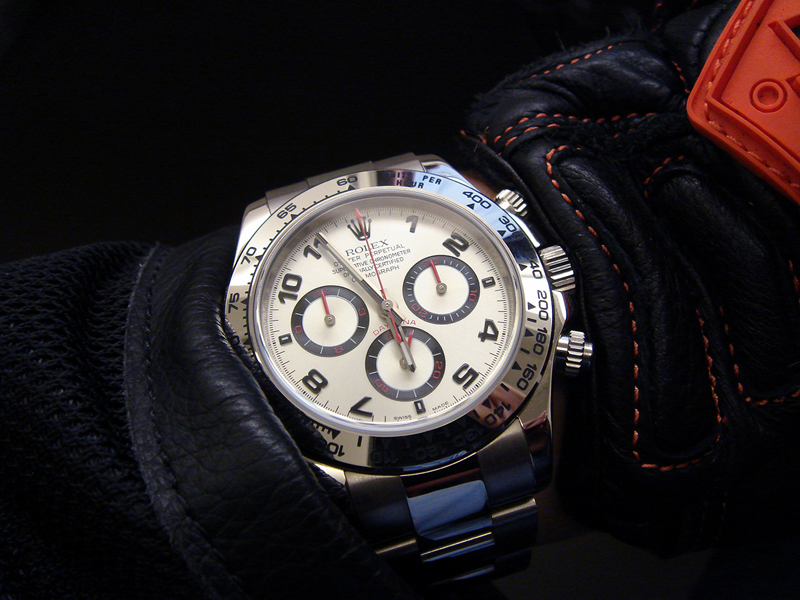
Newman's restraint shaped his watch image as much as his racing. He wore the Daytona daily, dressed-down on a leather strap, with the engraved caseback hidden against his wrist. Photos through the 1970s and 80s rarely show him in jewellery, sunglasses or any luxury signal beyond the watch.
The watches

The auction record
Cox consigned the original 6239 to Phillips New York in October 2017. It hammered for $15.5M, making the buyer's premium total $17,752,500, the world record for a wristwatch at auction at the time, eclipsing the previous record (a Patek 1518 in steel) by a wide margin. The buyer remains anonymous.
What changed
Before 2017 the 'Paul Newman dial' was a known niche. After 2017 it was the most-imitated dial in modern Rolex history, and the term entered general circulation. Modern Daytona ref. 116500LN models trade at roughly 2x retail in part because of this single hammer fall.
What he didn't trade on
Newman never licensed his name to a watch. Rolex did not pay him; he had no ambassador deal; no signature edition Daytona ever existed during his lifetime. The brand association is purely cultural, which paradoxically makes it harder to engineer and easier to sustain than modern celebrity-endorsement watch programmes.
Comments 1