
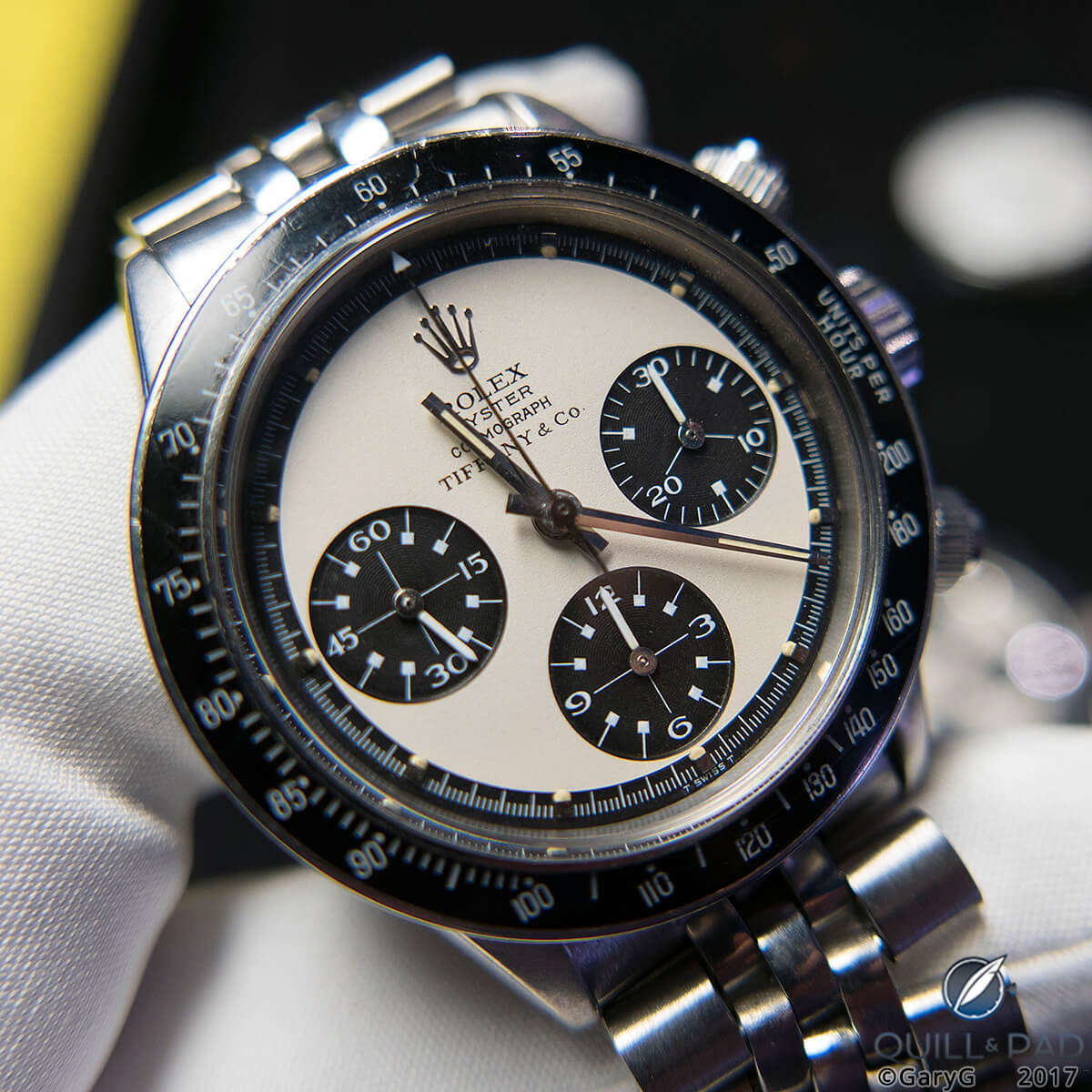
The Paul Newman Daytona is the most famous vintage Rolex in modern collecting. The watch is a Rolex Cosmograph Daytona (any of the manual-wind references 6239, 6241, 6262, 6263, 6264, 6265) fitted with the rare "exotic dial" variant produced approximately 1968-1972 by the dial supplier Singer. The exotic dial differs from the standard Daytona dial in three ways: contrasting sub-counters (white sub-counters on a black dial, or black sub-counters on a white dial), square hour markers with raised square painted lume rather than the standard rectangular markers, and Art-Deco serif numerals on the sub-dial graduations (rather than the cleaner sans-serif numerals on standard dials).
Singer produced approximately 3,500-5,500 exotic dials over the 1968-1972 period (estimates vary by source); they were fitted indiscriminately to whichever Daytona references were in production at the time, in both black-dial and white-dial variants. At Rolex retail in 1968, the exotic dial cost the same as the standard dial; commercial demand was light, and many of the watches sold with exotic dials sat in dealer inventories for years before reaching customers. The combination, exotic dial on Daytona, was simply unfashionable in the late 1960s and 1970s.
"Going into the auction we hoped for $5 million. Twelve minutes later, the watch sold for $17.8 million. The room understood, before we did, that this was no longer a watch sale, it was a piece of American history changing hands."- Aurel Bacs, Phillips Watches, on the 26 October 2017 sale
The watch became famous because Joanne Woodward, Paul Newman's wife, gave him a Rolex Daytona ref. 6239 with the white-dial / black-sub-counter exotic dial variant as a 1968 gift while he was filming Winning (1969), in which he played a racing driver. Woodward had the caseback engraved "Drive Carefully Me" (a quiet plea given Newman's well-documented racing-driving habits). Newman wore the watch continuously for the next 15 years, including in the famous photograph from Winning, in promotional shots, and on the racetrack at Le Mans where he raced as a Newman/Haas team driver.
In 1984 Newman gave the watch to James Cox, his daughter Nell's boyfriend at the time, on the porch of the Newman family home in Westport, Connecticut. The gift was completely informal; Newman is said to have noticed Cox glancing at his wrist and simply unfastened the watch and handed it over, joking "you're going to need this if you're going to be late picking up my daughter". Cox kept the watch for over 30 years; the photo of Newman wearing it became part of collector mythology in the 1990s, but the location of the actual watch was unknown to the public.
In 2017, Cox publicly came forward through Phillips Watches under Aurel Bacs, with the original engraved caseback, original strap, original Rolex paperwork from 1968, and a documented chain of custody from Newman through Cox. The watch was offered at Phillips Geneva on 26 October 2017 with a low pre-sale estimate of $1 million. The auction lasted 12 minutes; the watch sold for $17,752,500 (with buyer's premium) to an anonymous American collector, the highest price ever paid for a wristwatch at the time and a record that stood until the Patek Philippe 6300A Grandmaster Chime sold for $31M at the 2019 Only Watch auction.
The Newman effect has reshaped the entire vintage Rolex market. Before 2017, ordinary exotic-dial Daytonas (any reference, no Newman provenance) sold for $80,000-$200,000; after 2017 the same references sold for $200,000-$600,000+. Top examples (mint condition, original parts, original paperwork) reach $1M-$3M routinely. The "Newman-style" or just "exotic-dial" Daytona is the most-discussed reference in the entire vintage Rolex collecting community and the Phillips Newman watch in 2017 is widely cited as the auction sale that defined the modern vintage-watch boom of the 2017-2022 era.



Comments 2