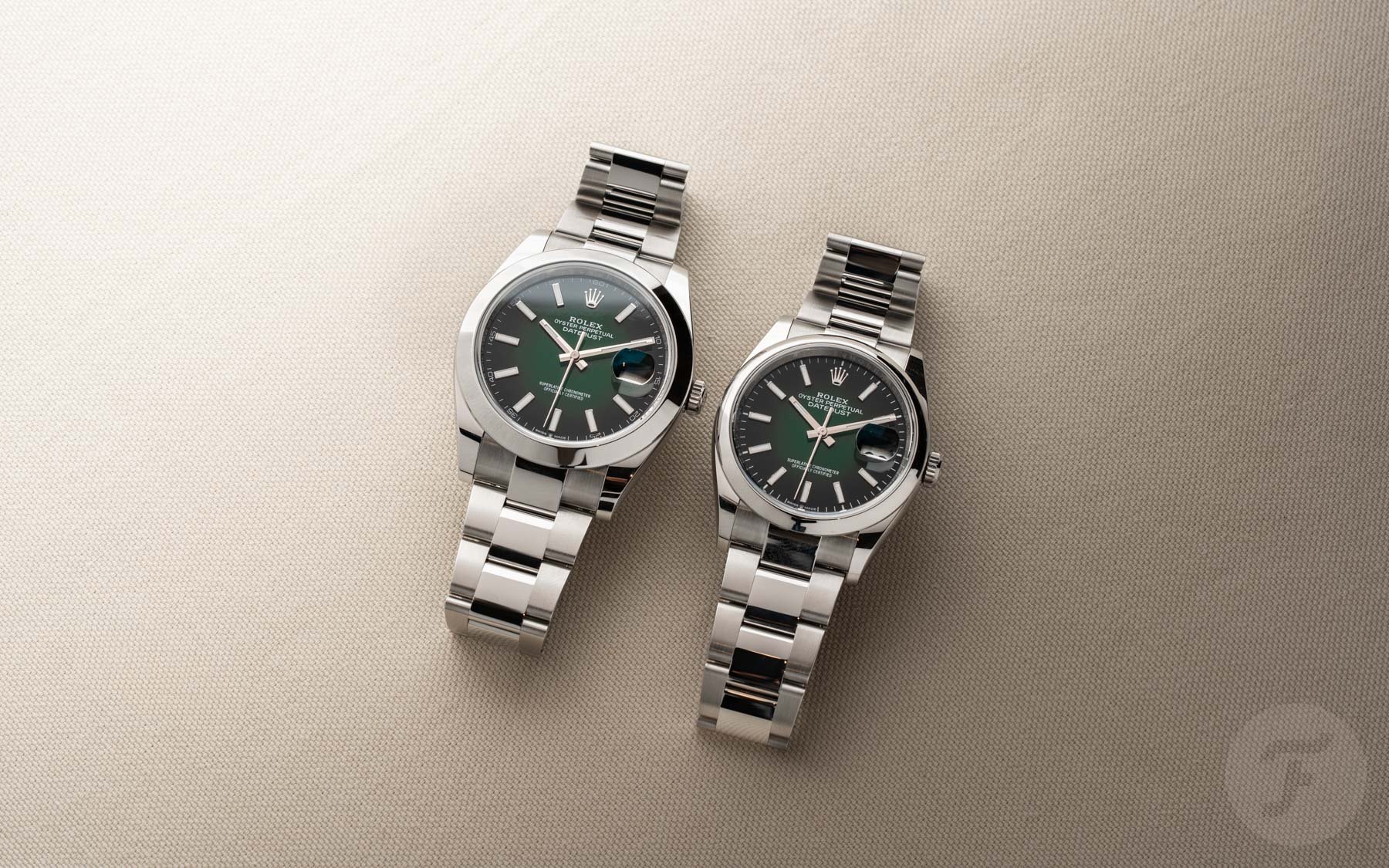
Every year at Watches and Wonders, Rolex announces a few things that get the headlines (this year: a new Land-Dweller, a refreshed Sky-Dweller in titanium) and a few things that quietly turn into the watches collectors actually chase. The Datejust Green Ombré Lacquer is squarely in the second bucket.
It is not flashy. It does not run on a new movement. The case profile is the one Rolex has been refining for seven decades. The interesting part is the dial, and it is interesting enough that boutique waitlists for it filled within hours of the announcement.
The references, all of them
Rolex has put the green ombré on five distinct references, splitting evenly across the two case sizes:
The dial choice is the same across all five. The bezel and case material vary. If you are shopping the gradient and the price tag matters, the 126200 (36mm) and 126300 (41mm) are the entry points. If you want the gradient with a fluted bezel and a touch more presence in the metal, the 126234 and 126334 do that with their white-gold fluting.
How the gradient is actually built

This is the part worth understanding, because it is the part that makes the dial different from every other Rolex Datejust before it. Rolex has done ombré dials before, in chocolate brown on the Sky-Dweller and in a few one-offs. What is new on the green Datejust is the fact that the entire dial is coated in lacquer. No metallic base. No sunray. No applied pattern under the colour.
The process, as Rolex describes it: a base layer of green lacquer goes down across the full dial. A second layer of black lacquer is then sprayed in concentric circles, heaviest at the outer edge and feathering toward the centre. The result is a dial that reads bright green in the middle, deep forest green halfway out, and almost black at the rim. Under sunlight the gradient blooms. Under indoor light it darkens. That visual range is what makes the dial photograph well across cases.
The case and the rest of the watch
Everything else is the standard 2020s-era Datejust. The 41mm models use the calibre 3235; the 36mm uses the calibre 3235 as well. 70-hour power reserve, Superlative Chronometer certification (-2/+2 seconds per day), Paraflex shock absorbers, Chromalight on the hands and indices. The Jubilee or Oyster bracelet options are the same as on the rest of the modern Datejust line.
What is missing, deliberately, is a cyclops swap or a new clasp. Rolex's pitch with this release is dial-only. Everything else stays exactly where it is. The reasoning is clean: the rest of the watch already works.
Why this one is selling fast
A few reasons stack:
- The colour. Green has been the dominant Rolex dial colour in modern releases (Submariner Hulk and Kermit, GMT-Master II "Sprite", the green Day-Date 36). Green ombré reads as a continuation, not a one-off.
- The size match. The 36mm Datejust is having its biggest cultural moment in years. Pairing this dial with the 36mm case lands at the exact intersection of "vintage proportions" and "current Rolex availability".
- The price band. A €9,300 entry point on a halo dial keeps it within reach of the buyers who would have aimed for a Submariner and walked away from the Sub waitlist.
The buyer's takeaway
If you have been looking for a Datejust with some visual edge but did not want the diamonds-and-fluted-everything thing, the green ombré is the one. The 36mm smooth-bezel 126200 is the most balanced pick: same dial as the four-figure references, no white-gold premium, the case size that is currently in the cultural sweet spot. The 41mm 126300 does the same thing in a bigger format if your wrist needs more presence.
The white-gold-fluted models (126234, 126334) are the dressier reading. If a Datejust to you is a fluted watch on Jubilee, those are the ones. The diamond 126284RBR is the boutique flex; budget for a five-figure jump.
Across all five, the dial is the watch. Spend the time in person if you can. Photos undershoot what the gradient does in actual light.
Comments
No comments yet, be the first to weigh in.