Watch brandsWatch wikiWatch videosVariousWatch calendarSaved articles
PopularRolexOmegaPatek PhilippeAudemars PiguetTudorGrand SeikoCartierSeikoIWCTAG HeuerBreitlingJaeger-LeCoultreA. Lange & SohneZenith
WristBuzzWatch WikiPower Reserve
⚙ Movement · Running Time

Power Reserve

How long a fully wound mechanical watch runs before stopping

The duration for which a mainspring delivers usable torque. Typical modern wristwatches run 40 to 80 hours; a few extreme watches run 10 or more days. Often displayed as a dial indicator so the wearer knows when to wind.

Typical40-48 hours
Long-PR modern70-120 hours
Extreme10-50 days
RecordHublot MP-05 (50 days)
CategoryRunning time
WristBuzz Articles557
Power Reserve

Photo: Revolution · Yesterday

48hEntry Standard
72hLong-PR Standard
31dLange 31
50dHublot MP-05
557WristBuzz Articles

The Power Reserve Story

The power reserve of a mechanical watch is the time it runs from fully wound to stopped. It is a function of the mainspring's length and the escapement's energy consumption. A shorter mainspring stores less energy; a high-frequency balance wheel consumes energy faster. The industry has gradually extended the standard from 40 hours to 72 hours, and a handful of specialist watches run for weeks.

The Monday-morning problem, a watch stopped over the weekend that needs resetting on Monday, motivated the 72-hour class. A watch with at least 65 hours of reserve started on Friday morning will still be running Monday morning. Rolex Cal. 3235 (2015) and Cal. 4130 (2000) are 72-hour; Cal. 3285 (2018) 72-hour. Omega Cal. 8500 / 8900 / 9900 family is 60 hours; newer Cal. 8800 is 55 hours. Audemars Piguet Cal. 4302 is 70 hours. The common denominator is a longer or thicker mainspring combined with more efficient escapement finishing.

Watches with week-long or longer reserves typically use twin or triple barrels. IWC's Portuguese 7-Day, Panerai's Cal. P.2002 (8-day), A. Lange & Söhne Pour le Mérite Tourbillon (7-day, with fusee-and-chain constant force). Beyond 10 days and you enter specialist territory, the Lange 31 (31 days), Jaeger-LeCoultre Duomètre (50 hours per train, two separate trains), and the record-holding Hublot MP-05 LaFerrari (50 days, eleven barrels in series).

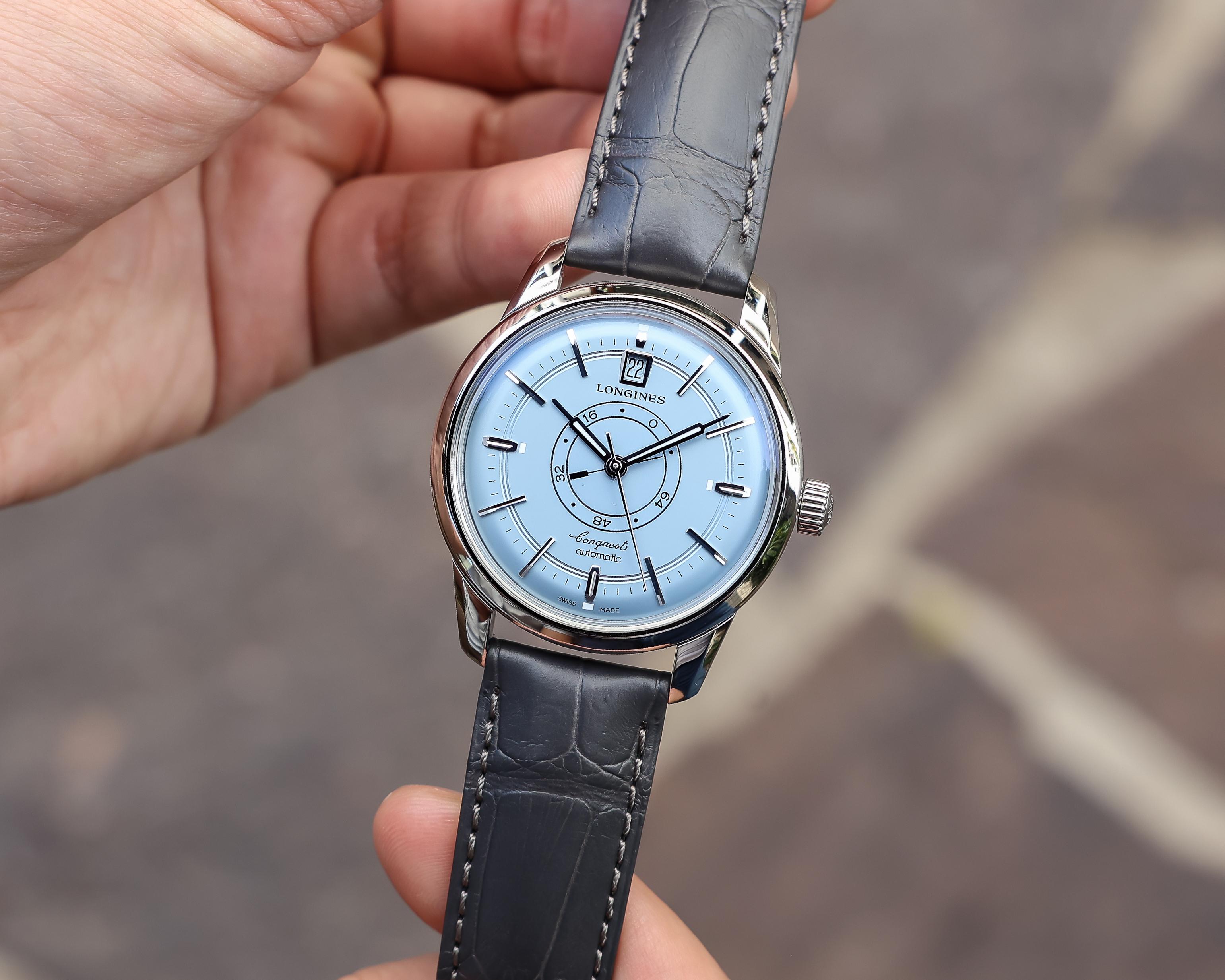
A power reserve indicator on the dial is a traditional complication. Often called a réserve de marche on French dials or "up/down" on English-market pieces, the indicator shows the remaining reserve with a small linear or arc gauge. Patek Philippe Cal. 31-260, Jaeger-LeCoultre Reverso Tribute Duoface, and the IWC Big Pilot all prominently display power reserve. On automatic watches the indicator is usually superfluous (wrist motion keeps the mainspring topped up), but it is a visually striking detail that has become a marker of technical seriousness.


Notable Power-Reserve Watches

2000 · Rolex
Daytona Cal. 4130
72h reserve

The long-PR benchmark of the modern era. Column wheel + vertical clutch chronograph with proprietary long-wound mainspring. Still the reference 25 years on.

72h
2010 · IWC
Portugieser 7-Day
Cal. <a href="/watch-calibers/iwc-52000/">52010</a>

Twin-barrel 168-hour power reserve with Pellaton winding system. The reference long-reserve wristwatch at a serious but attainable price.

7 Days
2007 · A. Lange & Söhne
Lange 31
Ref. 130.025

31-day power reserve with constant-force escapement. Two mainsprings, key-wound because manual crown winding would take too long. The sober, serious approach to an ultra-long reserve.

31 Days
2013 · Hublot
MP-05 LaFerrari
50-day PR

11 barrels in series, visible through sapphire case. The record-holder for serial mechanical power reserve. A technical showpiece more than a daily driver.

50 Days
1994 · A. Lange & Söhne
Pour le Mérite Tourbillon
Cal. L902.0

Fusee-and-chain constant-force mechanism gives uniform torque across the entire 36-hour reserve. The constant-force approach to the torque-falloff problem.

Fusee-Chain
2007 · Jaeger-LeCoultre
Duomètre Chronographe
Cal. 380

Two separate trains each with its own mainspring and wheel train: one for timekeeping, one for the chronograph. Each has its own power reserve indicator.

Dual Train

Latest Power Reserve News

Power Reserve
Hodinkee
Introducing: Citizen's New "The Citizen" And Attesa Recrystalized Titanium Limited Edition Eco-Drives
21h ago
Power Reserve
Revolution
Vacheron Constantin Updates the Twin Beat Perpetual Calendar with a 70-Day Power Reserve
Yesterday
Power Reserve
Worn & Wound
Farer Introduces a Trio of Classic Racing Inspired Chronographs
2 days ago
Power Reserve
Hodinkee
Introducing: The Vacheron Constantin Traditionelle Twin Beat Perpetual Calendar Is Back
2 days ago
Power Reserve
SJX Watches
Vacheron Constantin’s Twin Beat Returns with 70-Day Power Reserve
2 days ago
Power Reserve
Teddy Baldassarre
Vacheron Constantin Traditionnelle Twin Beat Perpetual Calendar Marks Another Power-Reserve Milestone
2 days ago
Power Reserve
SJX Watches
Insight: A Look At The Fusee and Chain
2 days ago
Power Reserve
Hodinkee
Introducing: The Angelus Instrument de Mesures – Three Vintage-Inspired Scales, Modernized
2 days ago
Power Reserve
Hodinkee
Introducing: The Doxa Sub 200 T-Graph II
3 days ago
Power Reserve
Worn & Wound
Industry News: Ronda Returns to Mechanical Movements with the Impressive R01
6 days ago
Power Reserve
Hodinkee
Introducing: The Longines Master Collection Refreshed For 2026
Jun 11, 2026
Power Reserve
Hodinkee
Introducing: Chopard L.U.C Quattro Revolution Re-Edition
Jun 8, 2026
View all 557 articles

Learn More

Comments 2

  1. WatchHusk
    This is why I always recommend checking the power reserve specs on microbrands before buying. A lot of smaller independent manufacturers are pushing 5-7 day reserves now without the premium pricing of the established houses. You don't need a ten-day in-house caliber to get genuine value; there's some really smart engineering happening outside the mainstream right now.
  2. Milo S.
    More curious about how the dial finishing holds up over those 40 hours versus ten days of constant mainspring tension. Does anyone know if longer reserves put extra strain on the dial's applied indices or printed elements?

Leave a comment

All comments are reviewed before they go live. Email is for our records only - it's never published.