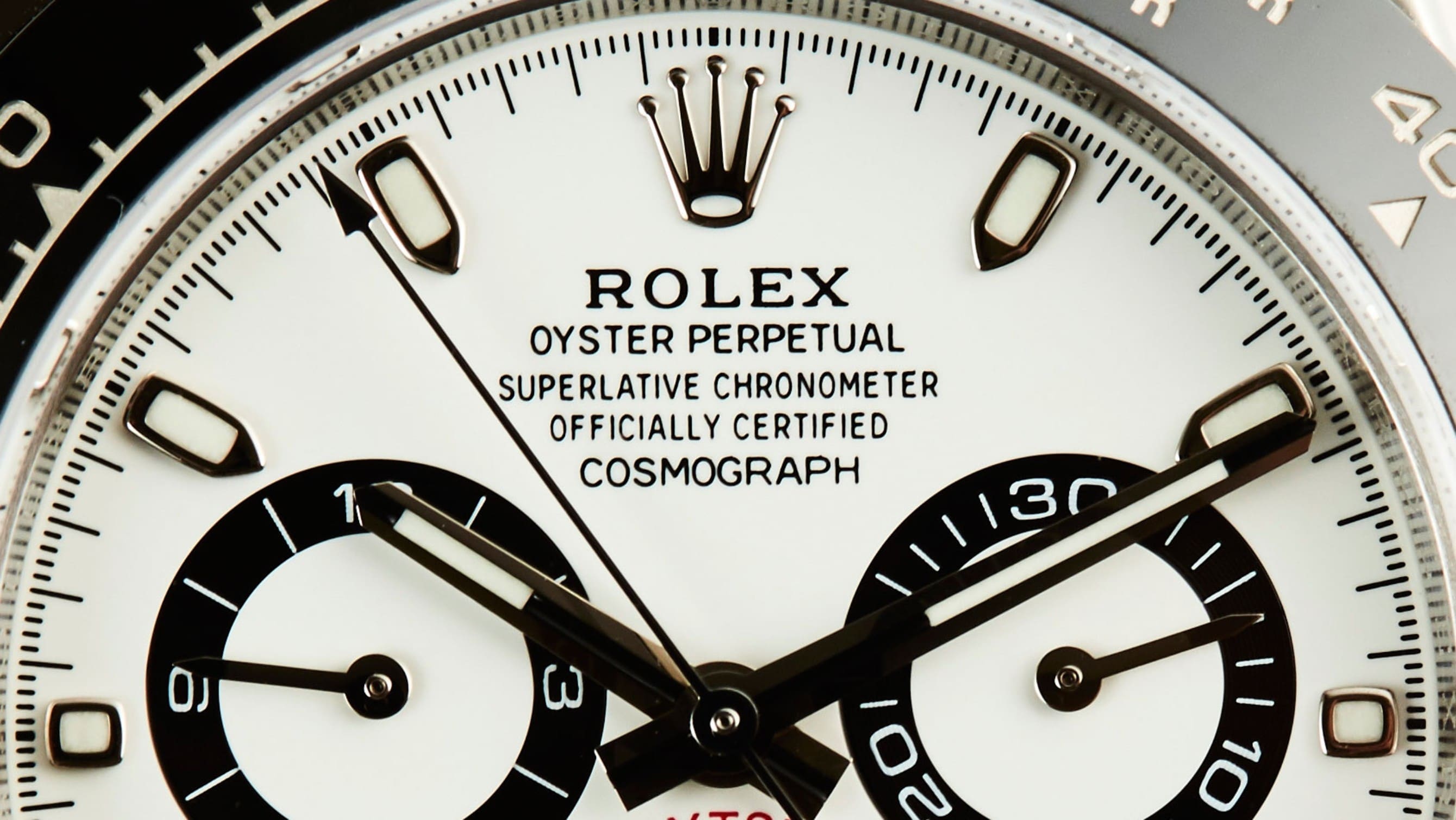
Superlative Chronometer is the in-house precision certification that Rolex applies to every modern Rolex watch. The term itself dates to 1957, when Rolex began printing "Officially Certified Chronometer" on its dials to indicate COSC certification. In 2015 Rolex modernised the meaning of the term: post-2015 Rolex watches certified as "Superlative Chronometer" must meet ±2 seconds per day rate accuracy on the cased watch, significantly tighter than the COSC standard of -4/+6 seconds per day on the bare movement. Every modern Rolex sold today carries the modern Superlative Chronometer specification.
The certification process has two stages. First, the bare movement is sent to COSC (Contrôle Officiel Suisse des Chronomètres) for the standard 15-day test in five positions across three temperatures. Each Rolex movement that passes COSC receives a Swiss state-issued chronometer certificate. Second, after the movement is cased and the watch is fully assembled (dial, hands, bracelet, crown), Rolex performs in-house testing on the cased watch using its own machinery at the Bienne and Geneva facilities. The cased-watch test must show ±2 sec/day rate across positions and conditions; failure means the watch goes back through service before being released for sale.
"The COSC certifies a bare movement. Rolex tests the cased watch. The two-second-a-day spec at the wrist is what makes the modern Superlative Chronometer text meaningful."- Rolex commentary on the 2015 specification update
The case-on testing is the meaningful technical addition. COSC tests bare movements; in real wear the case, dial, hands, and bracelet add weight and inertia that can shift rate slightly. Rolex's own testing measures the rate of the watch as it will be worn, capturing any rate shift from case-on assembly. The ±2 sec/day spec is a meaningful tightening; on a typical mid-tier Swiss watch with COSC certification, the as-worn rate may be ±4-5 sec/day even though the bare movement passed -4/+6. Rolex's Superlative Chronometer essentially guarantees chronometer-grade rate at the wrist, not just at the test bench.
The Superlative Chronometer specification was rolled out in 2015 across the entire Rolex catalogue, alongside the new Cal. 3235 family with the Chronergy escapement. Older Cal. 3135-era references retroactively earned the Superlative Chronometer mark when their movements were re-certified to the new spec; modern Cal. 3230, 3235, 3285, 3295, 3186 (Parachrom GMT), 3187, and 4131 references are all Superlative Chronometer certified at the ±2 sec/day spec.
Alongside the modern Superlative Chronometer, Rolex extended the international service warranty from 2 years to 5 years in 2015; the warranty is part of the same in-house quality programme. Tudor (Rolex's sister brand under the Wilsdorf Foundation) operates a similar but separate model: most modern Tudors are METAS Master Chronometer certified rather than Rolex Superlative Chronometer, reflecting Tudor's strategic differentiation as a separate technical house.
For collectors, "Superlative Chronometer" is the strongest in-the-watch precision signal at Rolex. Pre-2015 vintage Rolex watches with the older "Officially Certified Chronometer" text use the COSC-only spec; post-2015 Superlative Chronometer Rolexes use the tightened ±2 sec/day spec. The dial-text difference is one of the easier ways to date a Rolex production year: pre-2015 = COSC-only Superlative; post-2015 = the tightened modern spec. The certification has become the in-house Rolex equivalent of the METAS Master Chronometer at Omega; both deliver tighter-than-COSC rate on the cased watch, with different testing institutions and slightly different specifications.



Comments 1