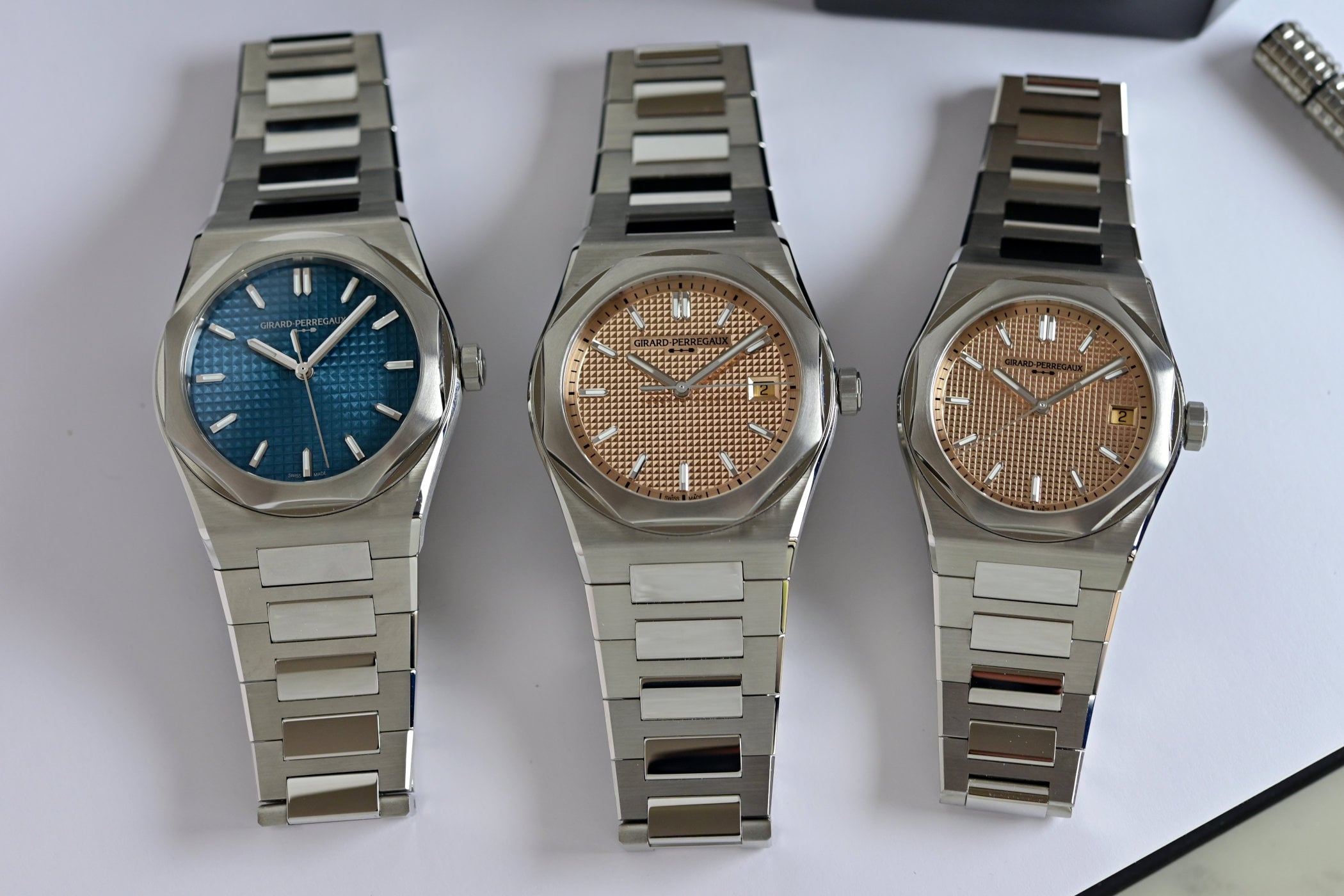
A year ago, Girard-Perregaux marked the Laureato's 50th anniversary with a 200-piece limited edition. It carried a new in-house movement, the Calibre GP4800, and a dial layout that felt sharper than the regular line. Then the brand did the smart thing: it kept the design.
The Laureato Fifty Collection is what happens when an anniversary piece becomes the new standard. Four steel references, two of them in a 36mm case that the modern range did not have, all running the GP4800, and one halo piece that quietly threatens to be the most interesting integrated-bracelet dial of the year.
Four watches, two sizes, one movement
The collection breaks down cleanly:
Inside every one of them is the Calibre GP4800: automatic, 4Hz, 60-hour power reserve, with a finely finished oscillating mass and bridges in the brand's signature anglage. The movement was new to last year's limited and is now standard across the Fifty range. GP's commitment to it is the headline. The fact that you can now get it on a 36mm steel bracelet for the first time in this era is the practical news.
The blue enamel deserves its own paragraph

The blue enamel reference is what justifies the collection. Grand-feu enamel is sintered on the dial at high temperatures, in multiple layers, and it does not match cleanly between dials. That is the point. Underneath the translucent blue, GP has stamped the Clous de Paris (a fine hobnail) pattern that has been the Laureato signature since 1975. The light hits the pattern through the enamel and the dial reads differently as you move your wrist.
This is the kind of dial work you usually see on a small-batch artisan piece from Vianney Halter or Voutilainen, not on the steel bracelet of a brand with a Kering distribution network. GP's done it before in white gold cases. Doing it on a steel sports watch with an integrated bracelet is the move that will get people who do not normally consider Girard-Perregaux to look twice.
About that 36mm
The 36mm size is the second piece of news. The current Laureato range bottomed out at 38mm. There is now a true vintage-proportion 36mm option, and on the steel bracelet, it lands in roughly the same territory as a Royal Oak Jumbo on the wrist for total presence. For collectors with smaller wrists who have been working around the size, this is the entry point that did not exist last week.
Where does this sit in the market
The Laureato has always been the integrated-bracelet steel sports watch you bought when you did not want the Royal Oak conversation at dinner. It launched the same year as the Royal Oak and was, frankly, ignored for decades. The 2017 revival changed that. The Fifty collection cements it: the Laureato is no longer the third option after the Royal Oak and the Nautilus. It is its own thing, with its own movement, and now with a 36mm size and a grand-feu enamel dial that neither of the bigger names in the category currently offers in steel.
Prices land in the upper steel-sports-watch tier (we'll update the exact numbers as European retail stabilises), with the enamel reference priced as the clear halo. None of the four breaks new ground on bezel-and-bracelet finishing, because the Laureato already had that. What they do is move the dial conversation forward and add the size that the line was missing.
The takeaway
The Laureato Fifty is the answer to a question collectors have been asking for years: when does GP commit to the Laureato as a flagship instead of treating it as one product among several? The answer is now. New movement across the range. New size. A grand-feu enamel dial that no direct competitor offers in steel. And, crucially, no asterisk: these are core-collection pieces, not limited editions hidden behind a phone call to the boutique.
If you have ever flirted with the Royal Oak waitlist and walked away, this is the line to spend an afternoon with.
Comments
No comments yet, be the first to weigh in.