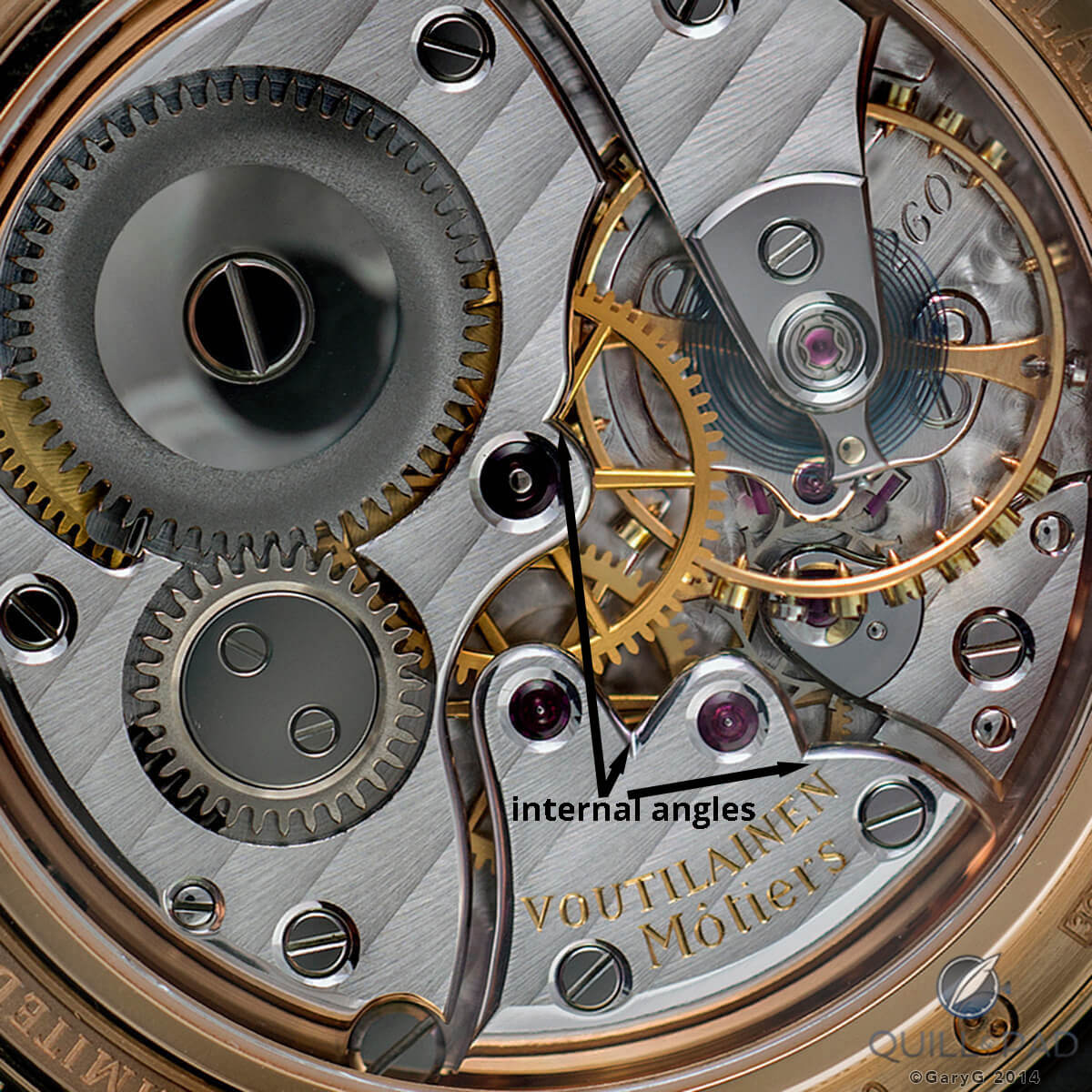
Anglage, also called bevelling or chamfering, is the polishing of the edges of a movement part at a 45-degree angle to a mirror finish. The process serves no mechanical function, the part would work identically without it, but it demonstrates a level of hand-finishing that cannot be achieved by machine. A bridge that has been properly anglaged has three polished surfaces per edge: the top (flat or Côtes de Genève), the bevel, and the side. All three must flow together cleanly, with sharp transitions and no rounding at the corners.
The tool is often a peg of gentian wood (also called "nene" or "zelkova" in some traditions), shaped by the watchmaker to match the profile of the part being bevelled. Diamond paste at progressively finer grits (starting at 3 micrometres, finishing at 0.5 or 0.25 micrometres) is applied to the peg, and the craftsman works the bevel in many passes. A good watchmaker produces a perfectly mirrored surface that, under a 10x loupe, shows no scratches or directional patterns; only depth.
The single most telling marker of hand anglage is the treatment of interior angles (also called "re-entrant" or "inside" angles). A CNC machine with a round-nosed cutter cannot produce a sharp inside corner; it always leaves a rounded fillet. Only a hand-wielded file can produce a perfectly sharp inside angle. The presence of clean sharp interior angles is the most reliable way to distinguish hand-finished haute horlogerie from CNC-finished approximations. Philippe Dufour's work, widely cited as the reference for anglage, features interior angles on his bridges that are literally as sharp as the human eye can perceive.
The top of the market for anglage includes: Philippe Dufour (hand-finished every component himself), F.P. Journe, Patek Philippe's Grande Complications (notably Cal. 29-535 PS Q), Audemars Piguet's Royal Oak Jumbo Cal. 7121, and independents Voutilainen, Akrivia, and Grönefeld. At the entry level, Swiss industry-standard movements (ETA, Sellita) have machine-bevelled edges that are functionally adequate but visibly lack the depth and sharp interior angles of hand work. The time difference between hand and machine anglage is roughly 30 hours per movement; the cost difference in a finished watch is typically €10,000 to €50,000.



Comments 2