Watch brandsWatch wikiWatch videosVariousWatch calendarSaved articles
WristBuzz Various Compare Rolex GMT-Master II vs Tudor Black Bay Pro
⚖ Head-to-head comparison

Rolex GMT-Master II vs Tudor Black Bay Pro

Two true-GMT watches at very different price tiers. Rolex GMT-Master II 126710BLNR with allocation against Tudor Black Bay Pro at retail in any AD.

Updated 2026-05-08 By the WristBuzz team
Rolex GMT-Master II
Rolex

GMT-Master II

126710BLNR · 40mm · 100m
Introduced 1955 Retail ~€11,200 · Secondary ~€18,000
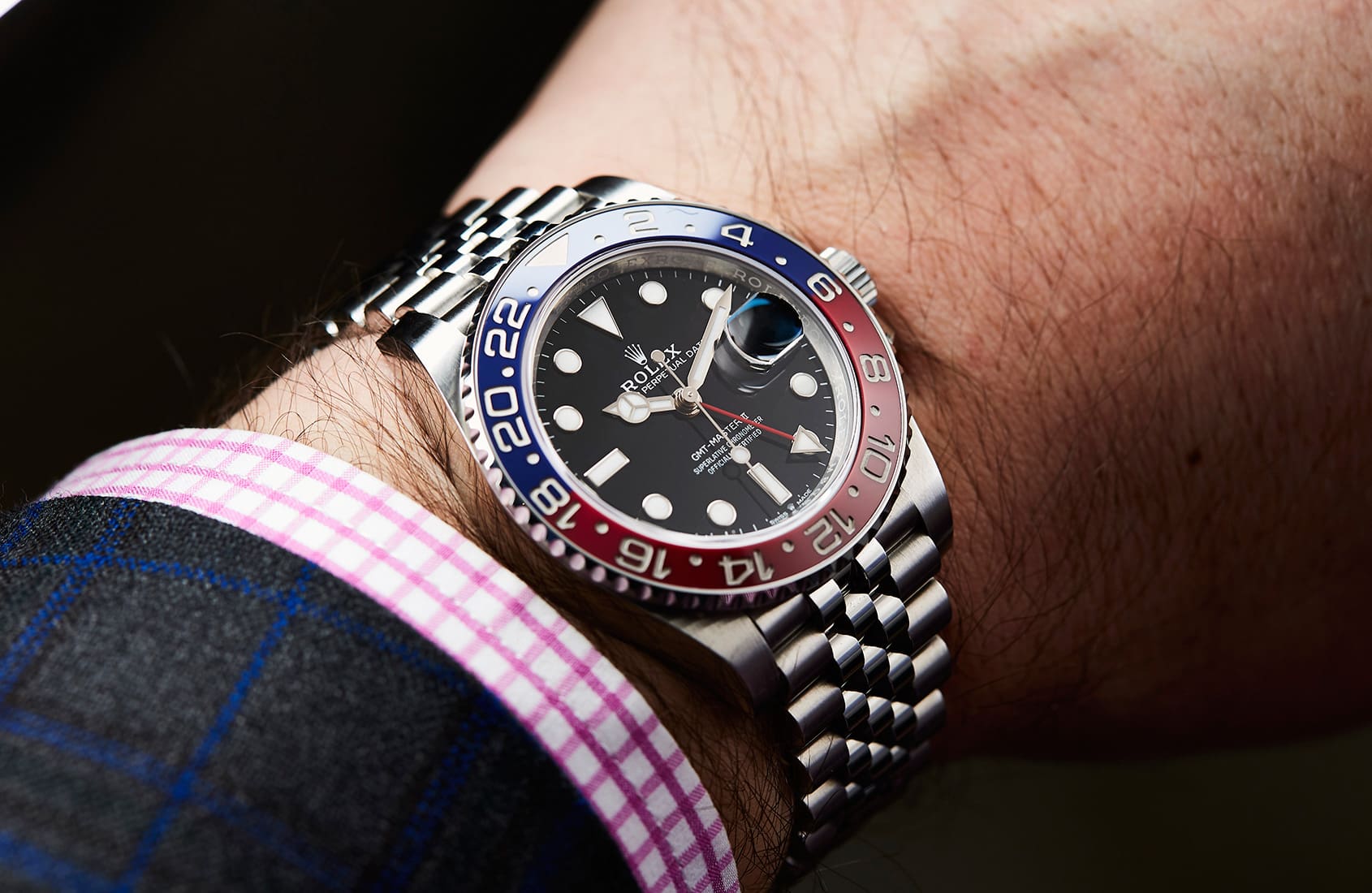
The Pepsi/Batman. The original true-GMT.
Tudor Black Bay Pro
Tudor

Black Bay Pro

M79470 · 39mm · 200m
Introduced 2022 ~€4,500
True-GMT in-house COSC. Available at retail.

Two true-GMT watches at radically different price tiers

Both watches use a 'true-GMT' architecture: the local-hour hand jumps independently in 1-hour increments while the 24-hour hand keeps tracking home/UTC. This is the right architecture for a traveller (vs caller-GMT, which is fine for monitoring a remote office but awkward when you're the one moving). The GMT-Master II is the 1955 original, designed with Pan Am pilots. The Black Bay Pro brought true-GMT to the under-€5k tier in 2022.

Spec sheet

Attribute Rolex GMT-Master II Tudor Black Bay Pro
Reference 126710BLNR M79470
Case diameter 40mm × 12mm 39mm × 14.6mm
Bezel Cerachrom (ceramic) 24-hr bidir. Steel 24-hr bidirectional
Water resistance 100m 200m
Movement Cal. 3285 in-house Cal. MT5652 in-house
Reserve 70 hours 70 hours
Certification Superlative Chronometer (-2/+2) COSC (-4/+6)
GMT type True-GMT (jumping local hour) True-GMT (jumping local hour)
Retail ~€11,200 ~€4,500

Allocation vs walk-in

GMT-Master II on Pepsi or Batman is allocation-only at every Rolex AD. Multi-year wait for first-time clients without significant Rolex purchase history. Secondary trades at ~1.6x retail.

Black Bay Pro walks out of any Tudor AD on request at €4,500. Same week, same retail price.

Wrist presence

Pepsi/Batman at 40mm × 12mm wears thin and integrated; the Cerachrom bezel is flat and refined. The Black Bay Pro at 39mm × 14.6mm is significantly thicker, 14.6mm is dive-watch territory and reads as a tool watch on the wrist.

Movement

Both are in-house, both 70-hour reserve. Tudor MT5652 is COSC-rated. Rolex Cal. 3285 is rated to -2/+2 sec/day, tighter than COSC. Finishing on the Rolex movement is a tier above Tudor's, as expected at the price gap.

Pros and cons

GMT-Master II · Pros
  • Cerachrom ceramic bezel (scratch-proof)
  • 70-hour reserve, Superlative Chronometer
  • Holds 1.6x retail consistently
  • Thinner / dressier 12mm case
GMT-Master II · Cons
  • Allocation-only at AD
  • Secondary 1.6x retail premium
  • 100m water resistance
Black Bay Pro · Pros
  • Walk-in retail purchase at €4,500
  • 200m water resistance (true diver spec)
  • In-house COSC GMT
  • Same 70-hour reserve
Black Bay Pro · Cons
  • 14.6mm thick (tool-y wrist presence)
  • Steel bezel scratches
  • Lower brand recognition than Rolex

Verdict: which one?

If you want the watch you can actually buy at retail: Black Bay Pro. True-GMT, in-house COSC, 70-hour reserve, €4,500.

If you want the watch with the resale and the brand and you have the AD history: GMT-Master II. The Pepsi or Batman is the most-wanted GMT in the secondary market.

Pre-owned BLNR (Batman) at ~€16,000 splits the difference: Rolex prestige at a known premium, no waitlist.

Common questions

What is the difference between the GMT-Master II and the Black Bay Pro besides price?
Both are true-GMT travellers with in-house movements and 70-hour reserves. The Rolex 126710BLNR ("Batman") has a scratch-proof Cerachrom ceramic 24-hour bezel, a Superlative Chronometer rating of -2/+2 sec/day, a slim 12mm case, and trades around €18,000 on the secondary market against ~€11,200 retail. The Tudor Black Bay Pro is COSC-rated (-4/+6), 200m water resistant, much thicker at 14.6mm so it reads as a tool watch, and available at retail for ~€4,500.
Can I walk into a dealer and buy a GMT-Master II?
Generally not on a Pepsi or Batman - those are allocation-only at every Rolex authorised dealer and need significant purchase history, with the secondary market around 1.6 times retail. The Tudor Black Bay Pro walks out of any Tudor dealer on request at €4,500. A pre-owned BLNR at roughly €16,000 splits the difference: Rolex prestige at a known premium, no waitlist.
Is the Black Bay Pro too thick at 14.6mm?
It is dive-watch thickness, noticeably chunkier than the GMT-Master II 12mm, so on the wrist it reads as a tool watch rather than a dressy travel watch. If you want a slim, integrated-feeling GMT, the Rolex is the thinner choice; if you want maximum spec for the money and do not mind the height, the Tudor delivers.
Which has the better movement?
Both are in-house with 70-hour reserves. The Rolex Cal. 3285 is rated to -2/+2 sec/day, tighter than the Tudor MT5652 COSC -4/+6, and the Rolex movement finishing is a tier above, as you would expect given the price gap.

Comments 9

  1. Anonymous
    Been wearing a GMT-Master II for eight years and never thought I'd consider switching. But half the price for an in-house movement and COSC certification is making me reconsider what I'm actually paying for. The Tudor's no joke.
    1. Anonymous replying to Anonymous
      Same boat here, eight years in with the Rolex. The Tudor's honestly made me question the premium we're paying for the name. That in-house movement is the real story though, not just the price tag.
  2. Mike
    Rolex holds value better, end of story.
  3. Anonymous
    I'll take the Black Bay any time over the Rolex. Value for money and no, or at least way less, stigma to it.
  4. Anonymous
    The Batman vs Pepsi thing always gets brought up but honestly the real differentiator here is the movement architecture. Tudor went in-house and it shows. Whether that justifies Rolex's markup is the actual question the article should hammer on more.
    1. Kevin O. replying to Anonymous
      Fair point on the movement, but I'd push back a bit. In-house doesn't automatically mean better; it means different priorities. I owned a Black Bay Pro for two years and the 3285 is smooth, but the GMT hand feels less robust than the Rolex equivalent. Tudor optimized for accuracy and cost; Rolex optimized for longevity under stress. The real question isn't whether the markup is justified, it's what you actually do with the watch. For desk diving, Tudor wins on value. For traveling hard, I'd spend the extra.
  5. WatchHusk
    Before you drop ten grand on a Pepsi, honestly consider what a micro-brand like Nezumi or Baltic can deliver for a fraction of that. Both offer true GMT movements, COSC certification, and actual in-house finishing. The Tudor sits in an interesting middle ground, but if you're already compromising on the Rolex name, why not explore brands that offer genuine value and character instead of just a smaller Rolex price tag.
    1. WristBuzz Team replying to WatchHusk
      Let us know where to get a Pepsi for ten grand 😁😮
    2. Karam replying to WatchHusk
      Fair point on value, but there's a real difference between COSC and actual chronometer performance under load. I've logged data on both Nezumi and Tudor movements; the Tudor's in-house cal consistently holds tighter deviation over temperature swings. Micro-brands nail finishing, but Rolex's vertically integrated QC is measurable. You're right to question the premium, but it's not just a name tax.

Leave a comment

All comments are reviewed before they go live. Email is for our records only - it's never published.