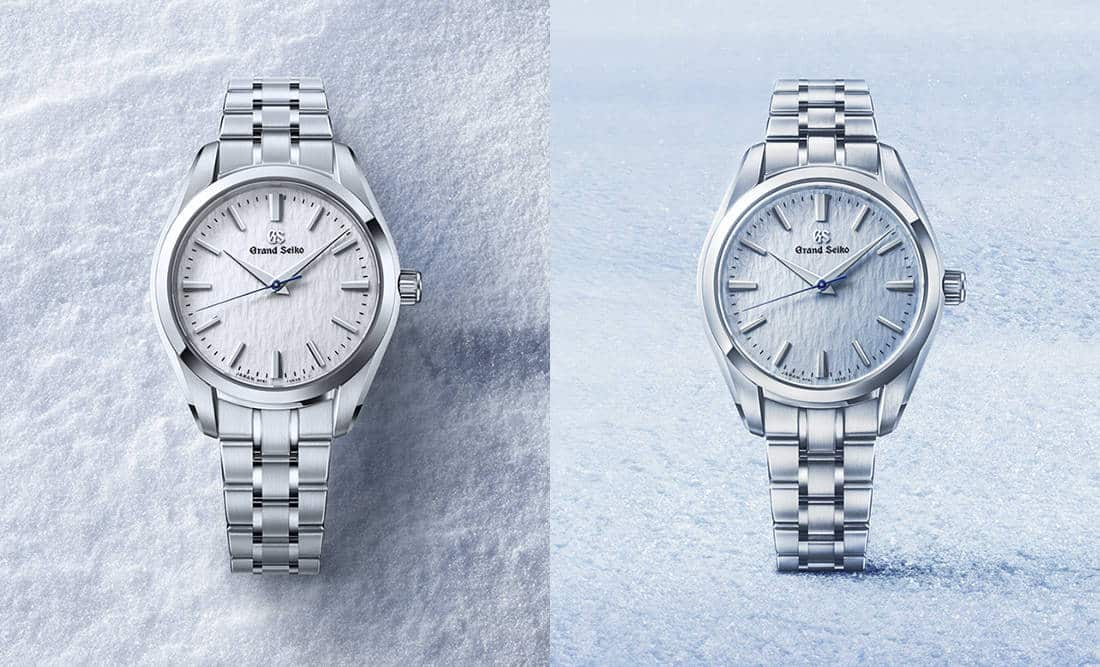
Grand Seiko
Snowflake
SBGA211 · 41mm titanium · 100m
Spring Drive ±1 sec/day. Titanium case.
The premium daily-wear decision. Grand Seiko Snowflake with Spring Drive's hybrid-mechanical precision against the Rolex Oyster Perpetual at its modern 41mm proportions.
Grand Seiko Snowflake uses Spring Drive: a hybrid mechanical-quartz movement where a mainspring drives a glide-wheel that's electromagnetically regulated by quartz oscillation. Result: ±1 sec/day rate, perfectly smooth seconds-hand glide (no tick), 72-hour reserve. The dial texture is the brand's signature 'snow surface' finish.
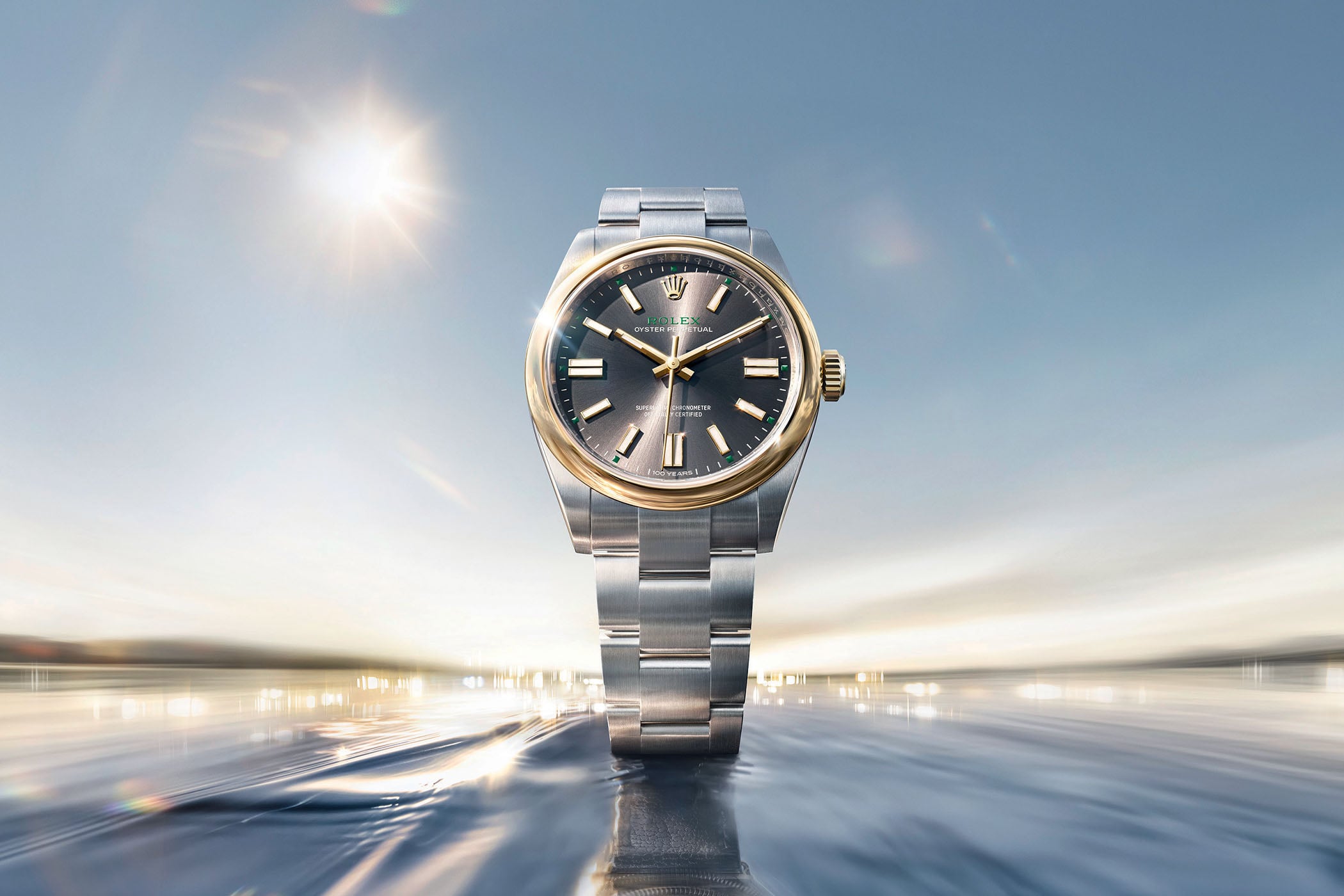
Rolex Oyster Perpetual 41 is the brand's purest expression: no date, no complication, just the Oyster case (the original 1926 waterproof case design) and Cal. 3230 with 70-hour reserve and Superlative Chronometer rating.
| Attribute | Grand Seiko Snowflake | Rolex Oyster Perpetual 41 |
|---|---|---|
| Reference | SBGA211 | 124300 |
| Case diameter | 41mm × 12.5mm | 41mm × 11.6mm |
| Case material | Grade-5 titanium (high-intensity) | Oystersteel (904L) |
| Water resistance | 100m | 100m |
| Movement | Cal. 9R65 Spring Drive | Cal. 3230 mechanical |
| Architecture | Spring Drive (mainspring + quartz) | Mechanical w/ Parachrom hairspring |
| Reserve | 72 hours | 70 hours |
| Accuracy | ±1 sec/day (±15 sec/month) | -2/+2 sec/day |
| Retail | ~€7,200 | ~€6,700 |
Snowflake's Spring Drive is unique to Seiko/GS. The mainspring provides the energy; the quartz oscillator only regulates the rate (no battery, no electronics needed for power). The chronometric output is 30x tighter than COSC. The seconds hand glides continuously with no perceptible tick.
Rolex Cal. 3230 is Superlative Chronometer (-2/+2 sec/day). 70-hour reserve. Conventional-mechanical, traditional balance-and-hairspring; the watch ticks at 4 Hz.
Snowflake's 'snow surface' dial finish is the watch's signature: a granular silver texture meant to evoke the cumulative snowfall around GS's Shinshu studio. Hands and indices are diamond-cut (Zaratsu polishing). Visually it's an unusually expressive watch.
OP 41 is the opposite: pure, restrained, no date window, available in solid lacquer dials (silver, black, blue, candy turquoise). The silhouette and dial are quintessential Rolex without the date complication.
OP 41 retains value better than the Snowflake: Rolex resale is structural. Snowflake depreciates ~15-20% from retail at private secondary, then stabilises. For a watch you intend to keep: Snowflake's depreciation is irrelevant. For a watch you might trade in 3-5 years: OP is the safer hold.
If movement engineering and dial uniqueness are the priority: Snowflake. Spring Drive is a genuine technical differentiator and the dial texture is unmatched.
If resale strength and brand permanence are the priority: Oyster Perpetual 41. The structural Rolex secondary holds across cycles.
Snowflake for a forever-watch decision; OP for a Rolex-first one-watch position.
Question, suggestion, or just want to say hi? Drop a note.
Comments 2