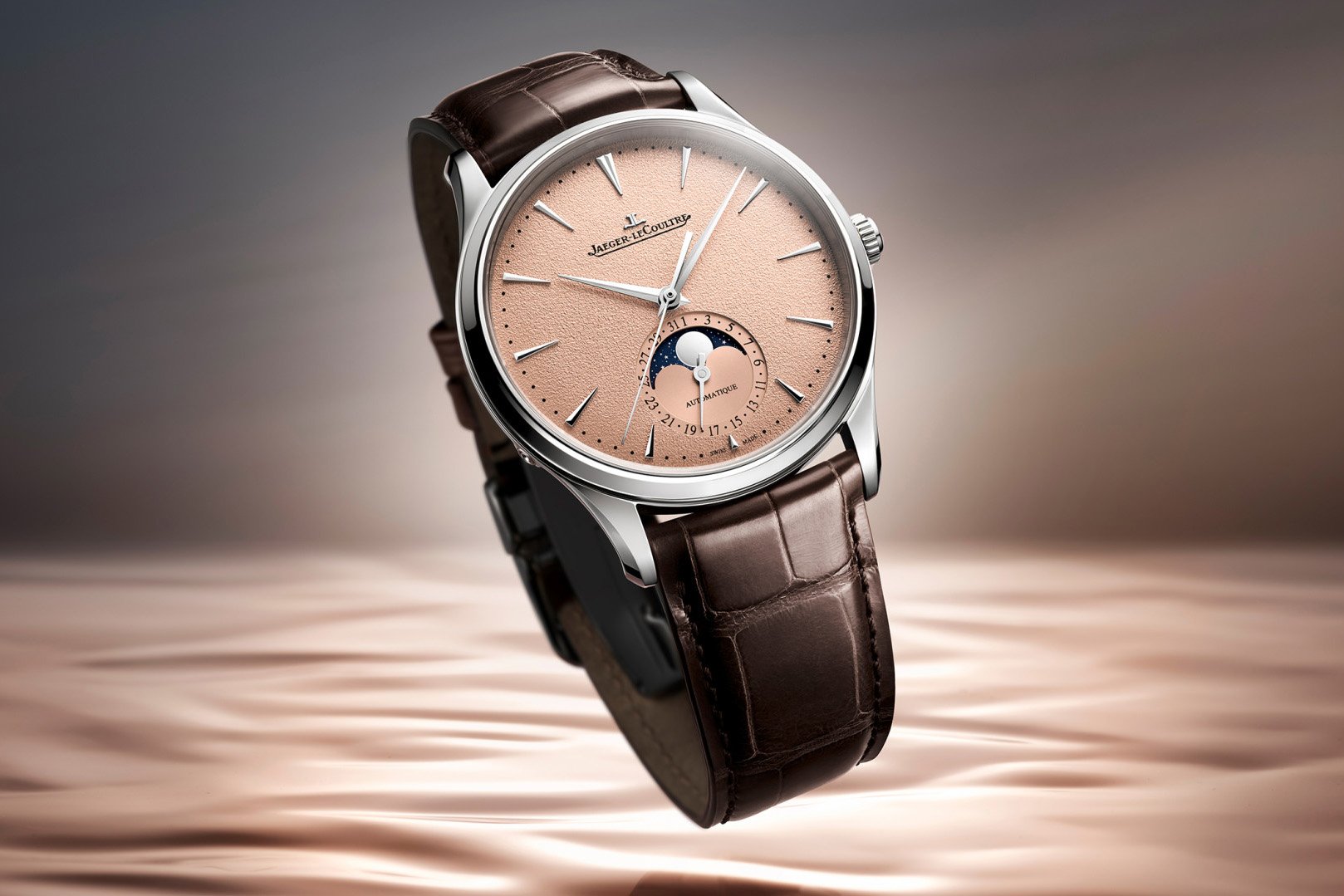
Jaeger-LeCoultre's ultra-thin pedigree predates the Master line by nearly a century. In 1907 JLC produced the Cal. 145, a hand-wound pocket-watch movement just 1.38mm thick, the world's thinnest mechanical movement at the time and the start of an ultra-thin specialism that runs unbroken through the modern Cal. 849 (1.85mm thick) and the contemporary Master Ultra Thin collection.
The Master Ultra Thin line launched in 1992 as part of JLC's restructured collection architecture. The original Master Ultra Thin was a 34mm round dress watch with the Cal. 849 (the modern descendant of the 1907 Cal. 145) hand-wound movement. Across the 1990s and 2000s the line expanded to include Date, Moon, Perpetual Calendar, and Tourbillon complications, all built on JLC's ultra-thin movement architecture, the same architecture supplied to Audemars Piguet, Patek Philippe, and Vacheron Constantin across the brand's history.
Modern Master Ultra Thin references include the Master Ultra Thin Date (39mm, Cal. 925, 70-hour reserve), the Master Ultra Thin Moon Enamel (39mm, grand-feu enamel dial, moonphase indication), the Master Ultra Thin Perpetual (39mm, perpetual calendar with year-window), and the haute-complication Master Ultra Thin Tourbillon (40mm, peripheral oscillating mass automatic tourbillon). Across the line the case thickness sits between 4.05mm (Time-Only) and 7.7mm (Tourbillon), making them among the thinnest production watches in their category.
The Master Ultra Thin is JLC's most-honest expression of haute-horlogerie classicism. Three-counter dials avoided, no oversized cases, blued steel hands, polished applied indices, sapphire caseback exposing the Côtes-de-Genève finished bridges and gold rotor. Retail spans ~€10,200 (Time-Only) to ~€31,500 (Perpetual Calendar) and ~€95,000+ (Tourbillon). The reference for buyers who want the dressy alternative to the Reverso.









Comments
No comments yet, be the first to weigh in.