Erhard Junghans founded a watch-case factory in Schramberg (Schwarzwald, Germany) in 1861, and his son Arthur transformed it into a complete watch manufacture over the following decades. By 1903 Junghans was the largest watch and clock manufacturer in the world, employing 3,000 workers and producing around 9,000 clock/watch movements per day. The distinctive eight-pointed-star logo of this era is still used today. Through the early 20th century Junghans supplied clocks and watches to European households at every price point, a mass-market powerhouse headquartered in the Black Forest.
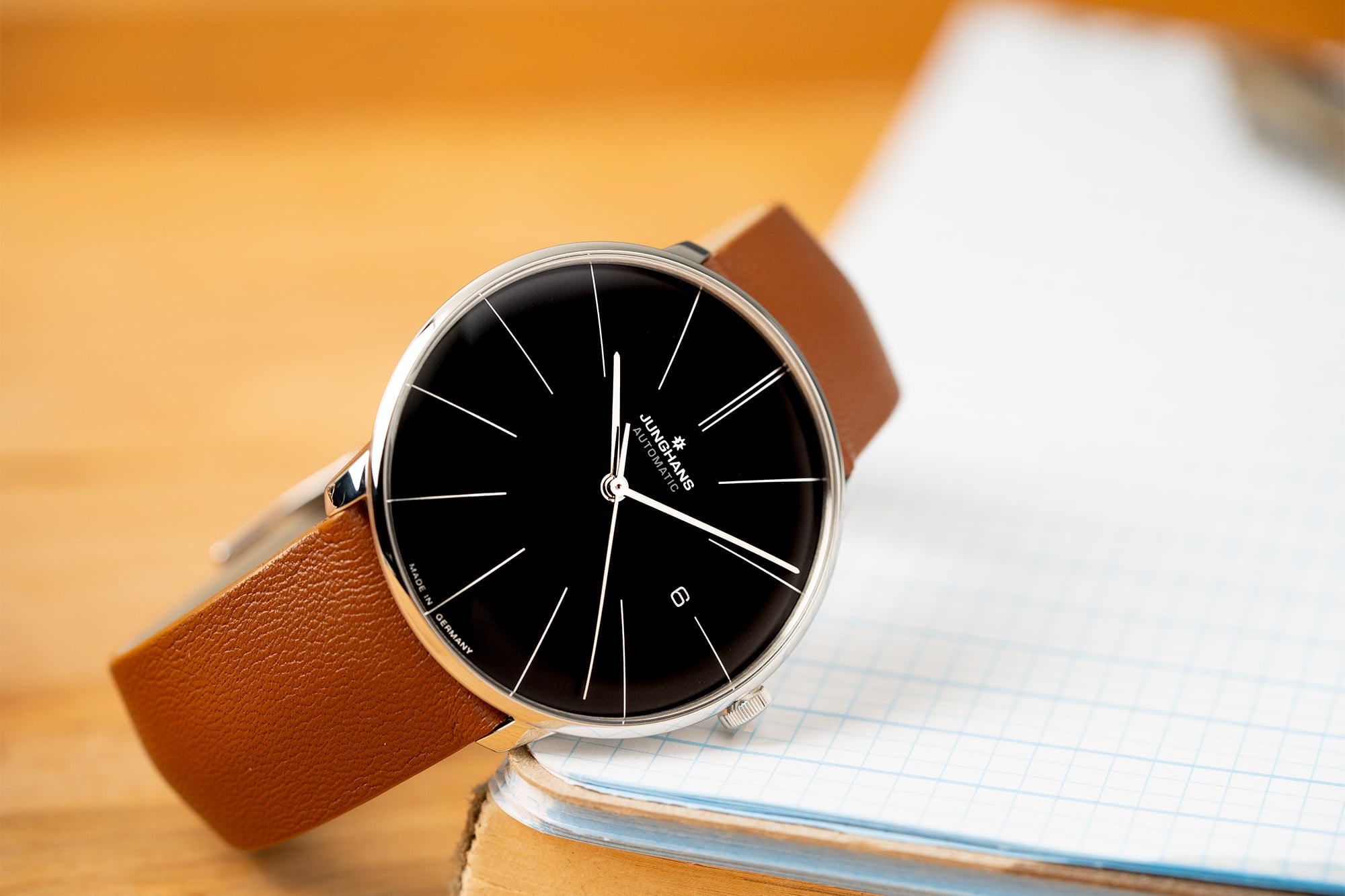
In 1956 Junghans commissioned Swiss architect and designer Max Bill - a founding faculty member of the Ulm School of Design and one of the most influential Bauhaus-adjacent designers of the 20th century - to design a new wall clock. Bill's rigorously geometric design, with sans-serif numerals and a clean grid-based dial layout, was such a success that Junghans extended the collaboration to wristwatches. The Max Bill wristwatch collection was released in 1961; sixty-five years later it remains in continuous production with minimal changes, making it one of the longest-running and purest Bauhaus design objects available at accessible prices.
Junghans's other major contribution came in 1990 when it launched the Mega 1 - the world's first radio-controlled wristwatch, synchronising to the German DCF77 atomic-clock signal. Through the 1990s and 2000s Junghans expanded the Mega concept with multi-frequency versions that could sync across Europe, North America, and Japan. Today Junghans operates as an independent mid-market German manufacturer, producing Max Bill, Meister (classical round three-handers and chronographs), Form, and 1972 (retro digital) collections. Max Bill pieces start at ~EUR 700 for quartz and reach ~EUR 2,200 for the automatic Chronoscope - positioning Junghans as the most accessible serious Bauhaus-design watchmaker.


Comments
No comments yet, be the first to weigh in.