Watch brandsWatch wikiWatch videosVariousWatch calendarSaved articles
PopularRolexOmegaPatek PhilippeAudemars PiguetTudorGrand SeikoCartierSeikoIWCTAG HeuerBreitlingJaeger-LeCoultreA. Lange & SohneZenith

Results for Spring Drive (9R65 / 9R86)

845 articles · 30 videos found · page 30 of 30

Promiscuous Wrist: Girard-Perregaux 1966 Minute Repeater, Annual Calendar & Equation Of Time Revolution
Girard-Perregaux 1966 Minute Repeater Annual Jan 16, 2013

Promiscuous Wrist: Girard-Perregaux 1966 Minute Repeater, Annual Calendar & Equation Of Time

Despite the fact that the Promiscuous Wrist, by definition, gets around a lot, it (or I, I should say) has never had the chance to test-drive a watch with an equation-of-time complication. For that matter, we’ve never had a run around the block with an annual calendar either. So, when the chance came to kill […]

Striking Improvement: Armin Strom’s Minute Repeater Resonance 12:59 SJX Watches
Armin Strom s Minute Repeater Resonance Oct 26, 2026

Striking Improvement: Armin Strom’s Minute Repeater Resonance 12:59

Armin Strom’s Minute Repeater Resonance 12:59 First Edition doesn’t just chime the current time, it chimes the best time (12:59) to show off its Westminster Carillon of four hammers chiming on four gongs. The watch combines the clever chiming complication with a clever chronometric innovation: a pair of sprung balances connected by an elastic “resonance clutch spring”, one of the brand’s signature invention. And all of that somehow squeezed into a water-resistant, 42 mm case that is slimmer than most chronographs. Initial thoughts Armin Strom’s repeater probably deserves an award for the brand’s most improved product. Its predecessor was 47.7 mm in diameter and 16.1 mm tall, while this is a wearable 42 mm and only 11.7 mm thick. That makes it slimmer than a Rolex Daytona — though most of the height is borne by the mid-case, making the watch look thicker than it is. It’s also somehow more water resistant, up to 50 m from an already solid 30 m, yet it costs just 2% more at the current retail price. That is before mentioning the Westminster Carillon, demonstration-chiming mode, and the more attractive design. The “demonstration mode”, which allows the watch to chime 12:59 on demand regardless of the current time, is well executed and suits the job of the repeater in the 21st century, which goes beyond simply telling time in the dark. Furthermore, the sound is good — pleasant and audible — but wristwatch minute repeaters have improved dramatically in ...

In-Depth: Understanding Resonance in Watches SJX Watches
F.P. Journe s Chronomètre à Résonance Feb 19, 2026

In-Depth: Understanding Resonance in Watches

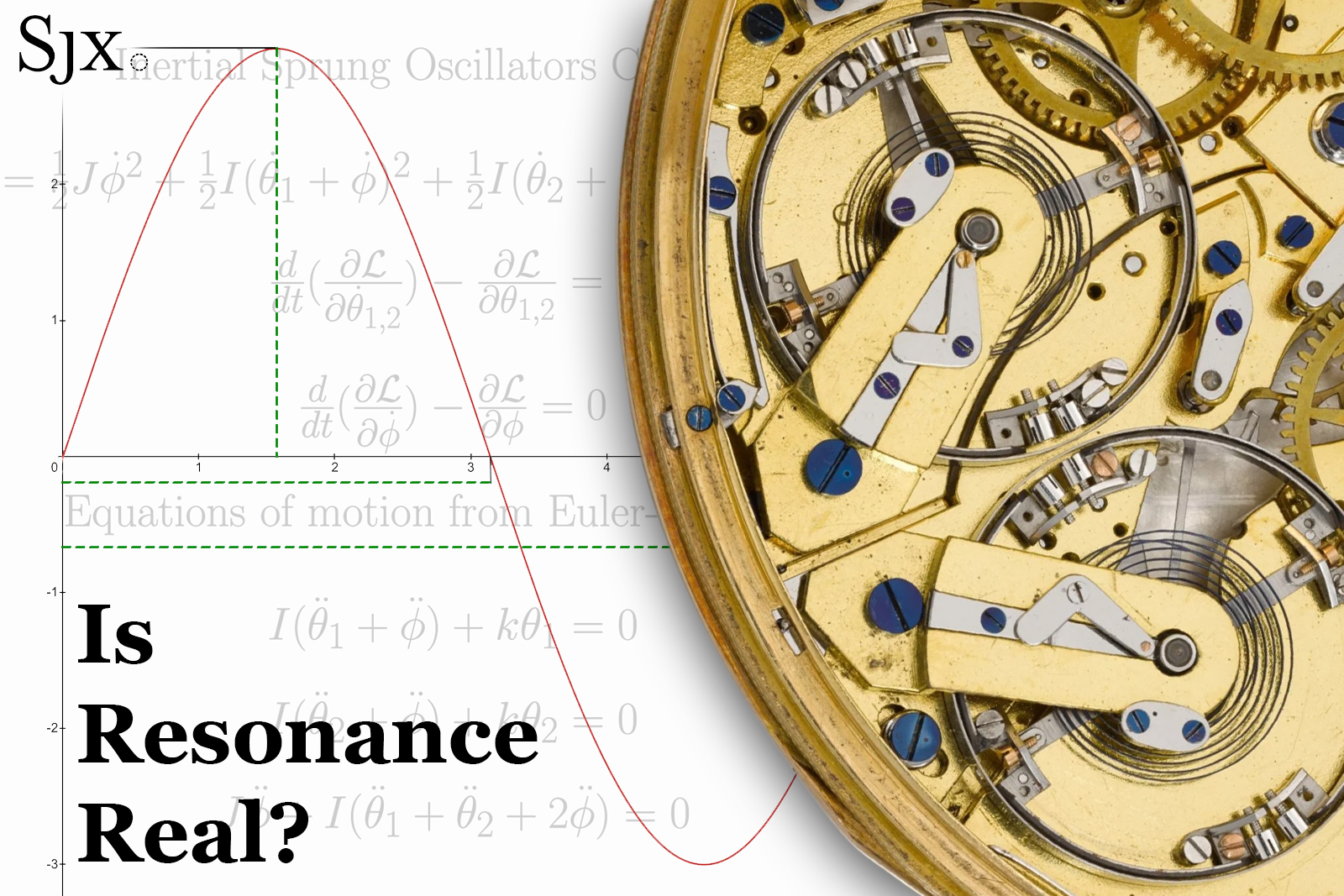
Resonance watches are among the most elusive machines in modern watchmaking. Creations such as F.P. Journe’s Chronomètre à Résonance perform well at auctions, commanding high prices. While their rarity and appeal are undeniable, watches that purport to harness resonance tend to be viewed with a degree of skepticism. A measure of skepticism is understandable - the concept of sprung balances becoming almost magically coupled is anything but straightforward and requires a profound understanding of oscillators in general.   This story seeks to shed some light on the concept of coupled oscillators by explaining the two models of coupling and explore the nuances of each system. Before exploring resonance, the reader is encouraged to review the basics of sprung oscillators and isochronism in order to become more familiar with the hairspring and balance wheel model.  The F.P. Journe Chronomètre à Résonance Souscription No. 2 sold for more than CHF3 million in November 2025. A confusion of terms First, the term resonance itself requires definition. In classical physics (mechanics, electrical engineering, signal processing, etc.) resonance is a phenomenon where a system vibrates under the influence of an external driving force that matches the system’s eigenfrequency (natural frequency). This is to say that a system at rest, which includes mass and spring elements, can be excited into a state of resonance by an external force when particular conditions are met. An imp...

Insight: Regulating a Mechanical Watch Movement SJX Watches
Patek Philippe Mar 7, 2025

Insight: Regulating a Mechanical Watch Movement

A mechanical watch is not always spot on; less-than-perfect timekeeping can happen, often due to an unruly oscillator. The solution is direct adjustments to the hairspring and balance assembly, either slowing down or speeding up the oscillator, a practice known as regulation. Watchmakers have devised multiple innovations to achieve this, including the free-sprung balance, exemplified by the Gyromax of Patek Philippe and Microstella of Rolex. While a simple concept in principle, the mechanics and practice of regulation are nuanced. Here we’ll delve into the theory of regulation and the primary regulating systems: the curb-pin regulator and the free-sprung (or variable inertia) balance. The Lange L043.4 with a screwed balance inspired by pocket watches Basic concepts In order to better understand watch regulation, we need to first cover some of the basic physics behind the watch oscillator: The component responsible for the running rate of a movement is its regulating organ. The regulating organ is made up of a hairspring paired to a balance, which together are also known as a harmonic oscillator. The natural oscillation period is the time it takes the balance to make a full swing, back and forth. The period is made up of two vibrations, one for each direction of the balance motion, with the escapement being unlocked at each vibration. Notably, the natural period of a balance wheel is intrinsic to itself and does not depend on the escapement type or the going train ratio. ...

The Ulysse Nardin Freak - The Saga of a Scientific Timepiece Part III SJX Watches
Patek Philippe Mar 31, 2024

The Ulysse Nardin Freak - The Saga of a Scientific Timepiece Part III

An outlandish concept that originally sprang from the mind of Carole Forestier Kasapi, the Ulysse Nardin Freak of 2001 was perfected by Dr Ludwig Oechslin and then made reality thanks to the advent of silicon in watchmaking. Lightweight and magnetism resistant, silicon was used for the escape wheels but that was only the beginning of the story. [This story, the third and final instalment in the series, details the history of silicium, the proprietary Ulysse Nardin silicium hairspring, and the patented Grinder rotor. The Saga of a Scientific Timepiece Part I covers the origins of the Freak, from its conception to realisation, as well as its distinguishing characteristics, namely the inventive movement construction and unique escapement. Part II deals with the evolution of the unique, high-performance escapement.] Silicon, Silicium, Silinvar Now used interchangeably with silicon, silicium is actually French for “silicon”, but now it is also used as the trade name for the proprietary form of silicon used by Ulysse Nardin for movement components, namely silicon with a hard oxide outer layer that gives the material thermocompensating properties. Silicium was developed by Swiss scientific institute Centre Suisse d’Electronique et de Microtechnique (CSEM) in collaboration with Ulysse Nardin. Notably, the material is also known as Silinvar, which resulted from a separated but related CSEM project backed by a consortium made up of Rolex, Patek Philippe and Swatch Group. As a ...