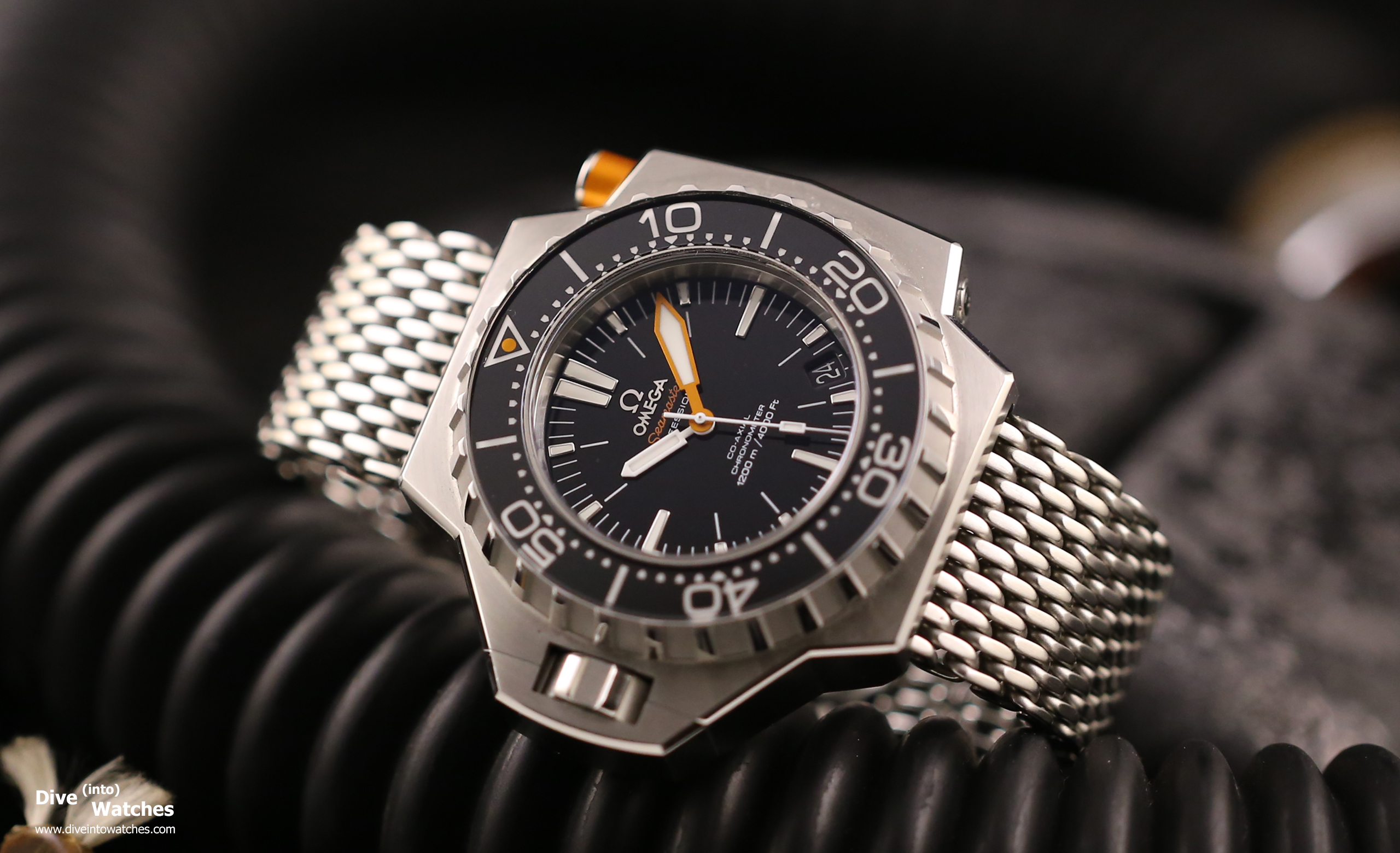
The Omega Seamaster Ploprof is a watch you almost never confuse with anything else. Crown at 9 o'clock. A red locking button on the bezel. A case shape that looks like a piece of industrial equipment more than a wristwatch. Some enthusiasts pass it every day for a decade and never really consider it. Others cross the room the moment they see one in a boutique window, and quietly start rearranging their collection. There is very little middle ground. Here is what the Ploprof actually is, where it came from, what the modern one is like, and whether it is genuinely for you.
What Ploprof actually means
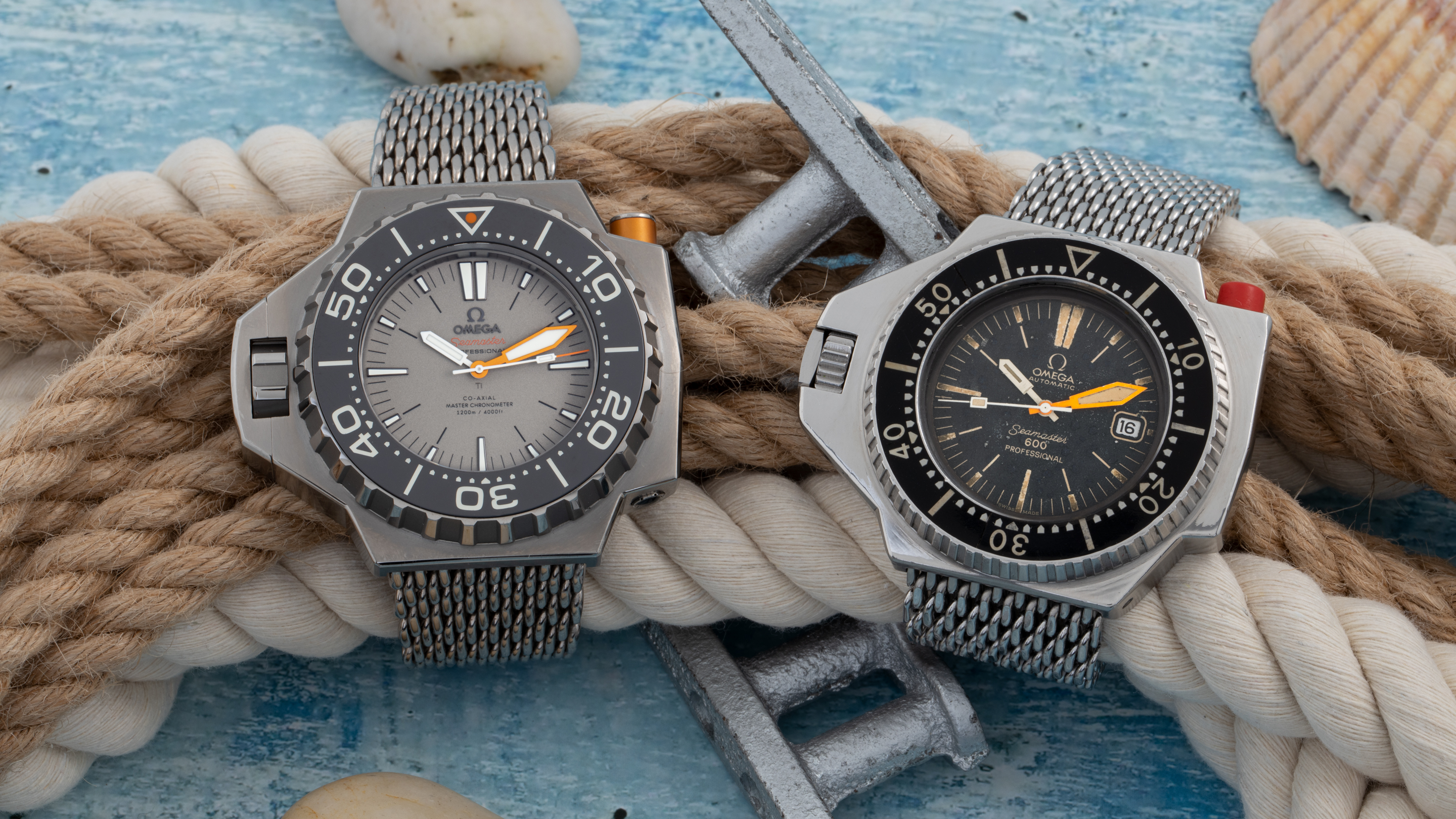
Ploprof is short for Plongeur Professionnel, French for professional diver. It is not a marketing name. It was literally a job description. In the late 1960s Omega was working with Compagnie Maritime d'Expertise (Comex), the French deep-sea diving company that trained and equipped saturation divers for offshore oil and gas work. Comex needed a wristwatch that could survive deep saturation dives without the crystal popping out under helium pressure, that had a bezel that would not accidentally move against a wetsuit, and that a diver could still operate wearing thick gloves. Omega delivered the ref. 166.077 Seamaster Ploprof 600 in 1970. It looked strange, it wore huge, and it worked.
Why the case looks like that
Every unusual thing on a Ploprof is doing a specific job. This is not a design exercise, it is an engineering exercise wearing a nice dial.
- Monobloc case. The original Ploprof case was machined from a single block of steel, with no caseback opening. That eliminated the biggest failure point in a dive watch (the caseback seal) and it is why an original Ploprof is described as more water- and air-tight than the Apollo spacecraft.
- Crown at 9 o'clock, threaded like a nut. The crown is not on the right because the right side of the case has the more important control. Also, off-wrist crown position means it does not dig into the top of your hand while you swim.
- Red locking button on the bezel. The rotating bezel is not friction-fit like every other diver. Press the red button, then rotate. Release, and the bezel is mechanically locked. A diver can bang it against a hull, an oil rig, or another diver, and the elapsed time still reads correctly. This is the single most Ploprof feature on a Ploprof.
- Asymmetric case shape. The case is wider on the crown side to protect the crown and give the diver something to grip. It reads oversized in photos and slightly less absurd on the wrist, but only slightly.
The modern Ploprof
Omega revived the Ploprof in 2009 and refined it further in the current generation. The Ploprof you can buy today is the Seamaster Ploprof 1200M, ref. 224.30.55.21.01.001 (steel-and-blue is the most common configuration; other colours exist including the Summer Blue special editions and titanium variants).
Key numbers:
- Case: 55mm x 48mm x 17.5mm thick, steel (a titanium version exists and shaves weight noticeably).
- Lug width: 24mm, but effectively integrated to the case.
- Water resistance: 1,200 metres. Rated for saturation diving. Includes an escape valve for helium.
- Movement: Omega Cal. 8500 with Co-Axial escapement, 60-hour power reserve, chronometer-certified.
- Bezel: Ceramic on the modern piece, still with the red-button lock.
- Crown: Still at 9, still threaded, still absurdly overbuilt.
What has changed since the ref. 166.077: the case is no longer strictly monobloc (there is now a screw-in caseback for serviceability), the movement is a modern Omega automatic with a full 60-hour reserve and Co-Axial escapement, the bracelet is upgraded, and the crystal is sapphire. What has not changed: the visual identity, the wear, the presence, the honesty of the thing.
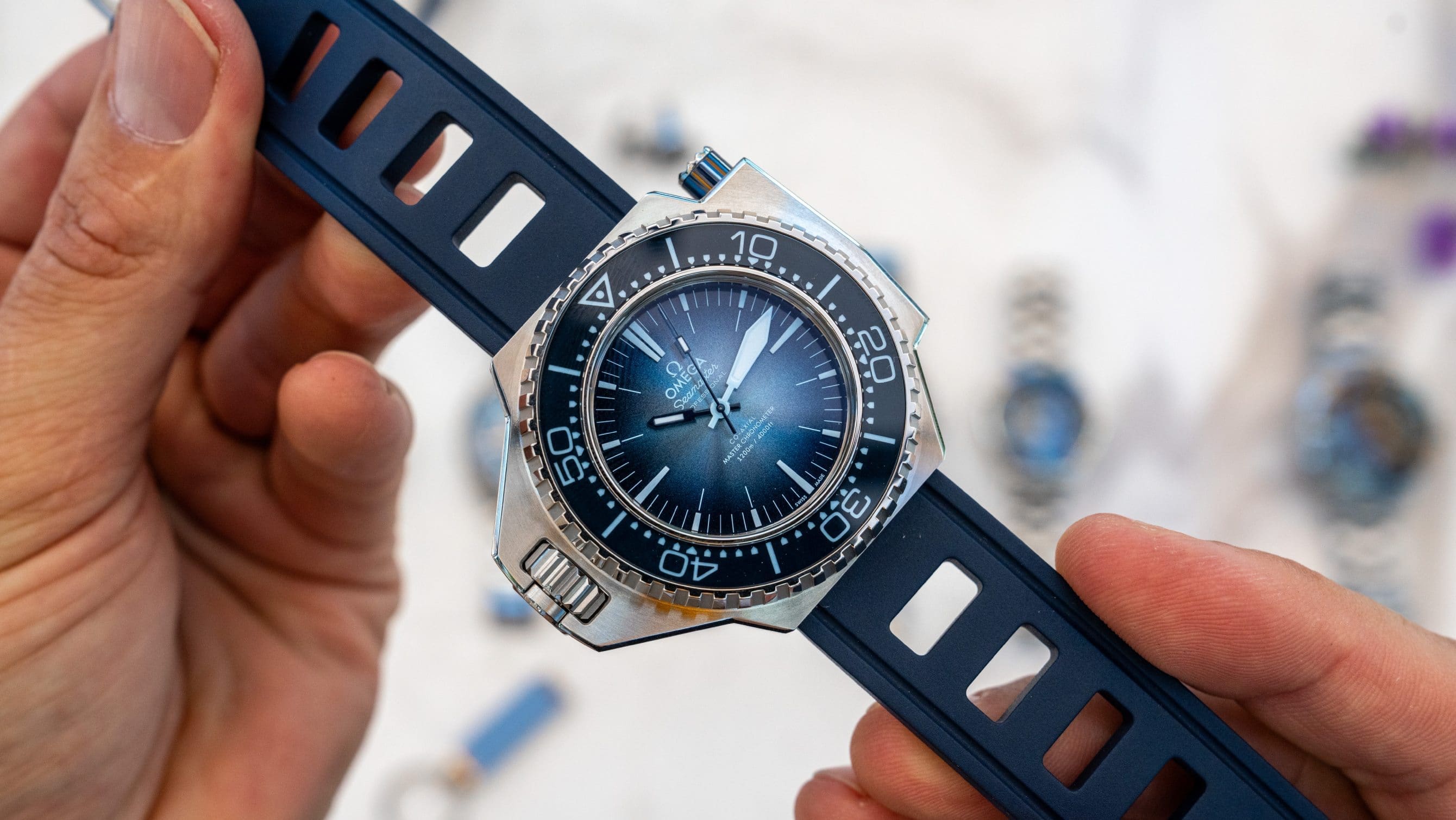
Nobody who has ever tried on a Ploprof for the first time has come away thinking "this is a subtle watch". At 55mm on paper and 48mm of usable height, it wears large in every direction. Under a shirt cuff, forget it. On a wetsuit or a t-shirt, it is spectacular. The gap between how a Ploprof looks in a press photo and how it lives on your actual wrist is bigger than the gap for almost any other production watch. Try one before you buy one. Or accept the flex and enjoy the ride.
Is it for you?
Simple test. A Ploprof might be for you if:
- You dive, or aspire to, and you want a watch that outperforms the depth you will realistically ever reach.
- You already own a "sensible" Speedmaster or Seamaster and want a piece with genuine engineering opinion attached.
- You like the idea of wearing something that reads clearly across a room and looks like nothing else in the boutique window.
- Your wrist is 7 inches or more, or you do not mind the visible overhang if it is not.
- You are the kind of collector who sees "impractical for daily wear" as a feature, not a bug.
A Ploprof is probably not for you if:
- You want a single-watch collection you can rotate through a shirt cuff. The Ploprof is not that.
- You are looking for resale-friendliness. Ploprofs move but they move slowly, especially the modern references. Buy for love, not liquidity.
- You wear your watch to formal events and cannot shift it for a Datejust for the evening.
- Your wrist is under 6.5 inches. Try it, but be honest about the overhang.
The verdict, sort of
The Ploprof is a watch that was engineered rather than styled. It was designed for a specific job by a specific customer, delivered in 1970, and never quite civilised. Omega has updated it, improved the movement, changed the case-back philosophy, ceramic-ised the bezel, and released a handful of colourways. What they have not done, and what they should not do, is smooth away the personality. A tamed Ploprof is not a Ploprof.
If you are on the fence about one, you already know which side you are on. The people who need a Ploprof know they need a Ploprof. The rest of us will keep quietly checking Chrono24 listings, telling ourselves it is just for research.
Comments
No comments yet, be the first to weigh in.