Watch brandsWatch wikiWatch videosVariousWatch calendarSaved articles
WristBuzz Various Compare Rolex Daytona vs Zenith Chronomaster Sport
⚖ Head-to-head comparison

Rolex Cosmograph Daytona vs Zenith Chronomaster Sport

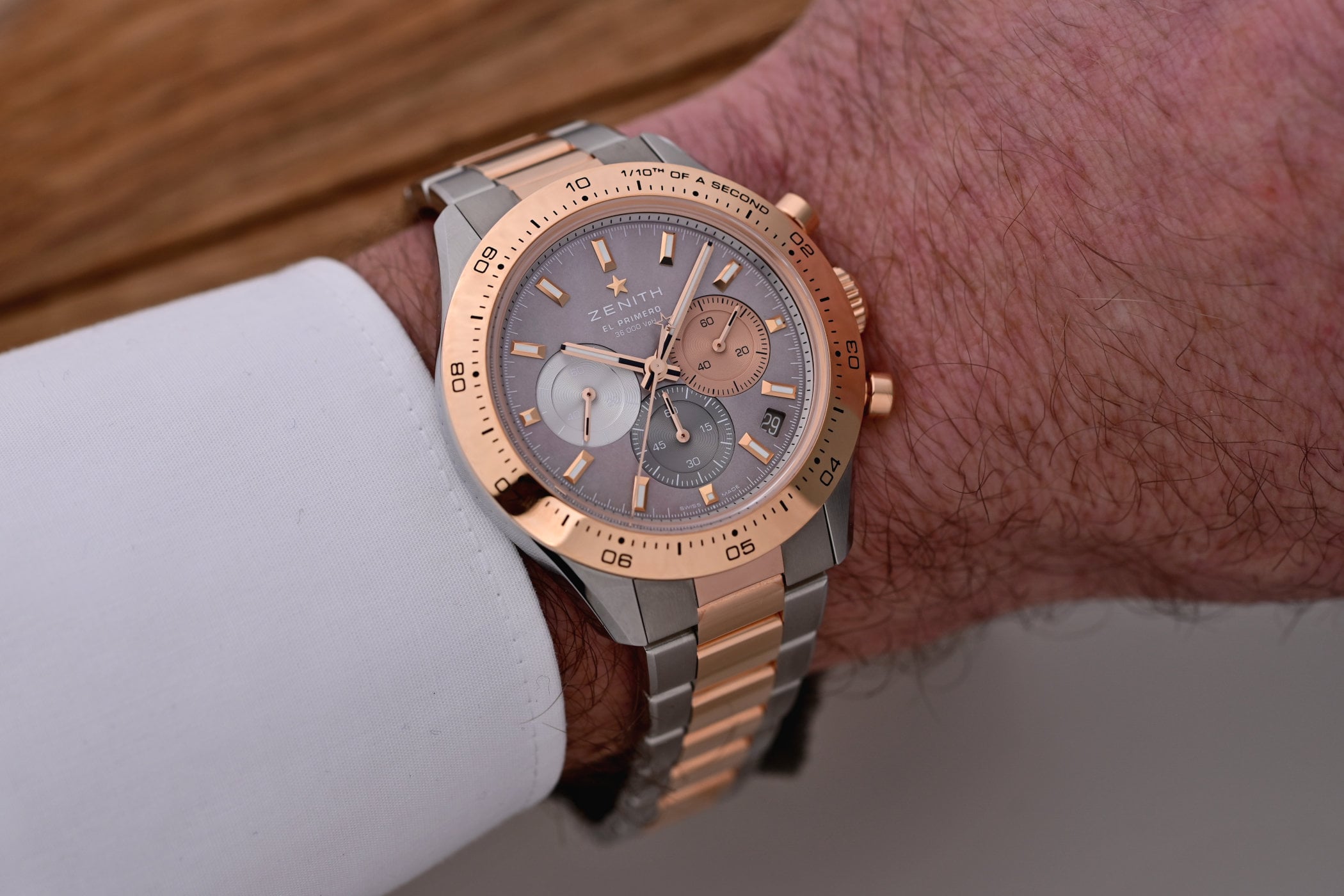
The watch Rolex used to license the El Primero for, and the El Primero now. Daytona 126500LN trades 2x retail; Chronomaster Sport ships at MSRP with a 1/10-second 36,000-vph movement.
Updated 2026-05-14 By the WristBuzz team
Rolex Cosmograph Daytona
Rolex

Cosmograph Daytona

126500LN · 40mm · 100m
Introduced 1963 Retail ~€15,500 · Secondary ~€32,000
Allocation-only at AD; secondary trades at 2x retail.
Zenith Chronomaster Sport
Zenith

Chronomaster Sport

03.3100.3600 · 41mm · 100m
Introduced 2021 ~€10,800 retail
El Primero 3600 with 1/10-second indication, available at retail.

The high-beat history Rolex paid for

Between 1988 and 2000, the Rolex Daytona ref. 16520 ran the Cal. 4030, a heavily modified Zenith El Primero 400. Rolex slowed its 36,000 vph beat to 28,800, swapped in the Microstella regulator, and pretended it was their own. When Rolex moved to the in-house Cal. 4130 in 2000, the El Primero went back to Zenith, and the brand kept improving it.

The 2021 Chronomaster Sport is the first El Primero with a 1/10-second indication on the central seconds (the 36,000 vph beat lets the second hand sweep one full rotation per 10 seconds, marking 1/10ths). It is the closest non-Rolex movement to the Daytona's spec brief, and it ships at retail with no waitlist.

Spec sheet

Attribute Rolex Cosmograph Daytona Zenith Chronomaster Sport
Reference 126500LN 03.3100.3600
Case diameter 40mm × 12.2mm 41mm × 13.6mm
Case material 904L Oystersteel Stainless steel
Bezel Cerachrom (ceramic) tachymeter Black ceramic 1/10-second graduations
Water resistance 100m 100m
Movement Cal. 4131 (in-house) El Primero 3600 (in-house Zenith)
Beat rate 28,800 vph (4 Hz) 36,000 vph (5 Hz)
Reserve 72 hours 60 hours
Architecture Column wheel + vertical clutch Column wheel + vertical clutch
Crystal Sapphire Sapphire
Bracelet Oyster Oystersteel Three-link steel
Retail price ~€15,500 ~€10,800
Secondary ~€32,000+ ~€8,500-12,000

Why 1/10-second matters

The Chronomaster Sport's second hand makes a full rotation every 10 seconds. The bezel is graduated 0-100 in 1/10-second increments. When the chronograph runs, the central seconds hand reads in 1/10ths against this scale: precision-timing utility no Daytona has had since the original 1963 4130-bezel references. Practical for racing? Marginal. Mechanically distinctive? Definitively.

Tachymeter vs 1/10-second bezel

The Daytona's Cerachrom tachymeter is the conservative choice: scratch-resistant ceramic, classic motorsport-watch graduations (60 to 400 units/h), platinum-coated numerals. The Zenith's 1/10-second bezel is functional, modern, and breaks the racing-chrono tradition for a new one. Both are 100m water resistant; both read clean in low light.

Allocation-only vs in-stock

The Daytona requires substantial AD purchase history; secondary market sits 2x retail. The Chronomaster Sport ships at retail in any boutique. The €5,000 retail-price gap (Zenith €10,800 vs Daytona €15,500) widens to €20,000+ on secondary. The Zenith costs less than half a Daytona on the open market.

Pros and cons

Cosmograph Daytona · Pros
  • Cerachrom (scratch-proof ceramic) bezel
  • Holds 2x retail in secondary market
  • In-house Cal. 4131 with 72h reserve
  • Most-recognised steel chronograph silhouette
Cosmograph Daytona · Cons
  • Allocation-only; multi-year wait at AD
  • Secondary 2x retail
  • 4 Hz vs the Zenith's 5 Hz high beat
Chronomaster Sport · Pros
  • 36,000 vph (5 Hz) high-beat El Primero 3600
  • 1/10-second indication on central seconds
  • Available at retail, no waitlist
  • Half the Daytona's secondary-market price
Chronomaster Sport · Cons
  • Ceramic bezel without the Daytona heritage signal
  • Slightly larger and thicker than the Daytona
  • 60h reserve vs the Daytona's 72h

Verdict: which one?

If you want the most-prestigious motorsport chronograph and have AD allocation history: Daytona 126500LN. The Cerachrom bezel and culture cachet are unmatched.

If you want a technically-superior chronograph at retail: Chronomaster Sport. 36,000 vph, 1/10-second readout, available now.

For most buyers without a Rolex AD relationship, the Zenith is the answer to the actual decision: a watch you can buy versus a watch you can't.

Common questions

Is it true the Rolex Daytona once used a Zenith movement?
Yes. From 1988 to 2000 the Daytona ref. 16520 ran the Cal. 4030, a heavily modified Zenith El Primero - Rolex slowed the 36,000 vph beat to 28,800 and added its own regulator. Rolex moved to the in-house Cal. 4130 in 2000; Zenith kept developing the El Primero, and the Chronomaster Sport now uses the modern El Primero 3600.
What is the 1/10-second function on the Zenith Chronomaster Sport?
The El Primero 3600 beats at 36,000 vph, so its central chronograph seconds hand makes a full rotation every 10 seconds against a bezel graduated 0-100, letting you read elapsed time to a tenth of a second. No Daytona offers this. It runs at 5 Hz against the Daytona 4 Hz, with a 60-hour reserve against the Daytona 72.
How much do the Daytona and the Chronomaster Sport actually cost?
The Rolex Daytona 126500LN is around €15,500 at retail but allocation-only, so the open-market price is around €32,000. The Zenith Chronomaster Sport is around €10,800 and available at retail with no waitlist, so it can cost less than half a Daytona on the secondary market.
Daytona or Chronomaster Sport: which should I buy?
If you have Rolex authorised-dealer allocation history and want the most-prestigious motorsport chronograph with a scratch-proof Cerachrom bezel, the Daytona. If you want a technically superior chronograph - higher beat rate, 1/10-second readout - that you can actually buy today, the Chronomaster Sport. For most buyers without a Rolex dealer relationship, the Zenith is the answer to the real decision: a watch you can buy versus one you cannot.

Comments 5

  1. Ben W.
    The Daytona allocation lottery is the elephant in the room here. Yes, 5Hz is impressive, but can you actually buy one without a five-year AD relationship or a grey-market markup. The Zenith is available now at retail. That's a real difference the comparison should weigh more heavily.
    1. Otis replying to Ben W.
      Why spend allocation anxiety money when the Seiko Prospex chronograph does 5Hz at a third the price. Seriously underrated.
  2. Frank
    In my view, the column-wheel architecture merits deeper discussion. Both watches employ it, but the El Primero's proven reliability over decades gives me confidence. The newer Daytona movement is certainly refined, though time will tell how it ages. Either way, owning a 5Hz chronograph feels like the right choice in 2024.
  3. Ed
    Zenith wins on wrist presence and availability.
  4. 1988_daytona
    Have you tried that Zenith? The watch is great but that bracelet is really bad. Just feels flimsy and not worthy a 10K+ watch.

Leave a comment

All comments are reviewed before they go live. Email is for our records only - it's never published.