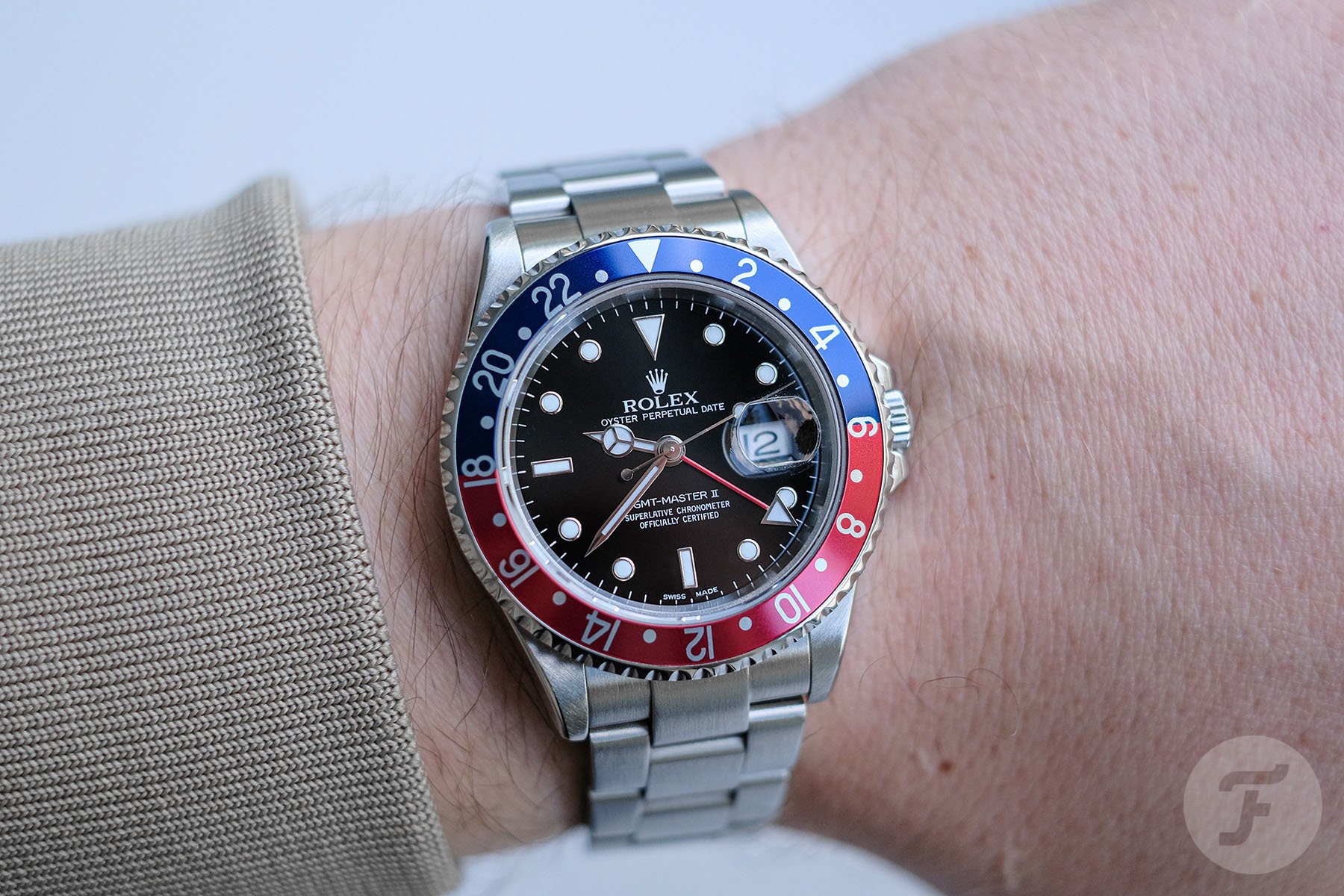
The GMT-Master was developed in collaboration with Pan American World Airways in 1954, the year Pan Am began transcontinental jet service to Europe. Pilots and navigators flying west across multiple time zones needed an instrument that displayed both Greenwich Mean Time (the aviation reference) and local time at the same time. Rolex's answer was the ref. 6542, launched in 1955: a 38mm Oyster case with an additional fourth hand making one revolution every 24 hours, a bidirectional rotating bezel with a 24-hour scale split half-red / half-blue (so the wearer could see at a glance which half of the day the second-zone hand was reading), and the basic Cal. 1036 chronometer movement underneath. The bezel was originally bakelite, which proved fragile and contained mildly radioactive radium; an aluminium replacement followed within a year.
Through the next several decades the GMT-Master evolved through a single very long-running reference, the ref. 1675 (1959-1980, Cal. 1565 then 1575). The 1675 introduced crown guards, the matt black dial that defined Rolex sport watches of the 1960s and 70s, and the Pepsi nickname for the red+blue bezel that survived three decades of production. A two-tone steel + yellow gold variant nicknamed the Root Beer appeared in the 1970s with a brown + gold bezel. The 1675 is the longest-running single GMT-Master reference and the most widely-collected vintage Rolex GMT.
In 1983 Rolex released the GMT-Master II ref. 16760 (the "Coke" / "Fat Lady"), introducing the second-generation Cal. 3085 that allowed the local hour hand to be set independently of the 24-hour hand. This is the move from a passive jet-lag indicator to a true two-zone watch, since the wearer could now adjust local time on landing without disturbing the home-zone reference. The 16760 case was thicker than the 1675 (hence "Fat Lady"), and the bezel was red + black, the first non-Pepsi colourway. The slimmer ref. 16710 (1988-2007) ran in parallel to the simpler GMT-Master ref. 16700, then took over the line completely in 1999. Cerachrom (ceramic) bezels arrived on the ref. 116710LN in 2007, in plain black; the breakthrough two-colour ceramic bezel came on the ref. 116710BLNR "Batman" in 2013.
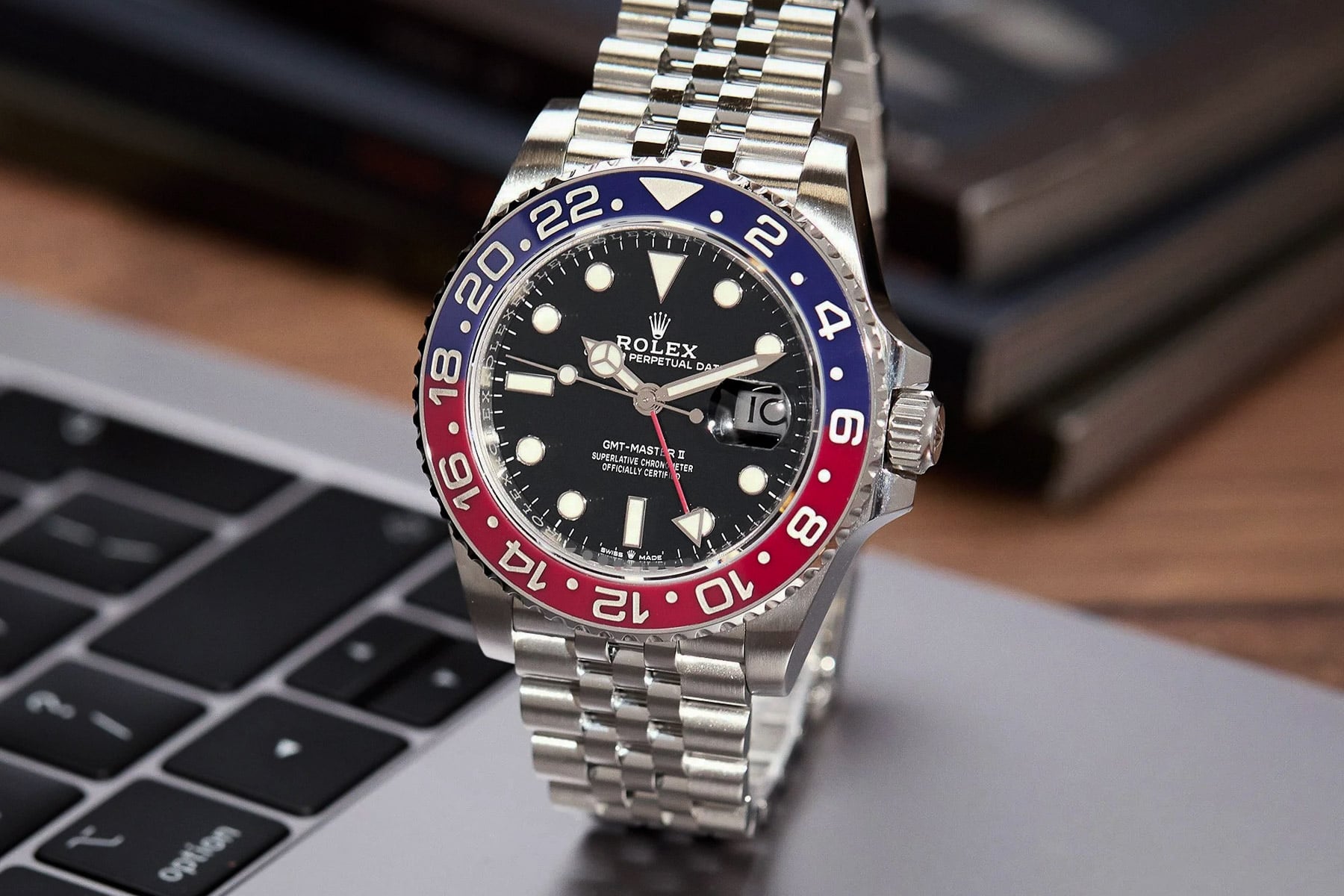
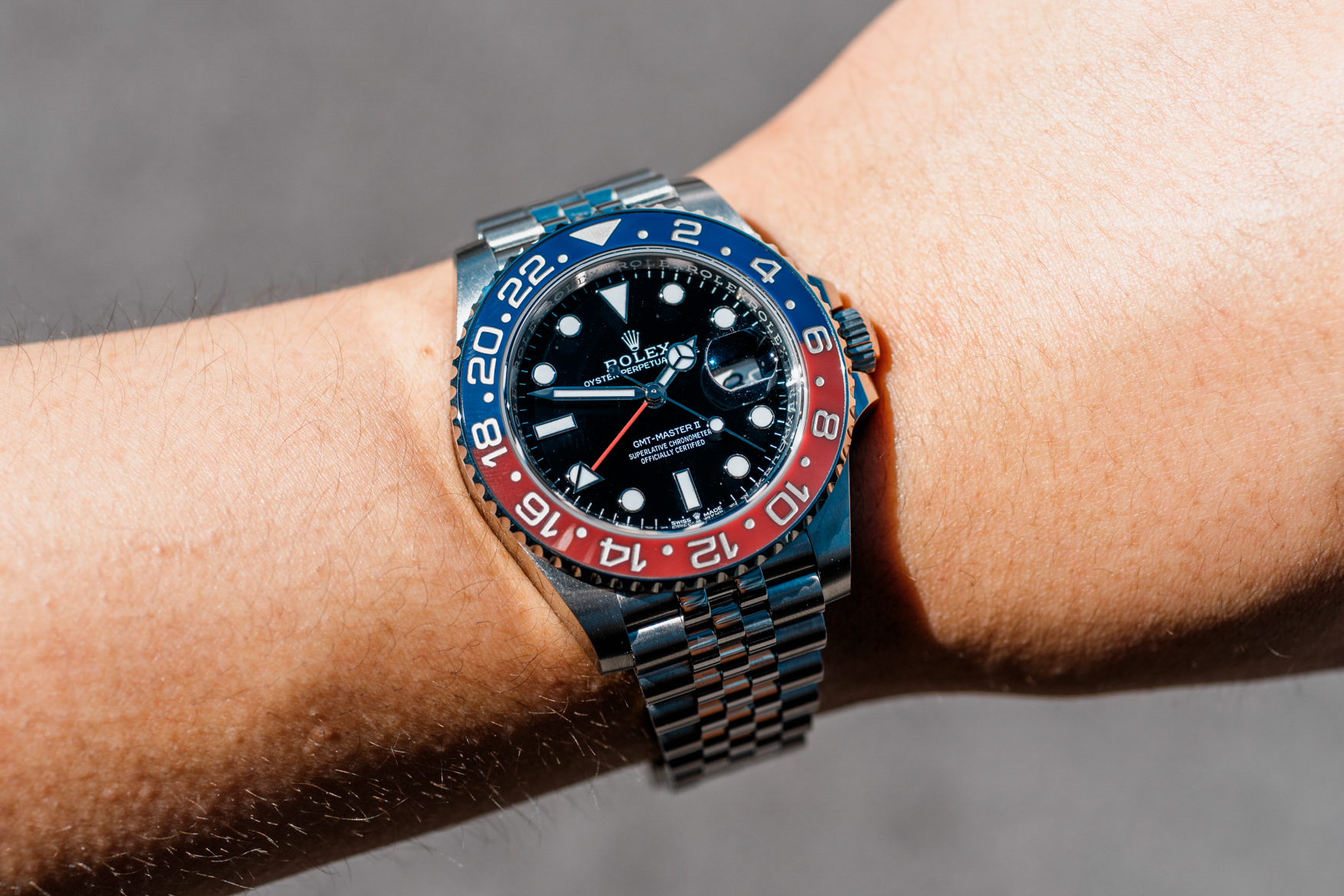
The current generation began with the ref. 126710BLRO Pepsi in 2018, returning the original red+blue colourway in ceramic and offered with both Oyster and Jubilee bracelets. The Batman returned as the ref. 126710BLNR in 2019 (Jubilee bracelet only at first, prompting collectors to christen the Jubilee version Batgirl). The ref. 126720VTNR "Sprite" arrived in 2022 with a green+black bezel and Rolex's first left-hand crown sport watch case. Two-tone Everose and steel "Root Beer" ref. 126711CHNR (brown+black) reintroduced the old colourway in modern materials. The catalogue rotates through colour combinations almost annually now, a sharp contrast to the ref. 1675's 21-year single-reference run. See the full Pepsi/Batman/Coke/Sprite/Root Beer glossary on the Rolex Nicknames page.

Comments
No comments yet, be the first to weigh in.