Watch brandsWatch wikiWatch videosVariousWatch calendarSaved articles
PopularRolexOmegaPatek PhilippeAudemars PiguetTudorGrand SeikoCartierSeiko

Dress Watches · Page 82

NOT ON MY WATCH: The one “truly strange and unnerving” detail that ruins the Cartier Tank for this writer Time+Tide
Apr 12, 2020

NOT ON MY WATCH: The one “truly strange and unnerving” detail that ruins the Cartier Tank for this writer

Remember the moral of The Emperor’s New Clothes? When something is universally praised, you become unwilling to speak out, even if something is gravely wrong on a fundamental level. That’s how I feel about the Cartier Tank. I know this is wildly sacrilegious. The Cartier Tank is, after all, one of the most iconic watches … ContinuedThe post NOT ON MY WATCH: The one “truly strange and unnerving” detail that ruins the Cartier Tank for this writer appeared first on Time+Tide Watches.

Hands-On: Brivet-Naudot Eccentricity SJX Watches
Mar 30, 2020

Hands-On: Brivet-Naudot Eccentricity

French watchmaker Cyril Brivet-Naudot made his debut two years ago with the Eccentricity, a time-only watch that’s fascinating and impressive on many fronts. Not only is it almost entirely made by hand, the Eccentricity is intriguing in design and mechanics – from the overall architecture to details like the key-winding mechanism and regulator-style time display with a twist, and above all, the proprietary escapement. Just 29 years old, Mr Brivet-Naudot began working on the Eccentricity after graduating from the École Polytechnique Fédérale de Lausanne (EPFL), one of Switzerland’s best technical universities. Prior to that, he earned a diploma in watchmaking from the Lycée Edgar Faure in Morteau, a small town in eastern France that borders Switzerland. The school has gained a reputation for producing imaginative watchmakers, many pursuing a similar style that’s inspired by 19th century pocket watch movements, including Theo Auffret, a peer of Mr Brivet-Naudot. The result of three years of development, the Eccentricity is very much in the same vein as the watches produced by Mr Brivet-Naudot’s fellow graduates. It artfully combines a 19th century aesthetic sensibility with exotic features, including a novel, free-eccentric escapement, for which the watch was named. And it is built by hand: with the exception of the mainspring, hairspring, jewels and crystals, every component of the watch was made from scratch by Mr Brivet-Naudot, without the aid of CNC machine...

Up Close: Cartier Santos-Dumont XL Hand-Wind SJX Watches
Mar 23, 2020

Up Close: Cartier Santos-Dumont XL Hand-Wind

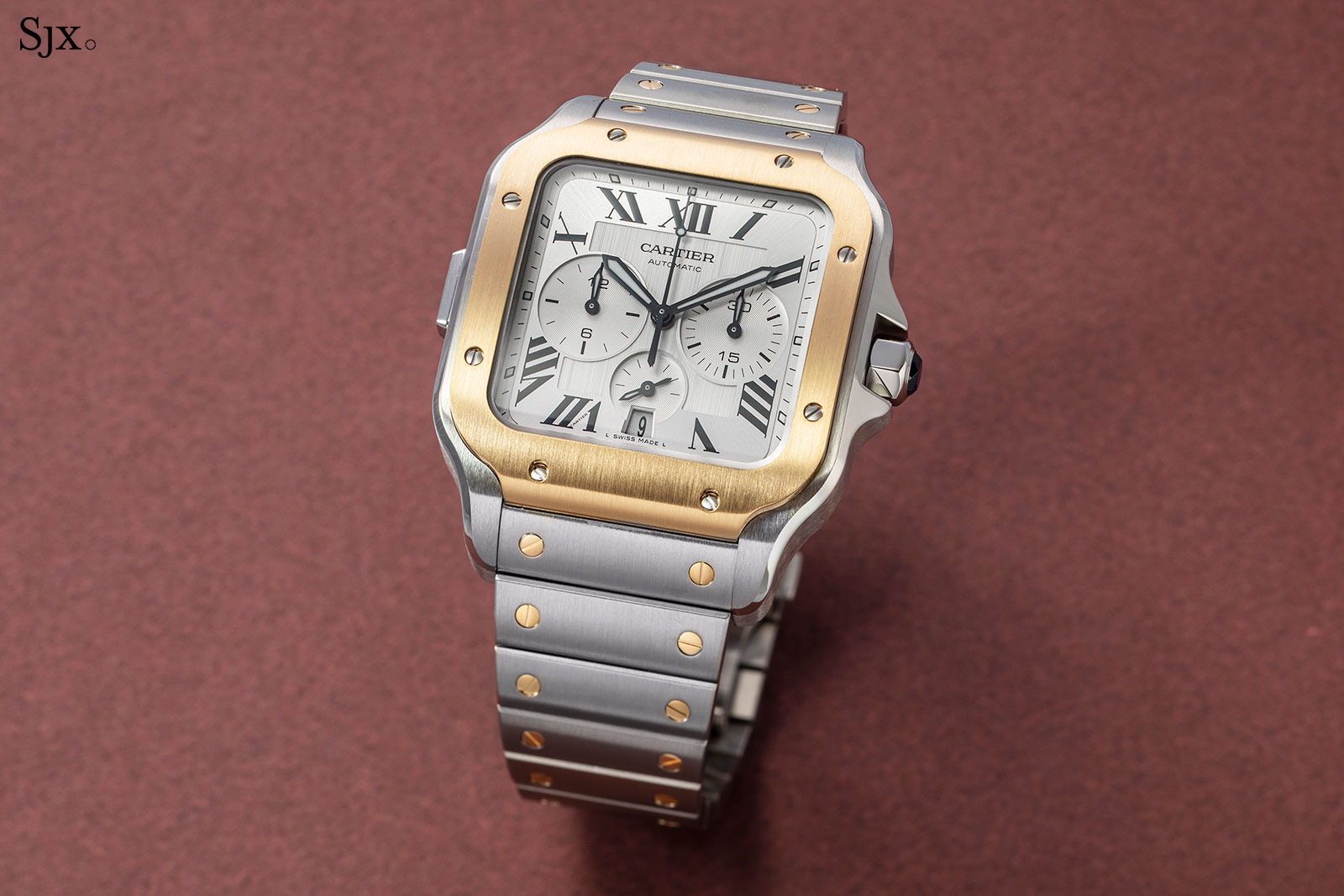
Though Cartier has a huge range of watch case styles, many are iterations from a handful of original designs that were usually created in the early 20th century. Only a handful stick closely to the design of the vintage originals, most notably the Tank Cintree and Crash, and now the new Santos-Dumont XL, newly launched at Watches & Wonders 2020. Originally (re)launched in last year in two sizes – both with quartz movements only – the Santos-Dumont is now available with a hand-wind, mechanical movement in a larger, but not too large, case. The elegant design that channels the spirit of the vintage original remains, with only the dimensions and movement changed. And the new hand-wind Santos Dumont XL is also well priced enough that it would be a value proposition in more ordinary times. Not only is the new model available in steel, which was absent before, the 18k gold version is almost 30% cheaper than the equivalent from the earlier generation. The Santos-Dumont XL in steel And in two-tone steel and 18k pink gold, which is a very 1980s look Since 1904… The watch gets its name from Alberto Santos-Dumont, a Brazilian inventor and aviator who spent his adult life in Paris. A minor celebrity in France for exploits in planes and airships, Santos-Dumont was a larger than life character: in the family history recently published by Francesca Cartier Brickell, The Cartiers: The Untold Story of the Family Behind the Jewelry Empire, Santos-Dumont is described as travelling betw...

Hands-On: The Kudoke 1 and Kudoke 2 SJX Watches
Mar 9, 2020

Hands-On: The Kudoke 1 and Kudoke 2

Two years ago, German independent watchmaker Stefan Kudoke announced his first proprietary movement, the Kaliber 1, which was developed in collaboration with Habring2. A year later, the movement has made its debut in a pair of classically-styled watches – the Kudoke 1 and Kudoke 2. Both models mark a stark departure from his earlier watches both in terms of design and price. Based in a small town east of Dresden, Kudoke was best known extravagantly engraved, skeletonised  timepieces, often powered by a Unitas-based movement (which meant they were all relatively large). But the latest Kudoke watches are far more understated, as well as attractively priced, starting at just over US$7,900. In fact, these watches present a compelling proposition, offering an unusual level of hand-decoration for its price bracket, save for a handful of other small independents, such as D. Dornblüth & Sohn. The Kudoke 1 Gently hand-engraved The Kudoke 1 is a well-designed watch showing the hours, minutes and seconds, while the Kudoke 2 replaces the seconds with a wonderfully engraved day and night indicator. Both watches are compact and thin enough to wear comfortably, though not quite so thin as to be true formal watches. Instead they feel like elegant everyday watches with discreet, appealing details in the hands, dial and movement. The two have the same steel case that’s 39 mm wide, but differ slightly in thickness due to the addition of the domed day and night indicator in the Kudoke ...

New IWC Portugieser Chronographs Now With In-House Automatic Movements Quill & Pad
Mar 6, 2020

New IWC Portugieser Chronographs Now With In-House Automatic Movements

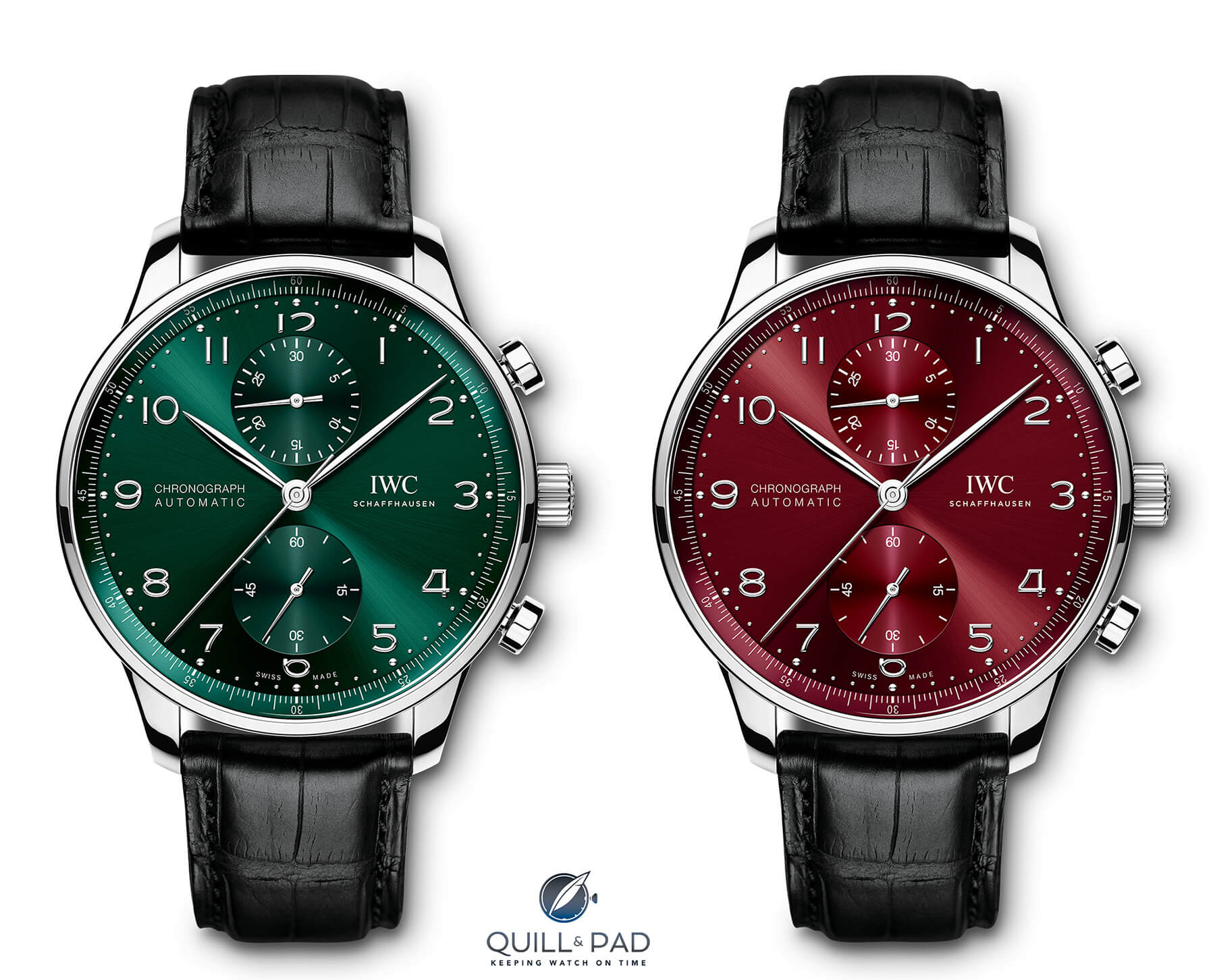
One of IWC’s most emblematic timepieces, the Portugieser chronograph has been a cornerstone of the brand’s collection for many years. The Portugieser, which first appeared back in 1939, has not always been a bestseller. The truth is, IWC failed with three separate launches before the Portugieser finally became a success in the early 1990s. Sabine Zwettler shares a brief history of the Portugieser here and introduces the six new chronograph variations powered by an in-house movement.

Grand Seiko Introduces the Elegance Collection ’60th Anniversary’ Engraved SJX Watches
Mar 5, 2020

Grand Seiko Introduces the Elegance Collection ’60th Anniversary’ Engraved

Twenty-twenty marks the 60th year of Grand Seiko and the brand is pulling no punches with its high-end commemorative editions. Dedicated to Grand Seiko’s workshop in the town of Shizukuishi, the 60th anniversary pair of Elegance Collection Thin Dress watches both feature decorative engraving, but executed by hand and machine respectively. Located in the northern province of Iwate, Shizukuishi is a small town surrounded by mountains, including the imposing Mount Iwate, which is an active volcano. The town is home to the Shizukuishi Watch Studio, where the best mechanical Grand Seiko watches are produced (Spring Drive watches, on the other hand, are produced at Seiko-Epson’s facility in Shiojiri in Nagano province). Elegance Collection ’60th Anniversary’ hand-engraved SBGW263 (left) and machine-engraved SBGW264 Shizukuishi, or しずく いし, translates literally as “water droplet on stone” – shizuku is “droplet” and ishi means “stone”. Legend has it that the town was founded a millennia ago when an old man living in the area heard the sound of dripping water, which originated in a cave where water from the ceiling was dripping onto the rocks below. The Grand Seiko Elegance Collection Thin Dress ’60th Anniversary’ Hand Engraved (ref. SBGW263) is a nod to the ancient origin story. It featured a solid gold dial hand engraved with a motif inspired by the town’s founding. Made entirely of 18k white gold, the dial is comprised of three parts – bas...

Crime or Sublime: Putting a NATO strap on a dress watch – the results Time+Tide
Mar 2, 2020

Crime or Sublime: Putting a NATO strap on a dress watch – the results

Last week, Nick Kenyon and Luke Benedictus got into a horological war of words over the rights and wrongs of the humble NATO strap. Luke took a defensive why-the-hell-not approach while Nick stuck to the purist’s line that some things must remain sacrosanct otherwise the whole of civilisation will go to pot. We then threw … ContinuedThe post Crime or Sublime: Putting a NATO strap on a dress watch – the results appeared first on Time+Tide Watches.

Hands-On: Cartier Privé Tonneau Skeleton Dual Time SJX Watches
Mar 1, 2020

Hands-On: Cartier Privé Tonneau Skeleton Dual Time

Launched last year alongside the time-only Tonneau, the Privé Tonneau Skeleton Dual Time is classical Cartier in style and execution. The case is a century-old Cartier design that has not aged, while the movement is interesting in aesthetics and mechanics. In fact, the 9919 MC inside is surprisingly novel – it’s a skeleton, form, and curved movement with two time zones. The Tonneau Skeleton is also being produced in a modest limited edition, which means it will remain unusual. But it is hindered by a high price tag. Double fuseau The Tonneau Skeleton Dual Time is modelled on the Tonneau double fuseau (French for “double time zone”) that was produced in a variety of versions, including a 1999 Macau handover commemorative edition, from the 1990s until the mid 2000s. A Cartier Collection Privee Cartier Paris (CPCP) Tonneau dual time zone in white gold, c. 1998. Photo – Sotheby’s Cartier was particularly fond of the twin time zone complication during the period, and the double fuseau was also produced in many Tank case styles, ranging from the Tank Cintree to the Tank Louis Cartier. Despite the diversity, all the double time zone watches shared a common feature – they were powered by two separate small movements – either mechanical or quartz, depending on the model – essentially two tiny watches combined into an extra-large case. Though mechanically unsophisticated, the two-in-one construction made each time zone entirely independent, down to the minute....

Hands-On: A. Lange & Söhne Grand Lange 1 Moon Phase 25th ‘Anniversary’ SJX Watches
Feb 27, 2020

Hands-On: A. Lange & Söhne Grand Lange 1 Moon Phase 25th ‘Anniversary’

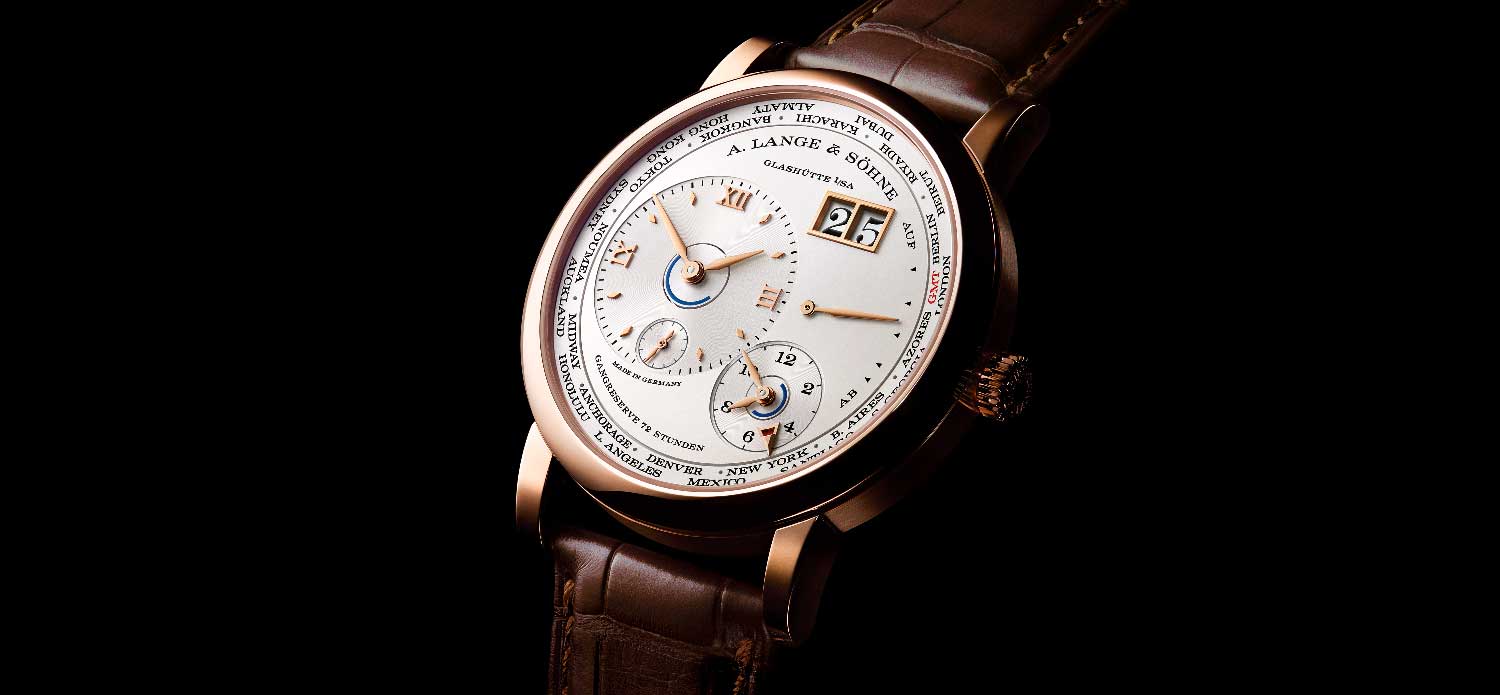
Last year was the 25th anniversary of A. Lange & Söhne’s modern-day revival in 1994, also the debut year of the iconic Lange 1. For the occasion, ten limited edition Lange 1 models were unveiled over the course of the year. The line-up ranged from the basic to the ultra complicated, but one of the standouts was a model in the middle of the spectrum – the Grand Lange 1 Moonphase “25th Anniversary”. Introduced in 2003, the Grand Lange 1 was essentially an upsized Lange 1, with a larger but slightly thinner case – and the same L901.0 movement found in the standard Lange 1. The result was an awkward, cramped dial with overlapping displays that abandoned the orderly asymmetry of the classic Lange 1 dial. Nine years later, the Grand Lange 1 movement was redesigned to create the cal. L095.1, which accommodated all of the indications on a dial with the correct proportions. A moon phase was added to the movement the following year, which increased its thickness slightly. The 25th anniversary edition is a second generation Grand Lange 1 Moon Phase with a subtle, beautiful twist – and one of the most appealing models from the anniversary line-up. Anniversary livery Though large, the watch is notably flat, giving it an elegant profile on the wrist. With a height of 9.4 mm, the white gold case is still thinner than that of the basic Lange 1, despite having the additional moon phase complication. The tripartite case construction has a brushed middle between the polish...

Crime or Sublime: Should you ever put a NATO strap on a dress watch? Time+Tide
Feb 27, 2020

Crime or Sublime: Should you ever put a NATO strap on a dress watch?

This week Time+Tide HQ sees two new opponents enter the ring, with Luke and Nick trading haymakers on the topic of a NATO strap on a dress watch - very vogue, or fashion faux pas? You be the judge of this one. Luke Benedictus – The For Argument In 2020, most of the dress codes surrounding … ContinuedThe post Crime or Sublime: Should you ever put a NATO strap on a dress watch? appeared first on Time+Tide Watches.

Why getting your Jaeger-LeCoultre Reverso engraved is worth the wait Time+Tide
Feb 25, 2020

Why getting your Jaeger-LeCoultre Reverso engraved is worth the wait

The Jaeger-LeCoultre Reverso is a paragon of the Art Deco dress watch style, delivering a clean and classic design that has remained the same for the best part of a hundred years. While most watches with a solid caseback offer ample space for an engraving, the Reverso offers more than most thanks to its beautifully … ContinuedThe post Why getting your Jaeger-LeCoultre Reverso engraved is worth the wait appeared first on Time+Tide Watches.

Up Close: Girard-Perregaux Classic Bridges 45 mm SJX Watches
Feb 20, 2020

Up Close: Girard-Perregaux Classic Bridges 45 mm

Girard-Perregaux is best known for the Tourbillon with Three Gold Bridges, one of the most distinctive and beautiful movements in watchmaking – even 160 years after it was first designed. Characterised by its symmetry and arrow-shaped bridges, the Tourbillon with Three Gold Bridges is one of the few movements has an irrefutably iconic design. Some of the three-bridges magic has democratised with the Girard-Perregaux Classic Bridges 45 mm, a time-only watch that’s a more affordable take on the 19th century design. Constant Girard’s movement French watchmaker Jean-Antoine Lépine revolutionised the construction of the watch movement around 1770 when he invented the Lépine calibre, which used bridges and cocks to secure the moving parts on the base plate, replacing the prevailing pillar construction where the parts were held between two full plates. Almost a century later, Girard-Perregaux founder Constant Girard took Lépine’s idea a step further by rethinking the layout of the movement, with an eye towards not just mechanical function, but also beauty. A Girard-Perregaux pocket watch with nickel-plated parallel bridges, c. 1875. Photo – Antiquorum Starting in the mid 1850s, Girard began working on a caliber with its barrel, gear train, and regulator arranged vertically in a straight line. They were secured by identical, parallel bridges shaped like an elongated rhombus, creating an incredibly elegant equilibrium in the movement layout. Eventually the large, par...

IWC Introduces the Portugieser Monopusher Chronograph “Laureus Sport for Good” SJX Watches
Feb 18, 2020

IWC Introduces the Portugieser Monopusher Chronograph “Laureus Sport for Good”

An annual edition now in its 14th year, the “Laureus Sport for Good” helps support the foundation of the same name, which promotes sport amongst disadvantaged and disabled children around the world. In a departure from the norm of using a current model as the base, the 2020 edition is a brand-new reference that’s not yet in the catalogue (though it probably will be by Watches & Wonders 2020), the Portugieser Monopusher Chronograph “Laureus Sport for Good”. The Portugieser Monopusher Chronograph is an unusual watch: a manual-wind, single-button chronograph with a long power reserve of 192 hours, or eight days. It’s powered by the cal. 59360, which has a notably thin chronograph mechanism built over the cal. 59000 eight-day movement. The movement, however, not actually new. It was last used in 2015 inside the Portofino monopusher chronograph, but subsequently absent until now. (Reputedly the movement had kinks that required fixing, particularly in terms of timekeeping while running the chronograph.) The cal. 59360 with its thin chronograph mechanism; note the wide and flat column wheel The movement is wide and relatively flat, resulting in a large watch that’s 46 mm wide and just shy of 14 mm high. Given the traditional Portugieser design of a wide dial and narrow bezel, the size of the watch is particularly pronounced. As is traditional with the Laureus edition, the dial is a deep, metallic blue with ample space for the two chronograph registers as well as the...

Comments 2

  1. Anonymous
    the whole point of a dress watch is that it disappears on your wrist. precious metal cases, minimal dial, two hands. that's the formula.
    1. Anonymous replying to Anonymous
      totally agree on the invisibility factor, but i'd push back on "two hands only." a good three-hander with a clean dial still disappears just fine. it's really about restraint, not the hand count.

Leave a comment

All comments are reviewed before they go live. Email is for our records only - it's never published.