
Max Bill was born on 22 December 1908 in Winterthur, Switzerland, and apprenticed as a silversmith in Zurich before enrolling at the original Bauhaus school in Dessau, Germany, from 1927 to 1929. There he studied painting under Wassily Kandinsky and Paul Klee, architecture under Walter Gropius, and form theory under Josef Albers, the same generation that would shape mid-20th-century product design across Europe and the United States. He returned to Zurich in 1929 and spent the 1930s as a painter, graphic designer, and sculptor, with growing involvement in the international Bauhaus diaspora that included Mies van der Rohe and Marcel Breuer.
In 1953 Bill co-founded the Hochschule für Gestaltung Ulm (HfG Ulm) in southern Germany, a continuation of the Bauhaus pedagogy through industrial-design and product-design programmes. The Ulm school trained Dieter Rams (later head of Braun design), Otl Aicher (Lufthansa identity), and many of the Italian and German designers who shaped 1960s modernism. Bill served as rector until 1957 and remained on the faculty afterward; HfG Ulm closed in 1968 but its alumni network continues today as the principal carrier of Bauhaus ideas into late-20th-century product design.
"Beauty is the result of a thing being right; form follows from purpose. A watch should look like the time it tells, and no more."- Max Bill, 1956 design memo to Junghans
The Junghans collaboration began in 1956, when the German watchmaker commissioned Bill to design a series of kitchen wall clocks for the consumer market. The clocks were instant successes and remain in production today (the Junghans Max Bill Wall Clock catalogue still ships in 2024). Encouraged by their reception, Junghans then commissioned a wristwatch design, completed by Bill 1961 and launched in 1962 as the Junghans Max Bill wristwatch.
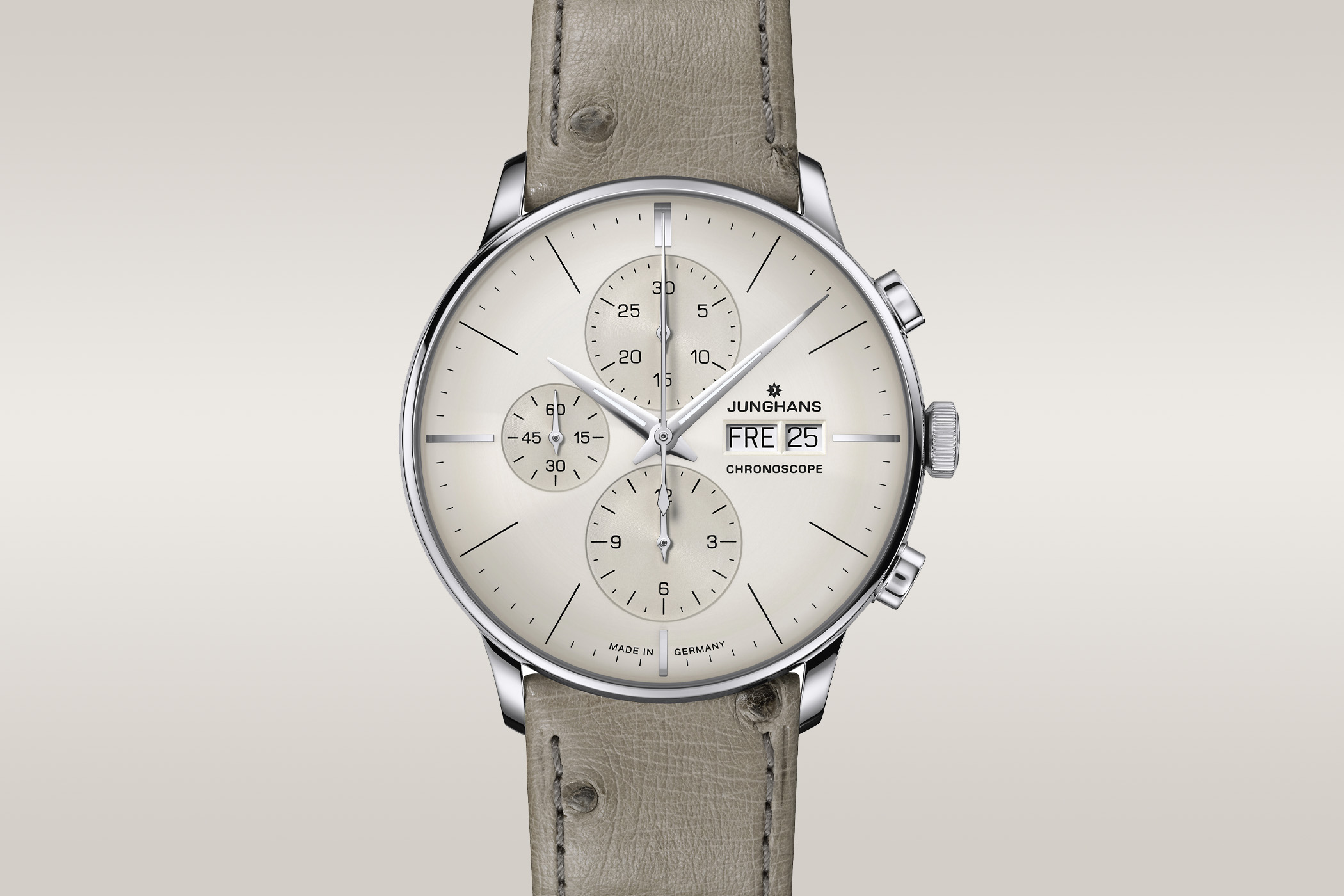
The Junghans Max Bill wristwatch is uncomplicated by design. Round case, no rotating bezel, baton hour markers, central seconds, no date. The dial uses simple Arabic numerals (the "Max Bill numerale" version) or pure baton indices ("Max Bill index"). The case is small by modern standards (34 mm or 38 mm). The hands are baton-shaped, lume on later versions, none on earlier. There are no decorative flourishes; everything is functional. The wristwatch is the canonical Bauhaus translation, "form follows function" applied to a wristwatch, and is the reference against which every later Bauhaus-claimed wristwatch (NOMOS Tangente, Junghans 1972 Form, Hamilton Pulsar, Braun digitals) measures itself.
Bill's broader output is unrelated to watches but worth understanding for context. Major commissions include the Pavillon-Skulptur sculpture in Zurich (1983), the HfG Ulm building (1953-55, with Otl Aicher and Inge Aicher-Scholl), the Endless Ribbon sculpture series (1935-1947, Möbius-strip-derived), and dozens of public buildings, exhibitions, and government typography commissions. He served as a member of the Swiss National Council 1967-1971 and as a professor at the Hochschule der Künste Berlin from 1967 until retirement.
Bill died in Berlin on 9 December 1994, aged 85. The Junghans Max Bill wristwatch has been continuously produced since 1962 with only minor updates (the modern automatic Cal. J800.1 and Cal. J505 sapphire-back versions); a 2009 anniversary edition matched the original specifications precisely. Annual production is small (a few thousand units) but the design has been so widely copied (including by NOMOS Glashütte's 1990 Tangente, which is essentially a tribute) that the Max Bill silhouette is now the visual shorthand for "Bauhaus dress watch" in collector vocabulary.




Comments 1