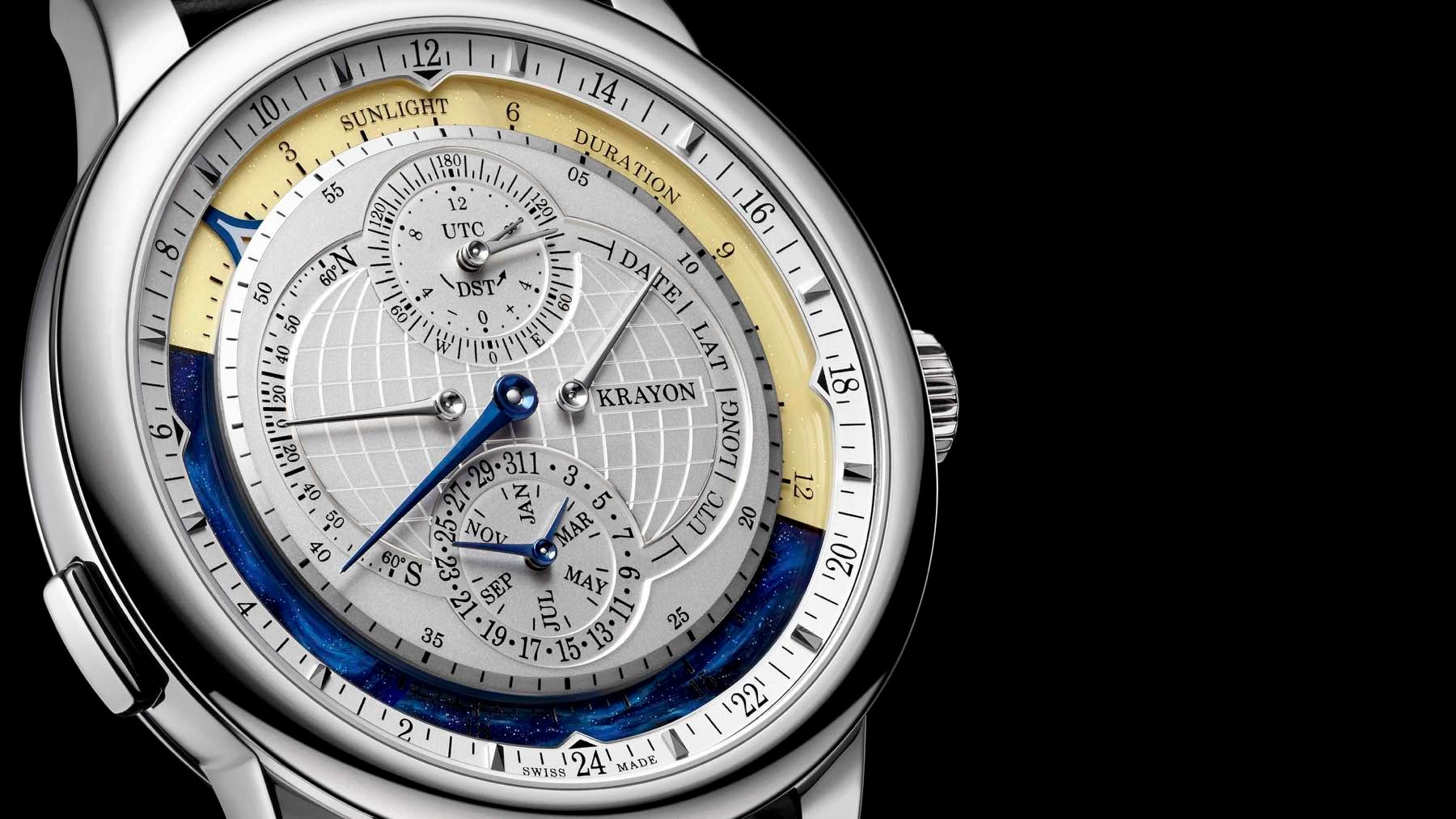
A sunrise/sunset indicator reflects the Earth's axial tilt: at a given latitude, the day length varies sinusoidally across the year, with maximum length at the summer solstice (longest in the Northern Hemisphere ~June 21) and minimum at the winter solstice (~December 21). At 48° N (Geneva), sunrise varies from ~04:30 (June) to ~08:00 (December), with sunset varying from ~21:30 (June) to ~16:30 (December). A mechanical sunrise/sunset indicator translates this annual curve into a pair of profiled cams (one per indication) that advance once per day in step with the calendar.
The complication is necessarily latitude-specific: the cam profile is cut for a single reference latitude (typically the city of the original commission). Wear the watch at a different latitude and the indication is approximate. Notable wristwatch references include the Patek Philippe Sky Moon Tourbillon (with sky chart, sunrise/sunset, and equation of time), Vacheron Constantin Les Cabinotiers Celestia astronomical grand complication, and the more accessible Patek 5102 Star Caliber descendant lines. The complication typically combines with equation of time in astronomical watches.


Comments 2