
The Monaco is one of those watches where the reference number actually tells you something useful. Heuer encoded the movement, the line, and the case material right into the digits. Once you know the key, spotting the difference between a 1133B and a 1533 at a glance takes about three seconds. This guide runs through every major reference in order, notes what physically changed each time, and closes with current prices and pre-owned guidance.
One thing to keep in mind before we start: the Monaco's story is inseparable from the Calibre 11, the automatic chronograph movement Heuer co-developed and launched on 3 March 1969. The Monaco was one of the watches that debuted that movement. Everything that came after was, in some sense, chasing that original combination of square case, left-side crown, and automatic chronograph.
Quick version: Monaco references at a glance
- 1133B (1969-1975): original, Calibre 11 (later Calibre 12), blue dial, crown at 9, acrylic crystal
- 1133G (1972-1975): same case, grey dial in two executions (grey registers, then black registers)
- 1533 / 73663 (1972-1975): same era, Calibre 15 automatic or Valjoux 7736 manual respectively
- CS2110 / CS2111 (1997 onward): first reissues, 5,000 pieces each, crown moved right, disputed movement
- CW2113 (2002-2003): richer blue dial, Calibre 17 (ETA 2892-A2 with module), 38mm case
- CAW2111 / CAW211A / CAW211P (2009-2018): 39mm, sapphire crystal and caseback, Calibre 12 or Calibre 11
- CBL2111 (2019-present): in-house Heuer 02, tri-compax dial, 39mm, 80-hour power reserve
The original: reference 1133B and its variants
The reference number itself is a decoder ring. "11" stands for Calibre 11, "3" identifies the Monaco line, the second "3" means steel case, and the "B" suffix means blue dial. So 1133B: Calibre 11, Monaco, steel, blue. Simple.
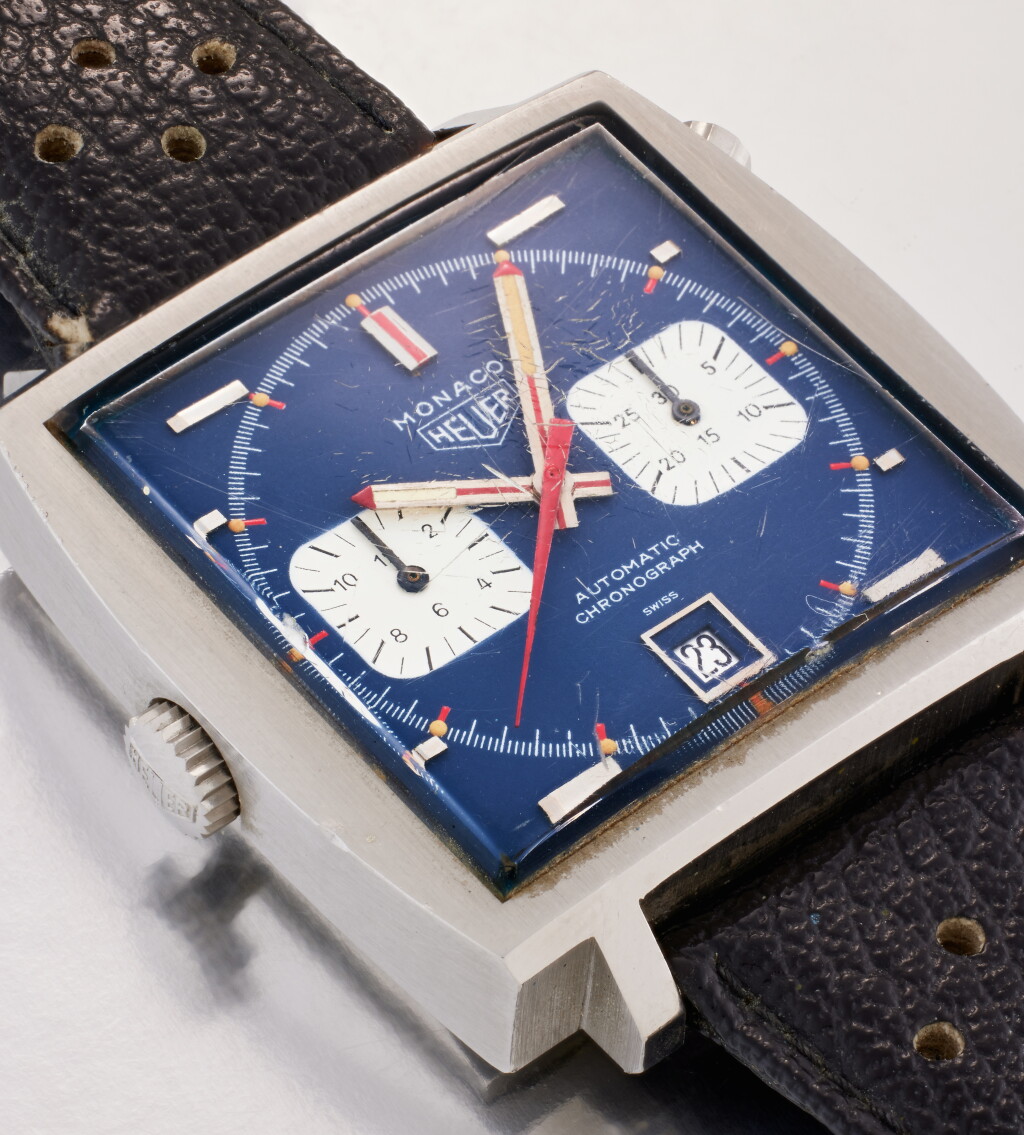

The case was square steel, measuring approximately 39 to 40mm (sources round differently, and the case size is noted as disputed across multiple references; the Sotheby's 2024 lot sheet for the McQueen example gives 40mm width). The crown sat at 9 o'clock on the left side of the case. The dial had white registers, red chronograph hands, and a date at 6. The crystal was domed acrylic.
There were actually three dial generations within the 1133B. The first, sometimes called the "Chronomatic" version, read "Chronomatic" at the top and "Monaco" at the bottom. A transitional version followed. The standard production piece eventually settled on "Monaco" at the top and "Automatic Chronograph" at the bottom, with triangular red-tipped hands. If you're buying a 1133B and the seller claims it's an early example, the dial text is the first thing to check.
Production ran from 1969 to roughly 1975. Heuer began transitioning to the Calibre 12 (running at 21,600 vph versus the Calibre 11's 19,800 vph) from 1971, so later 1133B examples will have the Calibre 12 inside despite the reference number suggesting otherwise.
The 1133G used the same case with a metallic grey dial. It came in two executions: grey registers first, then black contrasting registers. Both ran from 1972 to 1975. Reference 1533 paired the same case with the Calibre 15 automatic movement. Reference 73663 used a Valjoux 7736 manual wind. All three alternatives shared the 1972 to 1975 production window. There was also a PVD-coated black reference, 74033N, that was produced but never appeared in Heuer's catalogue.
Six reference 1133B watches were supplied by Heuer for the production of Le Mans. The specific example Steve McQueen wore, case number 160304, sold at Sotheby's New York on 6 December 2024 for $1,440,000, making it the second-highest price ever achieved for a Heuer at auction. The all-time record for a Monaco 1133 is $2,208,000, set at Phillips New York in 2020. Whether McQueen formally endorsed the Monaco or chose it himself is disputed: Jack Heuer's account says McQueen picked the watch over an Omega; other sources describe a formal arrangement. The nature of that relationship has not been definitively settled.
The 1990s reissues: CS2110 and CS2111
Heuer was acquired by Techniques d'Avant Garde in 1985 and became TAG Heuer. The original Monaco had already been discontinued by the late 1970s during the quartz crisis. The brand brought it back in 1997 with reference CS2110, a limited edition of 5,000 pieces. It had a black flat dial with the old Heuer shield logo, a 30-minute counter at 9, running seconds at 3, and a date at 6. Here's the detail that matters for identifying it: the crown moved to the right side of the case, abandoning the original left-side position.

What powered the CS2110 is disputed. One source calls it manually wound; another says it was the Calibre 12. Take both descriptions with some caution.
CS2111 followed, also in 5,000 units, with a sculpted black dial and three counters. CS2113 added a silver dial, introduced around 2001, using the ETA 2894-2 movement. By 2002 to 2003, CW2113 arrived with a rich blue dial, white sub-registers, bold red chronograph hands, and the Calibre 17 (ETA 2892-A2 with a Dubois-Dépraz module) in a 38mm case.
The CAW era: 2009 to 2018
In 2009, the case grew back to 39mm x 39mm and TAG Heuer made two important upgrades: a sapphire crystal replaced the acrylic, and a sapphire caseback was added for the first time. References CAW2110 (black dial) and CAW2111 (blue dial) were the standard pieces, powered by the Calibre 12 with ETA or Sellita SW300-1 base running at 28,800 vph and offering a 40-hour power reserve.
Also in 2009, CAW211A was released as a 40th anniversary piece, described as a faithful re-creation of the original 1133B, specifically the McQueen watch, with the crown back at 9 o'clock and a more period-correct dial layout. This was meaningfully different from the 1997 CS2110, which had modernised both the case and dial significantly.
CAW211P, the "Steve McQueen" reference with Calibre 11, arrived in 2015 and was last listed at USD 8,600 before being discontinued. The Gulf special editions also multiplied during this era. The first Gulf Monaco launched in 2004 as a limited run of 4,000 units. CAW2113 (Gulf III) arrived in 2009 with a grey dial and Calibre 12. In 2017, a Gulf Racing Stripes 50th anniversary special was a US-exclusive at $5,900, powered by Calibre 11. CAW211R, introduced in 2018, was the first Gulf Monaco to combine a blue-and-orange striped dial with the Calibre 11 and crown at 9.
For the Monaco's 50th anniversary in 2019, TAG Heuer released five limited editions of 169 pieces each under the CAW211P case reference with Calibre 11, one edition representing each decade of the watch's history.
The current reference: CBL2111 with Heuer 02
In 2019, TAG Heuer swapped the ETA/Sellita-sourced Calibre 12 for its own in-house Heuer 02 movement (first introduced in the Autavia in 2017) and launched the CBL2111. The case stayed at 39mm, but the inside needed reworking: the Heuer 02 measures 31mm in diameter versus the Calibre 12's 30mm.
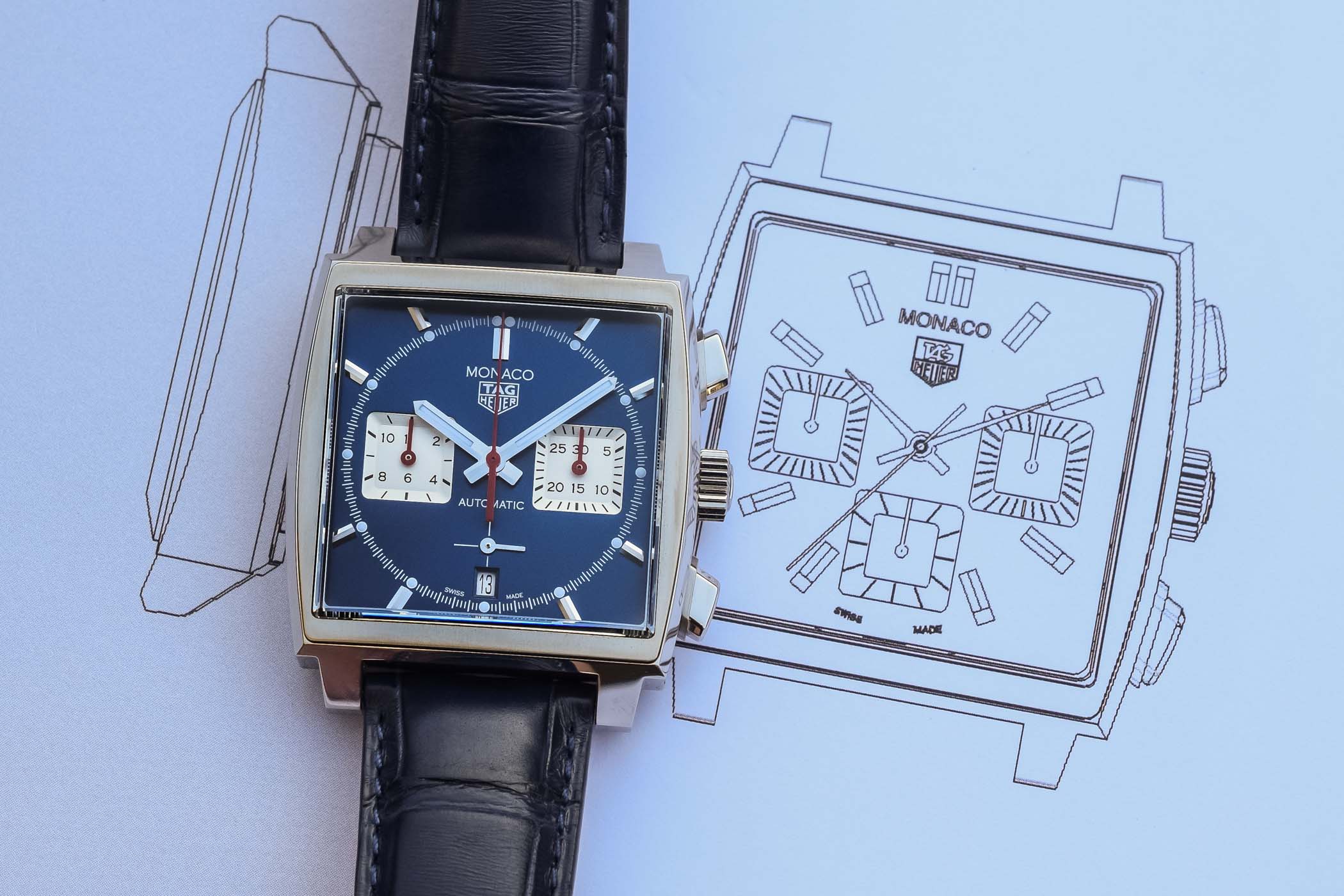
The dial changed too. It moved from bi-compax to tri-compax by adding a small seconds hand at 6 o'clock. An applied steel marker appeared at 12, and the sub-registers at 3 and 9 were updated to silver opaline. The Heuer 02 runs at 28,800 vph with an 80-hour power reserve, roughly double the Calibre 12's 40 hours.
Note that some sources call the CBL2111 bi-compax and some call it tri-compax. The Calibre11.com in-depth review is the more detailed source here and confirms three registers, making tri-compax the accurate description.
TAG Heuer now designates the movement in current Monaco variants as Calibre TH20-00, an evolution of the Heuer 02 refined further in-house, retaining the column wheel, vertical clutch, and 80-hour power reserve. More recently, the Monaco Evergraph (CEW5181) introduced the entirely new Calibre TH80-00, which uses a compliant chronograph mechanism built from flexible components.
CBL2111.FC6453
39mm square steel
Calibre TH20-00 (Heuer 02)
80 hours
28,800 vph
Blue, tri-compax
Sapphire front and back
EUR 8,250
Which one to buy now
If you want an original 1133B for collecting reasons, budget carefully. A regular non-McQueen example sold for $15,400 at Christie's Geneva in 2021 and $15,427 at Bonhams London in 2022. Condition and dial generation matter enormously at that level. The McQueen provenance is its own separate universe, as the 2024 Sotheby's result makes clear.
For a modern daily wearer, the CBL2111.FC6453 is the one to get. The in-house movement, the 80-hour reserve, and the sapphire caseback make it genuinely usable in a way the 1990s reissues never quite were. Current EUR list price is EUR 8,250 on leather (CBL2111.FC6453) or EUR 8,650 equivalent on bracelet. Pre-owned CBL2111 trades around USD 4,500 to USD 5,000 on WatchCharts as of late 2026, which is a meaningful discount from the USD 8,300 to USD 8,500 retail. The launch price in 2019 was EUR 5,400, so values have climbed at retail while the pre-owned market has settled below that trajectory. That spread makes pre-owned worth considering if you can verify service history.
Comments
No comments yet, be the first to weigh in.