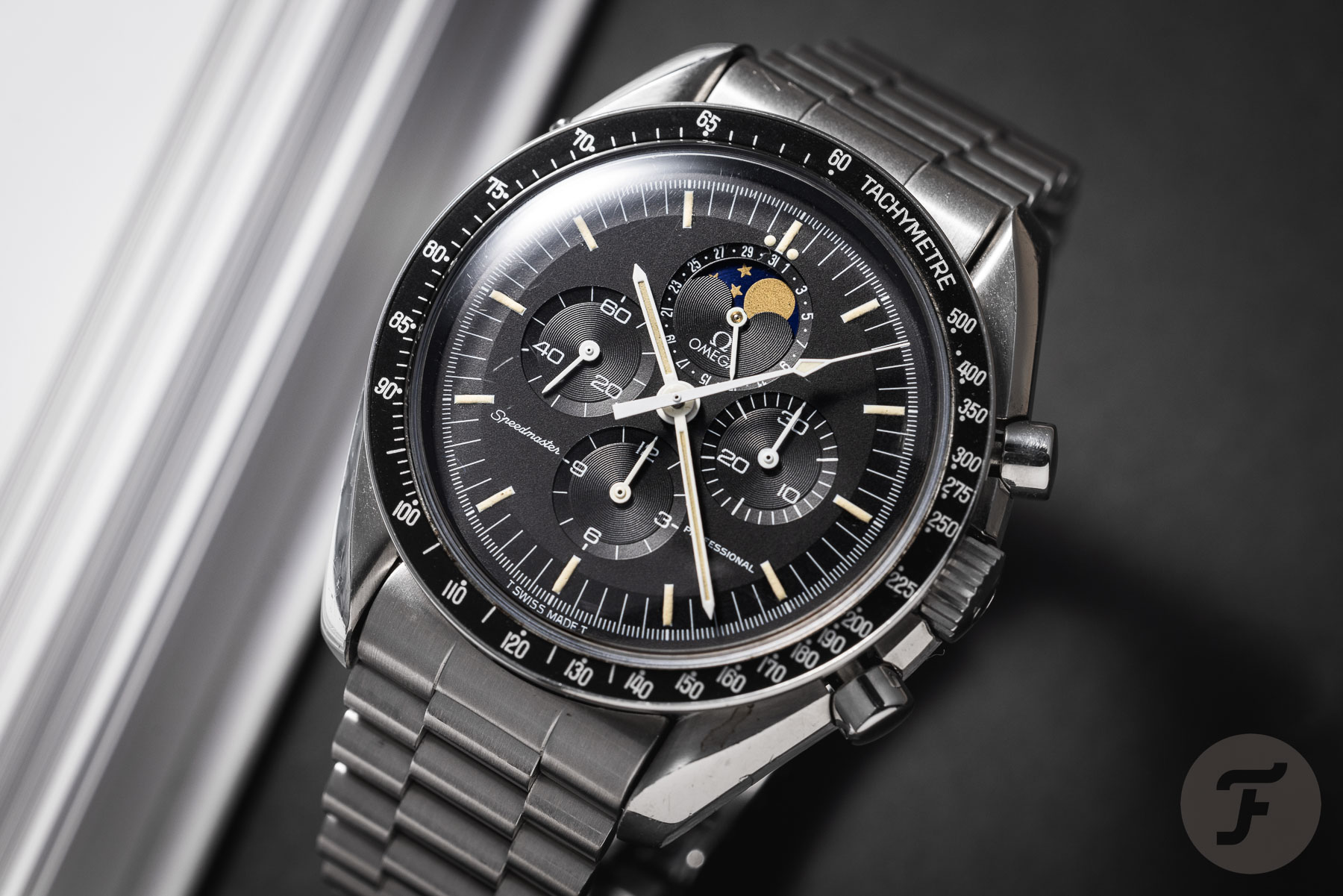
Ask most people what a Moonwatch looks like and they'll describe three subdials, a tachymeter bezel and nothing else. Omega broke that rule once in 1985, when it put a moonphase on the Speedmaster Professional. Collectors call it the Speedymoon, Omega calls it the 1985 Speedymoon, and the reference is 345.0809.
What it is
The Speedymoon is a 42mm steel Speedmaster Professional with a black dial, baton hands, tritium lume and a Hesalite crystal. The difference is a fourth subdial at 12 o'clock, with a date ring around the edge and a moon disc in the middle. According to Fratello, Omega made it between November 1985 and January 1989. Omega's own heritage page calls it a limited edition of 1,300 pieces. Hairspring notes that about 15% of those were strap-only watches, mostly for Mexico and Italy, which leaves roughly 1,100 on a bracelet.
Moonphases weren't new for Omega. The brand traces that tradition back to the Omega Cosmic of 1947. But this was the first time the complication showed up on the Speedmaster Professional.
Three different moons
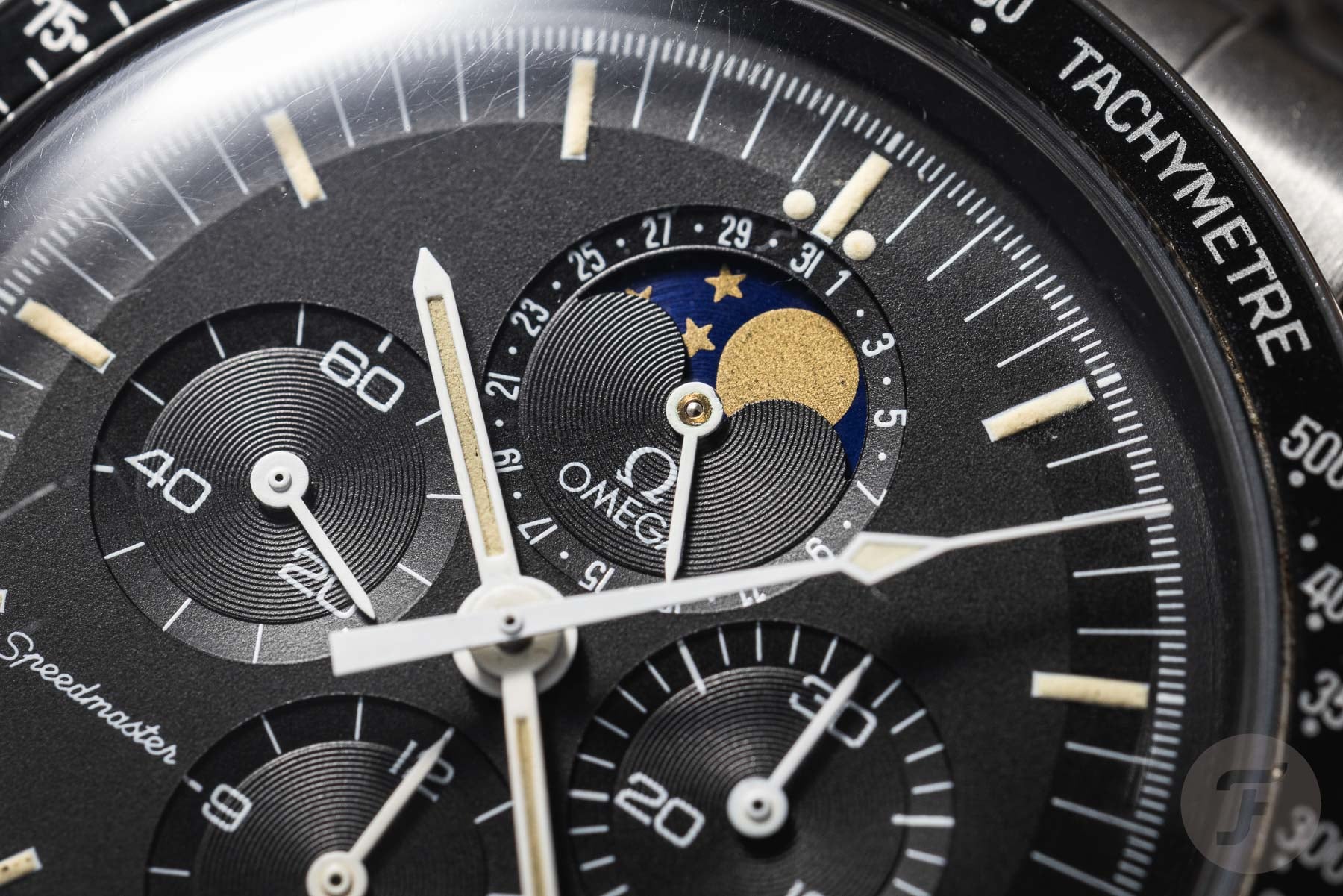
For a watch made in such small numbers, there's a surprising amount of variation. Collectors sort the Speedymoon into three types by its moon disc, as Hairspring and Belmont Watches describe them:
- Small moon: slightly smaller moons with four- or six-pointed stars. Most watches have this disc.
- Big moon: larger moons with five-pointed stars, like the Fratello example in these photos.
- Smiley moon: moons with a hand-painted smiling face. Fewer than 25 are thought to exist, and according to Hairspring they sell for two to three times the price of a standard one. Omega's page mentions these painted faces too.

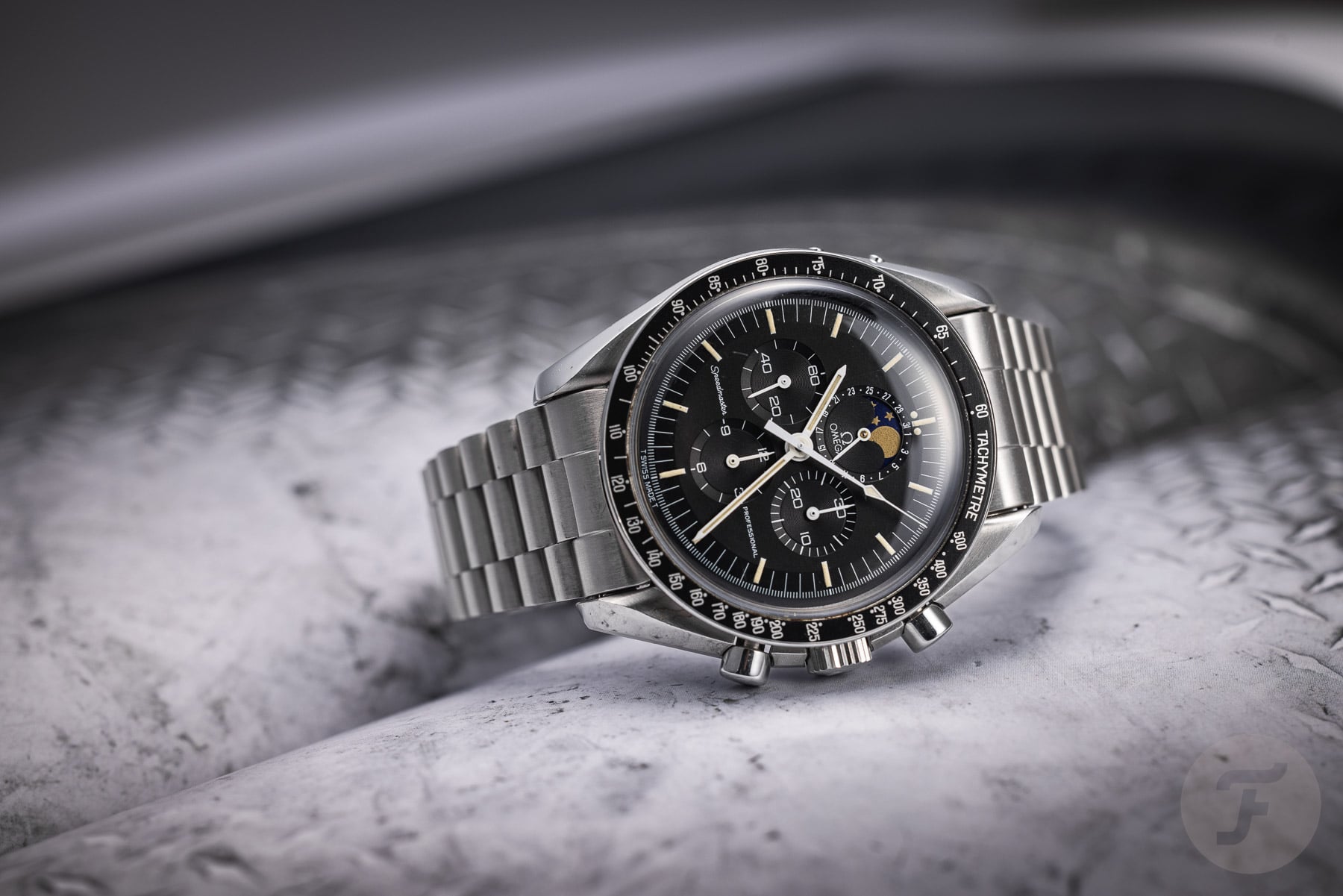
The bracelet changed too. Omega used three references: the 1447 (with 805 end links, as on Omega's own example), the 1450, and later the 1479, which only went on the last few watches to leave Biel.
Calibre 866
Inside is the hand-wound calibre 866. It's the Lemania-based calibre 861 from the regular Moonwatch of the time, with a date and moonphase added. Like the 861, it's copper-coloured and runs at 21,600 vibrations per hour. Omega points out the shuttle cam and the Delrin chronograph brake, which cut friction and helped the movement last.
You set the date and the moon with two small correctors in the case band. The upper one moves the moon disc, the lower one the date. The disc makes a full turn in about 29.5 days, while a real lunar cycle takes 29.53 days, so it needs a nudge roughly every two and a half years.
No NASA engraving
Here's the twist. Because of the moonphase, the Speedymoon didn't meet NASA's qualification criteria, Omega says. So its caseback doesn't carry the "Flight qualified by NASA" engraving you'd expect on a Speedmaster Professional. It's the first Moonwatch with a moon on the dial, and it never got the paperwork to go there.
The German sister: 345.0810
Around 1986 Omega made one more moonphase Speedmaster with the same movement, the 345.0810. It was based on the Mark V, sold only in Germany and limited to 700 pieces: 300 in gold and titanium and 400 in titanium only. Between the two references, Omega used 2,000 calibre 866 movements in total.
After that, the moonphase left the Speedmaster until 1999, when the white gold 3689.30 arrived with calibre 1866. Since then there's always been a moonphase Speedmaster in the catalogue.

Buying one
Prices climbed a lot over the past 10 to 15 years and have come down a little since. Today a good example sits around €14,000, with more for box and papers. In 2024 Hairspring still asked $19,500 (about €18,000) for a clean big-moon example with an Omega Extract of the Archives. Either way, that kind of money attracts watches that aren't quite what they claim to be.
Check the date ring. If the numbers from 9 to 21 face outward, it's often a service dial. That's still an original Omega part, but it lowers the value. Also look for the wrong hands, a different bracelet reference, and parts borrowed from the later moonphase Speedmasters 3576.50 and 3876.50 (2003 onwards).
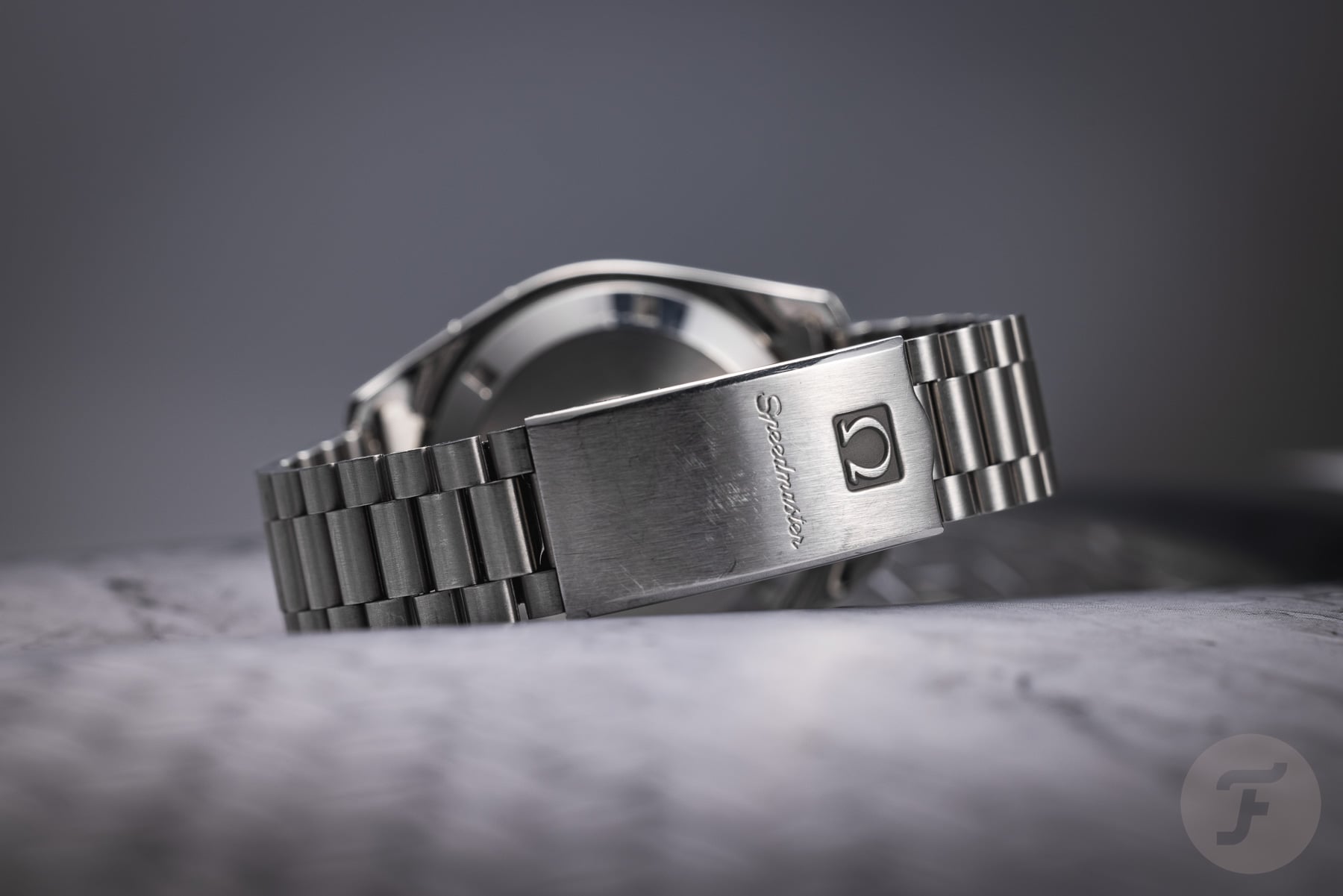
Is it worth it? If you already have a regular Moonwatch and want something that looks familiar but isn't, the Speedymoon is a great pick. It's the same case, the same bezel and nearly the same movement, with a little painted moon most people won't notice until you show them. Just buy the seller as much as the watch.
Comments
No comments yet, be the first to weigh in.