Watch brandsWatch wikiWatch videosVariousWatch calendarSaved articles
PopularRolexOmegaPatek PhilippeAudemars PiguetTudorGrand SeikoCartierSeikoIWCTAG HeuerBreitlingJaeger-LeCoultreA. Lange & SohneZenith

Results for Mainspring

73 articles found · page 2 of 3

Related pages

Wiki · Guide
Mainspring

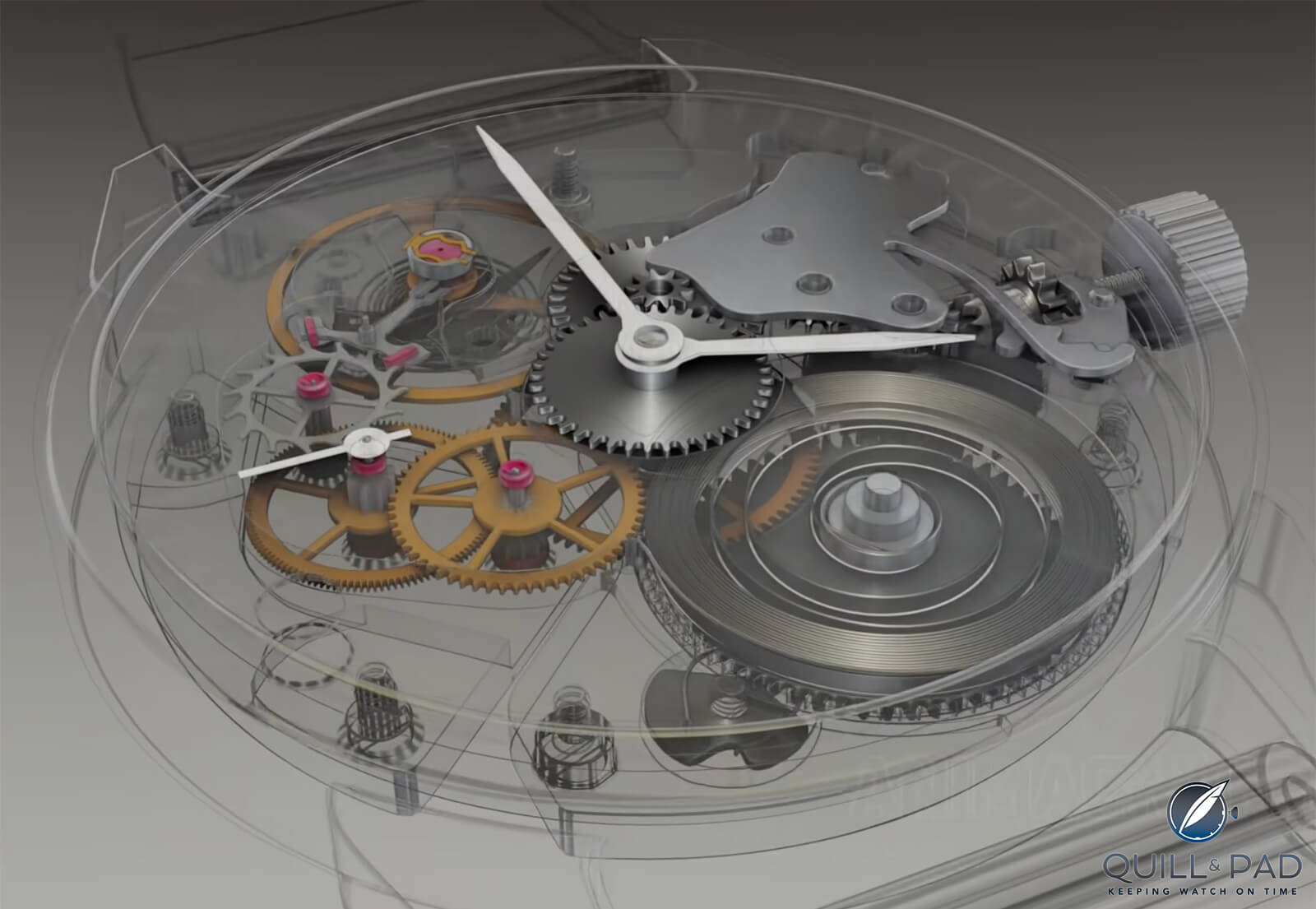
The coiled power source inside the barrel; stores all energy running a mechanical watch.

Grand Seiko Marks 20 Years of Spring Drive 9R SJX Watches
Grand Seiko Marks 20 Years Sep 5, 2024

Grand Seiko Marks 20 Years of Spring Drive 9R

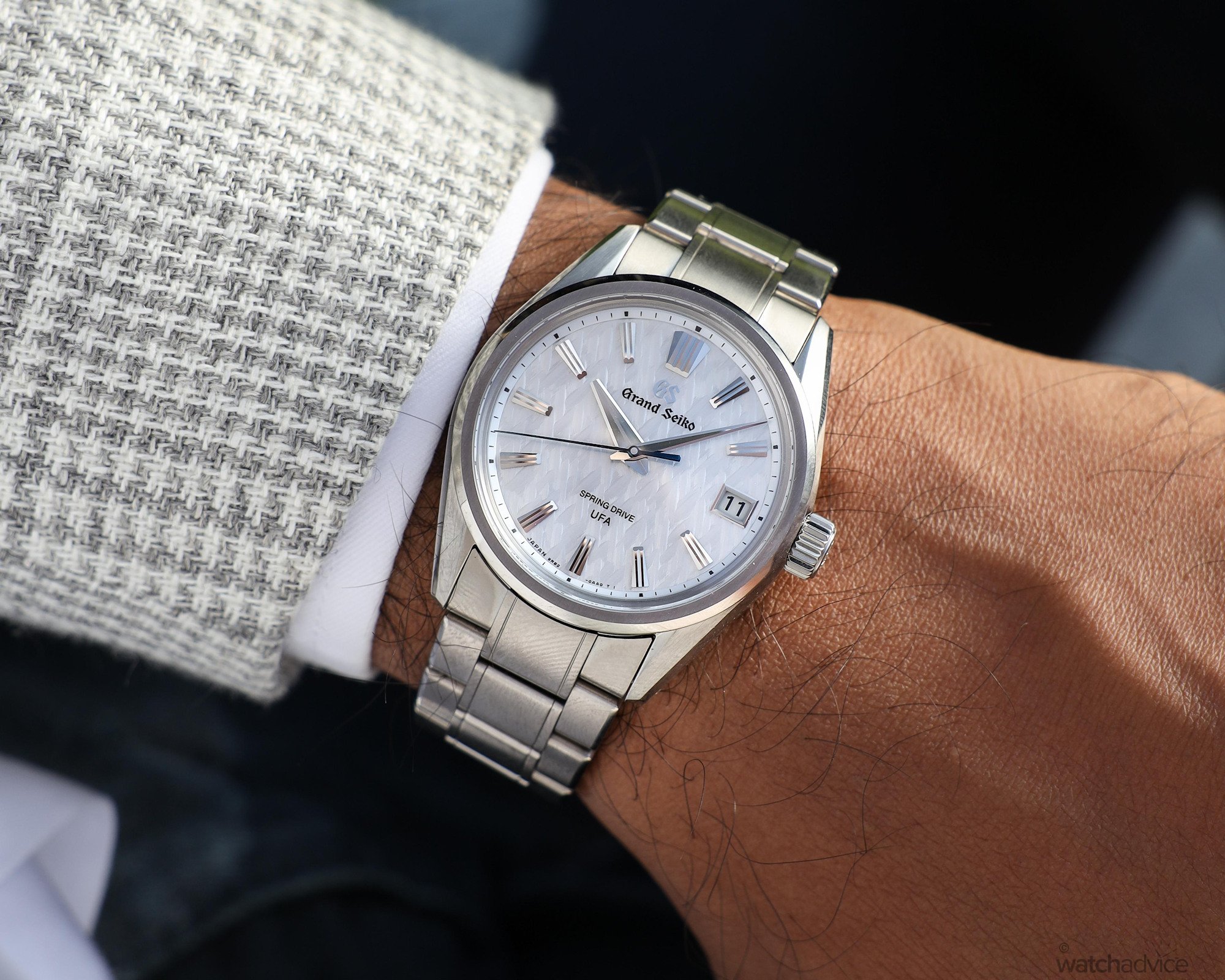
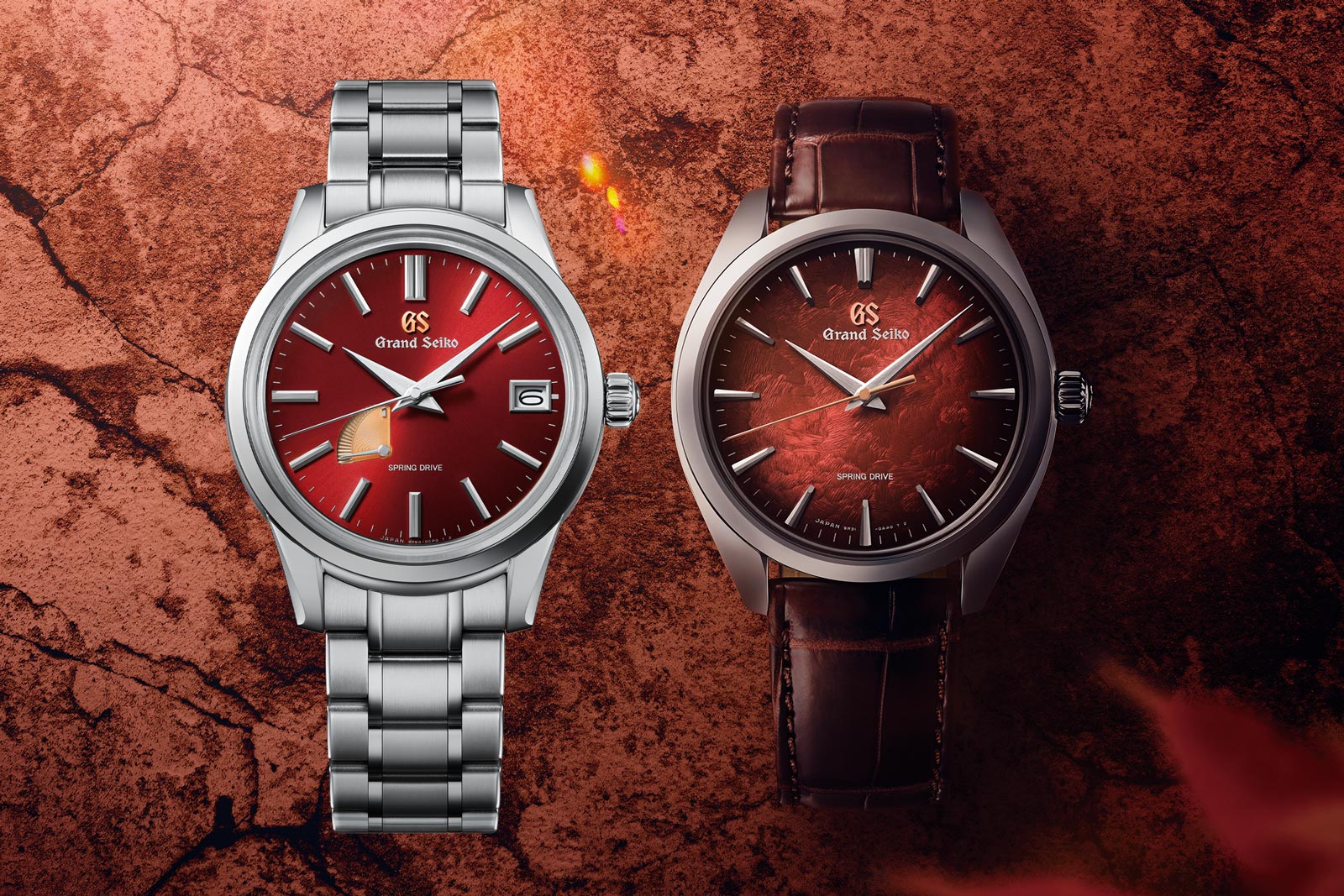
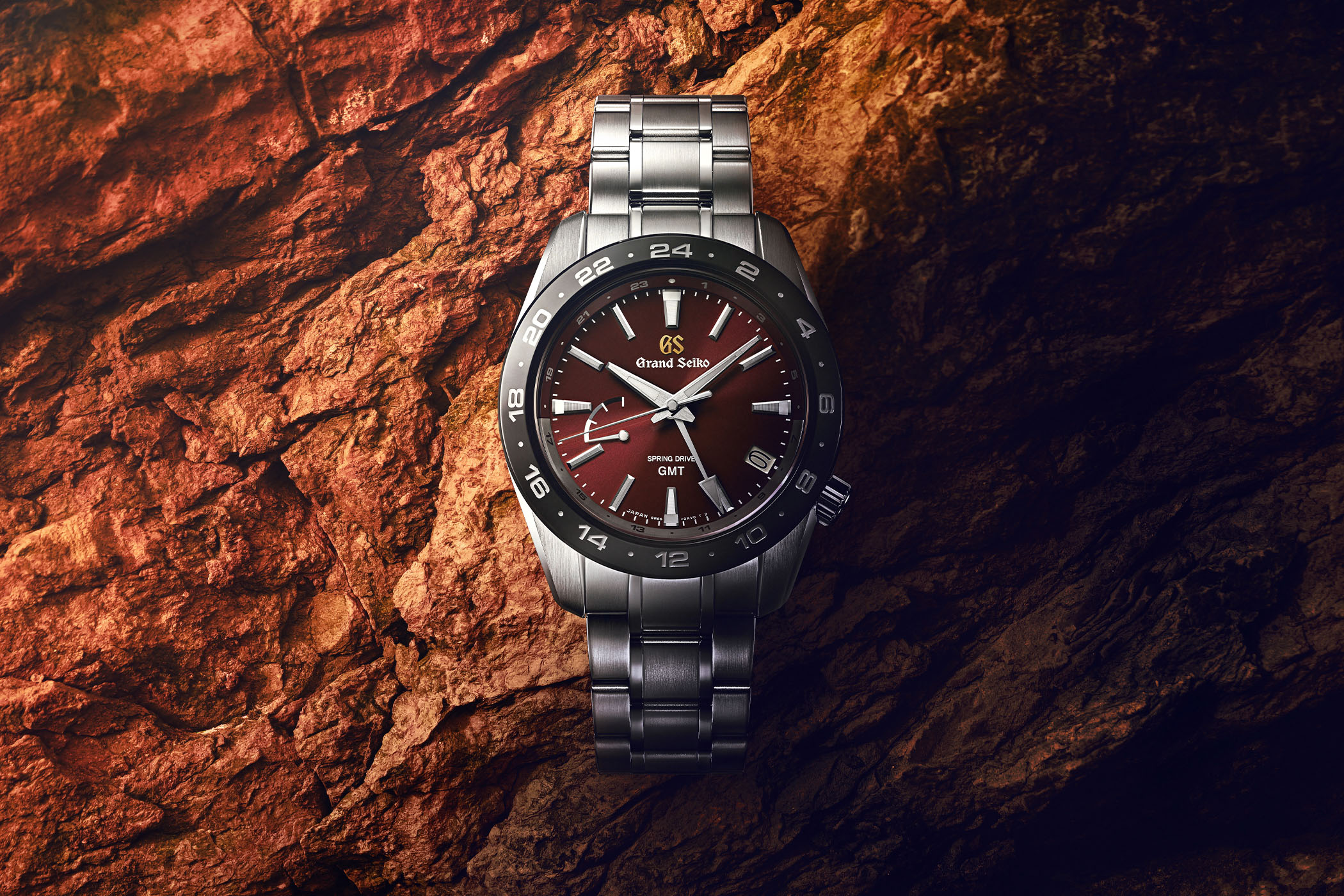
Grand Seiko’s debuted its first-ever Spring Drive movement in 2004 with the cal. 9R65. Now the brand is marking 20 years of the 9R Spring Drive movement family with the Elegance Collection SBGY035 and SBGA499, both sporting striking red dials inspired by the sunlit autumn scenery around Mount Hotaka. Part of the Thin Dress Series, the SBGY035 is flat and elegant, with a domed, textured dial. On the other hand, SBGA499 employs the classic Grand Seiko case and bracelet, matched with a sunburst-brushed dial in red that has the signature Spring Drive power reserve indicator at eight o’clock. The SBGA499 Initial thoughts I am a Grand Seiko fanboy. The brand offers a strong value proposition across its catalogue. Furthermore, Spring Drive is synonymous with Grand Seiko. The hybrid approach of Spring Drive means it boasts quartz-level accuracy despite being having an entirely mechanical mainspring and gear train. The new pair are perfect representations of Grand Seiko’s approach to horology, both good and bad. The two watches are striking, especially since red isn’t a colour often employed by Grand Seiko. The SBGY035 in particular stands out since the textured red dial is uncommon for Grand Seiko and dress watches in general. The SBGY035 That said, Grand Seiko’s limited editions feel too frequent, especially since many are only colour variations of each other. This is a regular criticism of Grand Seiko, but it hasn’t dampened sales of such limited editions, which pro...

Alarm Watches: A Complete Guide to the Most Underappreciated Watch Com Teddy Baldassarre
Sep 4, 2024

Alarm Watches: A Complete Guide to the Most Underappreciated Watch Com

If we're ranking watch styles by everyday practicality, it's hard to beat the alarm watch. Most of us are regularly needing reminders of appointments, events, and other commitments, and to have the source of such audible alerts right on your wrist, rather than buried in a pocket or a handbag, would seem to be the height of practicality even in today's high-tech world. Around the middle of the 20th Century, many watchmakers agreed and began to embrace the style, but alarm watches never achieved anywhere near the widespread popularity of other complications like chronographs and GMTs. Nevertheless, the alarm watch has played a significant role in horological history, and a handful of important brands have not only been instrumental in its creation and development but continue to rely on it as a major pillar of their collections today. Here is the story of how the mechanical alarm watch came to be, how it became a signature style of certain watchmakers, and how it continues to evolve today despite its niche status in the industry.  Johannes Dürrstein, regarded as the inventor of the alarm watch  Watches with alarm functions go back farther into horological history than most probably realize. Johannes Dürrsstein, a watchmaker in Glashütte, Germany, invented the first mass-produced, alarm-equipped pocket watch caliber in 1900. Dürrstein’s invention used an extra-long mainspring that could fuel both the timekeeping and the independent alarm hand, which was activated by a...

(Video) Incredible Watch Engineering from a Brand You Need to Know – Armin Strom Gravity Equal Force Worn & Wound
Armin Strom Gravity Equal Force Aug 1, 2024

(Video) Incredible Watch Engineering from a Brand You Need to Know – Armin Strom Gravity Equal Force

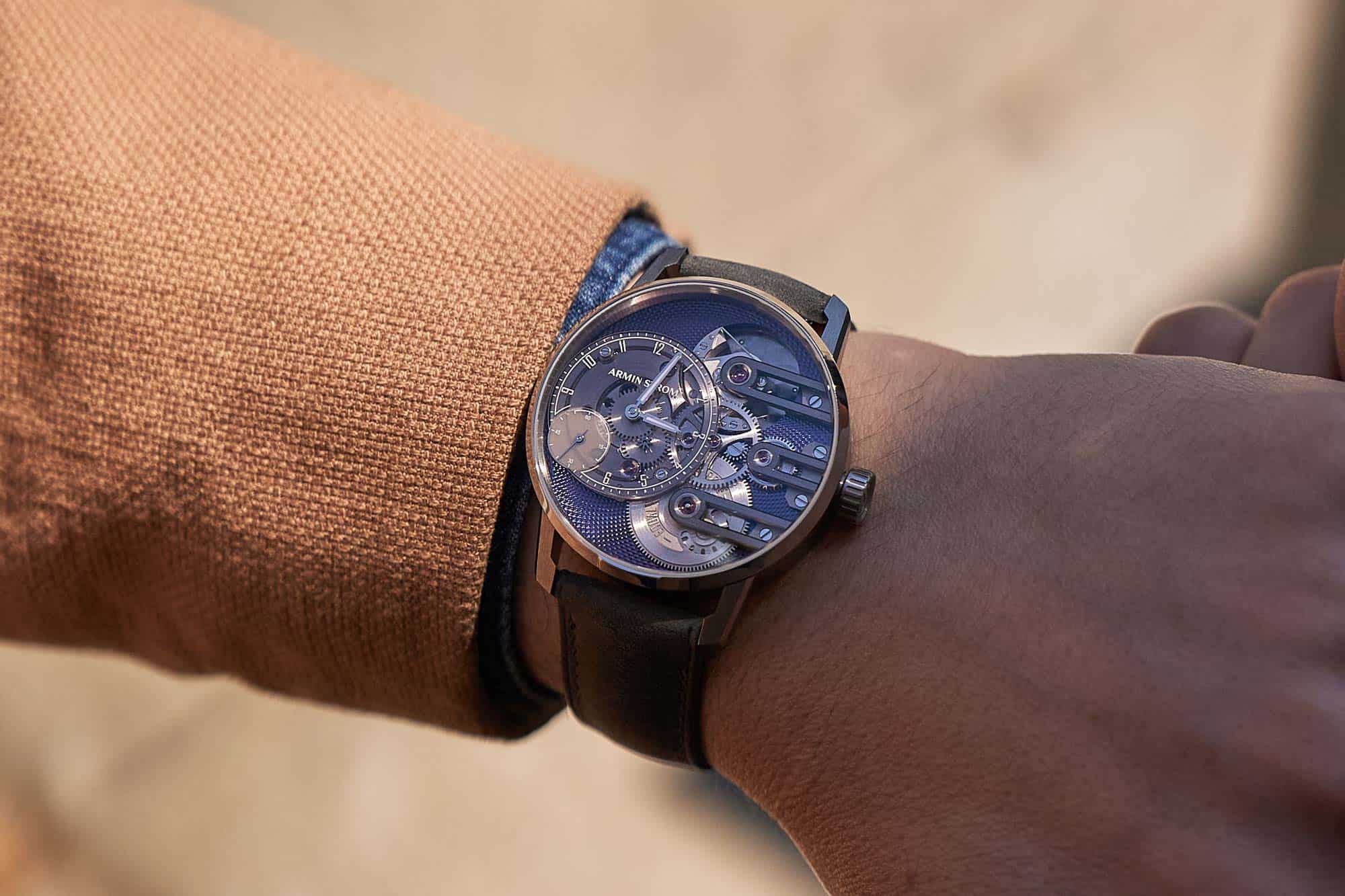
The Armin Strom Gravity Equal Force is not like other watches. At a glance, it clearly doesn’t look like them, but more importantly, it also works a bit differently too, featuring a first in watchmaking. To be clear, it still tells time with three hands, is operated by a crown, and has all of the movement components one expects to find on a watch, from a mainspring to an escapement. But it hides a very cool secret. Something that sets it apart. Hidden within is a little mechanism that helps it be more accurate. It’s not a complication, per say, as it doesn’t add any functions beyond time-telling, rather, it makes for a better watch. The Gravity Equal Force is one of a small handful of watches that attempts to address a fundamental issue with mechanical timepieces: variations in accuracy across their power reserves due to changing torque. As the power reserve diminishes, the torque, or force, decreases, the amplitude of the escapement falls, and the timekeeping becomes less accurate. Watchmakers have addressed this issue in various ways over the last few hundred years, which are often grouped together and referred to as “constant force” mechanisms. The Gravity Equal Force uses a simple, though uncommon, mechanism compared to typical “constant force” systems such as fuseé, chains, and remontoirs called a Geneva or Maltese cross. This mechanism prevents the watch mainspring from unwinding to the point where the torque and, thus, the accuracy really drop off. Ho...

Explained: The Detent Escapement SJX Watches
Breguet s natural escapement May 8, 2024

Explained: The Detent Escapement

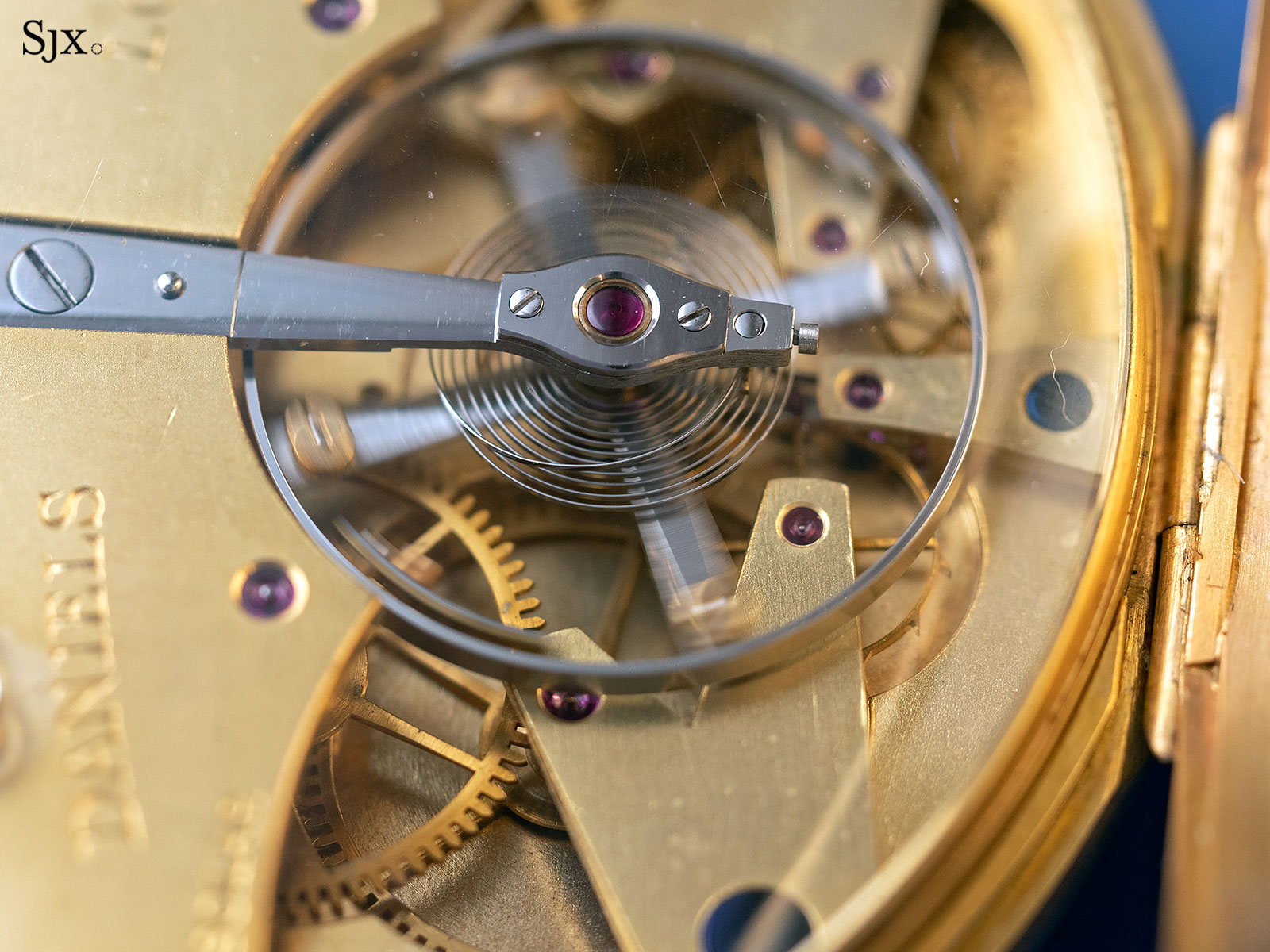
Among the many different escapement types, one in particular stands out, the detent escapement. Taking its name from détente, French for “trigger”, this system is often considered to be the purest type of escapement due to its efficiency and virtually lubrication-free operation. Any sort of mechanical clock or watch requires an escapement, a mechanism that transfers torque from the power source to the regulating organ. The escapement bridges the steady rotation of the gears in the going train and the oscillation of the balance. As a result, the escapement fulfils a double function, both maintaining the swing of the balance and regulating the discharge speed of the mainspring and going train. The detent escapement was invented in the second half of the 18th century,  somewhat simultaneously but independently by the English watchmakers Thomas Earnshaw (1749-1829) and John Arnold (1736-1799). A somewhat similar escapement was prototyped by the Frenchman Pierre Le Roy (1717–1785) some three decades earlier, but the modern detent escapement is derived mostly from Earnshaw’s design. Initially, the escapement was conceived for use in marine chronometers, explaining why it is also known as a chronometer escapement. The chronometer escapement also inspired many innovative subsequent escapements, like the Breguet’s natural escapement, the Robin escapement, and the Daniels co-axial. Drawings of detent escapement types taken from ‘The Marine Chronometer: Its History and ...

Explained: Barrels, Mainsprings, and the Trade-off Between Power Reserve and Energy SJX Watches
Mar 8, 2024

Explained: Barrels, Mainsprings, and the Trade-off Between Power Reserve and Energy

Every mechanical watch employs at least one mainspring barrel as its energy source. When a watch is wound, the coils of the mainspring tighten, storing potential energy which is then slowly released through the gear train to the escapement. The mainspring is enclosed in a toothed barrel, essentially a drum covered by gear teeth. As a result the barrel is often considered to be the first wheel of the going train.  Although one is the norm, two or even more barrels can be employed, typically to generate more energy. Double barrel movements usually feature two mainsprings kinematically linked in one of two ways: in parallel or in series. The number of mainsprings, energy stored, and power reserve are illustrated with equations (1), (2), and (3): As described by equation (1), the energy of a single barrel E is a function of its torque, angular discharge velocity and running time (autonomy). Linking two identical barrels naturally means having twice the energy, so 2E. By convenient association, equation (2) exploits the available energy to double the torque sent to the gear train, while equation (3) takes advantage of the total energy by doubling the running time.  Parallel barrels The parallel arrangement of barrels embodies equation (2), which delivers twice the torque, increasing the energy available to run the movement (but not increasing the running time). Here two barrels unwind at the same time on a centre pinion connected to a second mobile of the going train. An embo...

Farer Updates their World Timer Collection Worn & Wound
Farer Updates their World Timer Feb 26, 2024

Farer Updates their World Timer Collection

Introduced in 2019, Farer’s World Timer series has continued to garner attention for the brand and has become one of their most popular collections to date. Between a nearly pitch-perfect design for the dial and the impressive central rotating 24-hour disc and a bidirectional internal bezel, the wearer has the ability to read 24 time zones simultaneously.  Now, the Britain-based company has released a new iteration of the World Time collection, each with notable enhancements, reintroducing favorites like the Roché and Markham alongside the introduction of the all-new Foxe model in a striking green hue. Those familiar with the collection’s previous design will notice updated hour and minute hands, adopting a sleeker alpha shape to complement the watches’ aesthetics. Moreover, adjustments to the rotating bezel showcase city replacements: Chicago has replaced Mexico City, Beijing has replaced Hong Kong, and lastly, Paris has been replaced by Bienne to mark where the World Timers are produced. Less conspicuous is the update to the World Time’s movement. The collection now houses a customized version of the Sellita SW330-1 movement, specifically tailored to accommodate a rotating 24-hour disc instead of a traditional GMT hand. This modification, along with an upgraded mainspring, extends the power reserve to an impressive 50 hours.  As mentioned, three color options are available for this update. One can choose between Roche, Markham, and Foxe.  The Roché model com...

Five Analog Quartz Watches That Prove The Snobs Wrong Fratello
Feb 12, 2024

Five Analog Quartz Watches That Prove The Snobs Wrong

As watch lovers, we tend to be drawn to mechanical movements. There is something mysterious about the dozens of springs, wheels, pinions, jewels, screws, and plates that conspire to unwind a mainspring and turn its stored tension into a precise display of the time. I think the allure is in the fact that it is […] Visit Five Analog Quartz Watches That Prove The Snobs Wrong to read the full article.

Introducing – The Grand Seiko Sport Spring Drive GMT SBGE305 honours Caliber 9R 20th Anniversary Monochrome
Grand Seiko Sport Spring Drive GMT Feb 5, 2024

Introducing – The Grand Seiko Sport Spring Drive GMT SBGE305 honours Caliber 9R 20th Anniversary

This year marks the 20th anniversary of Grand Seiko‘s introduction of the 9R movement, featuring its revolutionary Spring Drive technology. The concept, conceived in the 1970s and which took decades to implement, aimed to blend the force of a mainspring with electronic watchmaking technology and surpass the precision of conventional mechanical watches. Now, 9R-family calibres […]

Hamilton Ventura and Elvis: A Comprehensive Guide and History Teddy Baldassarre
Hamilton Jan 30, 2024

Hamilton Ventura and Elvis: A Comprehensive Guide and History

One of the most enduring associations between a world-famous star and a legendary timepiece is the one between Elvis Presley and the world's first electric watch, the Hamilton Ventura. A bold horological gamble when it debuted in 1957, the Ventura is now a mainstay of Hamilton's sprawling portfolio of watch families, and the influence of the King of Rock 'n' Roll on its modern incarnations continues to this day. Read on to discover more about the Ventura and the musical icon who made it famous. Origins: The World’s First Electronic Watch (1957) Founded in Lancaster, Pennsylvania in 1892, during an era in which the United States was a world leader in timepiece production, the Hamilton Watch Company has played a key role in American watchmaking and innovation throughout the 19th and 20th Centuries - even though the company itself migrated its production to Switzerland in 1969 and became part of the Swiss Swatch Group in 1984. By the early 1950s, Hamilton joined other watchmakers, in the United States and around the world, in the quest to conquer the newest frontier of portable timekeeping – making a wristwatch with a fully electric movement.  It was Hamilton’s U.S.-based competitor, Elgin, which originally took the lead in such a project, along with the family-owned French watchmaker Lip. Elgin’s “Watch of Tomorrow,” which was unveiled as a prototype in Chicago on March 19, 1952, was powered by Caliber 725, a movement with no mainspring or winding mechani...

Girard-Perregaux Introduces the Neo Constant Escapement for Only Watch SJX Watches
Girard-Perregaux Introduces Jul 6, 2023

Girard-Perregaux Introduces the Neo Constant Escapement for Only Watch

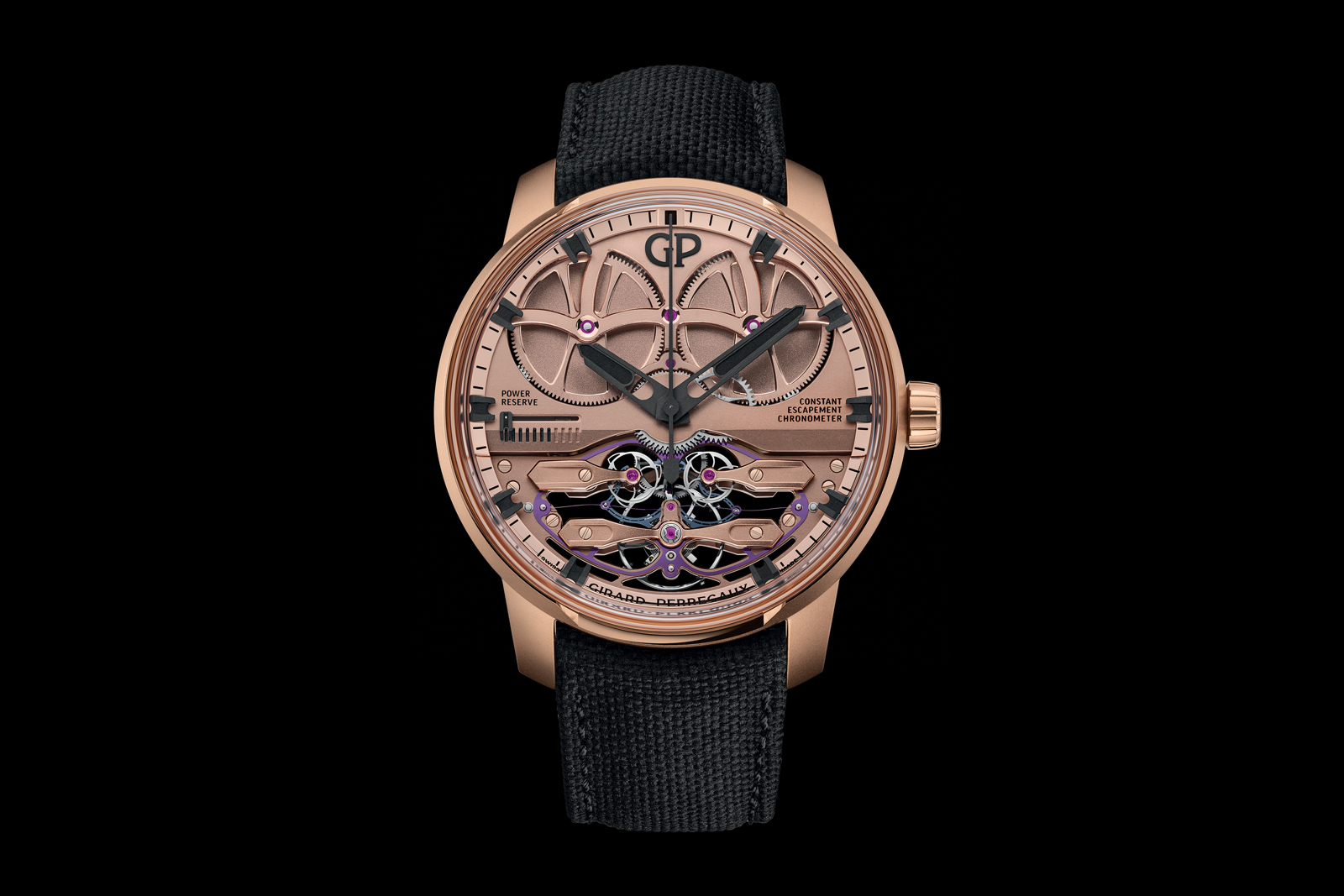
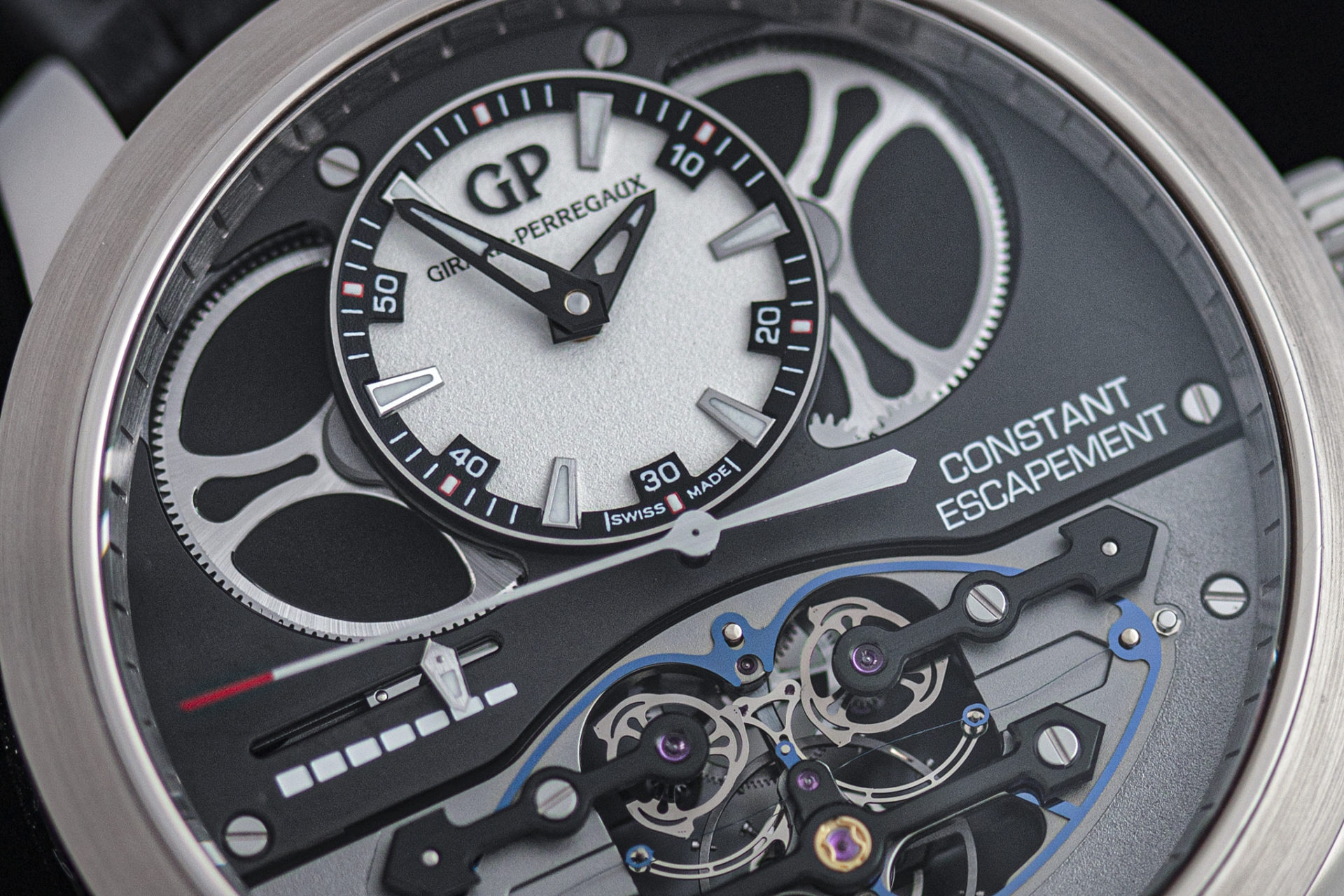
A regular participant at Only Watch, Girard-Perregaux’s latest contribution to the charity auction, the Neo Constant Escapement Only Watch 2023, revisits its innovation constant-force escapement. Girard-Perregaux (GP) first unveiled the Constant Escapement in 2013 as a wristwatch with a unique, dual-wheel escapement with an integral constant-force silicon buckling spring. Ten years on, the Neo Constant Escapement is a revamp of the original concept with incremental upgrades to the mechanism. Initial thoughts The Neo Constant Escapement (NCE) is not merely a rehash of the original. It is a technical evolution, which is at the very minimum an academically interesting take on an already exotic escapement. The Only Watch edition is dressed in predominantly monochromatic livery with a pink gold case and movement bridges – even the mainspring barrels are pink gold. The generous use of pink gold might be polarising, which arguably makes it perfectly suited as a one-off piece that will inevitably find an eager buyer at the auction. In the grander scheme of things however, the NCE Only Watch edition marks the beginning of GP reviving the Constant Escapement. Even by today’s standards of advanced tech in watchmaking, the Constant Escapement is an integrated design comprised of a double-wheel escapement with a remontoir spring, making it an escapement unlike any other. It is admirable that the escapement has been updated for better reliability, while preserving its original ide...

Insight: What’s Next for the Girard-Perregaux Constant Escapement? SJX Watches
Girard-Perregaux Constant Escapement? Jun 27, 2023

Insight: What’s Next for the Girard-Perregaux Constant Escapement?

In an era of modern and accessible digital technology, the utilitarian role of mechanical timekeepers has inevitably dwindled. Yet, it is still pursued as a luxury of an artform – either of the highest finishing by hand that can’t be performed by machines, or the research and development in making a mechanical timepiece – in particular wristwatches – as accurate as possible.  One of these horological pursuits, to preserve the accuracy of mechanical wristwatches, is the supply of a constant force to the escapement. To isolate the varying torque as a mainspring gradually unwinds, some haute horlogerie watches today incorporate either a fusée-and-chain or a remontoir, which supplies a steady torque to the escapement for stable timekeeping.  However, there is one particularly novel take on constant force released by Girard-Perregaux, in the form of a proprietary escapement. First unveiled as a prototype in SIHH 2008, the Girard-Perregaux Constant Escapement has a patented, double escape wheel system that is designed from the ground up to inherently have a built-in constant force system, thus eliminating the need of a remontoir or a fusée-and-chain.   Despite being first created 15 years ago, Girard-Perregaux (GP) is still further developing the escapement today, with a new set of patented improvements publicly available – strongly hinting at a revamped model in the near future. These patents make it worth a deep dive into the original Constant Escapement (CE) fr...

[VIDEO] The Freak Gets an Edit, The Curious Ulysse Nardin Freak X Reviewed Worn & Wound
Ulysse Nardin Freak X Reviewed Ulysse Jan 30, 2023

[VIDEO] The Freak Gets an Edit, The Curious Ulysse Nardin Freak X Reviewed

Ulysse Nardin is a peculiar brand. They have long been at the forefront of horological innovation, from marine chronometers in the 19th century, to creating stuff like DIAMonSIL in the 21st. However, they lack a singular, cohesive aesthetic that’s coalesced in broader culture in the same way watches like the Speedmaster, Submariner, or Royal Oak have. Except for a watch called the Freak, that is. A concept first released upon the world in 2001, the Freak was as impressive technologically as it was shocking to behold. With a movement that pivoted on itself to display the time, it was (and remains) daring, innovative, and downright novel. But, it never quite enjoyed a ‘hip status’ in the same way other exotic watches from the likes of MB&F; or Urwerk have since. This is likely due to a few reasons, but with the release of the Freak X in 2019, Ulysse Nardin is a whole lot closer. The Freak is a watch that has always commanded attention, both technically and visually speaking. The concept placed the gear train atop the mainspring, within a carousel that itself served as the minute hand. There was no dial to speak of, but rather a rotating plate containing the hour hand underpinning the structure. Winding and setting was managed via the deeply scalloped, somewhat steampunk-ish bezel unit. The launch of the Freak also marked the very first appearance of silicon within a watch movement, something the brand has been a pioneer of developing. This is a dramatic watch to behold ...

The Three Watch Collection for $5,000: Reader Edition – Vincent Deschamps Worn & Wound
Jan 13, 2023

The Three Watch Collection for $5,000: Reader Edition – Vincent Deschamps

Editor’s note: In our first Three Watch Collection for $5,000 of 2023, reader and fellow watch writer, Vincent Deschamps of Mainspring.Watch brings us a trio of classics from some of our favorite small independent brands. There’s a lovely and unique balance to these three watches and it’s one of the most creative we’ve come across yet.  You can make your submission to the Three Watch Collection – Reader Edition by filling out the form right here. It wasn’t until I thought of submitting my ideas for a three-watch collection for $5,000 that I imagined myself as someone who could have a three-watch collection. While I tend to only wear the same watch everyday (the Lorier Falcon III,) I do see the massive benefit of having other watches for different purposes. As an enthusiastic support of independent watchmaking, below you will find my selection for a three-watch collection below. Each watch fulfills a particular need and use case and I believe each one does it quite well. Lorier Falcon Mark III – $499 At the top of my list is the Lorier Falcon Mark III released in late 2022, the archetype everyday sports watch. I’m a sucker for watches that can do 100% of what I need 95% of the time, and that’s what the Falcon is to me. It comes with a solid build, good specs, and an elegant figure that makes it work in most situations I find myself in. And it’s quite affordable coming in at $499. There are two things about this watch that make it work so well for me: it...

What are the Different Types of Watches? A Comprehensive Guide Teddy Baldassarre
Oct 27, 2022

What are the Different Types of Watches? A Comprehensive Guide

To a newcomer, deciphering the world of timepieces can be an intimidating endeavor, and identifying the different types of watches presents a particular challenge. What distinguishes, say, a dive watch from a pilot watch, a quartz watch from a mechanical watch, a dual-time watch from a world timer? What are all those subdials and scales on the dial for? Do I need to change the date on my watch, and if so, how often? In this rundown of the various types of watches, we strive to answer the big questions (and/or link to another article that does).  Quartz vs. Mechanical vs. Automatic While watches vary widely in their styles, genres, and capabilities, they all fall into one of two major categories based on the type of movement inside them. Generally, with a few notable exceptions that we’ll touch upon, a watch is either “mechanical” or “quartz.” Mechanical watches further subdivide into two basic types: manually wound (or “hand-winding”), in which the user needs to periodically wind the watch via the crown to keep it working; and automatic (or “self-winding”), in which the movement’s mainspring is perpetually wound by an oscillating weight that swings with the natural motions of the wearer’s wrist. On the other hand, a quartz movement (as explained much more thoroughly in this article), replaces the mechanical movement’s traditional mainspring barrel with a small battery whose electrical charge passes via an integrated circuit into an oscillating tuni...

In Depth: Ulysse Nardin Freak S SJX Watches
Ulysse Nardin Freak S Utterly bizarre Aug 25, 2022

In Depth: Ulysse Nardin Freak S

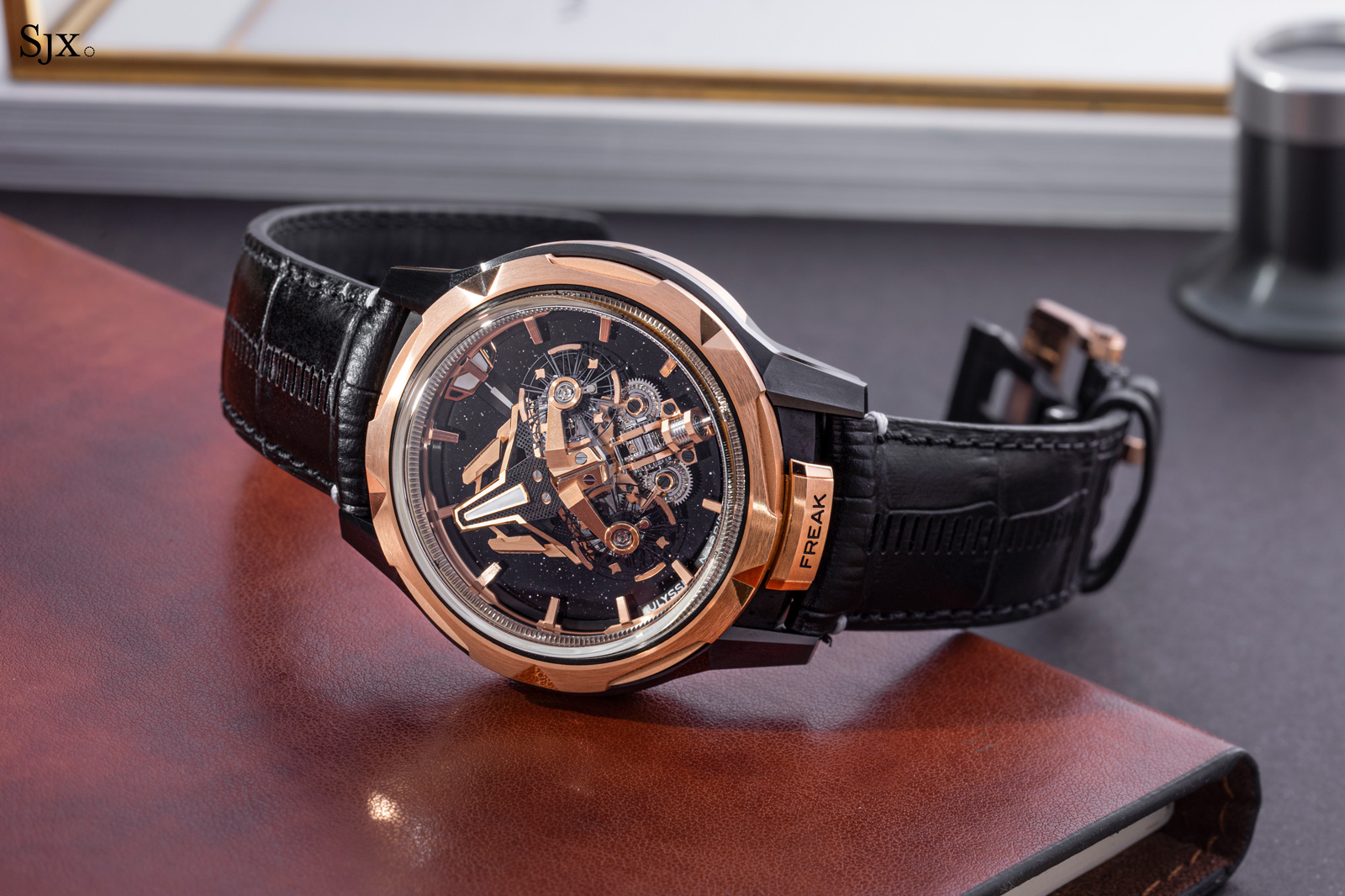
Utterly bizarre and thoroughly ingenious when it debuted in March 2001, the Freak remains avant-garde even two decades later. But unlike the highly modern creations from brands like De Bethune and Urwerk, the Freak arguably gets less credit than it deserves, simply because Ulysse Nardin isn’t a niche, independent watchmaker. But that takes nothing away from the concept, which has been made more avant-garde than ever. Launched earlier this year, the Freak S is now the flagship model in the Freak line-up. In a first for a Freak, it reimagines the trademark carousel display, which now carries twin inclined balance wheels linked by a differential. Initial thoughts The landmark creation of the modern-day Ulysse Nardin (UN) brand, Freak was and still is interesting because it turns conventional movement construction on its head. Most of the moving parts are mounted onto a carousel on the dial that doubles up as the minute hand, while under the dial sits a massive mainspring that occupies most of the case volume. No other watch combines unorthodox form and function like the Freak even though it was launched in 2001, well before most of today’s best known avant-garde timepieces. That was four years before Urwerk unveiled its satellite-cube hour display, for instance, ensuring the Freak’s place as a pioneering creation. The Freak S (left) and the original Freak from 2001 While the essence of the Freak has been mostly retained over the various iterations since its launch, ...

Ulysse Nardin Introduces the Freak S SJX Watches
Ulysse Nardin Introduces Apr 2, 2022

Ulysse Nardin Introduces the Freak S

Perhaps a sleeper hit of Watches & Wonders 2022, the Ulysse Nardin Freak S is an intriguing evolution of the brand’s trademark watch that makes its debut just as Ulysse Nardin has become an independent brand. The Freak S is equipped with twin balance wheels, but mounted on a central carousel as is de rigueur for a Freak. Initial thoughts The first twin-balance watch from Ulysse Nardin, the Freak S is perhaps the coolest iteration of the model since its inception in 2001. It has come a long way since the original, having been obviously enhanced in both style and performance. While its most obvious feature are the double balances, the Freak S also includes several details that enthusiasts will appreciate. For starters, it is a purebred Freak. Like the original, it does without a conventional dial, hands, and crown. In comparison, some of the more recent Freaks are more conventional in their execution. Thanks to double balances linked by a differential, the carousel is more striking than ever, while promising improved timekeeping. At the same time, the brand’s proprietary “Grinder” system means the Freak S is self-winding, eliminating the hassle of manually winding the huge mainspring via the notched back. Twin balances with a differential The overarching theme of a Freak is a movement that stands out, literally. The movement sits on three levels – carousel, barrel, and winding system, all arranged one over the other. Most of the movement, including the oscillat...

Cartier Introduces the Masse Mystérieuse SJX Watches
TAG Heuer Mar 30, 2022

Cartier Introduces the Masse Mystérieuse

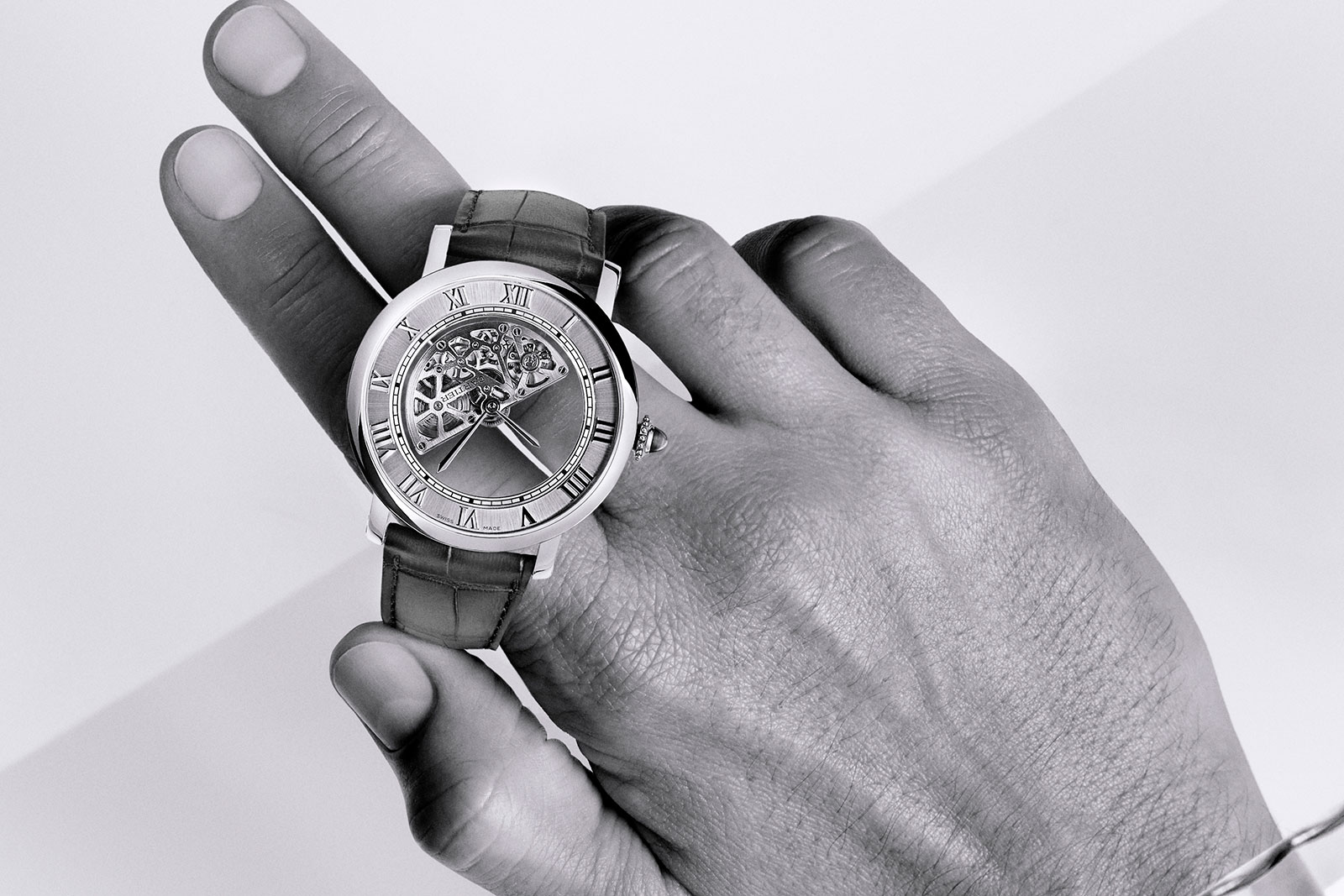
Cartier’s wide-ranging new launches at Watches & Wonders 2022 naturally encompasses new takes on its historical designs, including the Tank Chinoise and lacquered Santos-Dumont. But its most extraordinary creation stands apart from the brand’s contemporary timepieces. The Masse Mystérieuse is essentially a floating movement within an oscillating weight. As the weight oscillates around the central axis of the dial, it winds the mainspring contained within itself. Initial thoughts Cartier abandoned its once ambitious push into highly complicated watches when its current chief executive Cyrille Vigneron took charge in 2016. Mr Vigneron has stated publicly on several occasions that Cartier should not stray from its historical strength in simple, elegant watches in unusual forms. So the Masse Mystérieuse is definitely atypical, but that doesn’t take away from its fascinating mechanics. The complexity and creativity of its mechanics bring to mind an earlier era of Cartier watchmaking. While Cartier states that the Masse Mystérieuse was eight years in the making, it doesn’t mention who was responsible for the idea. It goes without saying that is was Carole Forestier-Kasapi, the former head of development at Cartier’s manufacture who now has the same role at TAG Heuer. The Masse Mystérieuse is instantly recognisable as her work, appearing to be evolved from the Astrotourbillon. Ingenious as it is, the Masse Mystérieuse is also similar to Ms Forestier-Kasapi’s pa...

Jaeger-LeCoultre Introduces the Reverso Tribute Minute Repeater SJX Watches
Jaeger-LeCoultre Introduces Oct 7, 2021

Jaeger-LeCoultre Introduces the Reverso Tribute Minute Repeater

Debuted exactly 90 years ago a sports watch, the Jaeger-LeCoultre Reverso is famous for its swivelling case that was meant to protect the crystal. But in the modern day, the Reverso has paradoxically evolved into brand’s signature dress watch, as well as a canvas for assorted complications and artisanal decoration. The latest 90th anniversary model falls into the former category – the Reverso Tribute Minute Repeater is highly complicated, with its mechanics visible on two open-worked faces: the chiming mechanism revealed on the front and the base movement on the reverse. The front (left) with the repeater revealed, and the back showing the hand-wind calibre Initial thoughts The Reverso Tribute Repeater is an example of smart engineering and design, executed in a way that is possible only with the Reverso’s two faces. Notably, doing away with a solid dial is actually a technical necessity (more on that later), rather than mere vanity, but it leaves the watch looking as impressively complicated as it is. Though a modular repeater, its repeating mechanism is no ordinary example, but instead incorporates two proprietary innovations that compound to produce louder chimes, namely the extra-large hammers and the gongs that are located as close to the wearer as possible – they are attached onto the front crystal, hence the absence of the dial. Upon activation, the slider on the left winds up the mainspring at six o’clock, which unwinds to power the repeater That said, t...

Bell & Ross Introduces the BR 05 Skeleton Nightlum SJX Watches
Bell & Ross Introduces May 17, 2021

Bell & Ross Introduces the BR 05 Skeleton Nightlum

Very much the fashion of today, sports watches with integrated bracelets have proliferated rapidly at every level of the price spectrum. At the more accessible end is the Bell & Ross BR 05 launched two years ago and now available in three formats: time-only, chronograph, and skeleton. Continuing a glow-in-the-dark theme established by several recent models, Bell & Ross (B&R;) now unveils the BR 05 Skeleton Nightlum. Legible in the dark Initial thoughts Though the BR 05 was contentious because of its design, I’m a fan. The square case – with perfectly aligned bezel screws – evoke B&R;’s signature watches like the BR 01 and BR 03, making the BR 05 instantly recognisable. And it is executed well, with strong finishing on the case and bracelet considering the price. The most striking BR 05 model is arguably the skeleton variant, and that remains true with the BR 05 Skeleton Nightlum. Revealing most of the movement, including key bits such as the balance wheel and mainspring, the skeleton is a good looker. The BR 05 Skeleton Nightlum to be more attractive than its predecessors, including last year’s iteration in blue. It has a tactical feel thanks to the all-black movement, bringing to mind the recent BR 03 Diver Military and feels true to the brand’s history of watches for military and police personnel. Notably, the new Skeleton Nightlum has a clear dial, in contrast to the blue-tinted dial found on last year’s Skeleton Blue. The clear finish gives the Sk...

Sinn Introduces the R500 Chronograph SJX Watches
Sinn Introduces Nov 11, 2020

Sinn Introduces the R500 Chronograph

Famous for its no-nonsense “tool” watches, some of which are supplied to the German military and law enforcement, Sinn’s latest debut is slightly different. Inspired by auto racing, the R500 chronograph is a watch that shows the brand can have some fun, while being properly functional. Modelled on a funky chronograph Sinn produced in the 1970s, the R500 is a “bullhead” chronograph, with the twin pushers positioned like horns at one and 11 o’clock. While the style very much evokes the 1970s, the R500 is built like a robust modern wristwatch, with titanium case rated to 200 m that’s resistant to extreme low and high pressures. Initial thoughts Radically different from Sinn’s usual fare of pilot’s or military-style watches, the R500 is arguably the most interesting watch amongst the brand’s recent releases. It’s recognisably 1970s in style, but with a clean dial design that avoids the “exotic” dial found on the vintage original, which was a typically 1970s feature that can look dated today. A notable element of the dial design is the power reserve indicator at 12 o’clock, which seems unnecessary for an automatic watch. But German rally champion Peter Göbel, speaking during a video interview for the launch of the R500, noted that a fully-wound mainspring is crucial before starting a race – since the chronograph can be used to time laps – so it is useful in that context. And it’s also unusual against the broader landscape because “bullhea...

MB&F; HM10 Bulldog: Forget The Dog, Beware Of The Owner (Video) Quill & Pad
MB&F; Sep 20, 2020

MB&F; HM10 Bulldog: Forget The Dog, Beware Of The Owner (Video)

Inspired by a bulldog, MB&F;’s Horological Machine No. 10 features a rounded, stocky body; the time display forms its eyes; and the stout legs form the lugs, hugging its owner fiercely and loyally. But what is more likely to attract your eye are the wildly canine jaws with teeth that open and shut according to the amount of tension in the mainspring. The Watches TV takes a close look (but not too close - woof!).

In-Depth: A History of the Pulsations Chronograph SJX Watches
Aug 3, 2020

In-Depth: A History of the Pulsations Chronograph

In 1816, Louis Moinet accomplished a first in watchmaking: a timepiece that could precisely track elapsed time. Measuring periodicity on demand had been accomplished before, but the French watchmaker’s invention gave it the functionality and exactness that we expect today. In assessing prototypes, we often tend to forgive their shortcomings and rosily reminisce, rewriting flaws as charms. Moinet’s timepiece, however, was a prescient opus. The layout of the dial had the now-familiar large central hand and elapsed time in subdials. Two pushers controlled the start, stop and reset functions, the power reserve lasted over 30 hours, and the mainspring could be wound while the timing mechanism was engaged to allow for longer timing runs. Most impressive, though, was its precision. Louis Moinet’s compteur de tierces of 1816. Image – Louis Moinet Named the compteur de tierces, or “timer of thirds”, Moinet’s invention ran at 216,000 beats per hour, measuring time down to one-sixtieth of a second. To allow for this ambitious exactitude to be utilised, the central chronograph hand completed revolutions once per second – such that the user could easily see which sixtieth of a second the period in question ended on - and the watch had an extra sub-dial for tracking elapsed seconds in addition to those for the minutes and hours. Whys and wherefores An impressive story, except that it’s missing something. Why did Moinet build it? And what did he use it to measure? A...

Oris Big Crown ProPilot X Calibre 115 Review WatchAdvice
Oris Big Crown ProPilot X Jun 18, 2020

Oris Big Crown ProPilot X Calibre 115 Review

The Big Crown ProPilot X Calibre 115 is simply a watch that explains Oris’s true personality. The Big Crown ProPilot X Calibre 115 goes back to the roots of what mechanical watches are all about. In today’s world, so many of us know what the things around us can do, but rarely actually know how they work.  The same logic applies to mechanical watches too. We see brilliant timepieces made and know what they can do, yet rarely see or understand the inner workings behind them. This is the idea behind the Big Crown ProPilot X Calibre 115, to show as much as possible how the true inner workings of a mechanical watch operate.  Oris Big Crown ProPilot X Calibre 115 There is almost a natural connection between a mechanical watch and its owner. If we don’t wind it, or even yet move, we won’t drive enough power to turn the mainspring which ultimately powers the movement. This is what Oris is trying to show with the Big Crown ProPilot X Calibre 115.   Oris Big Crown ProPilot X Calibre 115 Oris’s Big Crown ProPilot X Calibre 115 was inspired by nature, in particular, a Valley named Waldenburg, which surrounds the village of Hölstein. This particular village is significant to Oris, as it is there where the brand originally began. Oris was founded in 1904, and since then the brand has been based in Hölstein. It’s no wonder then that they would go back there to find sources of inspiration for arguably the “most Oris watch” they have ever made.  Oris Big Crown ProPi...

Jaeger-LeCoultre Introduces the New Master Control Collection SJX Watches
Jaeger-LeCoultre Introduces Apr 24, 2020

Jaeger-LeCoultre Introduces the New Master Control Collection

A mainstay of Jaeger-LeCoultre’s catalogue for almost three decades, the Master Control made its debut in 1992 and has been facelifted every couple of years since. Fresh off the press at Watches & Wonders 2020, the latest Master Control collection forgets the facelifts and is instead throwback to the inaugural line-up of three decades ago. The new range reproduces the models and style of the originals, including the popular, entry-level Master Control Date, but it also includes an all-new model, the Master Control Chronograph Calendar. From left: Master Control Date, Master Control Calendar, and Master Control Geographic And the Master Control Chronograph Calendar New tech, classic style While retaining the look of the originals, the new Master Control models are ever-so-slightly larger, now measuring 40 mm (while the 1990s originals were mostly 37 mm). More importantly, the new watches have been fitted with newly-upgraded movements equipped with silicon escapements. The cal. 899AA of the Master Control Date Though JLC has used silicon escapements in the past, most notably in the Master Compressor Extreme LAB 2 and the more recent Tourbillon Celeste, the movements in the new Master Control watches are the first affordable, regular-production models to feature such escapements. The use of silicon pallet levers and escape wheels, coupled with the use of new lubricants and a stronger and longer mainspring, means substantial improvements in operating efficiency, with power ...

Hands-On: Brivet-Naudot Eccentricity SJX Watches
Mar 30, 2020

Hands-On: Brivet-Naudot Eccentricity

French watchmaker Cyril Brivet-Naudot made his debut two years ago with the Eccentricity, a time-only watch that’s fascinating and impressive on many fronts. Not only is it almost entirely made by hand, the Eccentricity is intriguing in design and mechanics – from the overall architecture to details like the key-winding mechanism and regulator-style time display with a twist, and above all, the proprietary escapement. Just 29 years old, Mr Brivet-Naudot began working on the Eccentricity after graduating from the École Polytechnique Fédérale de Lausanne (EPFL), one of Switzerland’s best technical universities. Prior to that, he earned a diploma in watchmaking from the Lycée Edgar Faure in Morteau, a small town in eastern France that borders Switzerland. The school has gained a reputation for producing imaginative watchmakers, many pursuing a similar style that’s inspired by 19th century pocket watch movements, including Theo Auffret, a peer of Mr Brivet-Naudot. The result of three years of development, the Eccentricity is very much in the same vein as the watches produced by Mr Brivet-Naudot’s fellow graduates. It artfully combines a 19th century aesthetic sensibility with exotic features, including a novel, free-eccentric escapement, for which the watch was named. And it is built by hand: with the exception of the mainspring, hairspring, jewels and crystals, every component of the watch was made from scratch by Mr Brivet-Naudot, without the aid of CNC machine...

Jaeger-LeCoultre Introduces the Atmos Transparente SJX Watches
Jaeger-LeCoultre Introduces Dec 17, 2019

Jaeger-LeCoultre Introduces the Atmos Transparente

As crucial to Jaeger-LeCoultre’s identity as the swivelling Reverso wristwatch, the Atmos clock remains a unique and intriguing invention almost a century after its invention – a clock that runs on air. Having been offered in a variety of iterations over the years, including several by industrial designer Marc Newson, the latest is the Atmos Transparente, a clean, modernist reinterpretation of a longstanding model in the line-up. Despite being synonymous with Jaeger-LeCoultre, the Atmos was actually invented by someone else, who was inspired by a much older idea. Clocks wound by changes in atmospheric temperature were invented sometime in the 17th century, but remained largely experimental until French engineer Jean-Léon Reutter invented the Atmos in 1928. His idea was actually an evolution on the 400-day clock, which is regulated by an exceptionally slow pendulum and need only be wound once a year. The magic of air The genius of Reutter’s invention was a sealed metal bellows containing mercury, which expanded and contracted with changes in temperature, thus winding the clock’s mainspring. Despite its novelty, Reutter’s clock met with little commercial success – early Atmos clocks marked “J.L. Reutter” are rare but not especially valuable – leading him to sell the idea to LeCoultre in 1935 (and two years later the company joined forces with Edmond Jaeger to form Jaeger-LeCoultre). The company refined his concept, with the key improvement being the repl...