Watch brandsWatch wikiWatch videosVariousWatch calendarSaved articles
PopularRolexOmegaPatek PhilippeAudemars PiguetTudorGrand SeikoCartierSeikoIWCTAG HeuerBreitlingJaeger-LeCoultreA. Lange & SohneZenith

SJX Watches · Page 96

RJ Introduces the Arraw Spider-Man Tourbillon SJX Watches
Omega Oct 16, 2019

RJ Introduces the Arraw Spider-Man Tourbillon

Though RJ has long used pop culture icons – from Hello Kitty to Pokemon to Super Mario – on its watches, the Arraw Spider-Man Tourbillon is the most interesting to date, because it’s powered by a newly developed movement boasting a central flying tourbillon and a six-day power reserve. While earlier RJ cartoon- or comic-inspired were mostly standard watches with design tweaks, the new tourbillon modelled on Marvel’s web-slinger is mechanically interesting on several levels. The Arraw Spider-Man Tourbillon is powered by the RJ-7000, a hand-wound movement that, according to the brand, was developed in-house at its recently opened manufacture in Eysins, about 30 minutes from downtown Geneva. More notably is the fact that the concept of the movement was first developed by RJ chief executive Marco Tedeschi while he was studying micro-technical engineering at the École Technique de la Vallée de Joux (ETVJ). Central tourbillon The movement is fully skeletonised, with the large flying tourbillon sitting right in the centre. Though conventional tourbillons are extremely common, central tourbillons are notably uncommon. Only a few brands produce them, most notably Omega and Beat Haldimann, and now RJ. Open-worked to resemble a spider’s web, the tourbillon cage is made of titanium, and sits just over a pair of eyes taken from Spider-Man’s mask. Because the tourbillon sits right in the centre of the dial, the hands are are peripheral, sitting on the edge of the dial, b...

Breitling Introduces the Revamped Avenger Collection SJX Watches
Breitling Introduces Oct 16, 2019

Breitling Introduces the Revamped Avenger Collection

Launched by Breitling almost two decades ago as an upsized, sportier version of the then bestselling Chronomat, the Avenger has just been revamped into a streamlined collection made up of facelifted watches. Still retaining the styling of earlier generations of Avengers, the line is now made up of chronographs in three sizes (48mm, 45mm and 43mm cases), automatics in 45mm or 43mm cases, and a GMT. All models are rated to 300m and have a stainless steel case as standard. But the 45mm and 48mm watches are available in Night Mission livery – the best looking iteration – which means a black-coated titanium case and dial featuring military-inspired “stencil” numerals. Super Avenger Chronograph 48 Night Mission All the chronographs have the same basic specs, and the same COSC-certified Valjoux 7750 movement. The flagship model is the Super Avenger Chronograph 48, an enormous 48mm watch that’s probably too big for most, making the 45mm and 43mm chronographs more viable. The best looking watches of the line is the Avenger Chronograph 45 Night Mission, which manages to have a more modern military style that’s distinct from most other military aviation-type watches. Breitling ambassador and retired astronaut Scott Kelly The Average Automatic 45 Seawolf is a 45mm dive watch, powered by the Breitling Calibre 17, which is an ETA 2824. The specs are shared by the Avenger Automatic 43 that’s 43mm. Avenger Automatic 45 Seawolf And the last model is the Avenger Automati...

Breaking News: SIHH Will Now Become Watches & Wonders Geneva SJX Watches
Breitling also decided Oct 16, 2019

Breaking News: SIHH Will Now Become Watches & Wonders Geneva

From 2020 onwards, the Salon International de la Haute Horlogerie (SIHH) will be known as Watches & Wonders Geneva, adopting the name of an event that first started in Hong Kong before migrating to Miami in the wake of the slowdown in the Chinese territory. Last year’s shock announcement by industry giant Swatch Group that it would depart Baselworld permanently set up off chain of events: a botched response that led to the resignation of the chief executive of the fair’s organiser MCH Group, and then a full-year loss for MCH. Some prominent brands like Breitling also decided to leave Baselworld, though the giants, like LVMH and Rolex, have opted to stay. Since then Baselworld’s new management has announced a flurry of new initiatives and programmes, starting with Baselworld announcing it would unite with SIHH after a decade’s separation. It’s also revealed an unimpressive hotel deal and more recently, a concierge service for visitors. All of that seems to have compelled the Fondation de la Haute Horlogerie (FHH), the organiser of SIHH – a watch fair in healthy condition compared to Baselworld – to do something as well. And so they have, with the goal of making the event more consumer centric. Rebranded but pretty much unchanged Palexpo forever Despite the name change, the format of the event appears pretty much the same. The Salon with its 30 exhibiting brands will take place as it always has, at the Palexpo conventional hall beside Geneva airport, loca...

IWC Introduces the Pilot’s Watch Timezoner Chronograph “80 Years Flight to New York” SJX Watches
IWC Introduces Oct 15, 2019

IWC Introduces the Pilot’s Watch Timezoner Chronograph “80 Years Flight to New York”

IWC’s latest limited edition is a surprisingly small run – 80 pieces to mark the 80th anniversary of the flight of the giant Latécoère 521 flying boat Lieutenant de Vaisseau Paris from New York to Lac de Biscarrosse in Southwestern France. Starting on Bastille Day, July 14, in 1939, the flight was the first nonstop crossing of the North Atlantic by flying boat. A passenger on the 28-hour, 27-minute journey was French aviator Antoine de Saint Exupéry. And it happens that one of IWC’s most popular sub-collections of pilot’s watches watches is Le Petit Prince, named after the famous novel by de Saint Exupéry. So the Pilot’s Watch Timezoner Chronograph Edition “80 Years Flight to New York” is an offshoot of the Le Petit Prince collection, with a few tweaks. It retains the vaguely retro flavour, with Gothic-esque numerals and lozenge hands, but instead of the standard blue dial of Le Petit Prince, the anniversary watch has a brown metallic dial, matched with brown ceramic bezel. The edition is based on the Timezoner Chronograph, usually available only in the standard black and white livery of IWC’s basic Pilot’s Watches. It’s an unusual watch that combines both a flyback chronograph and IWC’s proprietary “timezoner” mechanism. Originally developed by the defunct watch brand Vogard, the timezoner mechanism has a rotating world time bezel linked to the second time zone, so turning the bezel moves the 24-hour hand in one-hour ste...

Ulysse Nardin Introduces the Hourstriker Phantom SJX Watches
Ulysse Nardin Introduces Oct 15, 2019

Ulysse Nardin Introduces the Hourstriker Phantom

A simple yet unusual chiming complication, the hourstriker has been a fixture in the Ulysse Nardin line-up for almost three decades, starting with the San Marco Jacquemart developed by Christophe Claret. The hour striker complication has been paired with various automatons over the years, including tigers, horses, oil pumpjacks, and a copulating couple. Now Ulysse Nardin has stripped away the automaton, streamlined the design, and reworked the acoustics – with help from French speaker specialist Devialet – resulting in the Hourstriker Phantom. It’s the brand’s sleekest and most contemporary hour striker to date, and according to Ulysse Nardin, the loudest chiming wristwatch in the world. High-end audio help Founded in 2007 by a trio of Frenchmen, who named the company after 18th century French engineer Guillaume Vialet, Devialet is most famous for its white, egg-shaped Phantom Premier speaker that is compact, powerful and fairly expensive. Most notably, one of its founders, designers Emmanuel Nardin, is a member of the Nardin family that once owned Ulysse Nardin. The Devialet Gold Phantom Opéra de Paris speaker Devialet’s contribution to the Hourstriker Phantom was to boost its sound, accomplished in two ways. The first element being the attachment of the gongs to the movement. In an ordinary striking watch, the gongs are fixed with screws. On the other hand, the Hourstriker Phantom has its gongs secured by “torsion arms”, presumably small springs. A...

Louis Erard Introduces the Regulator by Alain Silberstein (With Live Photos) SJX Watches
Louis Erard Introduces Oct 14, 2019

Louis Erard Introduces the Regulator by Alain Silberstein (With Live Photos)

Louis Erard has been around for some 90 years, but for much of that time the brand produced watches for other labels. A decade ago, shortly after new owners took over, Louis Erard began to move slightly upmarket with mechanical watches featuring proprietary modules. But most of its designs were plain or derivative. And so Louis Erard could have been just another brand making mostly anonymous looking watches. But recently Louis Erard recruited the talented Manuel Emch – best known for reviving Jaquet Droz and then running RJ-Romain Jerome until 2017 – as an advisor and suddenly things have brightened up – literally. Louis Erard has just announced the Alain Silberstein Regulator, a surprisingly affordable wristwatch created by the watch designer famed for his whimsical, Bauhaus-inspired style – captured here in photos taken by a Swiss collector for SJX (scroll to the bottom to read my thoughts on the watch after seeing them shortly after this was published). Since Mr Silberstein’s eponymous company went bust in 2012, he has created watches for MB&F; and RJ-Romain Jerome. Despite the diversity of the brands he has worked with, Mr Silberstein versatile yet distinctive style manages to ease into each brand’s house style. Illustrating the magic of Mr Silberstein’s creativity, the new watch is based on one of Louis Erard’s signature models, the Excellence Regulator, which is ordinarily available with a grained or guilloche silver dial featuring Roman numera...

Greubel Forsey Introduces the Entirely Hand-Made Tourbillon Watch SJX Watches
Greubel Forsey Introduces Oct 14, 2019

Greubel Forsey Introduces the Entirely Hand-Made Tourbillon Watch

The Hand Made 1 is a watch “95%” produced “using only hand-operated tools”, requiring some 6,000 hours, according to Greubel Forsey. That’s equivalent to three years of work, largely performed by a special team of watchmakers assembled by Greubel Forsey specifically for this project, along with independent specialists who produce certain components. Functionally, the Hand Made 1 is a straightforward timepiece – it shows the time, hours, minutes and seconds, and is equipped with a one-tourbillon regulator. The movement is made up of 272 parts, which is within the usual range for such a movement. The complexity of the watch comes from how it is made – by hand or by hand-operated tools – which is why only two to three examples will be produced per year. The genesis for the Hand Made 1 is the department within Greubel Forsey that produces prototypes, which are essentially one-off, hand-made watches. The same production techniques are applied to the Hand Made 1, except that they are taken to a far higher level, in order to create components that are produced with the same techniques as prototypes but to the same fit and finish as standard Greubel Forsey movements. So each screw is made on a manual lathe, and can take up to eight hours to complete. The case components are milled on a pantograph lathe, essentially a manually operated CNC machine that requires the operator to guide the cutting tool to by hand. And even the balance spring is rolled by a manua...

The New Omega Museum is Open SJX Watches
Omega Museum Oct 14, 2019

The New Omega Museum is Open

Located around the corner from its old premises, the Omega Museum has just reopened within La Cité du Temps – “The City of Time” – an impressive glass and wood building designed by Japanese architect Shigeru Ban, who has worked with the brand on several projects, including its new factory. Connected to the new Swatch brand headquarters via an aerial bridge, La Cité du Temps sits just behind Omega’s main building in Biel, a city about 90 minutes from Zurich by train. Appropriately, it is on a street named after Nicolas G. Hayek, founder of the Swatch Group, the Swiss watchmaking conglomerate that’s Omega’s parent company. La Cite du Temps, the horizontal building in the middle La Cite du Temps at right While the original museum was opened in 1983, making it the oldest watch brand museum in the world, the new museum sits on the second level of the five-story La Cité du Temps, with the Swatch Museum one floor above and another floor dedicated to temporary exhibitions. The new premises give the Omega Museum an expansive space to detail the watchmaker’s long and diverse history on a scale that was impossible in the museum’s former home, which it shared with the company canteen. The 64-window display that’s built like the links of a steel watch bracelet Each of the key themes in Omega history are captured in comprehensive exhibits, including being the official timekeeper for the Olympic Games, the Speedmaster Professional and the Moon landing – ...

Rolex Unicorns Part II – Ref. 8171 Triple Calendar “Padellone” in Steel SJX Watches
Rolex Unicorns Part II – Oct 13, 2019

Rolex Unicorns Part II – Ref. 8171 Triple Calendar “Padellone” in Steel

If I had a million dollars, or maybe two, to buy a Rolex, I could perhaps buy a ref. 4113 split-seconds, which is very large, very flat – a bit too large and flat for me – and exceptionally rare. Or I could buy a ref. 8171 triple calendar in steel, one in almost “new old stock” condition, as Phillips has in its upcoming Geneva auction. The ref. 8171 in question reminds me of the 369-year old Jehan Cremsdorff pocket watch Sotheby’s sold in the summer – it’s hard to believe something that old, admittedly not quite four centuries, can be so well preserved. The “Padellone” is incredibly – incredibly – clean and crisp. Up close, the ref. 8171 speaks for itself. The dial looks like the watch left the factory recently. It is clean, neat and the date track is in pure, vivid blue. Similarly, the hands are free of marks, meaning they were seldom, or never, removed from the dial. The condition of the dial is all the more unusual due to the fact that the ref. 8171 is not an Oyster. Instead, it has a snap-on back, instead of the water-resistant, screw-on back found on the Oyster watch case. Over time, snap backs tend to lose their water-resistance as a consequence of corrosion or deformation from repeated opening, which is why most ref. 8171s have dials that show obvious ageing. An example of a ref. 8171 with a dial showing ageing, this one offered at Christie’s Hong Kong in 2017 The steel case is similarly well preserved. Fortunately, steel is nota...

In-Depth: Andersen Genève Montre à Tact for Only Watch 2019 SJX Watches
Audemars Piguet Oct 11, 2019

In-Depth: Andersen Genève Montre à Tact for Only Watch 2019

Only Watch founder Luc Pettavino is a very persuasive man. Every two years, he manages to convince small watchmakers to risk neglecting paying customers, and instead to spend a lot of time and effort to exercise their creativity in building a one-off timepiece – and then give the resulting watch to the Only Watch charity auction. Most watchmakers regard it as an honour to be asked for a contribution, after all, the list of participants include boldface establishment names like Patek Philippe and Audemars Piguet. While Luc also receives many offers from brands, he wants to curate an interesting mix of watches for each Only Watch auction, capped at a maximum of 50 watches or so each time – he alone decides what’s in and what’s out. A few brands have been dedicated supporters of the charity since the very beginning, and they are usually invited to return year after year. In the inaugural Only Watch auction in 2005, lot 1 was the unique Eros “Navigation Pleasure” wristwatch. It was the work of Andersen Genève, the brand founded by Svend Andersen, a 77-year old veteran independent watchmaker best known for co-founding the Académie Horlogère des Créateurs Indépendants (AHCI). When Luc visited Svend at Baselworld earlier this year to solicit a contribution for Only Watch 2019, he received a swift “yes”. With the watch required to be finished for a world tour starting just three months after Baselworld, quick decisions were necessary a...

Longines Introduces the Heritage Classic “Sector” Dial SJX Watches
Jaeger-LeCoultre Oct 11, 2019

Longines Introduces the Heritage Classic “Sector” Dial

Longines continues its streak of solidly made and eminently affordable vintage remakes with the Heritage Classic featuring a “sector” dial. The segmented dial design revisits a style, sometimes known as a “scientific” dial, that’s currently popular, one that has been done by brands as diverse as Habring2, Jaeger-LeCoultre and Laurent Ferrier. The sector dial was fairly common in the first half of the 20th century, and unlike most other companies doing remakes, Longines actually did produce such watches back in the day. According to Longines, the Heritage Classic is modelled on a watch from 1934 that’s in the company museum. As with the original, the sector dial on the remake is two-tone, with the chapter ring for the hour markers having a concentric brushed finish, while the central portion is finely grained. The markings are all printed, while the hands are blued steel. The Heritage Classic (left) and its 1934 inspiration The modern day remake is a faithful approximation of the original, right down to the typography for the Longines logo. It’s correctly proportioned as well, with a steel case that’s larger than the original but not too large, measuring 38.5mm in diameter and 10mm high, including the domed, “box glass” sapphire crystal. And because the case is matched with an appropriately sized movement that’s 25.6mm (or 11 1/1”’) wide, the subsidiary seconds does not sit too close to the centre of the dial, as is the case with large cases an...

Hands-On: Bell & Ross BR 05 Skeleton SJX Watches
Bell & Ross BR 05 Skeleton Demand Oct 10, 2019

Hands-On: Bell & Ross BR 05 Skeleton

Demand for the luxury sports watches that were born in the 1970s – all with integrated bracelets and designed by Gerald Genta – is now red hot. That has fuelled the development of such watches from every corner the industry, from Chopard to Urban Jurgensen to Bell & Ross (B&R;). While many of these watches have sparked criticism for their derivative design, B&R;’s entry into the genre comes with a distinct price advantage. The BR 05 is probably the most reasonably priced watch in this design category, starting at under US$5000. No doubt it owes a great debt to Genta’s designs, but it would be futile to compare it with the alternatives given the price gulf. But the standard BR 05 is a pretty conventional watch – well done for the price but not something that jumps out at you. The BR 05 Skeleton, on the other hand, is striking, with a look and feel that is distinct – priced at about 20% more than the base model. Well dressed Like all watches in its category, the BR 05 is largely all about the case and bracelet. The BR 05 Skeleton is identical to the base model on the outside, with a rounded-square case and a bezel with visible screws at its corners. While it is appears to be a mishmash of Genta’s classics, it bears a strong enough resemblance to the brand’s signature BR 01 and BR 03 cases – which were inspired by aircraft instrument panels – that it can pass as a rather natural evolution. But in contrast to the BR 01 and BR 03, the BR 05 ha...

Introducing the Hasta la Vista Revolver 8-Day Table Clock SJX Watches
Chanel Oct 10, 2019

Introducing the Hasta la Vista Revolver 8-Day Table Clock

A recent startup dedicated to creating unusual objects, The Unnamed Society makes its debut with a table clock shaped like the Colt Bisley Model revolver of the early 20th century. The clock is produced by L’Epee 1839, the Swiss clockmaker that is responsible for practically all of the unconventional and avant-garde mechanical clocks of recent years, most famously those designed by MB&F; but also Chanel. But it’s undoubtedly the success of MB&F;’s sci-fi clocks that have compelled various brands, old and new, to develop their own L’Epee 1839 clocks. Named Hasta la Vista, “goodbye” in Spanish, the clock is the shape and size of an actual revolver, measuring 350mm or just under 14 inches long. It’s made of steel and palladium-plated brass, and can be mounted on its accompanying base either via the grip or the barrel. Pictured here with the grip made of horn from the bighorn sheep, as well as engraving on the frame Mechanically it is identical to the 8-day clocks L’Epee 1839 has produced in other shapes and sizes. The time is indicated by two revolving cylinders – one each for the hours and minutes – that take the shape of the rear section of the pistol frame. The escapement, wheel train and mainspring are where the cylinder (which contains the bullets) would be. Winding is accomplished by a key that’s inserted into the end of the barrel. Though it’s a limited edition of 50, each clock can be customised with a variety of options offered for the g...

Rolex Unicorns Part I – Ref. 4113 Split-Seconds Chronograph SJX Watches
Zenith Daytonas Oct 10, 2019

Rolex Unicorns Part I – Ref. 4113 Split-Seconds Chronograph

If I had a million dollars, or maybe two, to buy a Rolex chronograph, I could perhaps buy one of the five unique “Zenith” Daytonas in platinum, a Datocompax “Jean-Claude Killy” (as Davide Munari did), a “Paul Newman” Daytona (not), or a ref. 4113 split-seconds. Of the many ways to spend that much money on a Rolex chronograph – and not any other complication – the ref. 4113 is the most unusual, interesting and horologically complex. At the same time, the ref. 4113 was also a dead-end for Rolex, because it never furthered development of the split-second chronograph and instead relied on standard chronographs for all its auto-racing activities. Produced in 1942 in a run of just 12 watches – with case numbers “051’313” to “051’324” -the ref. 4113 is the only split-seconds, or rattrapante, chronograph ever made by Rolex. Phillips will soon sell ref. 4113 with case number “051’318” – the watch pictured here – at its upcoming November watch auction. Ref. 4113 with case number “051’318” The Valjoux 55 inside The racing connection Though formal documentation as to its origins no longer exist or are unknown, the story behind the ref. 4113 is by now familiar thanks to research over the years as examples emerged at auction. In 1991, a pair of these emerged at Christie’s, at its Geneva and London salerooms respectively. The first, with case number was “051’313”, was sold in May 1991 at Christie’s in Geneva for 82,500 Swiss fr...

Business News: Rolex to Replace New York Headquarters with 25-Storey Building SJX Watches
Audemars Piguet museum according Oct 9, 2019

Business News: Rolex to Replace New York Headquarters with 25-Storey Building

A year after the opening of the Rolex Building in Dallas, designed by Japanese architect Kengo Kuma, London-based David Chipperfield Architects just announced it won an international design contest for the new Rolex skyscraper in New York City, beating out big names like Foster+Partners and Bjarke Ingels Group (which designed the new Audemars Piguet museum), according to industry publication Architects’ Journal. “Our team is committed to creating an exemplary building befitting the heritage and culture of the Rolex brand, as well as its prominent 5th Avenue location,” says Mr Chipperfield, speaking in the press announcement. Modernist and fronted entirely in glass, much like the rest of its work, the Chipperfield design will replace the watchmaker’s existing building located at 665 5th Avenue, on the corner with 53rd Street. Originally built for Danish silversmith Georg Jensen in 1924, the 12-storey building was revamped with a glass and aluminium facade when Rolex acquired it in 1977 for its American headquarters. The current Rolex Building, home to the company since the 1970s. Image – Google Maps A rendering of the new Rolex Building. Image – David Chipperfield Architects According to industry lore, the then chief executive of Rolex, Andre Heiniger, decided to buy the 5th Avenue building during a visit to the United States, closing the deal before getting the approval of the company’s board. Heiniger also led Rolex to acquire several dozen lo...

Hands-On: Hermès Arceau L’Heure De La Lune SJX Watches
Hermes Chronode conceived Oct 8, 2019

Hands-On: Hermès Arceau L’Heure De La Lune

Hermès, as a brand, usually has an elegant, light and sometimes whimsical house style that makes it unique amongst luxury houses. The Arceau L’Heure De La Lune unveiled at SIHH at the start of the year exemplifies the house style, although the case is thicker than ideal. Functionally, the Arceau L’Heure De La Lune is a straightforward watch – it shows the time, date and phases of the Moon in both the Southern and Northern hemispheres. But the execution of the time and date is striking and clever. Orbital moon phases The two are essentially orbital displays, as each is on a sub-dial mounted on a rotating, central carousel. The carousel take 59 days to make one complete revolution around the dial. But each sub-dial also rotates on itself as the carousel turns. As a result, each sub-dial is always the right way up regardless of its position. Both sub-dials also double up as the moon phase indicator, with position of each sub-dial indicating the age of the Moon in each hemisphere. And in a bit of whimsy, the hemispheres have been inverted, with the Southern on top and Northern below. The Arceau L’Heure De La Lune with a meteorite dial The inventive display was built by Chronode, the complications specialist founded by Jean-Francois Mojon, which has a diverse body of work that includes Urban Jurgensen’s P4 movement, the MB&F; LM2, and the constant force tourbillon of IWC. The display module by Chronode. Photo – Hermes Chronode conceived and builds the ...

Cartier Opens ‘Crystallisation Of Time’ Exhibition in Tokyo SJX Watches
Cartier Opens ‘Crystallisation Oct 8, 2019

Cartier Opens ‘Crystallisation Of Time’ Exhibition in Tokyo

In the tradition of its extravagant exhibitions, Cartier has recently opened Cartier, Crystallisation Of Time in Tokyo’s National Art Centre. Made up of some 300 items, ranging from jewels to clocks to objet d’art, the exhibition is the third Cartier exhibition in Japan since the 1990s (and the 34th globally). Notably, half the exhibits are on loan from private collections, with the rest being from the Cartier Collection, the jeweller’s own trove of over 3000 items spanning 1860 to the modern day. More unusually, this is the first exhibition that includes contemporary Cartier creations from the 1970s and later, in contrast to past events that only included historical objects. The exhibition explores the jeweller’s rich history by juxtaposing vintage jewels, timepieces and objects against their modern equivalents or relations. So a lavish portico mystery clock made of gold, rock crystal and onyx from 1923 sits beside a 2016 mysterious tourbillon pocket watch hanging in its rock crystal and jade stand. Large ‘Portique’ mystery clock (left); and mysterious tourbillon pocket watch with stand Desk clock, circa 1929, made of ebonite, mother-of-pearl, and coral (left); and magnetic clock from 2016, in white gold, lapis lazuli, and mother-of-pearl It’s organised into three themes, detailing the jeweller’s work in materials, design, and cultural inspiration. The two scarab motif jewels, for instance, are six decades apart, but share the same Ancient Egyptian theme...

Zenith Introduces the Chronomaster El Primero Radar SJX Watches
Bulgari all companies Oct 7, 2019

Zenith Introduces the Chronomaster El Primero Radar

Having been one of the first brands to work with watch customiser Bamford Watch Department, Zenith has one gone one further with the Chronomaster El Primero Radar. Featuring a striking aesthetic reminiscent of the 1970s, it was designed by Bamford for Zenith, and will only be available at the watchmaker’s boutiques. In short, it is an official boutique edition designed by a former aftermarket customiser. Bamford Watch Department was founded by George Bamford, an entrepreneur who made a name for himself selling customised watches and clothing, but who also happens to be the son of a construction equipment tycoon. His watch division made its name customising Rolex watches, but has now become the official customiser for Zenith, TAG Heuer, and Bulgari, all companies of luxury conglomerate LVMH. According to Zenith, the red and brown livery of Chronomaster El Primero Radar was inspired by a 1916 pocket watch Mr Bamford spotted during a visit to Zenith’s factory in Le Locle. Mr Bamford used that to create the “retro-futuristic aesthetic” of the El Primero Radar. The dial is a graduated brown, while the sub-dial at three has five hashmarks that are the “negative of the [Zenith logo of a] star”, according to Mr Bamford. Dial aside the watch is identical to the standard Chronomaster El Primero, with a 42mm steel case that contains the El Primero 400 B movement.   Key facts and price Chronomaster El Primero Radar (ref. 03.2082.400/02.R830) Diameter: 42mm Heigh...

Seiko Introduces the Prospex SRQ029 & Presage SRQ031 Chronographs SJX Watches
Breitling Buren-Dubois-Depraz Caliber 11 – Oct 4, 2019

Seiko Introduces the Prospex SRQ029 & Presage SRQ031 Chronographs

Nineteen-sixty nine was a watershed year in watchmaking – the culmination of the race for the world’s first automatic chronograph. It was a three-way contest between two Swiss watchmakers and one from Japan. Both Swiss movements – the Zenith El Primero and the Heuer-Breitling-Buren-Dubois-Depraz Caliber 11 – have enjoyed a following to this day, but the third – the Seiko 6139 Speedtimer – remains relatively obscure as it went out of production in 1979. The 6139 was a single-register chronograph with a 30-minute totaliser at six o’clock and a quickset day-date display. Crucially, it had a column wheel and vertical clutch. And an even lesser known fact is that Seiko produced its first chronograph – the “Crown” with a column-wheel and mono-pusher – just five years before, in 1964 to coincide with that year’s Tokyo Olympic Games. In short, the 1960s were a major decade for Seiko in terms of chronographs. The Seiko “Crown” chronograph of 1964 with its characteristic black plastic bezel Hence, to mark the 50th anniversary of its first automatic chronograph, as well as the 55th anniversary of its first chronograph, Seiko has unveiled a pair of limited editions, both chronographs, naturally. The two editions are each limited to 1000 pieces and powered by the same calibre, the in-house cal. 8R48 that was introduced in 2014. The first and the more modern looking of the two, is the Prospex 50th Anniversary Automatic Chronograph ref. SRQ029. I...

Jaeger-LeCoultre Introduces the Gyrotourbillon 3 Meteorite SJX Watches
Jaeger-LeCoultre Introduces Oct 4, 2019

Jaeger-LeCoultre Introduces the Gyrotourbillon 3 Meteorite

When Jaeger-LeCoultre first introduced the Gyrotourbillon in 2004, it was an incredibly exciting watch, and arguably marked the high water mark of Jaeger-LeCoultre as a maker of contemporary complications. Fifteen years on, the Gyrotourbillon has cycled through many iterations, most more complex or sophisticated than the original but none quite as revelatory. Variants include the compact and slightly more affordable Reverso Tribute Gyrotourbillon and the more recent Gyrotourbillon Westminster Perpetuel. The latest to join the line-up is the Master Grande Tradition Gyrotourbillon 3 Meteorite, which is a third generation model dressed up with fired enamel, meteorite and aventurine. The chronograph sub-dial and digital counter are at nine o’clock, with the day-night display at three One of the most complicated versions of the Gyrotourbillon, the Gyrotourbillon 3 combines the double-axis tourbillon with a single-button chronograph with digital, instantaneous 60-minute counter as well as a day and night display. The tourbillon features two spherical , aluminium cages containing a cylindrical hairspring in the centre. The cages rotate in opposing directions and at a different rates, working to eliminate the gravitational errors caused by the changing position of the wearer’s wrist. And more importantly, it’s a compelling visual spectacle on the idea. Space rock and artisanal craft The sub-dial for the time at 12 o’clock features a meteorite centre ringed by an ...

Hands-On: Tudor Black Bay Ceramic One “Only Watch” SJX Watches
Tudor Black Bay Ceramic One Oct 3, 2019

Hands-On: Tudor Black Bay Ceramic One “Only Watch”

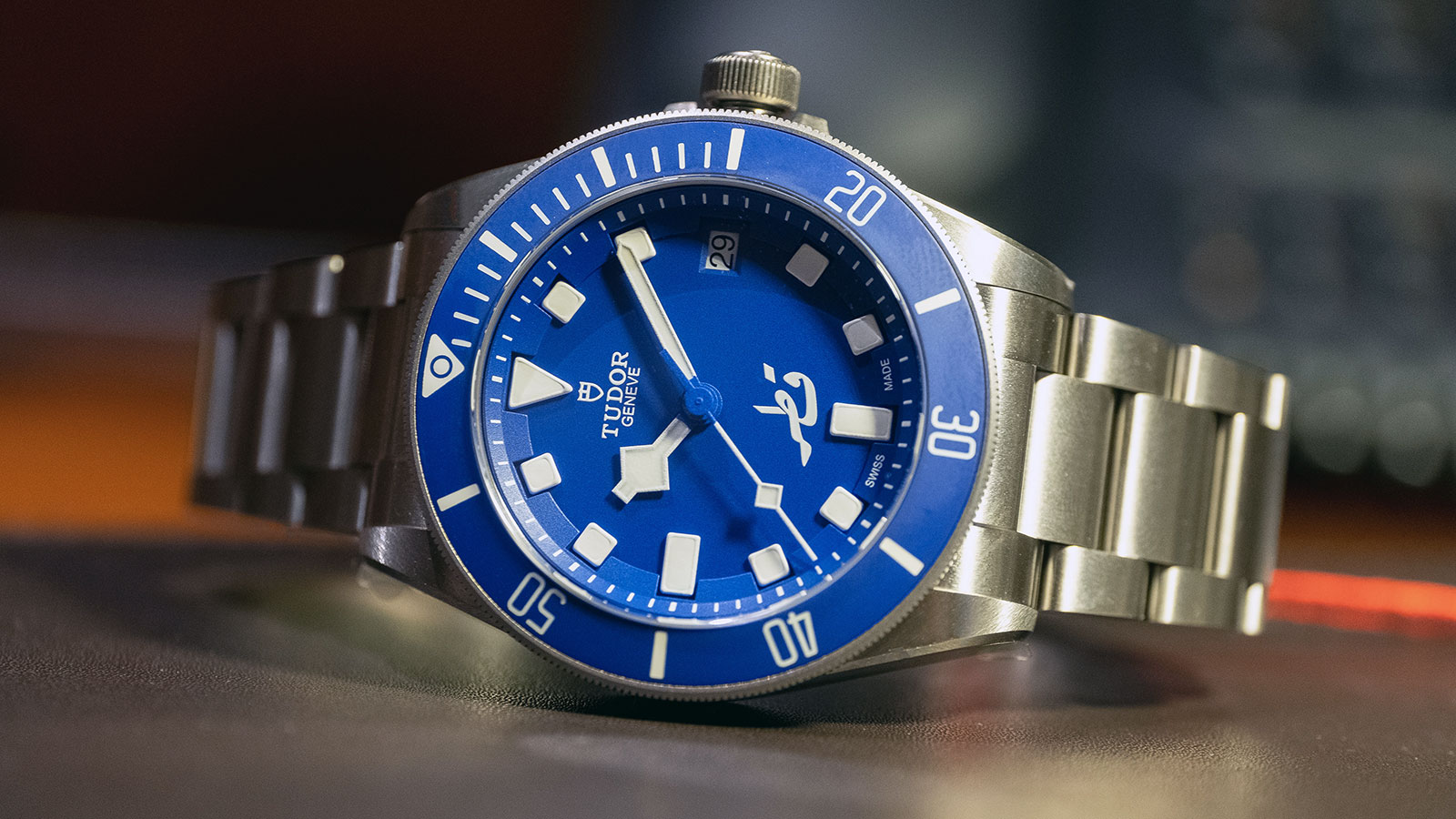
Tudor is taking part in Only Watch for the third time, but the watchmaker has arguably created its most unique timepiece to date for the biennial charity auction. While Tudor’s earlier Only Watch were variants of existing models, first the Heritage Black Bay One and then the Black Bay Bronze One, the Black Bay Ceramic One is wholly different from all current (and past) watches, it is a piece unique. Announced just a few weeks before the similarly all-black Black Bay Chrono Dark limited edition, the Black Bay Ceramic One is essentially Tudor’s signature dive watch, but with a black ceramic case. Though Tudor does have ceramic watches in the line-up, namely the usually forgotten Fastrider Black Shield, the material has not been used for the bestselling Black Bay, until now. Though the watch is entirely unique, the look is a fairly common one – all-black, everywhere. That being said, it’s an attractive one, especially for a dive watch like this. The dial is done in different textures and shades of black for legibility. So the markings on the dial are printed in glossy black lacquer to distinguish them from the matte black dial surface. And the Super-Luminova is also black, or more specifically standard Super-Luminova with pigments added for colour, which diminishes the green night-time glow substantially. While that’s not a practical look for an actual dive watch, it is a cool look for a “desk diver”. The bezel continues the shades-of-black colour schem...

Obituary: Gilbert Albert, Jeweller and Watch Designer SJX Watches
Patek Philippe Oct 3, 2019

Obituary: Gilbert Albert, Jeweller and Watch Designer

Designer of some of the most striking wristwatches of the 1960s, jeweller Gilbert Albert (1930-2019), passed away in his hometown of Geneva on October 1 , 2019. He was 90. Son of a newspaper deliveryman, Albert trained as a jeweller at Geneva’s l’Ecole des Arts Industriels and was only in his mid 20s when he joined Patek Philippe in 1955 as a designer. In his seven years at the watchmaker, which was then led by Henri Stern, himself a trained jeweller, Albert was responsible for some of the most radical watch cases of the era. These strikingly asymmetrical timepieces, like the Asymétrie wristwatches and Ricochet pocket watches, are still incredible designs six decades on. Gilbert Albert. Photo – lenouvelliste.ch He then set up his own workshop in 1962, where he became known for the use of unusual materials like coral and meteorite, all installed in quirky, unique jewellery desirable enough that frequent fakes eventually emerged. Albert also designed watches and jewellery for other watchmakers, most notably Omega, where he created several collections, including the Maille d’Or and Arabesque d’Or, all characterised by a distinctive, almost organic style. With his success, Albert built a small but highly regarded jewellery business. He opened his first store in his hometown in 1973, sited on rue de la Corraterie, a street just outside the walls of Geneva’s Old Town. Ten years later that was followed by a boutique in Zurich. Albert’s boutique in Gen...

Introducing the Klo & Co. Alpesailer SJX Watches
Girard-Perregaux Laureato. While Oct 3, 2019

Introducing the Klo & Co. Alpesailer

Having made its debut two years ago with a dual-dial watch that combined an automatic and quartz movement, Klo & Co. is an unusual “microbrand”, having been started by a trio of young Filipino watch enthusiasts. The Manila-based brand has just unveiled the Alpesailer, a steel sports watch with an internal rotating bezel and an integrated bracelet. Head-on, the Alpesailer clearly derived from Gerald Genta’s famous octagonal design – think of it as a “Super Compressor” style homage to the Royal Oak. That being said, the bezel is actually brushed and round on top, with a polished octagonal base, bringing to mind the Girard-Perregaux Laureato. While the watch wins no prizes for ingenious design, it’s well spec’ed and only US$400. Depth rated to 100m, the case measures 41mm wide and 12.5mm in height. It features a “Super Compressor” style design with an internal rotating bezel and twin crowns – one for winding and setting, the other for rotating the bezel. However, like most modern watches inspired by actual Super Compressor dive watches from the 1960s, this does not have the same, Super Compressor sealing technology pioneered by case maker Ervin Piquerez, which relied on a spring-loaded back that press against the case as external water pressure increased. While the twin-crown design remains attractive even today, advancements in the fabrication of cases, crystals and gaskets have made such sealing technology superfluous in a modern watch. The A...

Up Close: Audemars Piguet Royal Oak Perpetual Calendar Openworked in Black Ceramic SJX Watches
Audemars Piguet Royal Oak Perpetual Calendar Oct 1, 2019

Up Close: Audemars Piguet Royal Oak Perpetual Calendar Openworked in Black Ceramic

The last time Audemars Piguet had a skeletonised Royal Oak perpetual calendar in the catalogue, it was 2015. The skeleton perpetual is familiar enough that it doesn’t seem to have been missing for that long, but it’s been a half-decade. In the mean time, Audemars Piguet (AP) unveiled the next generation of Royal Oak Perpetual Calendar, with the case widened to 41mm, and then introduced it in black ceramic, and only just, in white ceramic. And it took some time to develop the thinnest automatic perpetual calendar ever. But now the Royal Oak Perpetual Calendar Openworked is back, in proper, fine form. Putting a skeleton movement inside the bestselling Royal Oak in black ceramic is obvious, and could have been done in the easiest way possible. But AP went one better; it developed a new calibre, the 5135, that is not merely open-worked, but also redesigned for maximum aesthetic effect. “This is the first time in many years that AP has introduced an openworked perpetual calendar wristwatch,” says Michael Friedman, the head of complications at AP, “The effort here was to create an experience of contrast and play of light.” I’d say AP succeeded. The watch pictured is a travelling prototype, so pardon the cleanliness of the movement Ceramic and the Royal Oak But first, a small, modestly technical digression on the material and the watch. The case and bracelet are made of black ceramic, specifically zirconium oxide stabilised with yttrium oxide – essential for...

Zenith Introduces the El Primero A386 “One-Off” in Platinum SJX Watches
Zenith Introduces Oct 1, 2019

Zenith Introduces the El Primero A386 “One-Off” in Platinum

With this year being the 50th anniversary of its defining movement, Zenith has unveiled several limited editions to mark the occasion, including a three-piece set and a remake of the El Primero A386 in 18k gold. Now the ultimate anniversary watch has just been announced: the one-of-a-kind El Primero A386 in platinum with a lapis lazuli dial, and a 50-year warranty. This one-off watch – it’s marked as such on the case back – was designed in collaboration with Phillips, the auctioneer led by Livia Russo and Aurel Bacs. And the watch will be sold by Phillips in November, with all proceeds going to a Swiss charity that helps children with cancer. It’s the first ever El Primero in platinum, and also the first with a lapis lazuli dial. Commenting in the announcement, Zenith chief executive Julien Tornare states unequivocally: “This will be the first and sole El Primero in platinum.” Materials aside, the rest of the watch is identical to the standard A386 remake. The case is 38mm, fitted with sapphire crystals front and back, while the movement is the El Primero 400. Key facts Diameter: 38mm Material: Platinum Water resistance: 50m Dial: Lapis lazuli Movement: El Primero 400 Functions: Time, chronograph, date Frequency: 36,000bph, or 5Hz Winding: Automatic Power reserve: 50 hours Strap: Blue calfskin Price and availability The Zenith El Primero A386 in platinum will be sold at the Geneva Watch Auction: X that takes place on November 9-10, 2019. It has n...

Interview: Patek Philippe Museum Curator Dr Peter Friess on Restoration SJX Watches
Patek Philippe Museum Curator Dr Peter Oct 1, 2019

Interview: Patek Philippe Museum Curator Dr Peter Friess on Restoration

The epic Patek Philippe Watch Art Grand Exhibition Singapore 2019 was massive not just in scale and numbers, but also in the Patek Philippe executives who travelled halfway across the world from Geneva to Singapore just for the event. All of the company’s top management is the town for the event, including president Thierry Stern, chief executive Claude Peny, and commercial director Jerome Pernici. But perhaps the most interesting personality for a hardcore watch geek is Dr Peter Friess, curator of the Patek Philippe Museum in Geneva. A studied man who’s spent his life in museums and cultural institutions, Dr Friess is an art historian by training but also a true horologist. He’s the sort of guy who gets deeply excited over the “new old stock” 369-year old Cremsdorff pocket watch the museum recently acquired, and is familiar with the catgut used in 16th century chain and fusee mechanisms. Dr Peter Friess at the Singapore exhibition, with a portrait of Antoine Norbert de Patek behind him The first ever Patek Philippe wristwatch; importantly, it was not conceived as a bangle with a pendant watch movement bolted on, instead it is a timepiece for the wrist Unsurprisingly, the German native is also a professional watch- and clockmaker. Dr Friess joined the Patek Philippe Musuem as Director and Curator exactly seven years ago. Before that, he was President of the Tech Museum of Innovation in California, as well as a curator at the Smithsonian where he put tog...

Introducing the Seiko Presage Green Enamel Dial Limited Edition SPB111J1 SJX Watches
Seiko Presage Green Enamel Dial Oct 1, 2019

Introducing the Seiko Presage Green Enamel Dial Limited Edition SPB111J1

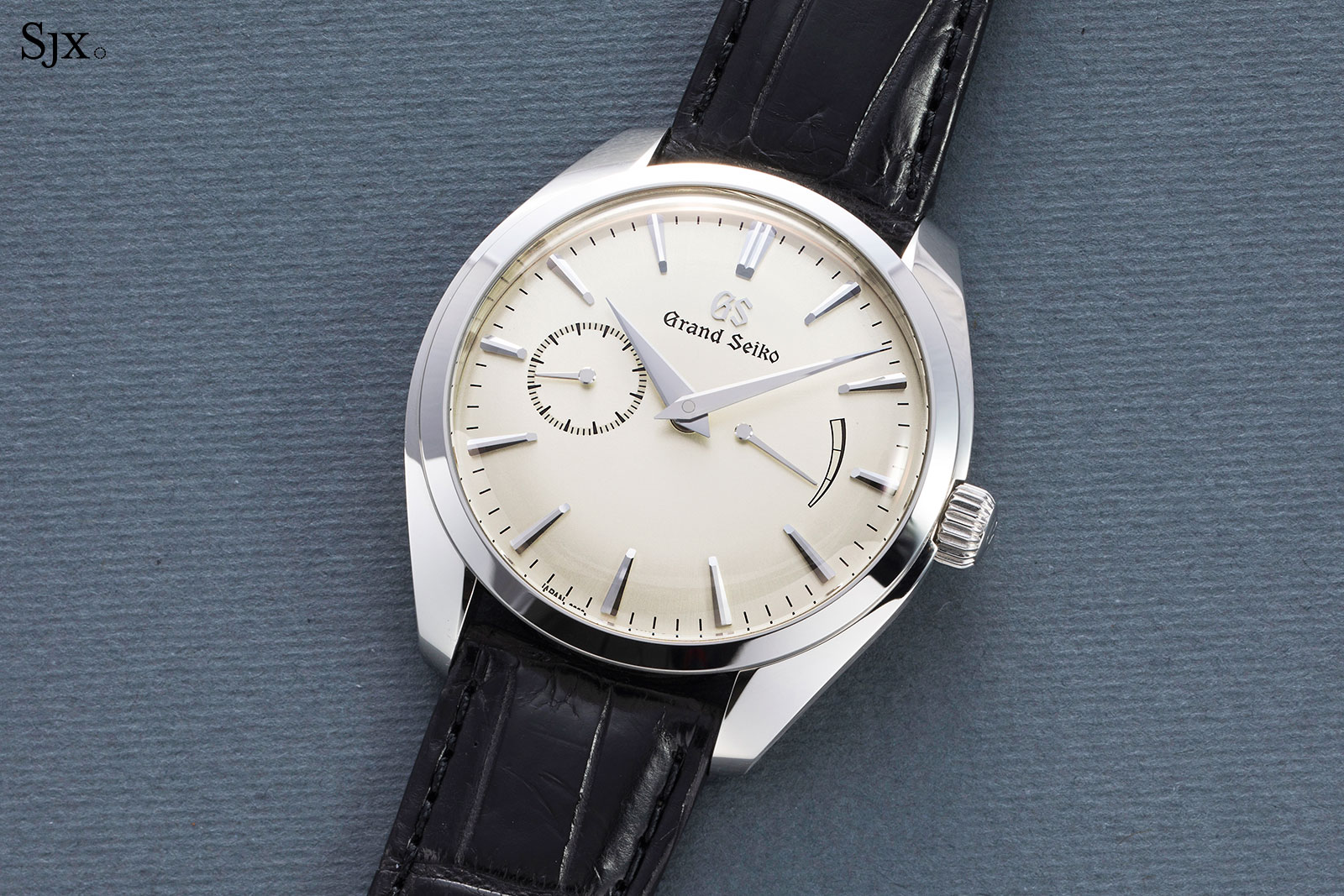
Since its global debut in 2016, the Seiko Presage collection has quickly gained a following for its dials that feature artisanal decoration, usually executed with traditional Japanese crafts such as urushi lacquer and Arita porcelain, but at strikingly affordable prices. Following the launch of the first Presage with a Spring Drive movement (in the past, automatic or hand-wound movements were the norm) a few months ago, the brand has now unveiled a limited-edition automatic with a deep green dial made of fired, vitreous enamel, otherwise known as grand feu enamel in Swiss watchmaking. Inspired by the colour of Japanese cedar trees, the green enamel dial features applied hour markers – instead of the more common printed or painted markers found on enamel dials – paired with rounded dauphine hands. The dial is once again produced by master craftsman Mitsuru Yokosawa and his team, who work for Fuji Porcelain Enamel Co., Ltd., one of Japan’s biggest makers of enamelware. The company has been Seiko’s go-to supplier for high-quality enamel dials made on a large scale at relatively low cost, a crucial reason why the Presage watches equipped with enamel dials are eminently affordable. As with a majority of automatic Presage models, the case is in stainless steel and measures 40.8mm wide and 12.4mm in height. It’s simply finished with a bright mirror polish on most surfaces, with the top of the lugs brushed for a little contrast and structure. Visible throu...

Interview: 800 Years of Japanese Swords and the G-Shock SJX Watches
Casio announced Sep 30, 2019

Interview: 800 Years of Japanese Swords and the G-Shock

Acclaimed in ancient literature and collectible today, swords made by the Gassan school trace their lineage back centuries, as is only possible in Japan. The school originated some 800 years ago, dating back to the early Kamakura period, approximately the 13th century. It started at the base of Mount Gassan, the highest of a trio of sacred mountains in what is now Yamagata prefecture. Though the school became dormant sometime in the 16th century, it was revived sometime in the mid 1800s by a descendant of the Gassan family in Osaka. The revival was successful and the Gassan school made swords for several Japanese emperors in the 19th and 20th century. Six generations on, the Gassans continue their craft with Sadanobu Gassan, and his father, Sadatoshi, now based in the city of Sakurai in Nara prefecture, about six hours southwest of Tokyo. At Baselworld 2019, Casio announced its collaboration with Sadanobu Gassan to create the G-Shock MR-G “Gassan” MRG-G2000GA, which has key parts of the case and bracelet finished by Mr Gassan himself in his workshop. In essence, it links the Gassan family’s eight hundred centuries of tradition with the latest in Japanese timekeeping technology. We got in touch with Mr Gassan to discuss his work for G-Shock, and also the state of his ancient craft. The interview has been edited and condensed. The G-Shock MR-G “Gassan” MRG-G2000GA What made you want to continue in your family’s footsteps? At a young age, I witnessed my...

A Guide to the Patek Philippe Watch Art Grand Exhibition Singapore 2019 SJX Watches
Patek Philippe Watch Art Grand Exhibition Sep 29, 2019

A Guide to the Patek Philippe Watch Art Grand Exhibition Singapore 2019

Having only begun yesterday and open until October 13, the Patek Philippe Watch Art Grand Exhibition in Singapore is a watchmaking extravaganza – with free entry to the public – that’s already a box office hit on its opening weekend. Reputed to have cost some 20m Swiss francs, the vast historical and cultural showcase is the biggest Patek Philippe has staged to date, with 10 rooms spread over 1900m2, or over 20,000ft2. Pre-registrations for the event exceeded 35,000 people, with the total tally after two weeks expected to substantially surpass that; the first day alone saw some 4000 visitors pass through. The venue: Sands Theatre at Marina Bay Sands But as important as its broad appeal is the fact that the exhibition has drawn some of the world’s most important watch collectors to the city state. Outside of a factory event in Geneva, there probably hasn’t been this many custom Patek Philippe wristwatches together in one place. A custom dial ref. 5970J owned by the gentleman collector known as @horology_ancienne One of the major contemporary timepieces on show: the Star Calibre 2000 And arguably the most major watch of any sort in the exhibition: the landmark Calibre 89, the most complicated portable watch ever at the time of its creation in 1989 The six limited edition watches created especially for the event have garnered the most headlines, but the exhibition itself is worth a long visit because there’s a lot to see. It covers not just Patek Philippe, but...

Patek Philippe Introduces the World Time Minute Repeater Singapore 2019 Ref. 5531R SJX Watches
Patek Philippe Introduces Sep 27, 2019

Patek Philippe Introduces the World Time Minute Repeater Singapore 2019 Ref. 5531R

Originally introduced in 2017 for the Grand Exhibition in New York, the Patek Philippe World Time Minute Repeater Ref. 5531R was the first minute repeater that could chime the local time, as opposed to a conventional world-time repeater that would only strike the home time. The reference then entered regular production in 2018 with a cloisonné enamel of Lake Geneva, or the lac Léman as locals know it, a recurring motif on Patek Philippe enamel watches. Patek Philippe has now unveiled a special-edition version for the Watch Art Grand Exhibition 2019 in Singapore, featuring a cloisonné enamel dial depicting the city centre of Singapore, along with the country’s name listed on the city disc in place of Beijing. It joins the Minute Repeater Tourbillon Singapore 2019 Ref. 5303R as one of the grand complications created especially for the event. As was always the case, the watch is in red gold and measures 40.2mm wide. it features hand-guillochéd, hobnail pattern on the case band as well as on the repeater slide on the left. In it is the self-winding cal. R 27 HU which features the patented repeater mechanism that chimes the time of the city at the 12 o’clock position on the world time mechanism. While a minute repeater usually operates independently from the world time and thus chimes only the home time, the two mechanisms in this case are mechanically coupled. The hour snail of the repeater is continuously driven by the time zone wheel of the world time mechanism. ...