
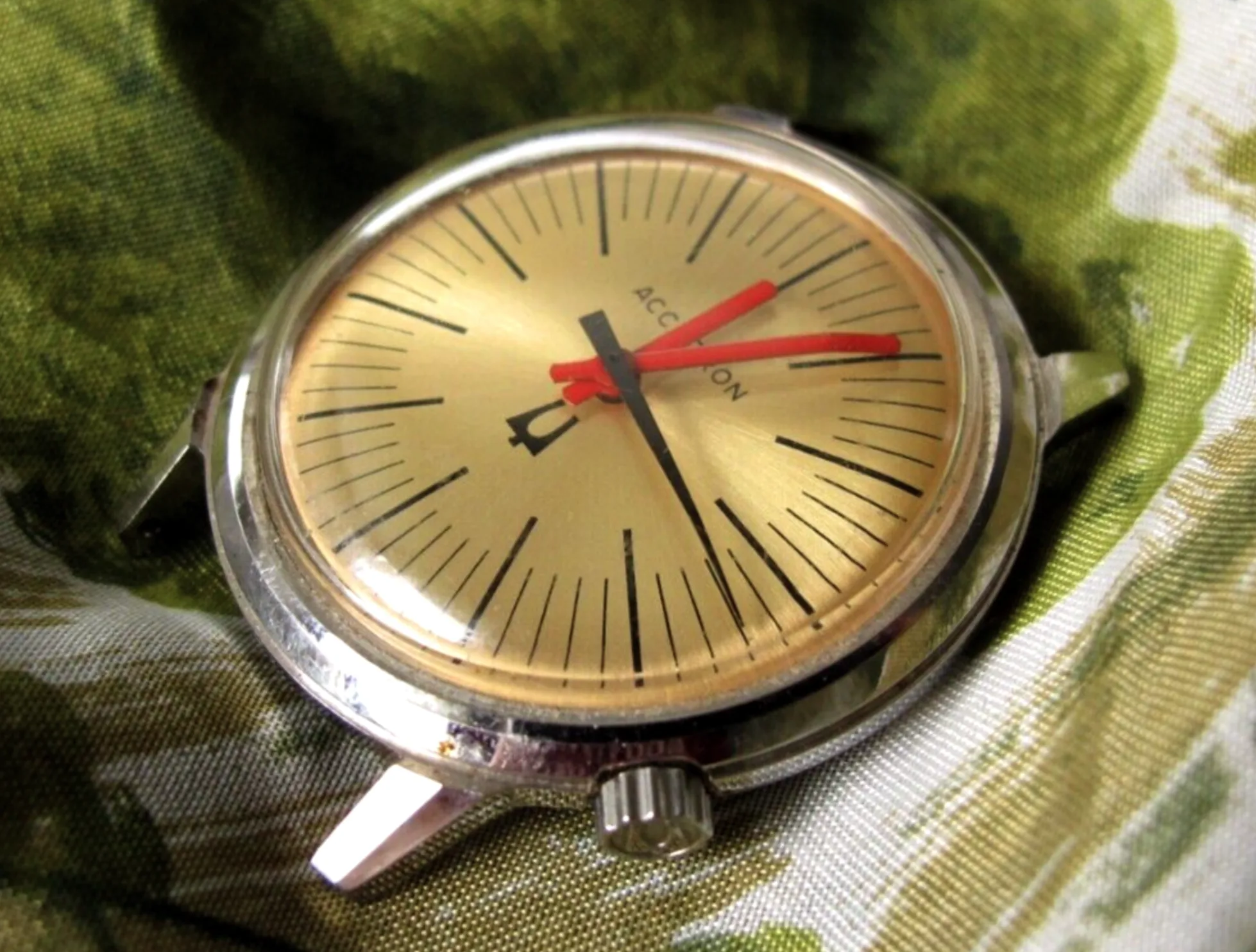
Accutron was developed at Bulova in the late 1950s by engineer Max Hetzel and launched in October 1960. The mechanism replaced the standard balance wheel + hairspring oscillator with a 360 Hz tuning fork driven electromagnetically by a transistor circuit. A miniature ratcheted index wheel converted the fork's vibrations into rotary motion for the gear train. The result: ±2 seconds per day accuracy, 100x better than typical 1960 mechanical watches.
The Accutron Astronaut (1962) became the official watch of the US Mercury and Gemini space programmes; Bulova claims it was the first watch worn in space. NASA briefly considered Accutron for the Apollo programme but selected the Omega Speedmaster after impact testing. Accutron production scaled through the 1960s-70s; by the mid-1970s quartz movements (32,768 Hz, far cheaper, far more accurate) outcompeted the tuning fork. Accutron production ended c. 1977.






Comments 2