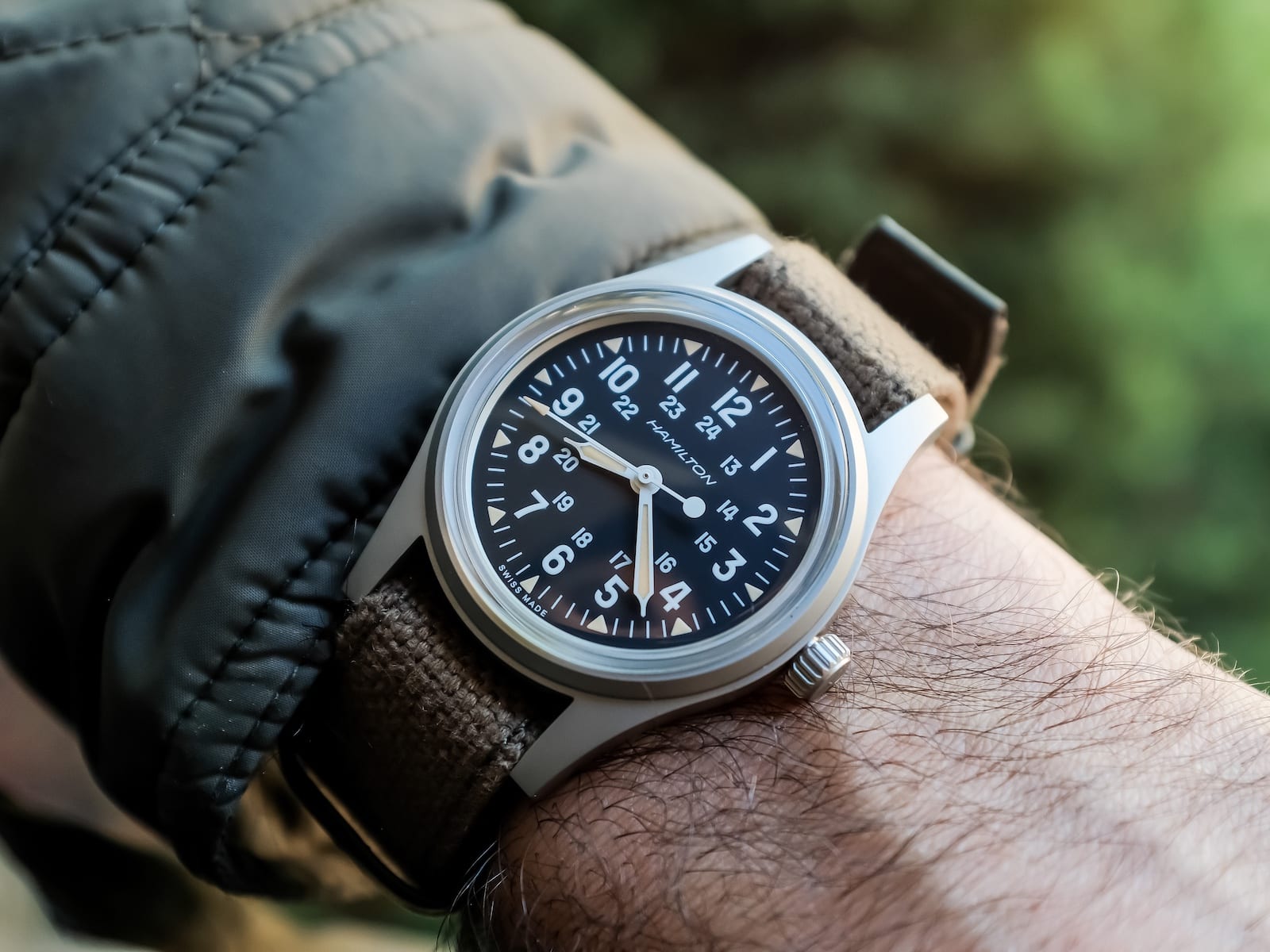
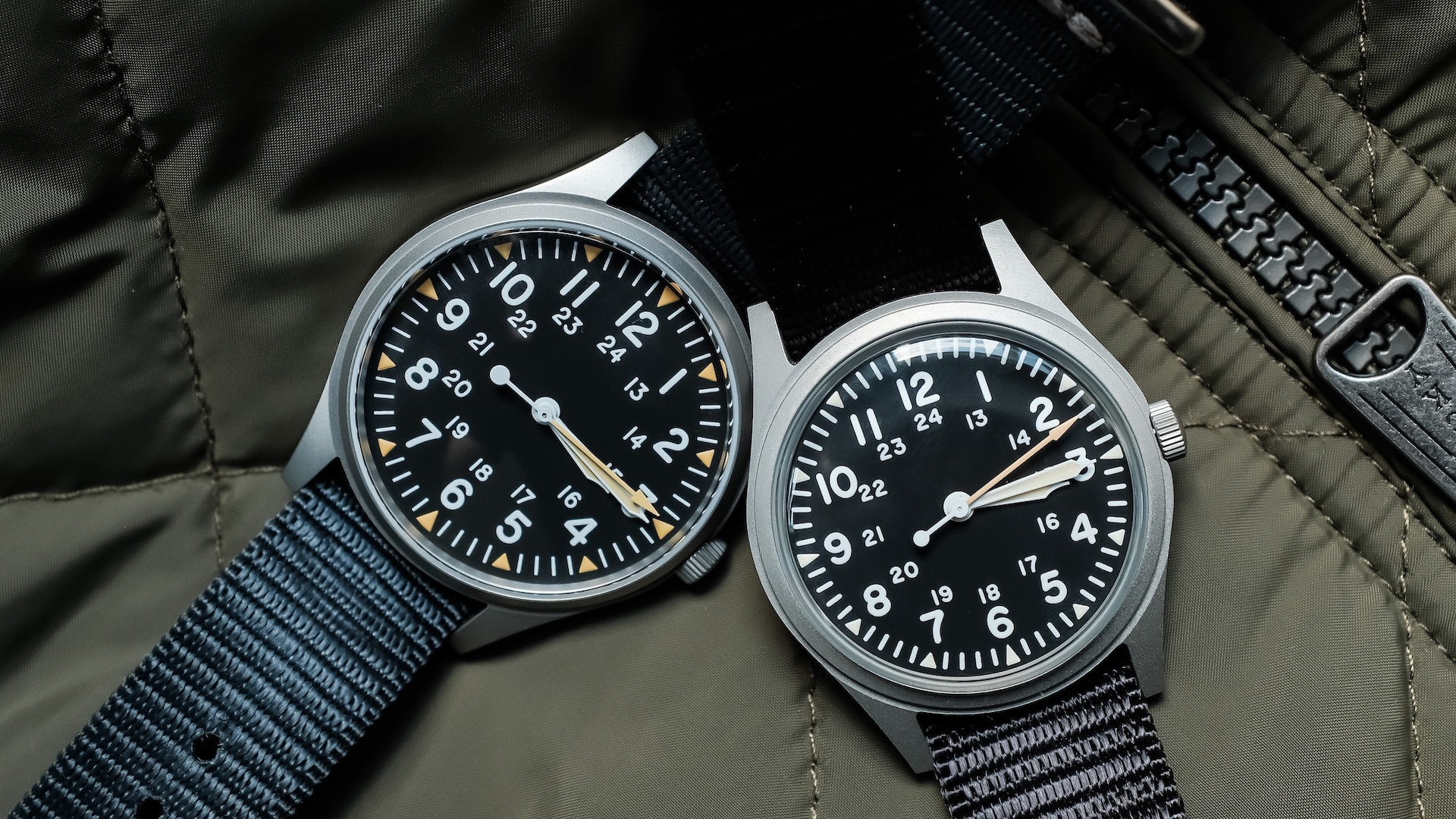
A field watch is, in collector vocabulary, the most utilitarian of the four canonical tool-watch genres alongside the diver, the pilot, and the racing chronograph. The brief is narrow: be readable, be robust, be cheap enough to issue at scale, and stay legible in poor light. There is no rotating bezel, no chronograph, no calendar (or, at most, a single date window), and no decorative finishing. The dial is matt black or matt khaki-green; the numerals are large white-printed Arabic, often with a 24-hour secondary scale; the hands are baton or syringe with full-length lume fill; the case is 34-40 mm, water-resistant to 50-100 m, with a fixed bezel and a wire-loop or brushed-flat lug profile that takes a 16-20 mm canvas or NATO strap.
The lineage is military-issue. The earliest field watches were the WWI trench watches (1914-1918), pocket watches converted to wristwear via wire lugs welded to the case and a leather strap, with the dials painted in radium for nighttime trench reading. Major British, American, and Swiss makers, Waltham, Elgin, Hamilton, Longines, Borgel, Omega, all delivered. The modern field-watch silhouette dates more precisely to the Dirty Dozen (1944-1945), the British Ministry of Defence W.W.W. ("Wrist Watch Waterproof") contract that selected twelve Swiss makers, including Longines, Omega, IWC, JLC, Vertex, and Eterna, against a single specification: 30 m water resistance, hacking seconds, luminous baton hands, fixed bars, 36 mm steel case. Approximately 145,000 W.W.W. watches were issued to British forces; modern examples sell for £4,000-£25,000 depending on maker.
"A field watch should disappear on your wrist until you need it. The minute you can read the dial in any light without thinking, you have one."- Marathon Watch Company product brief, MIL-W-46374 spec note
In the United States the equivalent specification was MIL-W-3818 (1941, manual-wind, 17-jewel, hacking) followed by MIL-W-46374 (1964, plastic-cased general-purpose; latest revision MIL-PRF-46374G, 1999). Hamilton, Benrus, Marathon, Stocker & Yale, Westclox, and Timex all delivered against MIL-W-46374; the resulting "GG-W-113" pilot variant and "MIL-W-46374" infantry variant were issued through Vietnam, the Gulf War, and into Iraq. The visual template, matt black dial, white 12-hour and 24-hour numerals, no logo on the dial ("sterile" dial), tritium lume, fixed canvas strap, became the canonical field-watch look that civilian brands now reference.
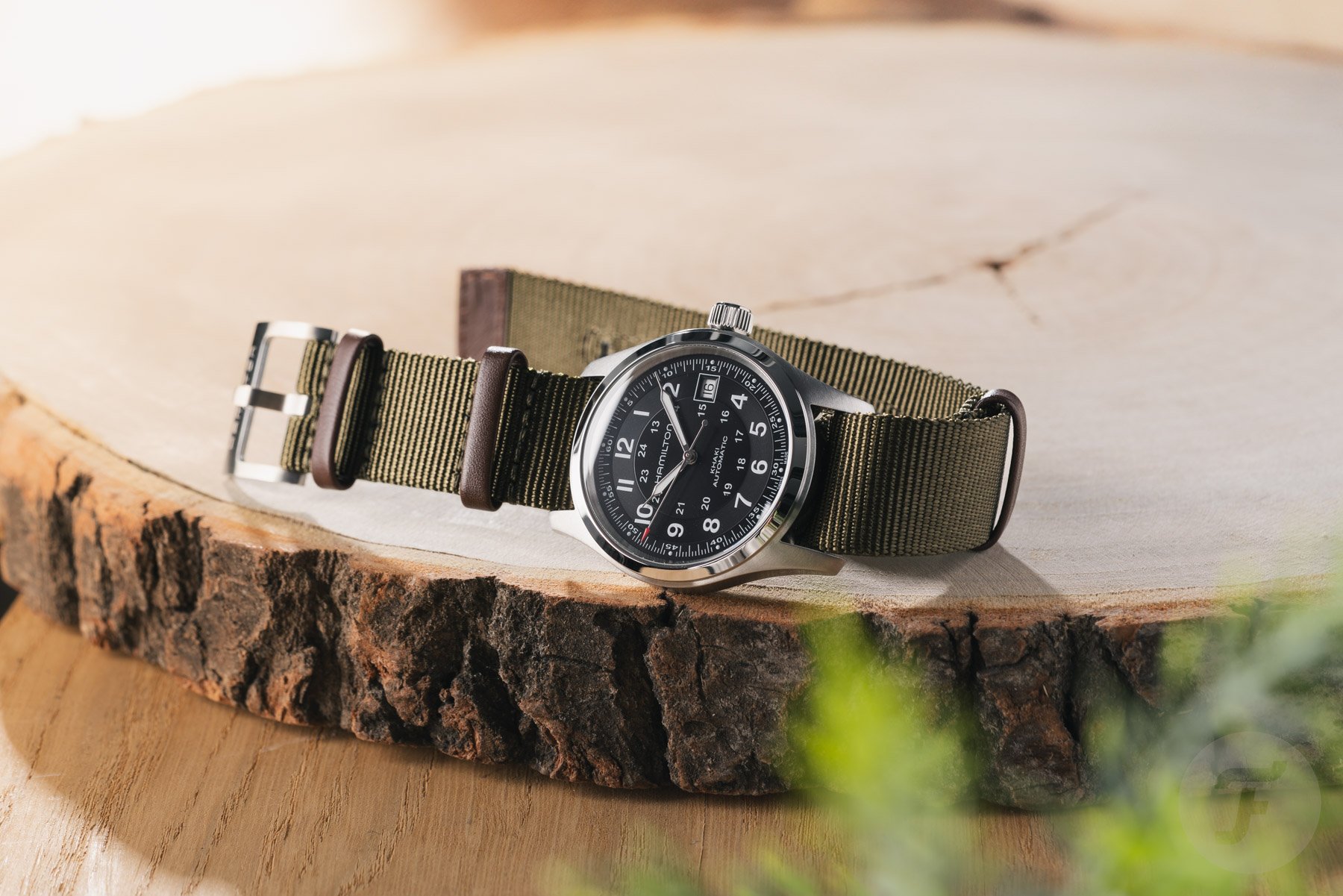
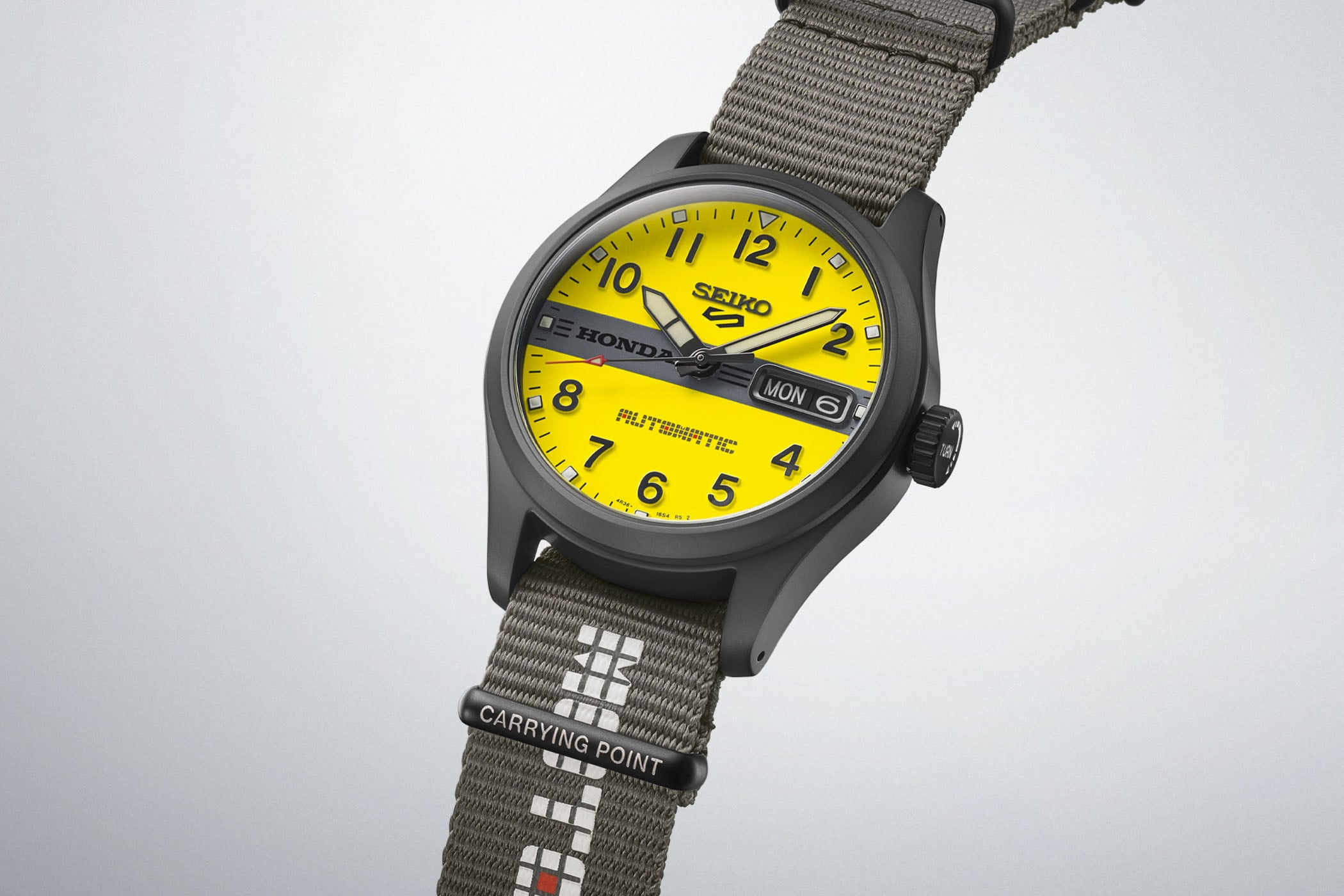
The civilian benchmark is the Hamilton Khaki Field, in continuous catalogue since the 1980s and now sold in mechanical (Cal. H-50, ETA 2801 base, hand-wound 80h reserve), automatic, and quartz forms across 38 mm and 42 mm cases. The 38 mm Hamilton Khaki Field Mechanical (ref. H69439931, ~CHF 600) is the reference specification: white printed numerals on matt black dial, 24-hour secondary scale, hacking seconds, beadblasted case, 50 m WR. Other mainstream civilian field watches: Seiko 5 Sports field references, Citizen Tsuno Chrono Field, Mido Multifort Patrimony, Christopher Ward C65 Sandhurst, Vaer A12 Solar / A5, Boldr Venture, Praesidus A-11 (Type A-11 reissue), Sangin Atlas, Marathon Officer's.
Modern issued field watches still exist. Marathon Watches (Canadian/Swiss) holds active US DoD and Canadian Forces supply contracts and produces the GPM (General Purpose Mechanical), GPQ (Quartz), and the JSAR (Jumbo Search & Rescue) diver under MIL-PRF-46374. The watches are issued sterile, with no retail branding; Marathon also sells civilian-market versions with the same case and movement. Vertex Watches reissued the W.W.W. M100 in 2016 for the family of the original Vertex partner. Praesidus reissued the WWII A-11 specification in 2021. These are the modern remaining links to the original mid-century military supply.
Where the field watch sits in a collection is interesting. It is the small, wearable, indestructible default; sometimes called a "beater" in collector vocabulary, sometimes the entry point for a serious collection. A used Khaki Field Mechanical at $400 is most collectors' first mechanical watch; a Sangin Atlas or Sinn 656 at $1,200 is a modest upgrade; a Vertex M100 at $3,000 is a heritage statement. Above that, the Dirty Dozen originals from the 1940s start, depending on maker, at £4,000 (Lemania) and run past £25,000 (IWC, JLC). The genre survives because the brief is narrow, the requirement is real, and the design space has converged: a good field watch in 2024 looks remarkably similar to a good field watch in 1944.



Comments 2