
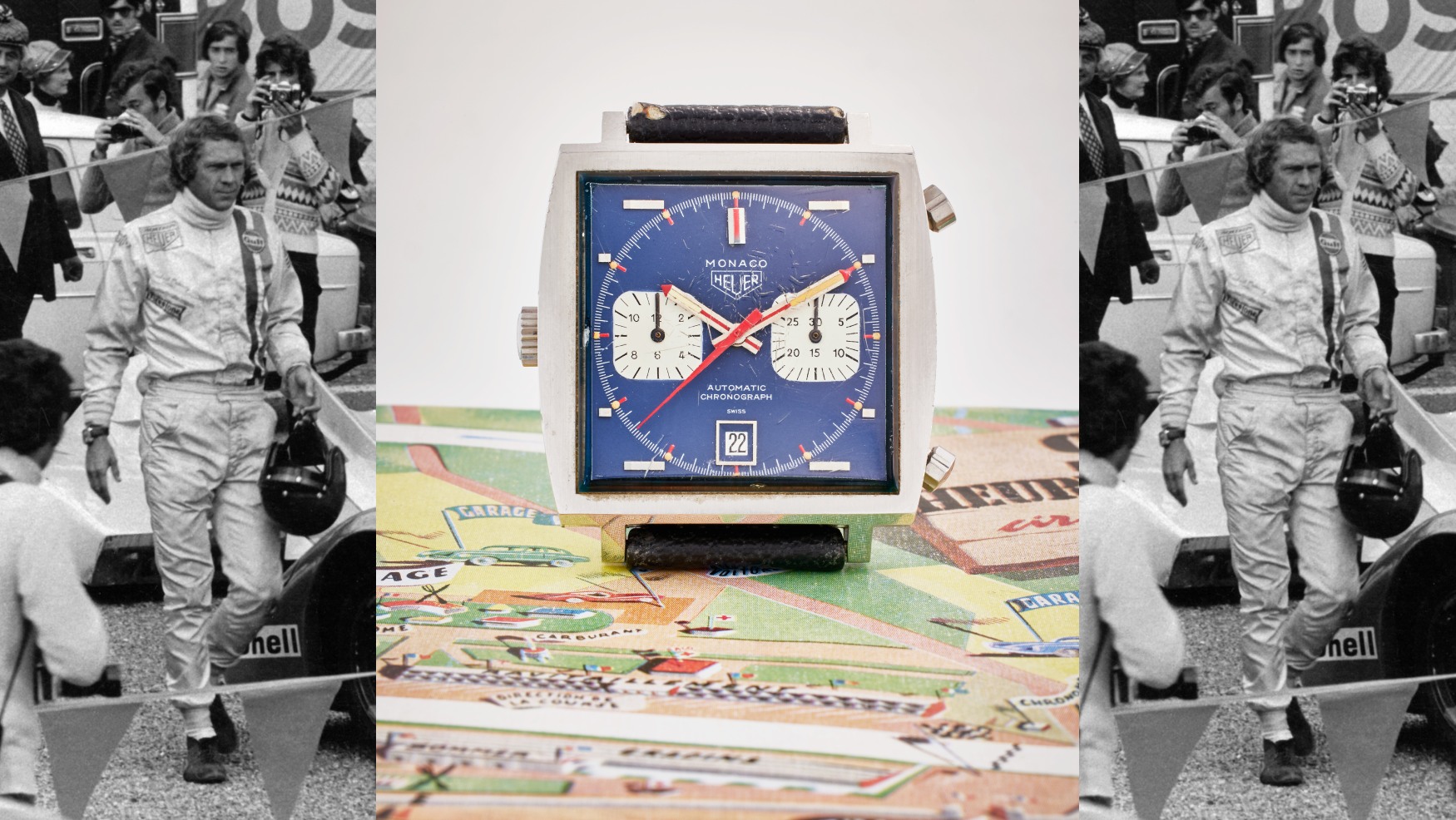
The Heuer Monaco reference 1133 launched at the 1969 Basel Fair alongside the broader Project 99 Caliber 11 programme that brought the world's first automatic chronograph to market. The Monaco was a deliberate departure from convention: a square steel case (39 mm × 39 mm) at a moment when nearly every chronograph was round, vivid blue or grey "metallic" dial, applied luminous baton hour markers, racing-stripe sub-dials, and the Cal. 11's crown at 9 o'clock (because the chronograph module displaced it). The square case was claimed to be the first water-resistant square wristwatch, achieved by an unconventional case-back gasket geometry; the case design was the work of Erwin Piquerez.
In 1970, while preparing his self-financed racing film Le Mans, Steve McQueen spent extensive time at the Solar Productions production base in Le Mans, France, and at French and Swiss racing circuits. McQueen had been a serious amateur racer since the 1960s and had befriended several professional drivers, most notably Jo Siffert (Swiss Formula 1 and endurance racer, Porsche works driver) who was Heuer's ambassador and consultant. Siffert wore Heuer racing chronographs (Carrera, Autavia, Monaco) on track and had a Heuer-branded fireproof orange driver's suit with the Heuer logo on the chest.
"You drive a car as fast as it will go in a straight line. Then a little faster. The watch tells you when you have done it again."- Steve McQueen, set interview during Le Mans production
The story of the watch reaching McQueen's wrist on the film set is well-documented. McQueen's racing-suit costume designer was Hubert de Givenchy; for screen authenticity McQueen requested a working racing suit modelled on Siffert's actual Porsche team kit, including the Heuer chest patch. With the chest patch on the costume, the wrist needed a complementary Heuer; Siffert provided one of his personal Monacos, ref. 1133B, which McQueen wore through the 35-day production schedule. The blue Monaco appears in approximately 40 minutes of screen time across the film's 106-minute runtime, including the iconic on-track helmet shots.
Le Mans was a commercial failure. Released in June 1971 after a difficult production (multiple budget overruns, McQueen-fired director Sturges replaced by Lee H. Katzin, and an injury crash that sidelined McQueen from his planned active racing scenes), the film recovered only ~USD 5 million on a USD 7-8 million budget. Critical reception was mixed. The Monaco watch product placement, deliberate or not, did not materially help Heuer sales: the firm went through quartz-crisis difficulties through the 1970s and was acquired by TAG (Techniques d'Avant Garde) in 1985, becoming TAG Heuer.
The cultural rehabilitation began through the 1990s as the watch enthusiast community formalised vintage-watch collecting and as Le Mans was reassessed as a serious motorsport drama. Rolex Daytona and Heuer Monaco emerged as twin "cinema racing watches" of the 1970s. TAG Heuer reissued the Monaco in 1998 as the CW2113 (steel, automatic Cal. 17 ETA-based) and again in 2003 as the CS2111; the modern Calibre 11 (a Sellita SW300 module-based reproduction of the original Cal. 11 architecture) was introduced in 2009 and runs the modern Monaco line. McQueen estate licensing has produced numerous limited editions.
A 1971 production-correct Monaco 1133B in original condition trades at USD 50,000 to USD 200,000 at vintage auction. The specific watch worn by McQueen on set (one of three or four Monacos used through the production) sold at Phillips New York in December 2020 for USD 2.2 million, the auction record for a Heuer at the time. The Monaco today is also a continuous production reference at TAG Heuer with the modern Cal. 11 Heritage Calibre Monaco in steel and various special editions; the line is the longest-running square chronograph in Swiss watchmaking.


Comments 1