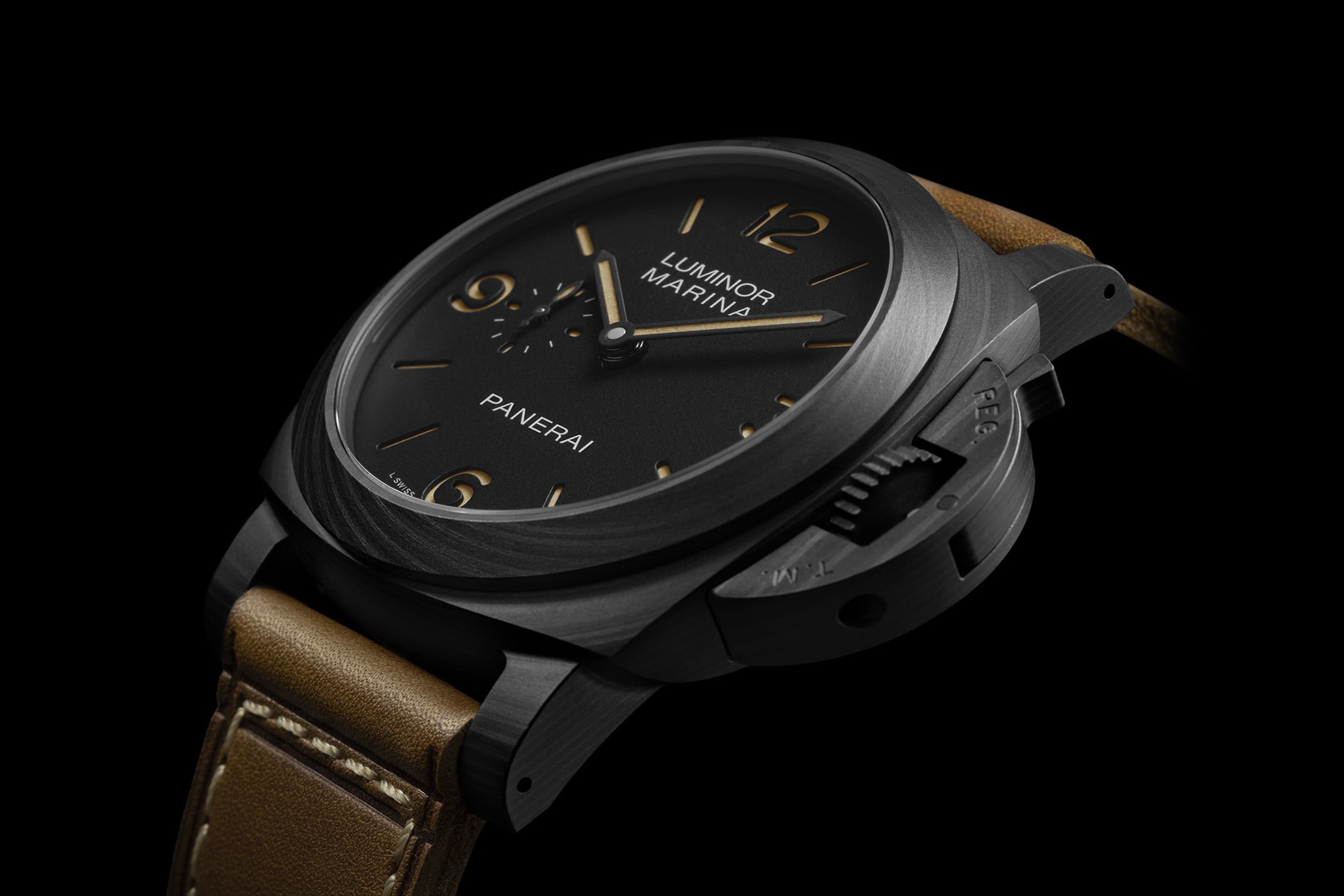
A sandwich dial is a two-layer dial construction in which the upper plate has the numerals, indices, and (sometimes) sub-dial markings cut out as open windows, and a lower plate filled with luminous material sits directly behind it. Looking at the dial straight on, the cutouts in the upper plate become the markers themselves; the lume below them glows through. Compared to a conventional single-layer dial with painted or applied indices, the sandwich construction gives the markers maximum luminous surface area and a recognisable "set into the dial" appearance.
The sandwich dial was developed by Panerai for the Italian Royal Navy (Regia Marina) in 1936, when Panerai was contracted to build dive watches for Italian frogman commando units. The technical brief: maximum readability under water at depths where natural light has disappeared entirely. The available luminous material at the time was radium, which glowed brightly but was strongly radioactive. To minimise the radium exposure for the wearer while still maximising visible lume area, Panerai used a thicker layer of radium paint behind a steel upper plate with cutout numerals; the steel plate shielded the wearer's wrist while the cutouts presented the lume directly to the diver's eye. The first sandwich-dial Panerai was the Radiomir 3646, ~1936-1942.
"A sandwich dial is the difference between a luminous index and a luminous window into the dial itself. Once you have seen it lit up at depth, you do not want a painted dial again."- Panerai brand commentary on the 1936 dial design
The construction has three lasting visual signatures. First, the markers appear recessed rather than applied or painted: a lit-up index sits visibly below the dial surface, not on it. Second, the lume glow extends slightly outside the cutout boundary in low-light conditions because of the lume layer's thickness; this gives sandwich-dial markers a soft halo that conventional dials cannot reproduce. Third, the dial finishes around the cutouts must be perfectly clean and burr-free, since any flaw in the cutout edge is visible at lume distance; sandwich dials are technically harder to produce than conventional dials.
Modern Panerai uses sandwich dials across the bulk of its Radiomir and Luminor catalogues. The lume material is no longer radium: Panerai switched to tritium in the 1960s, then to Super-LumiNova in the late 1990s when the brand was revived after a 25-year hiatus by Vendôme Group (later Richemont). The 1993 revival under Richard Mille's management at Vendôme retained the sandwich dial as the visual differentiator from Rolex and IWC military-style watches; subsequent Panerai expansions (PAM 005 Logo, PAM 112 manual, PAM 372 Radiomir 1940) all use sandwich construction.
Outside Panerai, sandwich dials appear on a wide range of military-style and homage watches. Sinn uses sandwich construction on the U-series dive watches; Squale applies it to selected dive references; Steinhart, Halios, Raven, and dozens of microbrand divers offer sandwich dials as a feature option. IWC's Pilot Mark XX (2022) and selected Bell & Ross military pieces use the construction. Hamilton's Khaki Field Mechanical uses a partial sandwich dial. Total industry use is significant; precise figures are not published, but probably tens of thousands of sandwich-dial watches ship per year across all brands.
For collectors, a sandwich dial is the strongest visual cue that a watch belongs to the military / tool-watch genre. The construction reads as functional rather than decorative; it announces "this watch was designed to be read in the dark, not to look pretty in jewellery-store light". Sandwich-dial Panerais carry a noticeable price premium over similar-spec conventional-dial alternatives in the brand's catalogue, reflecting both manufacturing complexity and the design's strong association with the brand's 1936 military origin.



Comments 2