
A Travel Time watch separates the local-time hour hand from the running movement. The user advances the local hour by 1-hour steps via pushers on the case (typically at 8 and 10 o'clock, or at 9 and 11): one pusher steps the local hour forward, the other steps it back. The minute and seconds hands continue to run on the underlying movement; the home-time reference (often a sub-dial or skeletonised central second hour hand) is preserved. The date typically follows local time via a coupling that drops a date click on each rollover.
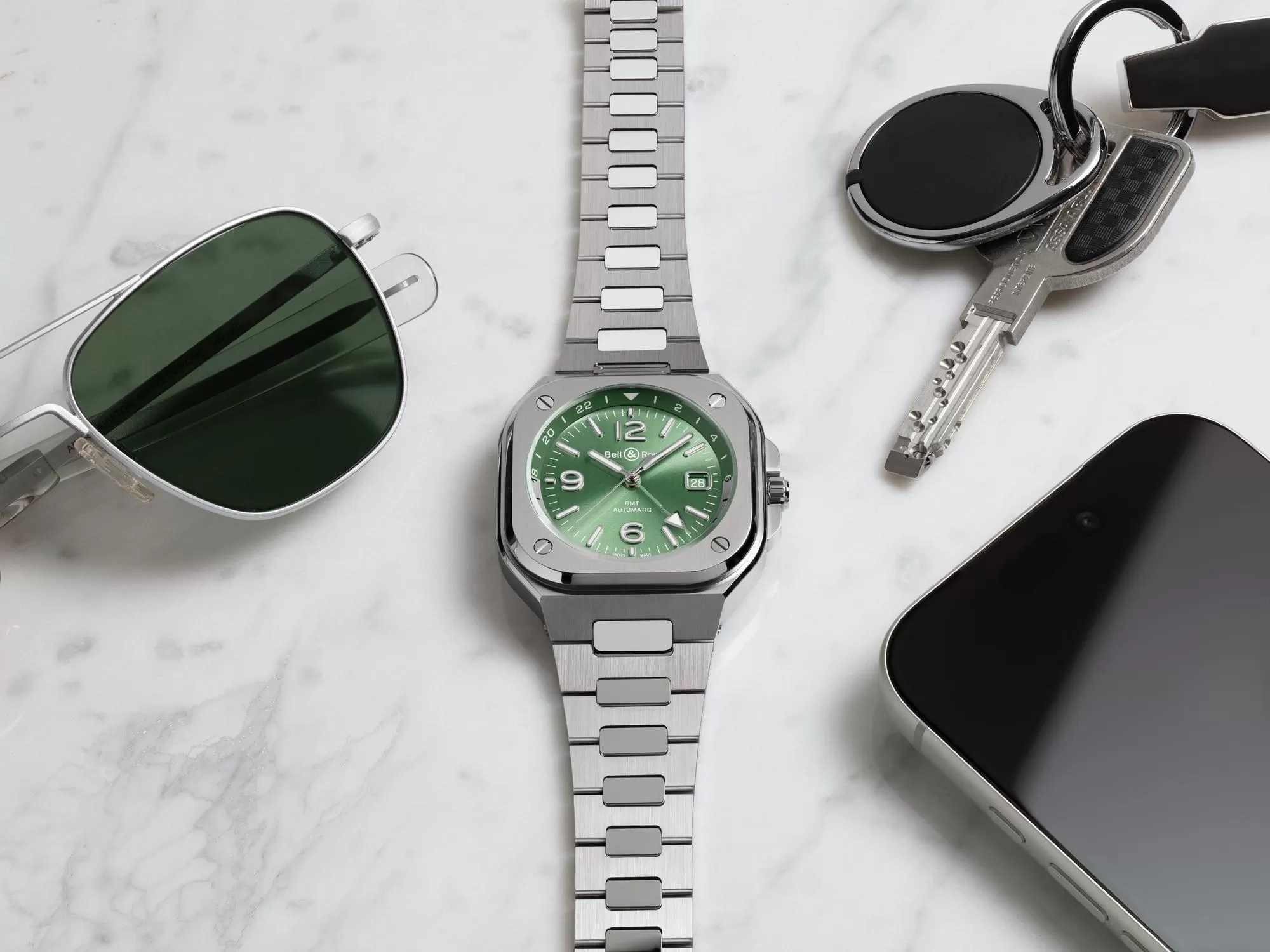
The complication differs from a standard GMT in user flow. A GMT (Rolex, Omega, Tudor, Glashütte) has a fixed local-time main hand and an independent 24-hour second-zone hand; the user reads the second zone off the 24-hour scale on the bezel or rehaut. A Travel Time, by contrast, lets the user step the displayed local hour to wherever they are on landing, leaving the home-time reference intact for context. The Travel Time format is more natural for international travellers; the GMT format is more natural for pilots and operations staff who need a continuous UTC reference.
"A pilot needs UTC. A traveller needs to read where they are. The Travel Time is for the traveller."- Watch designer on the Travel Time vs GMT distinction
Patek Philippe codified the modern format with the reference 5110 in 1997: 38mm gold case, two pushers at 8 and 10 o'clock, local hour jumps in either direction, home time read off the central skeletonised hour hand. The 5110 was succeeded by the 5134 (2005, Calatrava-cased), the 5230 (2016, World Time-derived), and the modern 5524 Pilot Travel Time (2015, the controversial pilot-cased Patek). Patek Travel Time is now a sub-category at the top of the haute-horlogerie segment.
Jaeger-LeCoultre launched the Master Geographic in 1992, a parallel implementation with second-zone reading via a city-disc instead of pusher-stepped local hour. A. Lange & Söhne's Lange 1 Time Zone (2005) and the Saxonia Dual Time implement the format with the brand's signature outsize date moving with local time. IWC Big Pilot Constant-Force Tourbillon, Blancpain GMT, and Ulysse Nardin Dual Time are other notable implementations.
The complication is more complex to build than a GMT. The local hour wheel must be decoupled from the underlying time train and stepped via a pusher-actuated jumper that drops the date click on each rollover. The integration with an automatic movement plus date complication produces a full-featured travel watch in a slim case; the Patek 5524 Cal. 324 S C FUS is approximately 55 components beyond a base automatic. Retail pricing reflects the complexity: most Patek Travel Time references are CHF 35,000-60,000 in steel/gold; Lange Time Zone CHF 40,000-70,000.





Comments 1