If you are looking for a Patek Philippe perpetual calendar under 40mm, in white gold, with a proper in-house movement, and you do not want to write a six-figure cheque, the shortlist is short. It is the 3940G or the 5140G. Same family. Same movement (Cal. 240 Q). Same 19mm lug width. Same three-subdial dial layout with the moonphase at six. And yet the market treats them as two distinct watches with distinct buyers. Here is why, and which one we think makes more sense in 2026.
The short version
- 3940G - the icon. In production 1985 to 2007 across four dial series. 36mm case, 8.9mm thick. Cal. 240 Q. Clean examples trade €64k to €87k. Strong-condition second series, first series, and special dials now push well over €92k.
- 5140G - the successor. In production 2006 to 2018. 37.2mm case, 8.5mm thick. Same Cal. 240 Q. Trades in the €46k to €64k band; full sets with box, papers, and Extract at the top of that range.
- Both share the same movement, lug width, dial layout, and philosophy: a self-winding ultra-thin perpetual that reads like a dress watch.
- Neither has ever been "cheap". Both are still dramatically cheaper than a modern 5327G at retail (~€84k, if you can get one).
Timeline: how we got here
The 3940 arrived in 1985 as the replacement for the reference 3450, which had replaced the reference 2438/1. It was the perpetual calendar that made the complication accessible in a modern, ultra-thin, self-winding case. It ran for 22 years across four series, distinguished by dial details like the shape of the applied hour markers, the alignment of the sub-registers, and the transition from tritium to Luminova on some markers. Roughly 7,000 pieces were made across all metals, of which the 3940G is the white-gold slice.
The 5140 arrived in 2006, launched exclusively in white gold as the 5140G, with yellow, rose, and platinum variants following through 2010. Patek increased the case diameter from 36mm to 37.2mm, softened the bezel profile slightly, and left the movement, dial layout, and character alone. Production ran until roughly 2018, when the current 5327G took over the slot as the "entry" perpetual.
Case and wearability
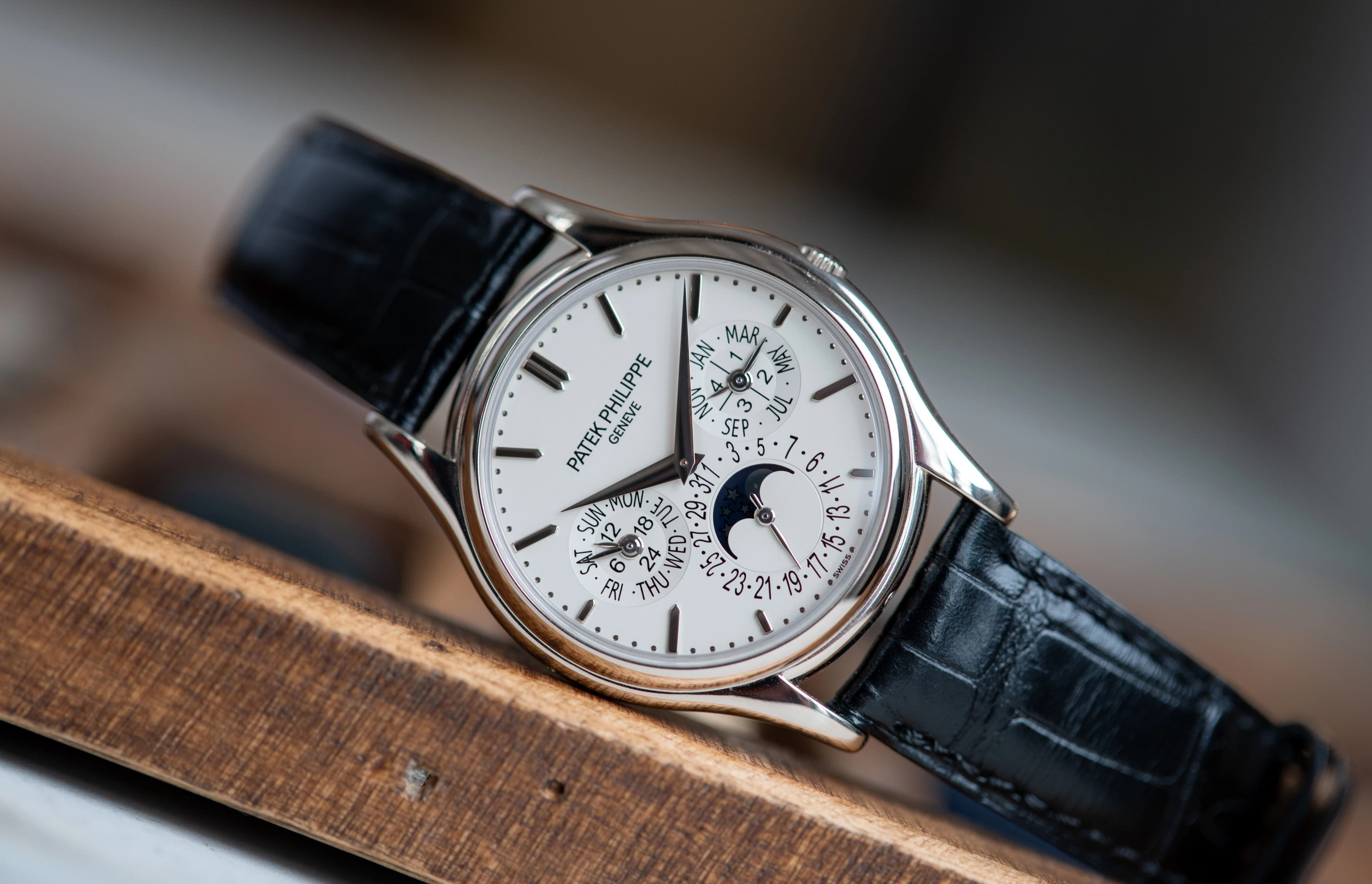
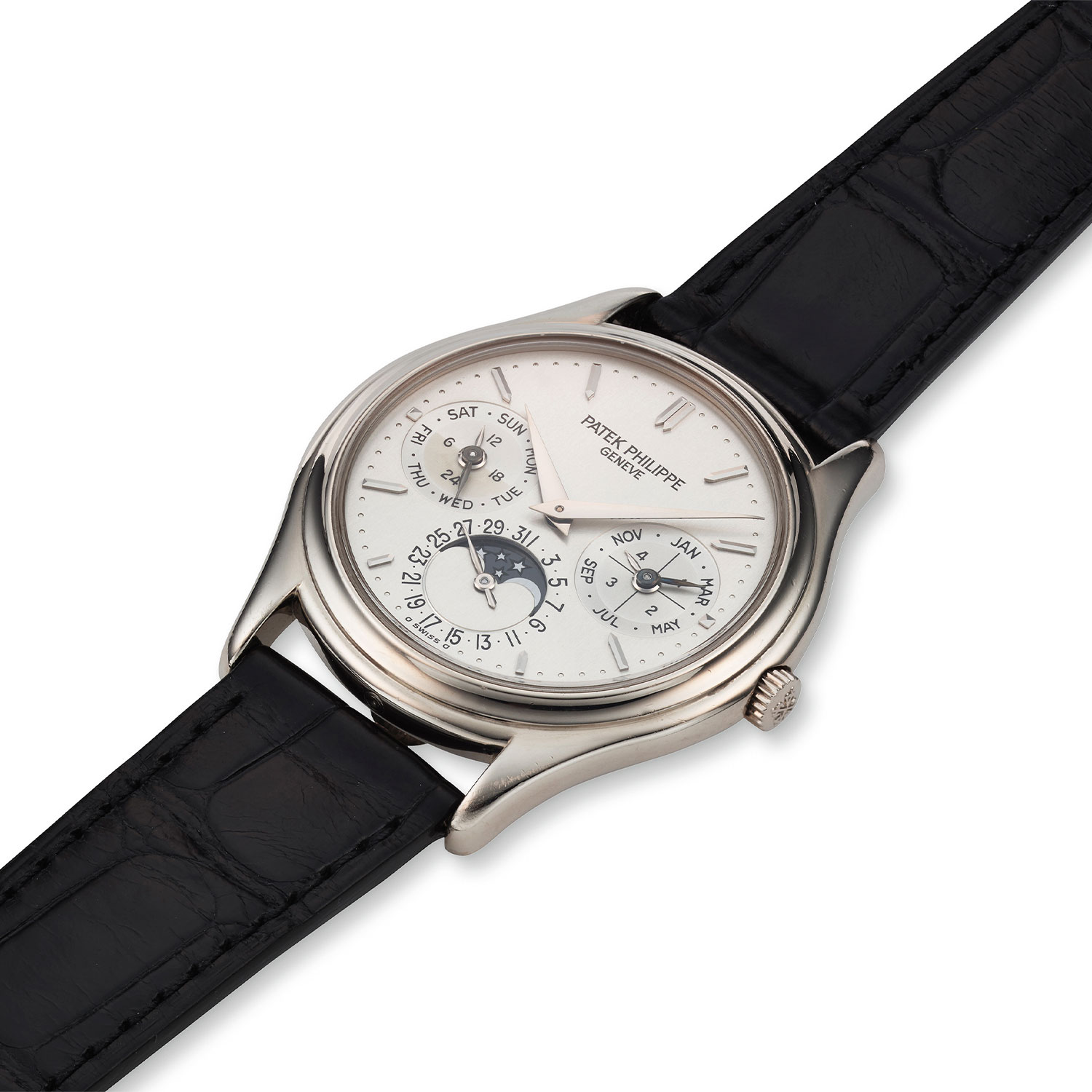
The 3940G measures 36mm across by 8.9mm thick. That is genuinely small by 2026 standards. On a 7-inch wrist it disappears under a cuff. Lug-to-lug sits around 44mm. It wears exactly the way a Patek dress watch is supposed to wear: light, discreet, and unmistakably from the top drawer.
The 5140G is 37.2mm by 8.5mm. Lug-to-lug is about 46mm. The extra 1.2mm of diameter is the difference between "quite small" and "just right" for most modern wrists. Patek also trimmed the case by 0.4mm because the crystal profile was redesigned; that keeps it visually tight even at the larger diameter. Both share the same 19mm lug width, so any strap that fits one fits the other.
Which is better on-wrist is genuinely down to your wrist and your era preference. Anyone who grew up with 34 to 36mm dress watches will find the 3940G perfect. Anyone whose baseline is a modern 40mm sports watch will find the 5140G more balanced without ever feeling large.
Dial and design
Both watches use the same three-register layout: day + 24-hour at 9, month + leap year at 3, date + moonphase at 6. The main hands are dauphine, the seconds are shown as a needle in the 6 o'clock subdial, and the moon is at the bottom half of that subdial. That was Patek's language for a self-winding perpetual and both watches speak it fluently.
Where they differ, and this is the reason a lot of long-time 3940 owners never really warmed to the 5140:
- Subdial size. This is the biggest visual difference. The 5140's subdials are noticeably larger than the 3940's, filling more of the dial and leaving less negative space around them. On the 3940 the three registers sit as tight, distinct pods; on the 5140 they push closer to the chapter ring and to each other.
- Logo size. The "PATEK PHILIPPE GENEVE" signature under 12 is visibly larger on the 5140. Letter height, letter width, and stroke thickness all go up a notch. On the 3940 the logo sits as a discreet crown-plus-signature; on the 5140 it announces itself.
- Font and print size. The day, month, and date printing on the 5140 is set in a chunkier, taller font than the 3940. The moon-cycle arc is wider. The "PERPETUAL CALENDAR" line sits bolder as well.
- Bezel. The 3940G bezel is slightly stepped and thinner. The 5140G bezel is a single sloped surface, marginally taller. Combined with the larger subdials, the 5140 reads as the more assertive watch of the two.
- Hour markers. Late 3940G (third and fourth series) and 5140G use similar applied faceted batons. Early 3940G first series (1985-1989) has narrower, more delicate markers.
- Subdial texture. Both use snailed subdials. The 5140G subdials read a touch cleaner because the printing has slightly less baseline age.
Sum it up and you get the running collector opinion: the 5140 is a good-looking watch, but it is less subtle than the 3940. The 3940 is the quieter, more classical dial. The 5140 is the same idea, one confidence step up in weight. On the wrist at a distance, most people still mistake one for the other. Up close, the person wearing the 3940 usually notices the difference first.

Movement: identical, and that is the point
Both watches use calibre 240 Q. Introduced in 1977 for the reference 3738, it is one of the great self-winding ultra-thin movements: 275 parts, 27 jewels, 22K gold micro-rotor recessed into the mainplate so the movement stays 3.75mm thin even with the perpetual module. Power reserve is 38 to 48 hours depending on state of wind. The rate is regulated to Patek's own Superlative Chronometer standard, which is stricter than COSC.
There is no difference in movement between a 3940G from 1998 and a 5140G from 2014. If you buy either, you own a great calibre 240 Q perpetual, and servicing them costs about the same at Patek (roughly €1,100 to €1,650 for a standard service on a perpetual, budget every 5 to 7 years).
Prices right now
Current market, checked August 2026 against Chrono24, EveryWatch, and dealer listings:
- 3940G, honest daily example: €64k to €78k. Third and fourth series with box, papers, and clean dials cluster here.
- 3940G, strong condition or early series: €87k to €101k. Second series with sharp original dial, first series with tritium markers, and unpolished cases are all at or through six figures now.
- 3940G, special dials and collector pieces: €110k and up. Salmon, breguet-marker, and full-provenance early-series pieces regularly clear that at auction.
- 5140G, everyday example: €43k to €53k. Bare watch or partial documentation in this range.
- 5140G, full set: €55k to €64k. Box, papers, Extract of the Archives, recent service invoice.
- 5140G, boutique-fresh or NOS: €69k to €85k. Rare, but they do surface.
The interesting takeaway: the older watch is roughly €23k more expensive than the newer one, and the gap is widening. Vintage-adjacent Pateks normally command a premium over their production successors, and the 3940G has done that for years - but the last twelve months have seen strong-condition 3940G examples push over €92k, while the 5140G has held closer to the €51k line. If you want a Patek perpetual, the 5140G is now the value play. If you want the piece with the collector arc, the 3940G is the one that keeps moving up.
For the 3940G, obsess over dial condition, service history, and originality of the applied markers. Refinished dials exist and drop value meaningfully. For the 5140G, obsess over box, papers, and Extract of the Archives; a full set is worth roughly €4,600 to €7,350 more than a bare watch of the same reference. Both benefit from a recent Patek service; ask for the invoice.
Which one is for you?
Pick the 3940G if: you have a smaller wrist, you want a piece with the collector arc and the strongest upside in the segment, and you are comfortable spending well into six figures for a strong-condition example. It is the watch that put the self-winding perpetual on the map, and the market is treating it accordingly.
Pick the 5140G if: you want the modern wear (37.2mm reads more contemporary), you want the reassurance of a full set with recent service, and you want a Patek perpetual for roughly half the money a comparable 3940G now costs. It is the value play in Patek's perpetual line right now.
Neither is a mistake. Both are dramatically better value than the current 5327G at retail, both are quieter than a Nautilus in every conceivable way, and both are the sort of watch you buy once and keep for 20 years. If we had to choose in 2026 on cold value, we would take the 5140G with box and papers. If we were writing the cheque for the piece we would hand to a child, we would take the 3940G, and we would understand exactly why it costs what it costs.
Comments
No comments yet, be the first to weigh in.