
In the late summer of 1971, Audemars Piguet's managing director Georges Golay commissioned Gerald Genta - already an established independent watch designer in Geneva with previous work for Omega and Universal Geneve - to produce a new watch for launch at the Basel Fair in April 1972. Golay specified that the watch had to be in steel, unprecedented for a Patek-tier luxury manufacturer, and had to be an “unprecedented sports watch”. The brief was remarkable both in its ambition and in its source: AP in 1971 was a small manufacture producing roughly 6,000 watches a year and facing severe competitive pressure from the emerging quartz industry. Genta completed the design overnight and delivered technical drawings the next morning.
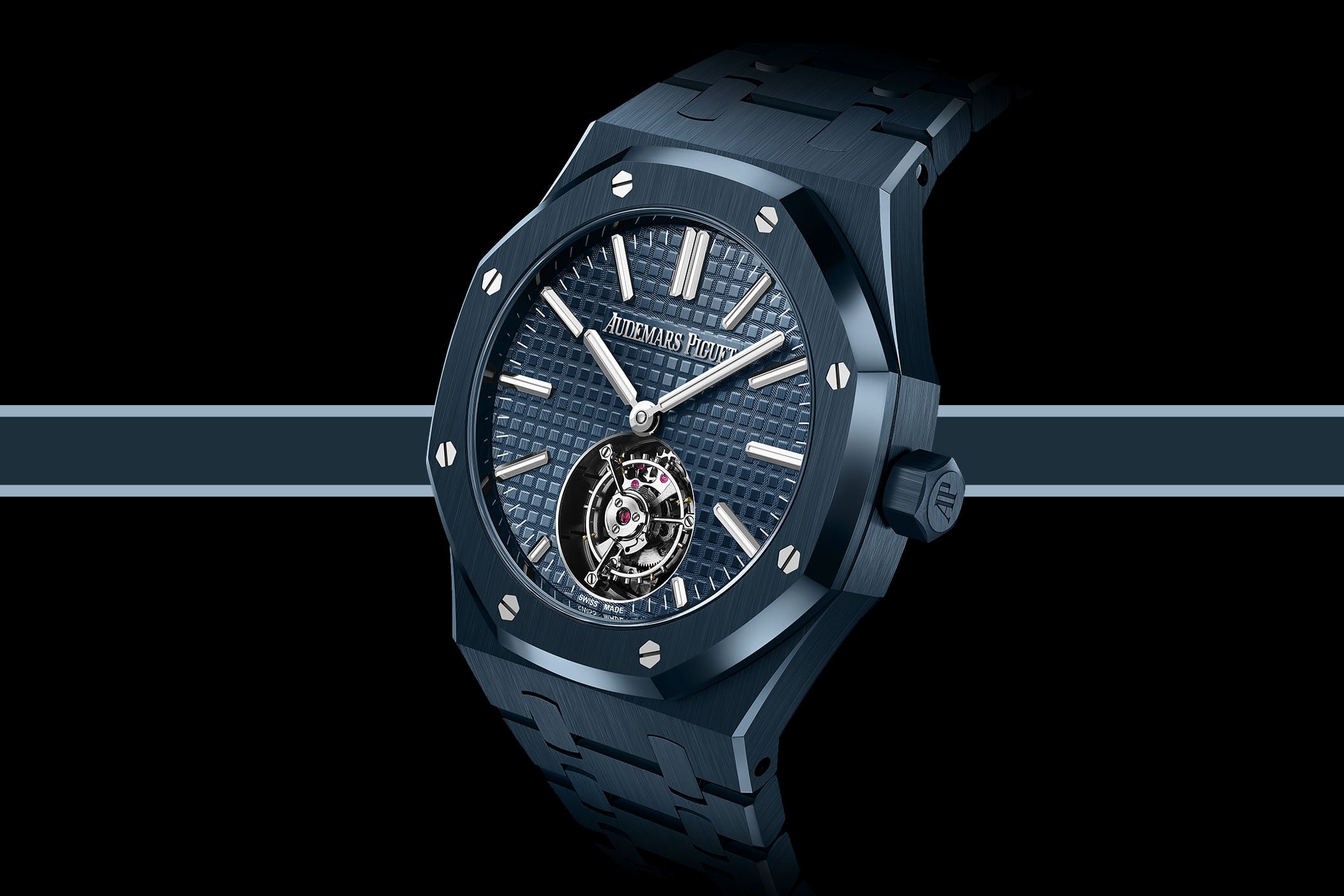
The design took its name and its distinctive octagonal bezel from the portholes of the HMS Royal Oak, a British Royal Navy battleship. The eight hexagonal screws piercing the bezel, visible rather than hidden, referenced the industrial aesthetic of deck fastenings. The dial carried a small-scale checkerboard grid called tapisserie - a hand-guilloche pattern that Genta saw as providing texture appropriate for a luxury sports object. The integrated bracelet, with its trapezoidal link architecture, was equally unprecedented: until the Royal Oak, integrated bracelets on wristwatches existed almost exclusively on low-price quartz or digital designs. Genta was reportedly paid 3,000 Swiss francs for the complete design - a figure widely regarded in retrospect as the most undercharged industrial-design commission of the 20th century.
The Royal Oak ref 5402ST launched at the Basel Fair in April 1972 at 3,650 Swiss francs - ten times the price of a Rolex Submariner and approximately the price of a solid-gold Patek Calatrava. Production was strictly limited: the original A-Series was capped at 1,000 pieces, each case individually numbered and signed on the dial with a small letter “A” before the reference. The 39mm Jumbo case housed the ultra-thin Cal. 2121 automatic (4mm thick), based on the Jaeger-LeCoultre Cal. 920 and refined in-house by AP - the same movement used simultaneously by Patek Philippe in the 3700 Nautilus and by Vacheron Constantin in the 222. Initial reception among dealers and collectors was cool: a luxury steel sports watch priced at ten times a Submariner was without precedent, and AP sold approximately 1,000 units per year through the mid-1970s.
The Royal Oak survived the quartz crisis against expectations, and through the 1980s and 1990s became the commercial anchor of the brand that it remains today. The 36mm ref 14790 launched in 1992 added a smaller-diameter version aimed at a broader customer base, and in 1993 AP launched the Royal Oak Offshore - designed by Emmanuel Gueit while in-house at the manufacture - as an oversized 42mm sports chronograph aimed at a new generation of collectors. The Offshore was initially controversial; Genta himself reportedly called it “The Beast” with disdain when he first saw it. But it established an entire sub-family that now rivals the original Royal Oak in commercial importance. The 41mm ref 15400ST (2012) introduced the modern Selfwinding mid-size Royal Oak, and the Royal Oak Concept line launched in 2002 became a laboratory for experimental materials including forged carbon, titanium, and high-tech ceramic.
In 2022, for the Royal Oak's 50th anniversary, Audemars Piguet introduced the ref 16202ST with the new in-house Cal. 7121 automatic movement (55-hour power reserve, fully hand-finished to the highest Swiss standards) and a subtly revised Jumbo case that preserved the original 1972 proportions while updating the finishing and dial treatment. The 16202ST replaced the long-running ref 15202ST (2012-2022), which itself had been the direct successor to the original 5402. The complete Royal Oak family now spans the Jumbo Extra-Thin, Selfwinding, Chronograph, Offshore, Concept, and Perpetual Calendar sub-collections in diameters from 34mm to 44mm and in steel, pink gold, white gold, yellow gold, platinum, titanium, ceramic, and composite materials. Fifty years after Genta's overnight sketch, the Royal Oak has become the single most imitated luxury sports watch design in the world - the template that every integrated-bracelet sports watch from every luxury manufacturer references either directly or obliquely.










Comments
No comments yet, be the first to weigh in.