Patek Philippe
Calatrava / Nautilus / Aquanaut
Various
Geneva-tradition haute horlogerie. Calatrava-cross seal, multi-generational ownership.
The collector dilemma at the absolute top of horology. Patek Philippe's Geneva tradition vs A. Lange & Söhne's Saxon revival, two of the most-finished movement architectures in production.
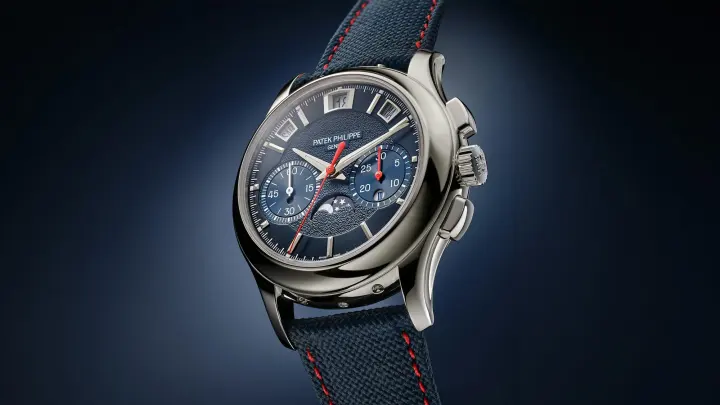
Patek Philippe founded in Geneva, 1839, and never stopped operating; the Calatrava cross seal of quality has covered the brand since the late 19th century. The Geneva-tradition movement decoration vocabulary (anglage on bridges, Côtes de Genève / Geneva stripes, polished sinks for the jewels) is the brand's house language. Patek's flagship references span Calatrava (round dress), Nautilus (integrated-bracelet sport), Aquanaut (rubber-strap sport), and the perpetual-calendar / minute-repeater / split-seconds complications at the very top.
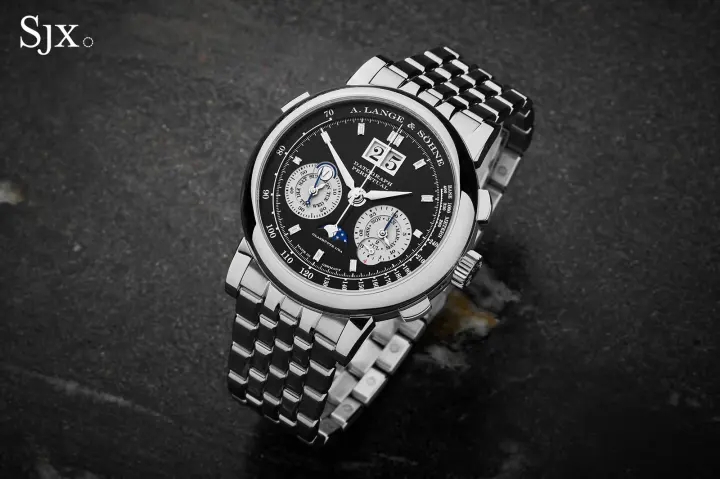
A. Lange & Söhne founded in Glashütte, 1845, was wiped out by the Soviet expropriation of East Germany in 1948 and revived by Walter Lange in 1990. The Saxon decoration vocabulary (German-silver three-quarter plate, gold chatons, hand-engraved balance cock with anglage) is distinct from Geneva tradition and visible through the case-back. Lange's flagship references are the Lange 1 (asymmetric off-centre dial), Saxonia (clean round dress), Datograph (flyback chronograph), and 1815 (manual-wind heritage).
| Attribute | Patek Philippe Calatrava / Nautilus / Aquanaut | A. Lange & Söhne Lange 1 / Saxonia / Datograph |
|---|---|---|
| Reference watches | Calatrava 5226G, Nautilus 5811, Aquanaut 5167 | Lange 1, Saxonia Thin, Datograph Up/Down, 1815 |
| Founded | 1839 (Geneva, continuous) | 1845 (Glashütte) / 1990 revival |
| Annual production | ~62,000 watches | ~5,500 watches |
| Movement architecture | Geneva-tradition bridges + plate | German-silver three-quarter plate |
| Decoration | Anglage, Côtes de Genève, polished sinks | Glashütte ribbing, hand-engraved balance cock, gold chatons |
| Hairspring | Spiromax silicon (modern refs) | Bespoke alloy (in-house) |
| Service interval | 5-7 years | 6-8 years |
| Sport flagship | Nautilus 5811 (€38,000) | Odysseus (€39,500) |
| Dress flagship | Calatrava 5226G (€34,000) | Saxonia Thin 211.027 (€18,300) |
| Chronograph flagship | Patek 5170 (€65,000) | Datograph Up/Down (€85,000) |
| Resale (Nautilus / Lange 1) | 1.5-3x retail | 0.95-1.2x retail |
The two finishing schools look distinctly different through the case-back. Geneva tradition (Patek): movement bridges in rhodium-plated brass, anglage (45° polished bevels) on every bridge edge, Côtes de Genève striping (parallel polished waves), polished sinks around each jewel hole, a gold rotor with the Calatrava cross.
Saxon tradition (Lange): the famous three-quarter plate in untreated German silver (a single bridge covering two-thirds of the movement), Glashütte ribbing (perpendicular wave pattern, not Geneva's parallel), gold chatons (gold rings holding jewels in place, screwed in), hand-engraved balance cock with anglage applied by hand on every example.
Both are at the highest tier of mechanical watch finishing in production. They are not interchangeable; collectors with both routinely cite the Lange decoration as visually richer through the case-back.
Patek's catalogue strength is at the perpetual-calendar / minute-repeater tier: the 5236P in-line perpetual calendar (€115,000), the 5520P alarm with travel time (€225,000), the 5374 minute-repeater perpetual calendar (€625,000+). Patek essentially owns the multi-complication category.
Lange's catalogue strength is at the chronograph tier: the Datograph Up/Down (€85,000) is widely cited by collectors as the most-finished serial-production chronograph in the world; the 1815 Chronograph (€55,000) is the simpler version of the same architecture; the Triple Split (€175,000) is mechanically unmatched. Lange chronographs are designed and decorated more heavily than Patek's equivalent references.
Patek produces roughly 62,000 watches/year, against Lange's 5,500 watches/year. Patek's sport-watch references (Nautilus, Aquanaut) trade at 1.5-3x retail; the 5711/1A discontinuation in 2021 pushed peak resale to 5x retail and brought the brand into mainstream awareness.
Lange's production volume is roughly 1/11th of Patek's. Resale on the Lange 1 sits around 0.95-1.2x retail; Datograph variants similar; Odysseus (the integrated-bracelet sport) trades at 1.0-1.4x retail. The Lange brand does not have the speculative premium that Patek sport references carry; this is treated as a feature by serious collectors who want to wear what they buy without flipper anxiety.
If you want brand recognition outside watch circles and resale upside: Patek Philippe. Calatrava 5226G for round dress, Nautilus 5811 if you have the allocation, Aquanaut 5167 if you don't.
If you want the most-finished movement at the price and you want to wear without flipper attention: A. Lange & Söhne. Saxonia Thin 211.027 for entry-Lange (€18,300, the most-recommended starter), Lange 1 for the asymmetric flagship, Datograph Up/Down for the most-finished chronograph in production at any price.
For collectors building a collection of two: many start with a Patek Calatrava and add a Lange Saxonia or Lange 1; the Geneva and Saxon decoration vocabularies sit next to each other rather than competing. They answer different aesthetic questions in the same finishing tier.
Question, suggestion, or just want to say hi? Drop a note.
Comments
No comments yet, be the first to weigh in.