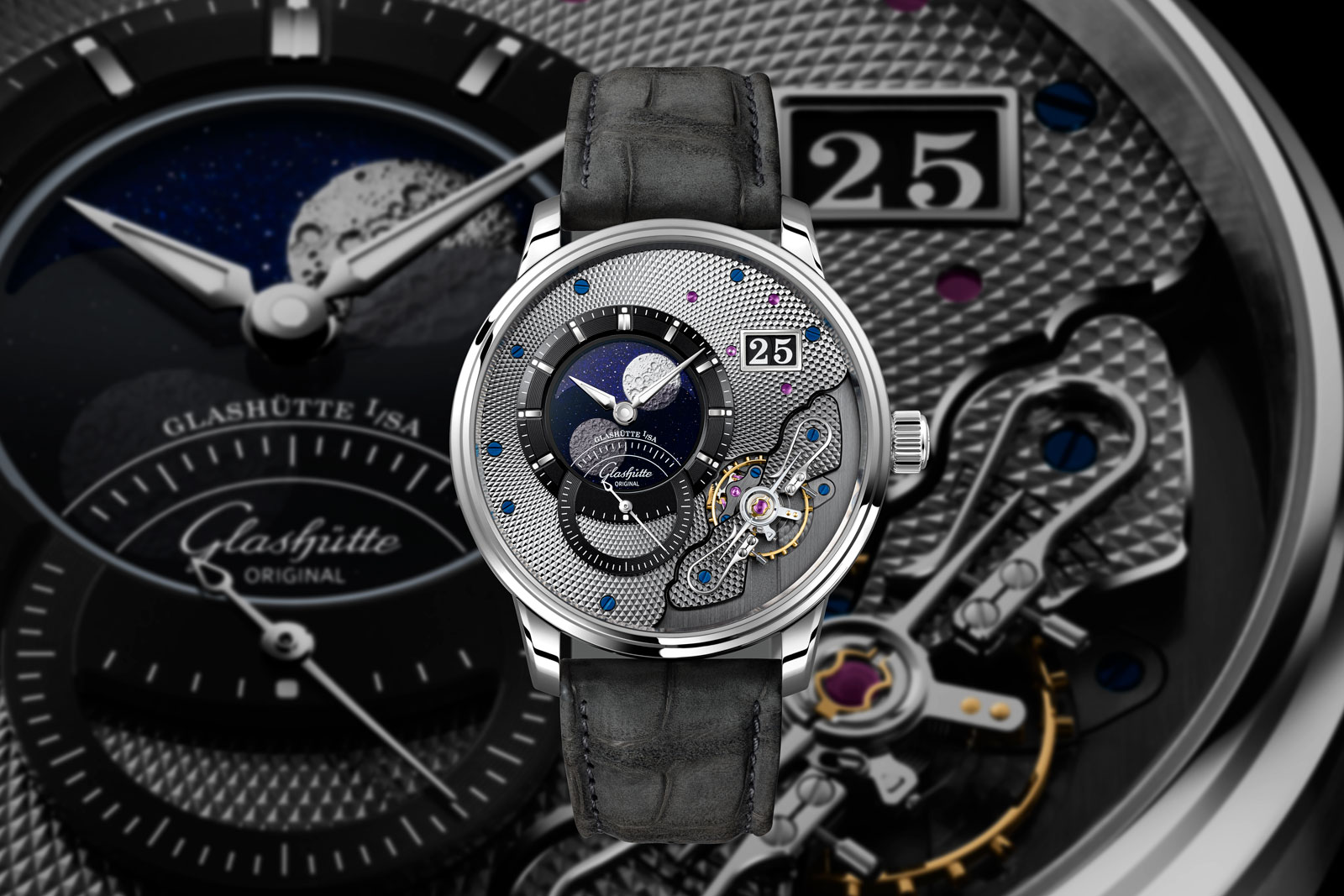
The three-quarter plate, in German Dreiviertelplatine, is the movement architecture that defines Glashütte watchmaking. Where a typical Swiss-style movement uses multiple smaller bridges, separately-secured pieces of metal that each cover one element of the gear train (barrel, third wheel, fourth wheel, escape wheel), a Glashütte caliber uses one large bridge covering approximately three-quarters of the back of the movement, with only the balance cock and a small barrel-side cutout left as separate pieces. The visual effect is monolithic: a single broad expanse of polished German silver or rhodium-plated brass, often hand-engraved across its surface, with the gear train hidden underneath.
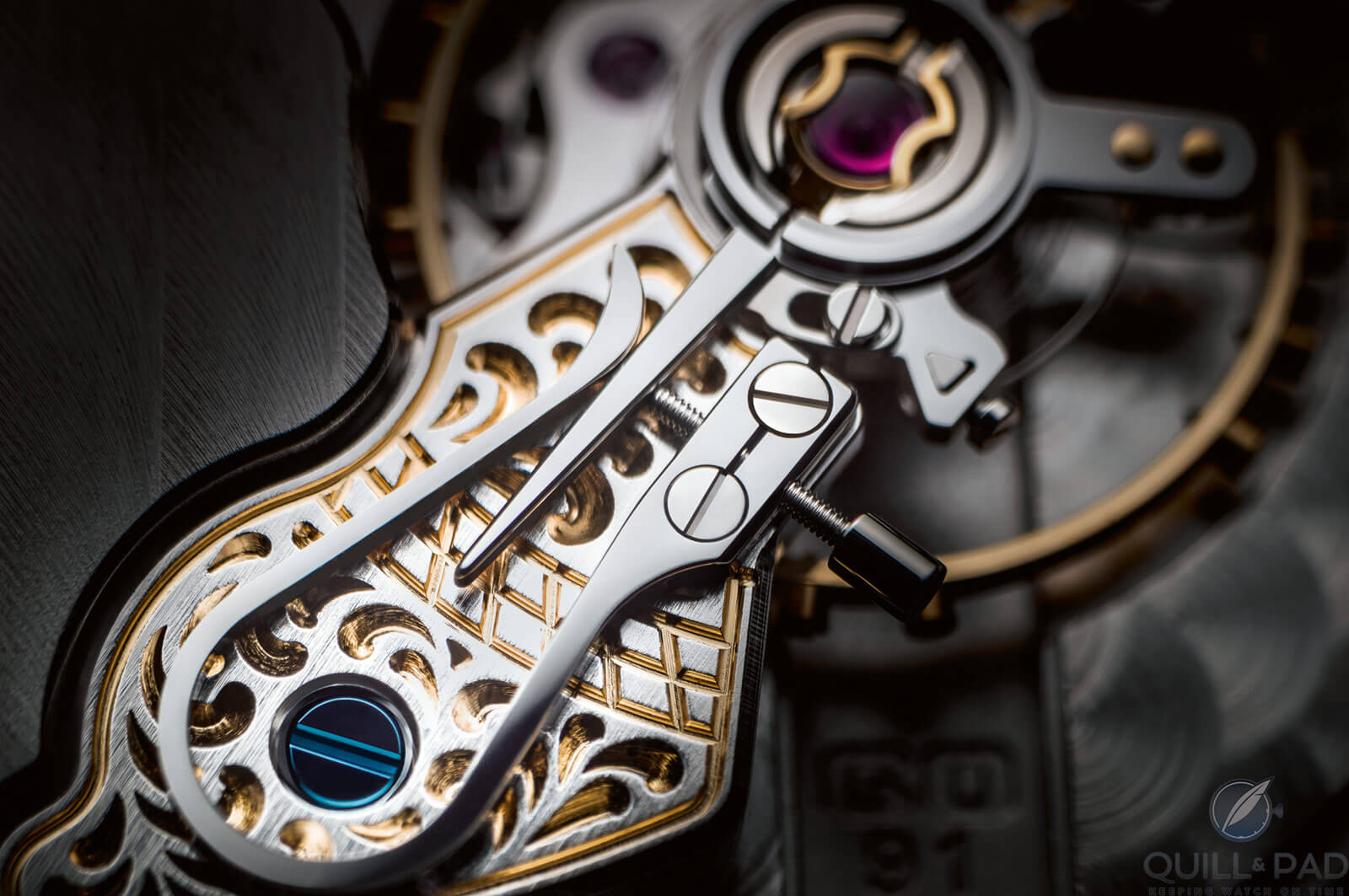
The architecture was introduced by Ferdinand Adolph Lange in 1864, twenty years after he founded the original A. Lange & Söhne workshop in Glashütte. Lange's reasoning was both technical and aesthetic. Technically, a single large bridge is significantly more rigid than multiple small bridges; the gear-train pivots remain in better alignment under shock and over time, leading to better long-term rate stability. Aesthetically, the large bridge offered an enormous canvas for hand-finishing, perlage, hand engraving (the balance cock, which was retained as a separate piece, was always hand-engraved), and decorative cuts. Lange's 1864 caliber was visually unlike any Swiss movement of the period and immediately became the technical visual identifier of Glashütte production.
"The three-quarter plate is to Glashütte what Côtes de Genève is to Geneva: a way of saying, before you have read the dial, where the watch was made."- Watchmaking commentary on regional movement architecture
The three-quarter plate spread across the entire Glashütte watchmaking community over the next fifty years. Strasser & Rohde (founded 1875) and Union Glashütte (1893) used three-quarter plates in their pocket calibers; the Deutsche Uhrmacherschule Glashütte (the German Watchmaking School, founded 1872) taught it as the standard German construction. By 1900 any Glashütte movement carried a three-quarter plate as a near-universal identifier; by contrast, in Le Locle and La Chaux-de-Fonds the multi-bridge construction remained dominant. The two Swiss-vs-German philosophies, "many small bridges" vs "one large plate", crystallised in this period and have remained essentially unchanged for 160 years.
The 20th century interrupted but did not end the three-quarter plate tradition. The 1948 nationalisation of Glashütte under the East German GUB combine kept the three-quarter plate as a technical convention; the GUB Cal. 70/75 family, built into millions of Spezimatic and Spezichron watches between 1948 and 1990, used a simplified three-quarter plate. After reunification, A. Lange & Söhne's post-1990 revival, the Lange 1 (1994) and the Saxonia (1994), restored the three-quarter plate to the haute-horlogerie level, complete with hand-engraved balance cock, gold chatons screwed into the plate around the jewel bearings, and Glashütte ribbing as the surface finish.
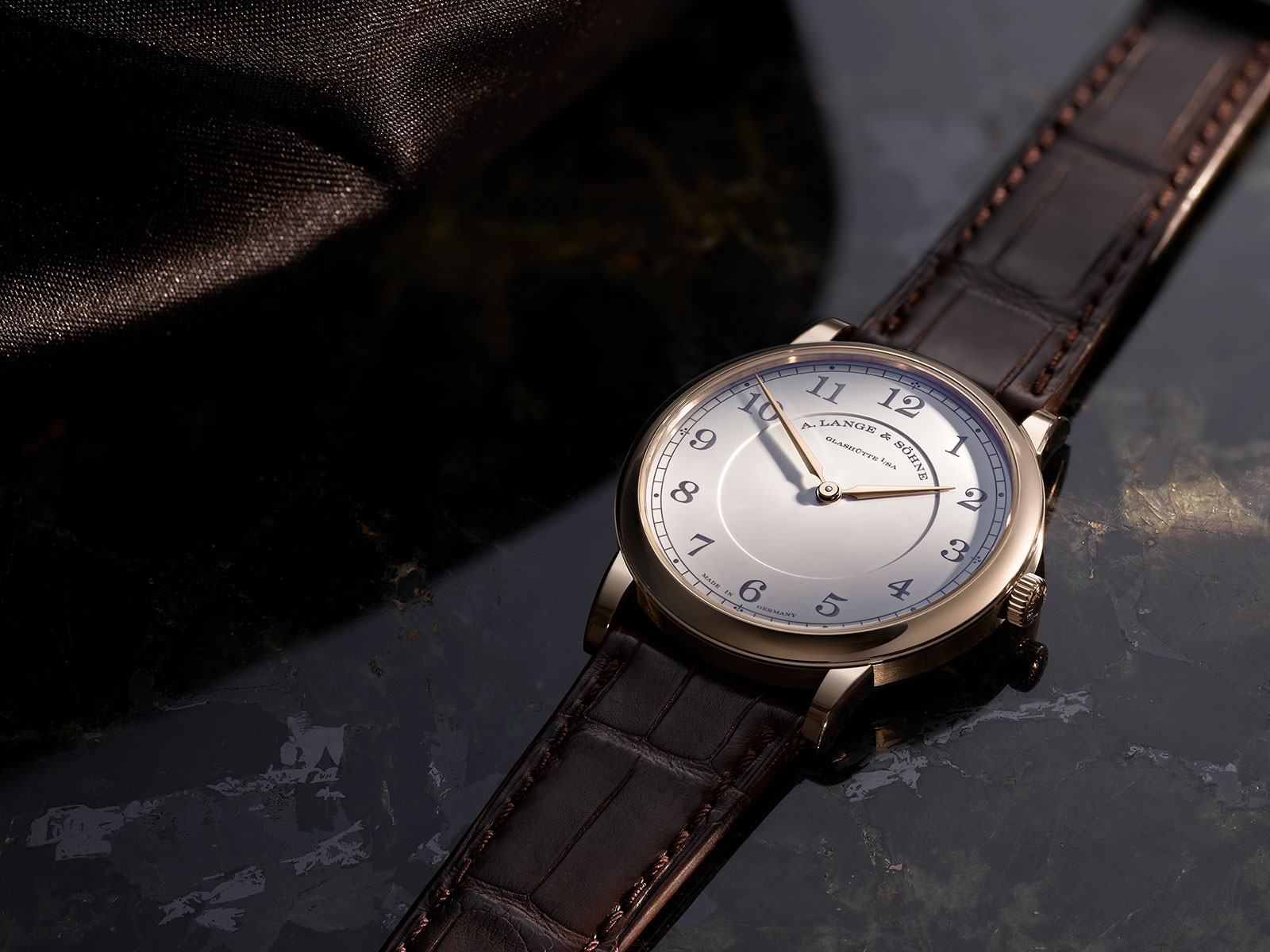
In current production the three-quarter plate is the visual identifier across the entire German fine-watchmaking range. A. Lange & Söhne's Cal. L121.1 (Lange 1, 2015) and Cal. L101.1 (Saxonia Thin) are textbook examples; Glashütte Original's Cal. 36 family carries the three-quarter plate at the slightly more industrial mid-tier; NOMOS's in-house Cal. DUW 6101 (Tangente Neomatik) uses it at the entry point of German haute-horlogerie. Mühle-Glashütte applies a three-quarter plate over its modified Sellita SW200 base to maintain the German visual identity; Moritz Grossmann applies a hand-engraved three-quarter plate on its Cal. 100 family.
The three-quarter plate is, in Glashütte brand vocabulary, what the Côtes de Genève stripes are to Swiss-finished movements: an immediately readable visual marker of provenance. A movement with three-quarter plate, hand-engraved balance cock, gold chatons, and Glashütte ribbing is, with very high probability, German. A movement with multiple smaller bridges, Côtes de Genève striping on each bridge, and individual chamfered bridge edges is, with very high probability, Swiss. This split is the strongest visual division in 20th and 21st century mechanical-watch construction, and the three-quarter plate is the single most important technical signature on the German side.
Comments 2