
The balance wheel, paired with a hairspring, is the oscillating mechanism that gives a mechanical watch its sense of time. When the escapement delivers an impulse to the balance, it swings in one direction against the restoring force of the hairspring, stops momentarily, and swings back. Each complete swing releases the escapement to advance the train one tooth. A typical 4 Hz movement beats 28,800 times per hour, or 8 beats per second.
Modern balance wheels are made from Glucydur, a beryllium-copper alloy with extremely low thermal expansion. The wheel is sized and weighted so that its rotational inertia, combined with the hairspring's stiffness, produces the target frequency. Adjustment has two schools: the classical screw balance (adjustable weights on screws threaded into the rim, poising done by adding or removing mass) and the modern free-sprung balance (no regulator; rate adjusted by varying the inertia via Gyromax-style weights, four or eight moveable inertia blocks on the rim, pioneered by Patek Philippe in 1949).
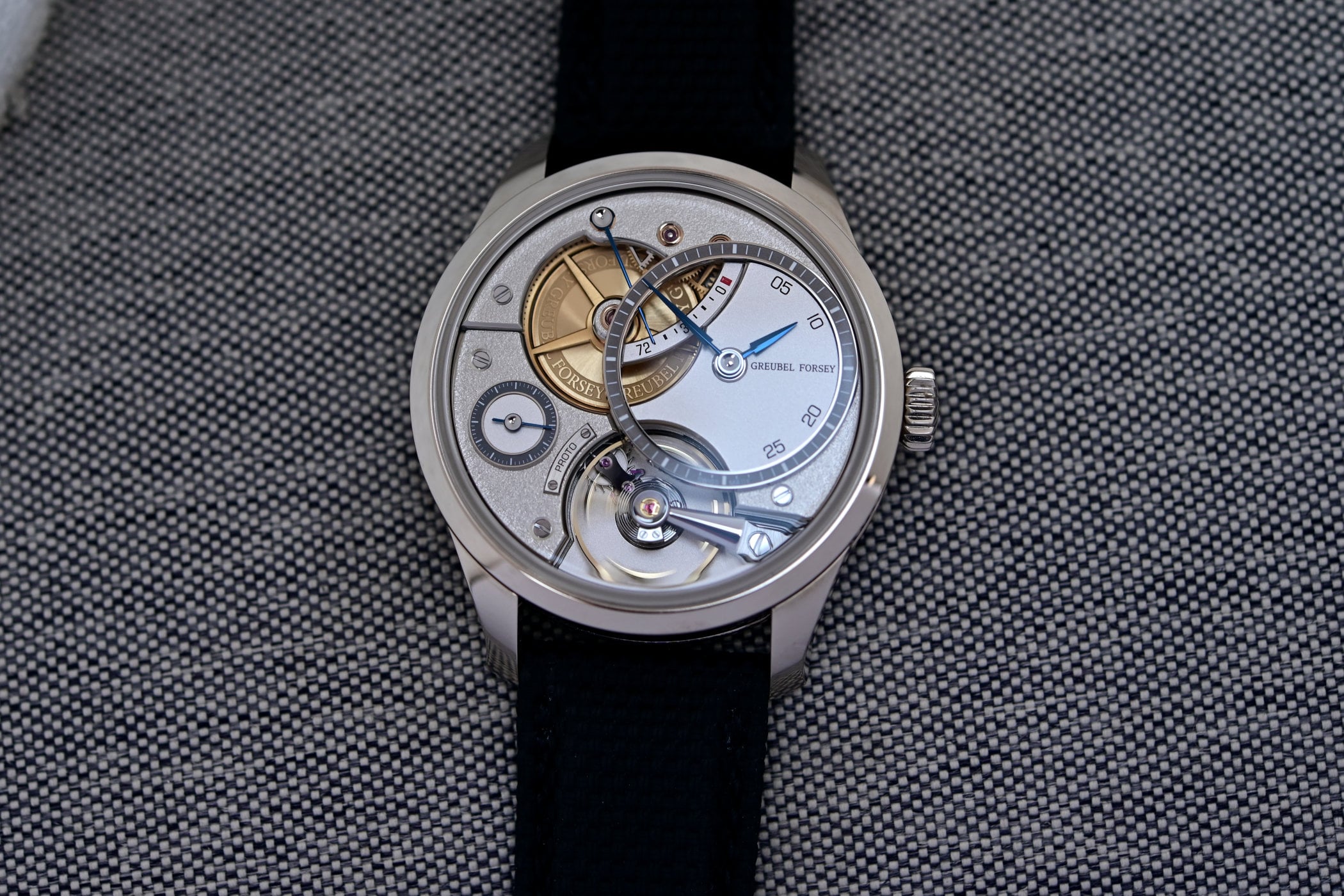
The modern trend is toward free-sprung balances with variable-inertia adjustment: Patek Philippe Gyromax, Rolex Microstella, Omega variable-inertia balance. All remove the conventional regulator arm, which is a point of vibration-induced error. Audemars Piguet, A. Lange & Söhne, and Jaeger-LeCoultre also use free-sprung balances in their higher-end movements.
Beat rates trade off amplitude against accuracy. Lower beats (2.5 or 3 Hz) give wider amplitude and lower wear but greater susceptibility to shock-induced rate changes. Higher beats (5 Hz, rarely 10 Hz) give better shock resistance and more precise chronograph timing, at the cost of higher escapement wear and greater amplitude loss. The Zenith El Primero (1969, 5 Hz) remains the only mass-market 5 Hz chronograph; Breguet's 10-Hz Type XXII (2012) is one of the few consumer 10-Hz watches ever produced.




Comments 2