COMEX (Compagnie Maritime d'Expertises) was founded in Marseille in 1961 by French naval engineer Henri Germain Delauze as one of Europe's first commercial saturation diving companies. The 1960s North Sea oil discoveries created a sudden demand for diving operations at 100-200+ metre depths for weeks at a time; conventional surface-supplied diving could not stay below the water more than a few hours per day. Saturation diving kept divers in pressurised "habitats" (small steel chambers) for the duration of an operation, breathing a helium-oxygen ("heliox") gas mixture, and decompressing only at the end of the multi-week shift.
In 1967, Rolex and COMEX formalised a technical partnership: COMEX divers would wear and operationally test experimental Rolex Submariners under saturation diving conditions, providing real-world failure data that no commercial test rig could replicate. Within months a recurring failure pattern emerged: during slow decompression at the end of saturation operations, helium gas that had dissolved into the watch case during pressurisation would expand outward faster than the gaskets could vent it, popping the crystal off the case and destroying the watch. The crystal-popping was not just a Rolex problem; Doxa (whose Sub 300 was widely used by COMEX) experienced the same failure mode.
"The crystal blew clean off the case on decompression. We knew the next watch we built had to vent the helium itself."- Rolex engineer on the 1967 COMEX field reports
Rolex and Doxa independently developed solutions in 1967: a one-way valve in the case side that vented helium during decompression while remaining sealed against water ingress under operating pressure. The Doxa version, the "Doxa Sub 300T HE-Patent", and the Rolex equivalent (the helium escape valve introduced in the Sea-Dweller ref. 1665 in 1967) used different valve geometries but solved the same problem. Rolex and Doxa cross-licensed the technology informally; both manufacturers credit the COMEX testing programme as the technical driver.
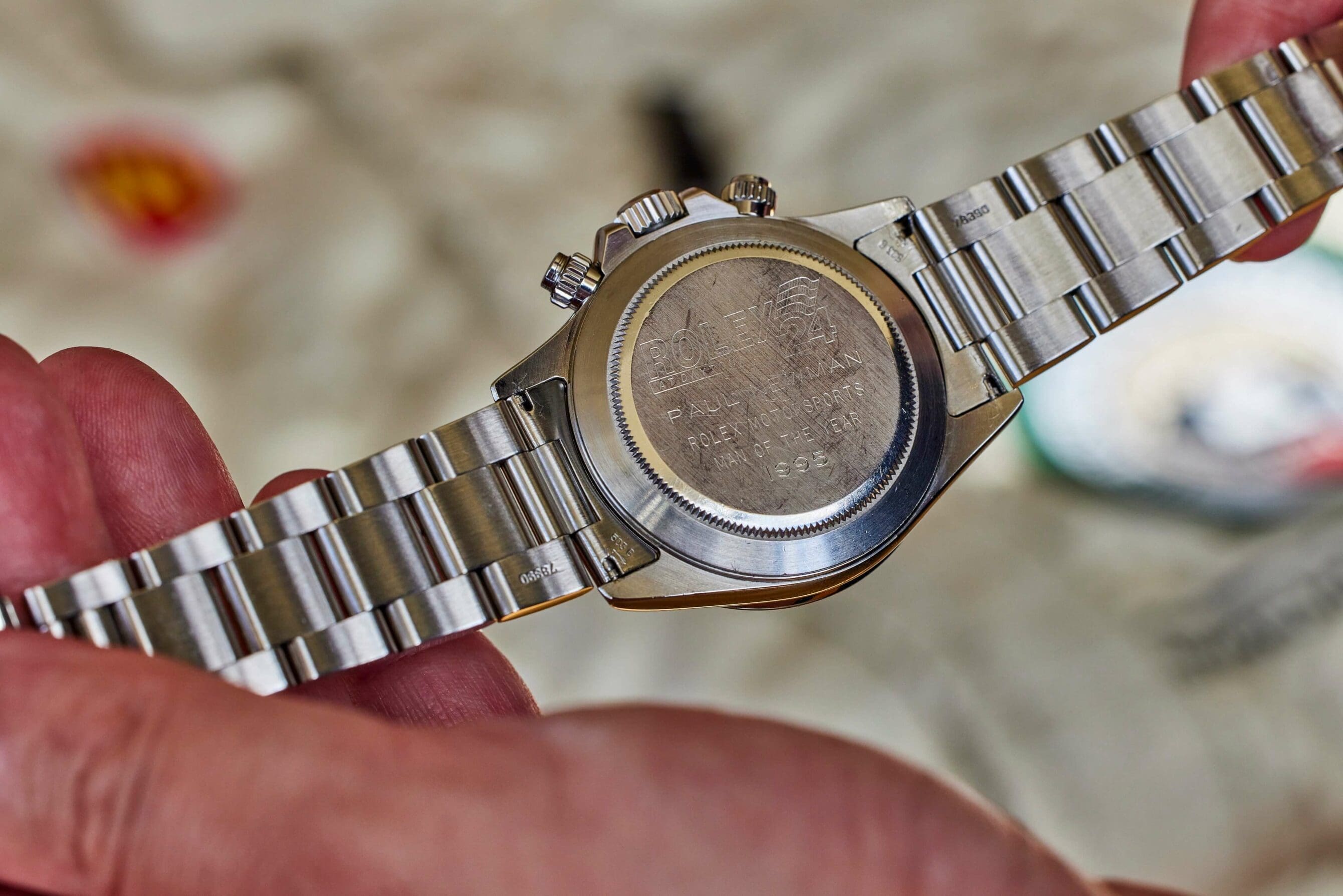
The COMEX Submariners and Sea-Dwellers with the diver's name engraved on the caseback or the COMEX logo on the dial are now among the most-collected vintage Rolex references. Production was tiny: each reference was produced in batches of 50 to ~3,000 pieces over the partnership period, and the watches were distributed direct to COMEX divers rather than through retail. Notable references: Submariner 5513 COMEX (no HEV, ~150 made), Submariner 5514 COMEX (with HEV, ~150-300 made; the only steel Submariner Rolex officially produced with a helium valve), Submariner 5517 COMEX (later HEV variant, <100 made), Sea-Dweller 1665 COMEX (~1,000 made through 1980), Sea-Dweller 16660 COMEX (~1,000-1,500 through the 1980s), and Sea-Dweller 16600 COMEX (latest production, into the 1990s).
Auction performance reflects the combination of low production and documented operational provenance. A typical Submariner 5513 COMEX in worn-but-original condition trades at USD 200,000 to USD 400,000; the rarer 5514 with HEV at USD 600,000 to USD 1,200,000+; the 5517 at USD 1,000,000+. Sea-Dweller 1665 COMEX with intact dial and original case engraving sits in the USD 200,000 to USD 500,000 range. Phillips, Christie's, and the specialist Bonhams auctions are the canonical venues; COMEX provenance is verified through Rolex's factory records (still maintained) and (where available) the diver's personal documentation and photographs.
The Rolex-COMEX partnership wound down through the 1990s as Rolex shifted from operational-test relationships to in-house engineering test programmes. The Sea-Dweller line continued to develop independently, culminating in the 2008 Deepsea (3,900 m WR) and the 2012 Deepsea Challenge (12,000 m, James Cameron Mariana Trench dive). The COMEX-marked references remain a closed historical chapter: no Rolex production with COMEX dial markings has been made since the 1990s, and the company itself, while still in saturation-diving operations, no longer issues new Rolex equipment to its divers.
Comments 1