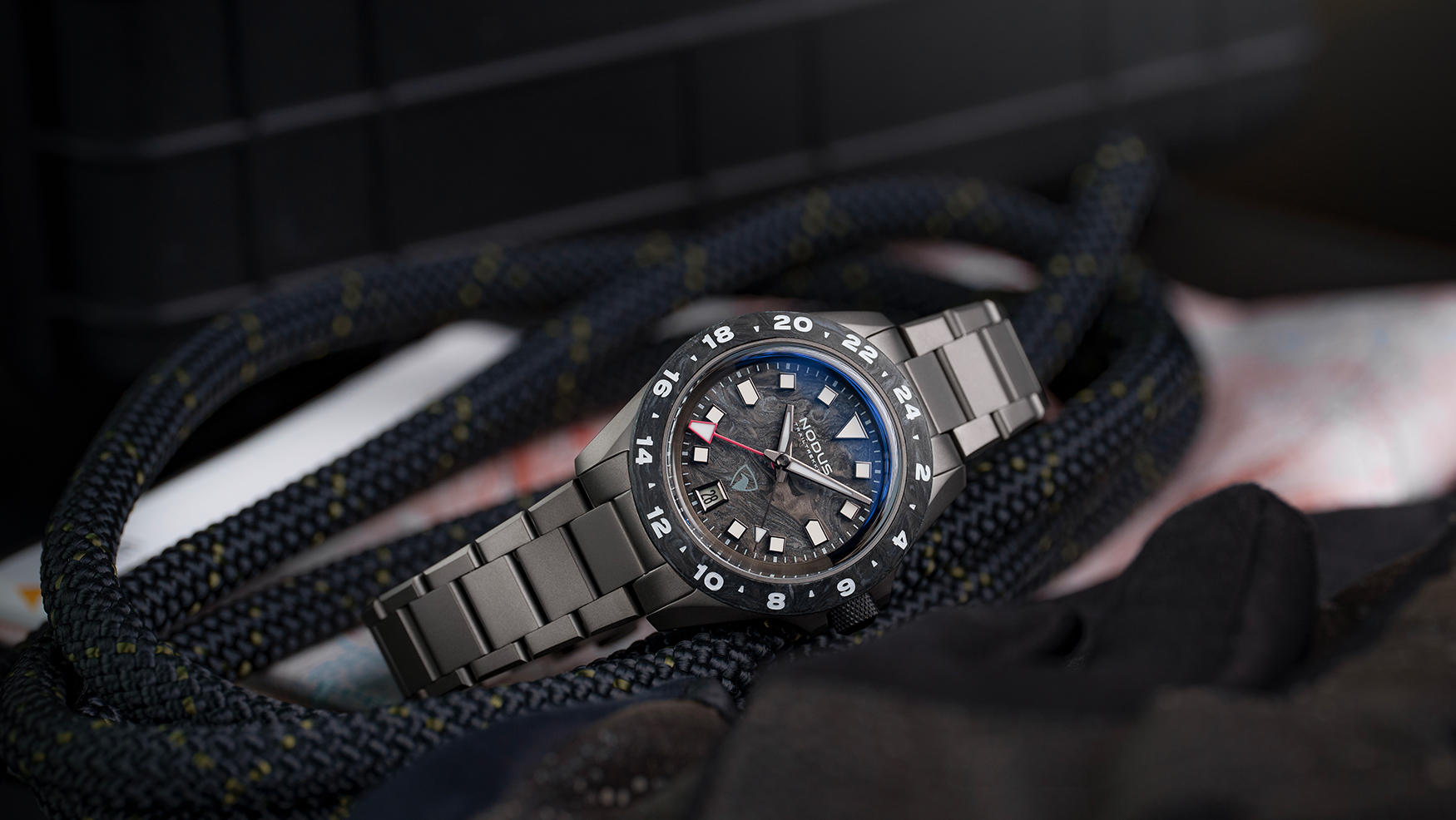
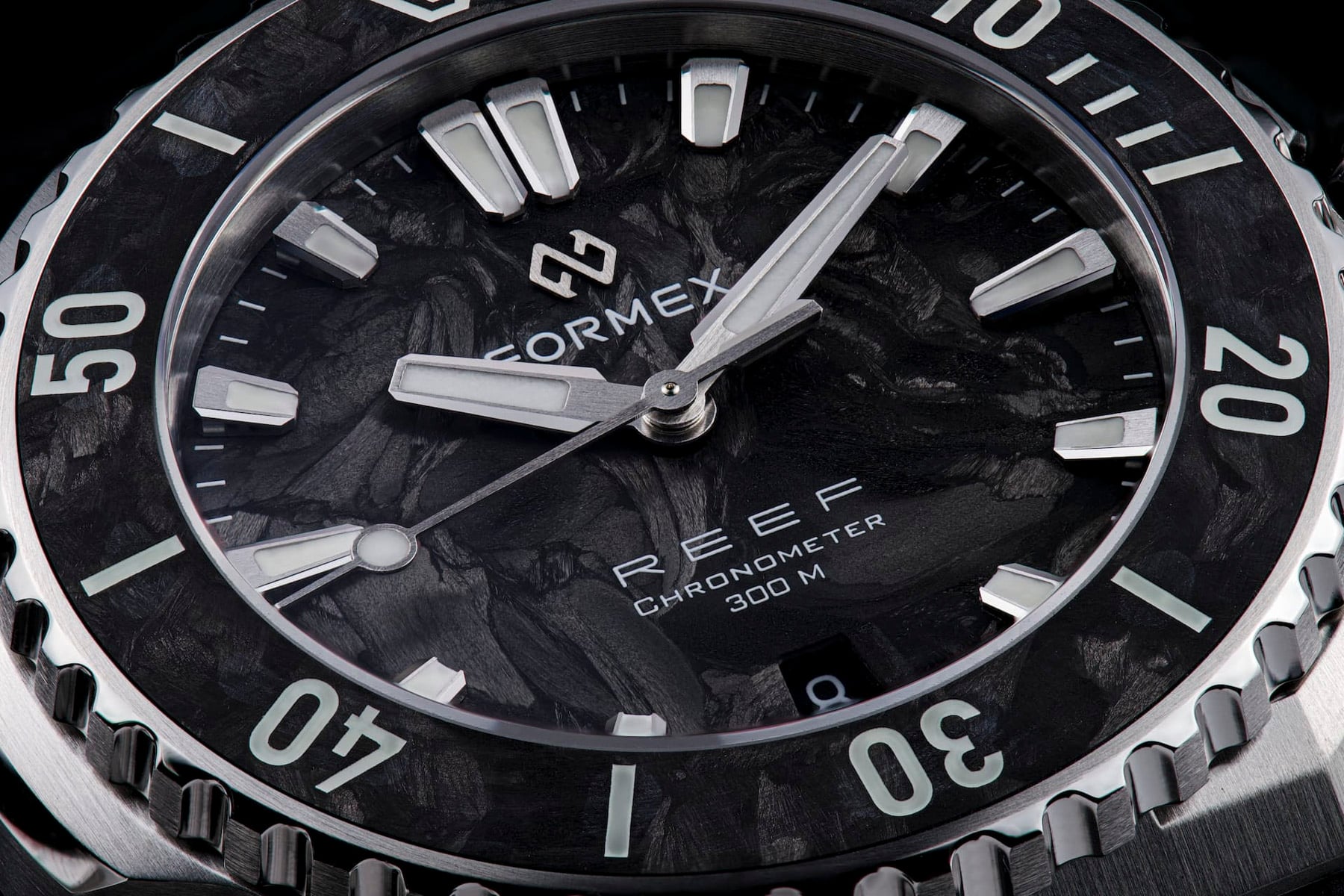
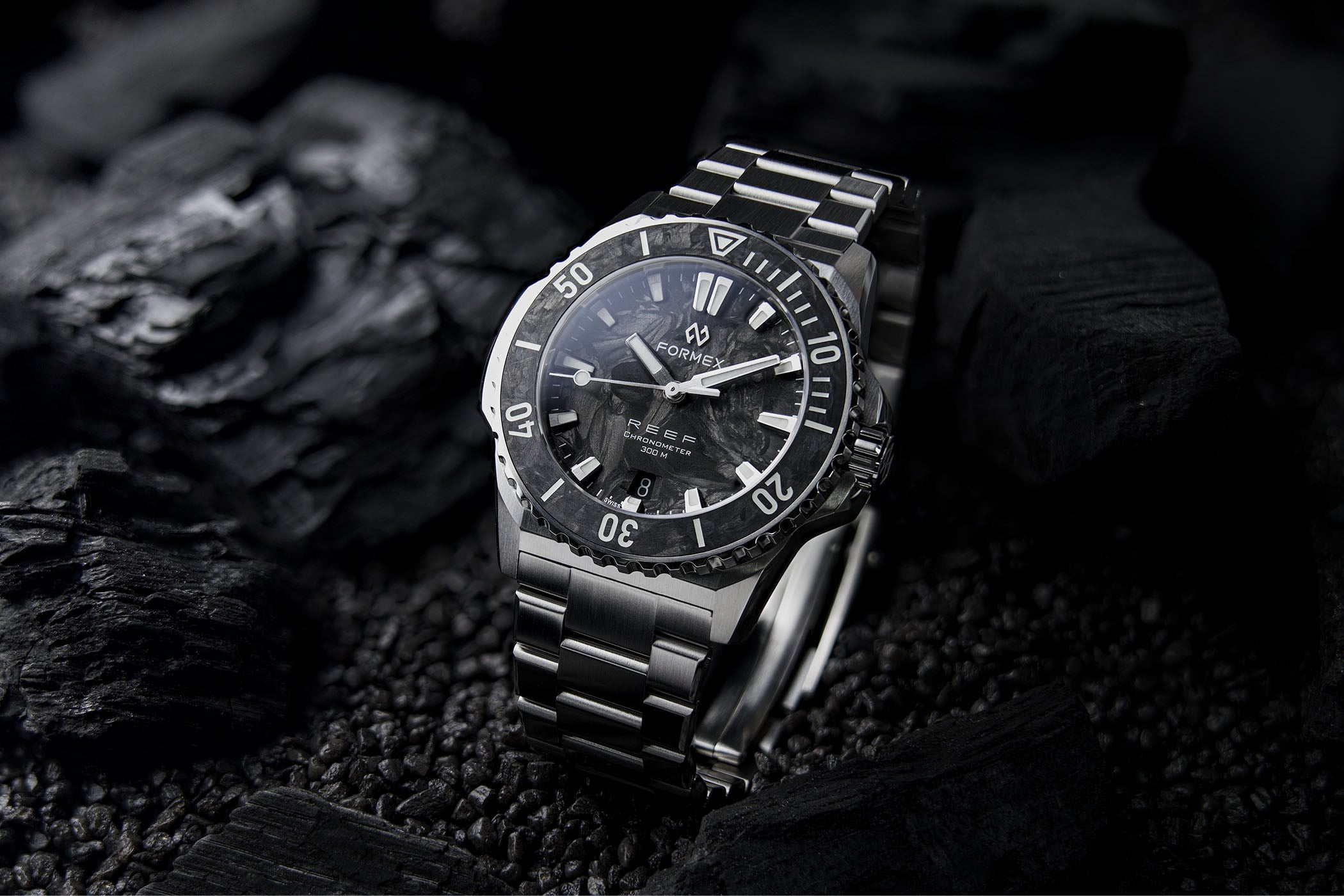
Forged carbon is a composite material made from chopped carbon fibres bonded with epoxy resin in a high-pressure, heated mould. The process is borrowed from the aerospace and Formula 1 industries, where it has been used since the 1970s for structural panels. Carbon fibre woven into a sheet (the standard way carbon fibre appears in cars and bikes) gives a regular cross-hatch pattern; in forged carbon, the fibres are short (typically 5-50 mm), randomly oriented, and pressed into a mould rather than woven. Each finished part comes out with a different random grain, like marble or wood; no two forged-carbon watches have an identical case pattern.
The first watchmaking use was Audemars Piguet's Royal Oak Offshore Survivor ref. 26165IO in 2007. AP's case-development team (led by Octavio Garcia and the brand's Le Brassus engineering group) had spent two years developing the compression-moulding process specifically for watch-case scale. The Survivor's 44 mm forged-carbon case was significantly lighter than the steel and ceramic-bezel Royal Oak Offshore variants of the period, with a unique surface pattern visible at every angle. Production was complex; the 1,000-piece initial run was the most technically demanding case AP had built outside its precious-metal lines.
"Steel is uniform; ceramic is uniform; gold is uniform. Forged carbon is the first watch case material where every example is mathematically different. That changes the relationship between buyer and watch."- Audemars Piguet R&D commentary on the 2007 Survivor
The density advantage is the key wear-on-the-wrist benefit. Forged carbon has a density of approximately 1.5 g/cm³, compared to 7.9 g/cm³ for stainless steel, 4.5 g/cm³ for titanium, 6.0 g/cm³ for zirconia ceramic, and ~21.5 g/cm³ for platinum. A 44 mm forged-carbon case typically weighs 50-70 grams compared to 150+ grams in steel; the difference is immediately noticeable to a wearer. Richard Mille in particular has built its modern catalogue around this advantage, with Carbon TPT cases that put 50-gram tourbillons on the wrist.
Carbon TPT ("Thin Ply Technology") is a technical refinement developed by Richard Mille and the Swiss firm North Thin Ply Technology. Where standard forged carbon uses chopped fibres oriented randomly, Carbon TPT layers thin sheets of unidirectional carbon fibre at progressively rotated angles (typically 45° offsets) before pressing. The result has a more uniform striped grain rather than the marbled appearance of standard forged carbon, and slightly higher mechanical strength due to the controlled fibre orientation. The Richard Mille RM 035-02 Rafael Nadal (2014) was the first Carbon TPT wristwatch.
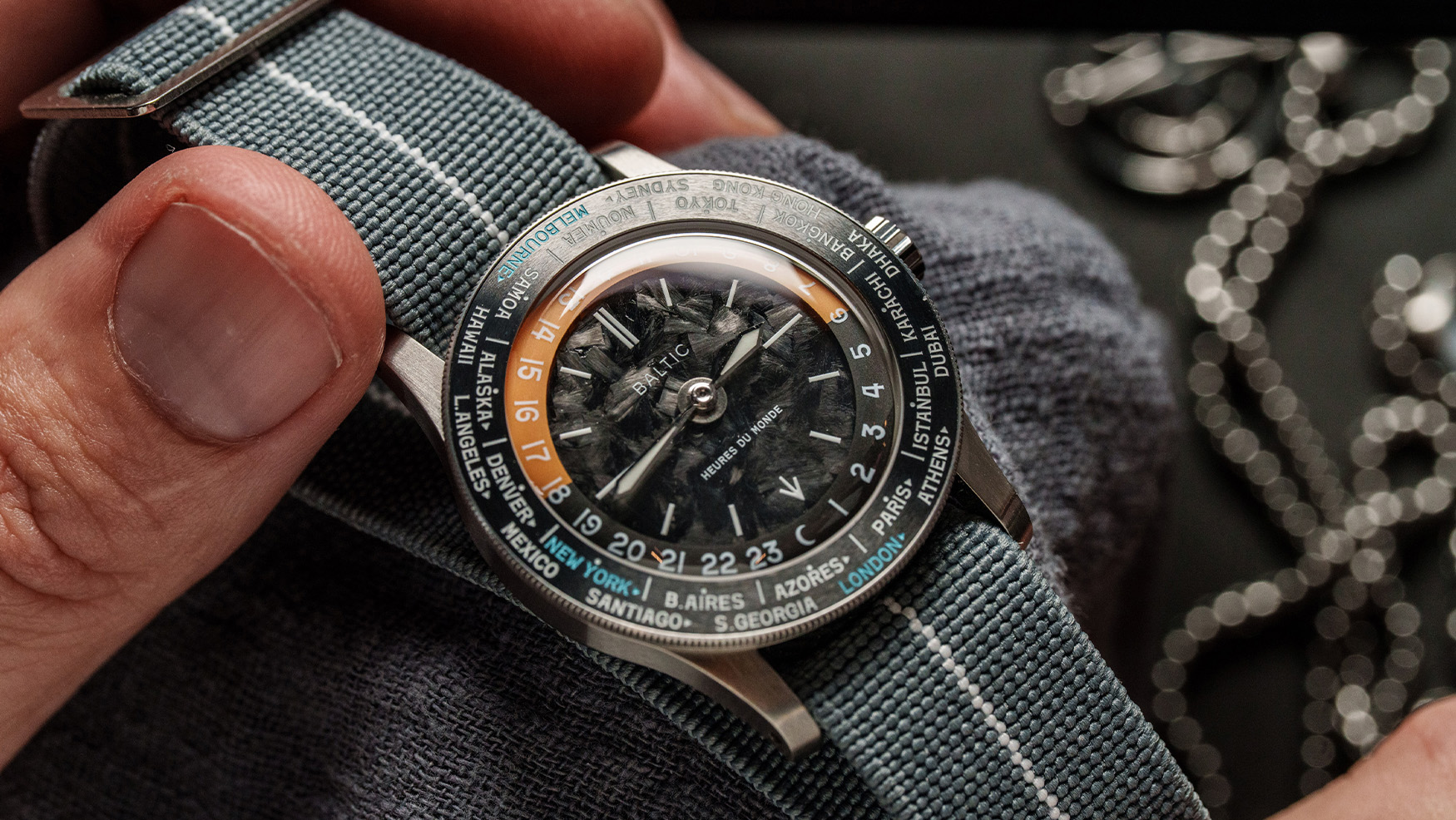
Outside AP and Richard Mille, forged carbon has spread widely. Hublot uses Texalium (a similar composite with aluminium-fibre additions) on selected Big Bang references; Panerai uses Carbotech (their proprietary forged-carbon variant) on the Submersible 1950; Zenith uses standard forged carbon on the Defy 21 Carbon; TAG Heuer has built motorsport-themed forged-carbon Carrera and Monaco references. Microbrands and homages followed in the late 2010s. Total industry production is probably several thousand forged-carbon watches per year, concentrated at the high end (Richard Mille alone produces ~5,000 watches per year, of which a meaningful share use Carbon TPT or related composites).
For collectors, forged carbon's value proposition is the uniqueness of every case combined with the structural mass advantage. Unlike 904L Oystersteel, which produces visually identical cases by design, forged-carbon cases are individually distinct; the marbled grain is part of the watch's identity. The aesthetic association with motorsport, F1, and aerospace is also a strong marketing pillar; forged-carbon watches sit firmly in the "performance / luxury sport" segment rather than the "heritage / dress" segment. The trade-off is durability: forged carbon scratches more easily than ceramic and chips at sharp impacts, although day-to-day it survives better than aluminium.




Comments 2