
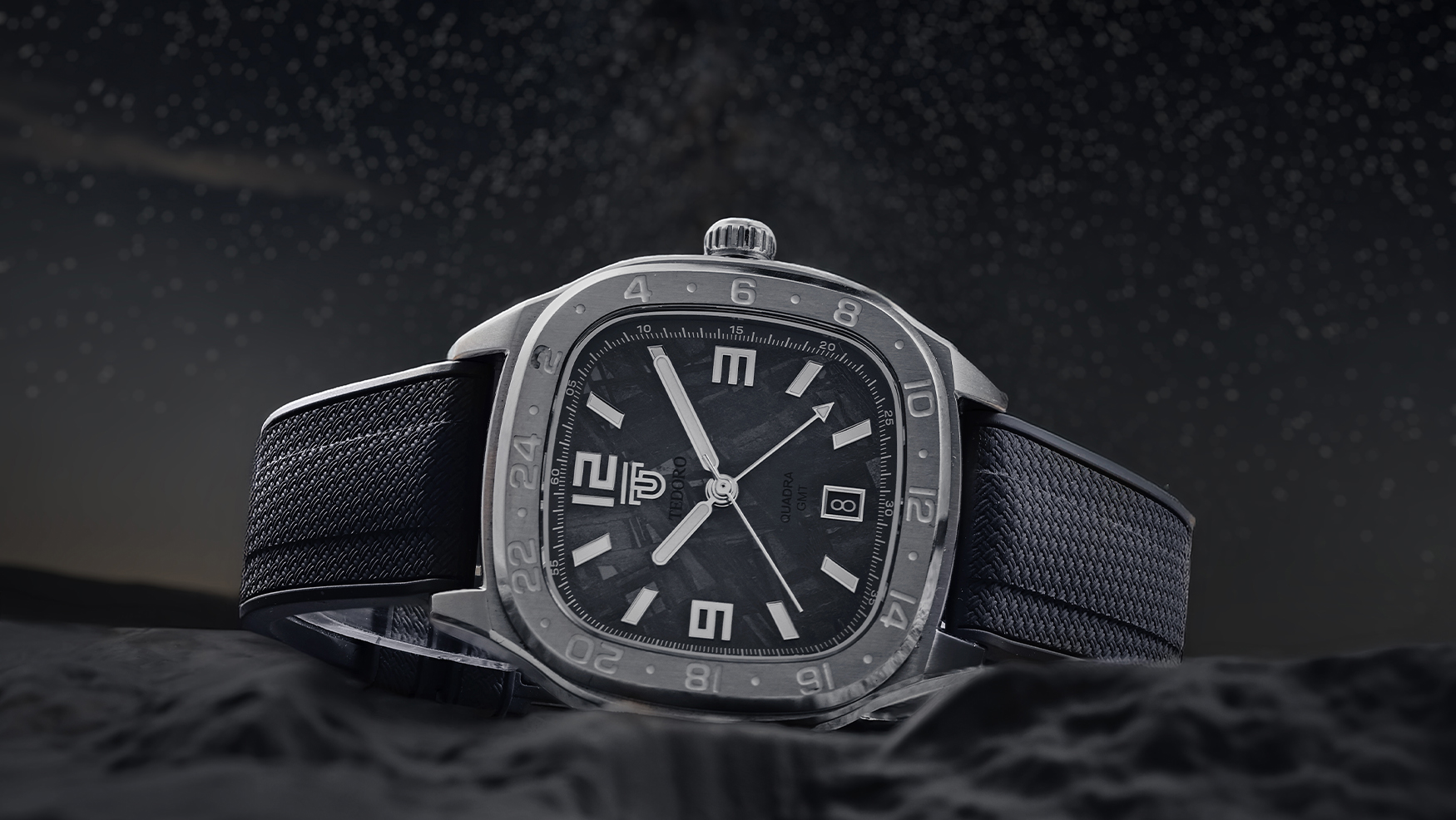
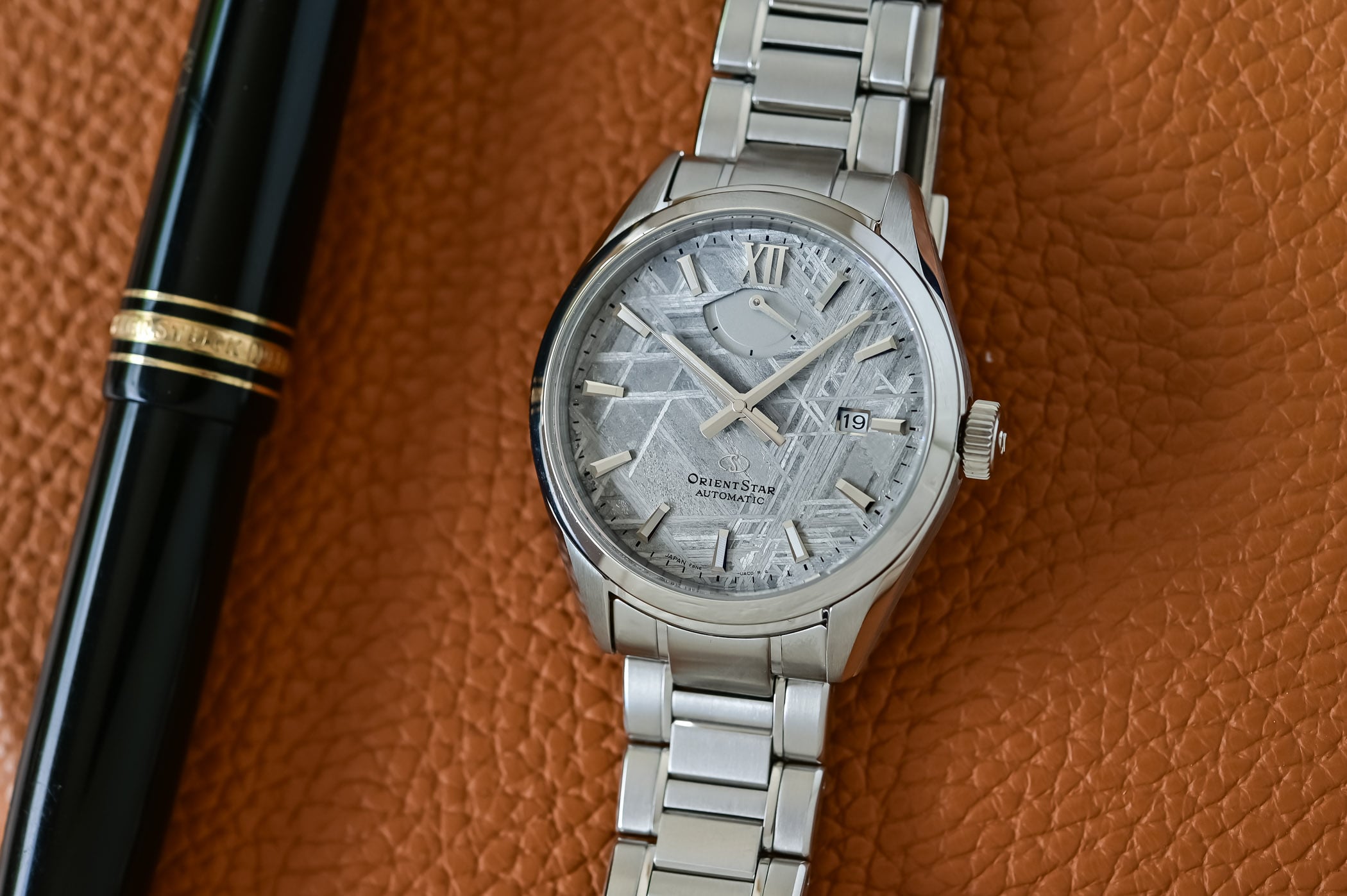
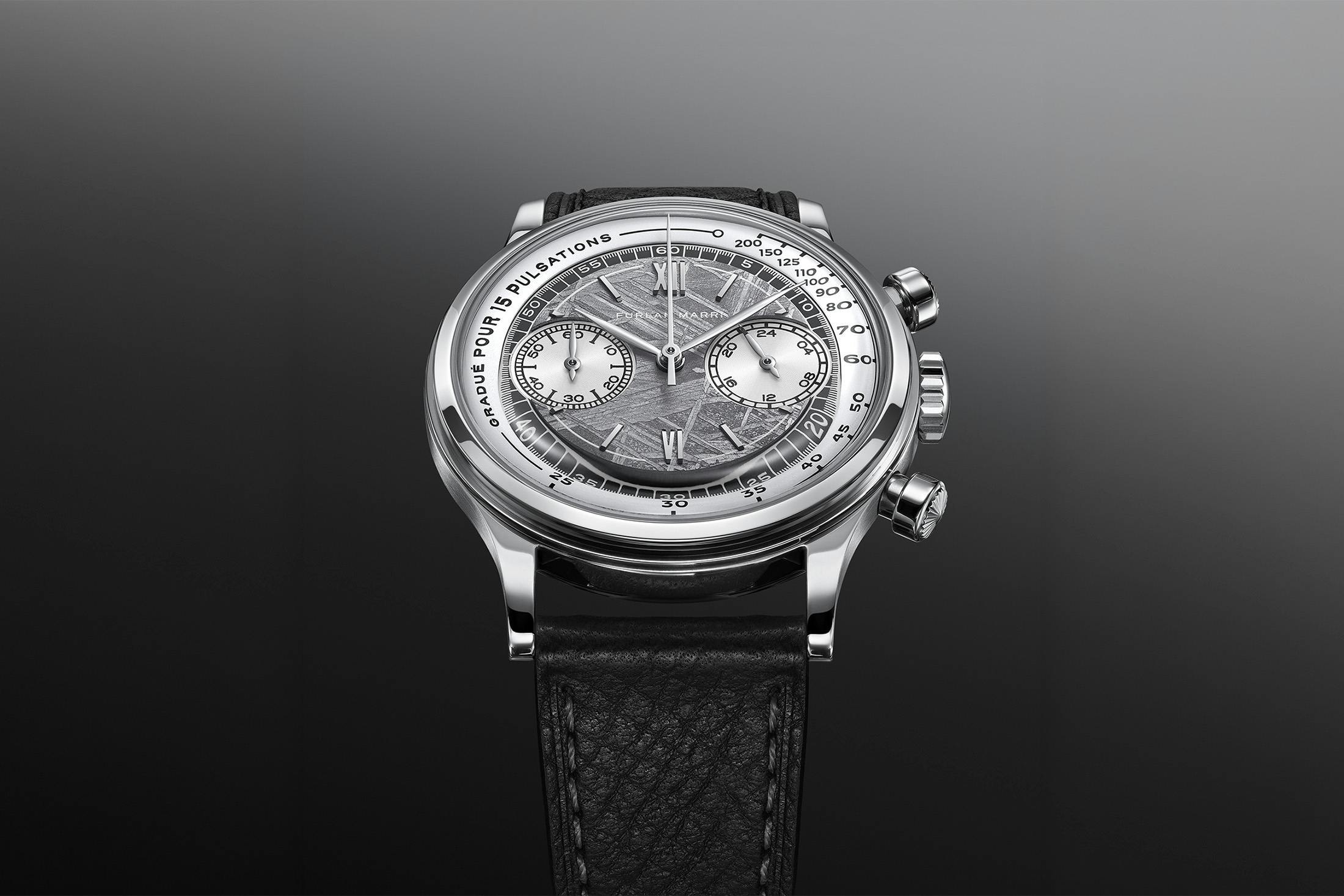
A meteorite dial is sliced, ground, and etched from a small block of iron-nickel meteorite, the metallic remnant of an asteroid core that crystallised in space over hundreds of millions of years and survived an atmospheric entry to land on Earth. The interest, mechanically and aesthetically, is the Widmanstätten pattern: thin interlocking bands of two iron-nickel alloys, kamacite (low-nickel) and taenite (high-nickel), that form only when liquid metal cools at roughly 1°C per million years, a rate impossible to reproduce in any terrestrial laboratory. Polishing the slice and exposing it to dilute nitric acid for several minutes etches the kamacite faster than the taenite, and the resulting raised criss-cross lattice is then washed, neutralised, and used as the dial face.
Two meteorite finds dominate watch-grade supply. Gibeon, discovered in the Namibian desert and known to local Nama people long before Western collection began in 1838, is the most-used watchmaking meteorite, mostly because the chemistry (~7-8% Ni, very low phosphorus) etches into a clean medium-grain pattern that photographs well. Muonionalusta, discovered in northern Sweden in 1906 and dated to roughly 1 million years on Earth, has a finer Widmanstätten figure and is preferred for smaller dials and dial inserts. Seymchan (Russia, 1967) is occasionally used; it is a pallasite, with olivine crystals embedded in the iron matrix, and produces an unmistakable speckled appearance that some independents (notably De Bethune) have used for moon-disc and dial backgrounds.
"A meteorite dial is the only watch component you can wear that is older than the planet you're standing on."- Geological dating note, NASA Meteorite Working Group documentation
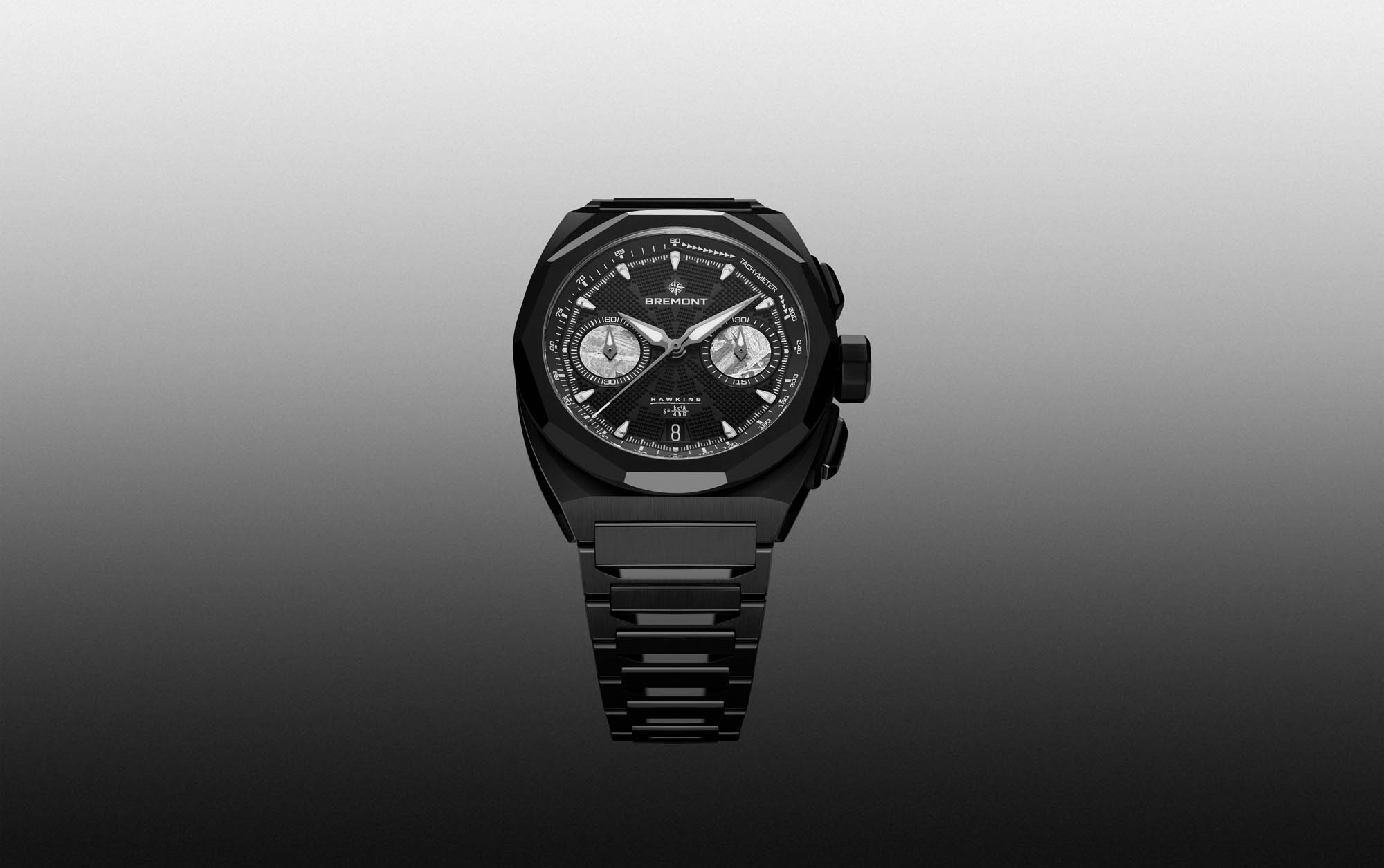
In serial production, meteorite dials first appeared in the late 1980s on Corum Admiral's Cup and Rolex Day-Date references; Rolex still produces a meteorite-dial Day-Date today (ref. 228398TBR, 228398TGR among others). The technique reached the mainstream luxury catalogue in the 2010s when Omega released the Speedmaster Apollo 11 50th Anniversary Limited Edition with a meteorite sub-dial, Jaeger-LeCoultre launched the Master Calendar Meteorite, and Piaget introduced the Altiplano Meteorite dress reference. The luxury Patek Philippe 5980R Nautilus Chronograph "Meteorite" and the haute-horlogerie De Bethune DB25 Starry Varius "Meteorite Tourbillon" represent the upper end. Rolex has occasionally produced meteorite-dial Daytonas (gold ref. 116595RBOW, platinum 116506) at the very top of the modern catalogue.
Meteorite is a difficult dial substrate. The blocks are small (typical Gibeon source pieces are 5-15 cm), brittle, and prone to internal cracks; cutting yield is poor, often 30-50% scrap. The metal is ferromagnetic, which means the dial itself can interact weakly with hairspring antimagnetism on the bench (no impact in normal wrist use). It rusts: untreated meteorite dials oxidise within days in normal humidity, so finished dials are stabilised with a thin protective coating, frequently ruthenium, rhodium, or a clear lacquer. Working the dial flat and parallel without losing the etched pattern requires a finisher who has seen meteorite before; Stern Frères (the Patek-affiliated Geneva dial maker) and a small number of specialised Vallée de Joux ateliers do most of the high-end work.
Because the lattice is set by the original cooling history of the parent body, no two slices, even taken millimetres apart from the same Gibeon block, are identical. This is the appeal: every meteorite-dial watch is verifiably one-of-one within a serial reference. It also creates a small but real provenance market: Gibeon is now scientifically protected in Namibia (export limits since 2004), Muonionalusta is regulated in Sweden, and several smaller meteorite suppliers have been accused of mis-labelling slag and other terrestrial iron alloys as "meteorite". Reputable dial makers source from a handful of named auction-track lots and document the provenance in the watch's service paperwork.
For the watch wearer, the meteorite dial sits between a grand feu enamel and a stone dial in collector taxonomy: as exotic as enamel, more visually unusual, and uniquely tied to a single object's 4.5-billion-year history. Premium over a steel-dial equivalent ranges from a CHF 2,000 dial-only upcharge on a Day-Date to CHF 50,000+ for a Patek meteorite Nautilus chronograph; the upcharge tracks dial-makery and brand allocation rather than the meteorite material cost itself.




Comments 1