
When Gérald Genta sketched the Royal Oak the night before the 1971 Basel Fair, the dial-pattern decision came almost as an afterthought, Audemars Piguet wanted something visually distinct that didn't compete with the case architecture. The result was a dense grid of tiny pyramids, each square roughly 0.6mm, stamped into a solid brass dial blank. Petite Tapisserie, as it became known, defined the visual identity of the original 1972 ref. 5402.
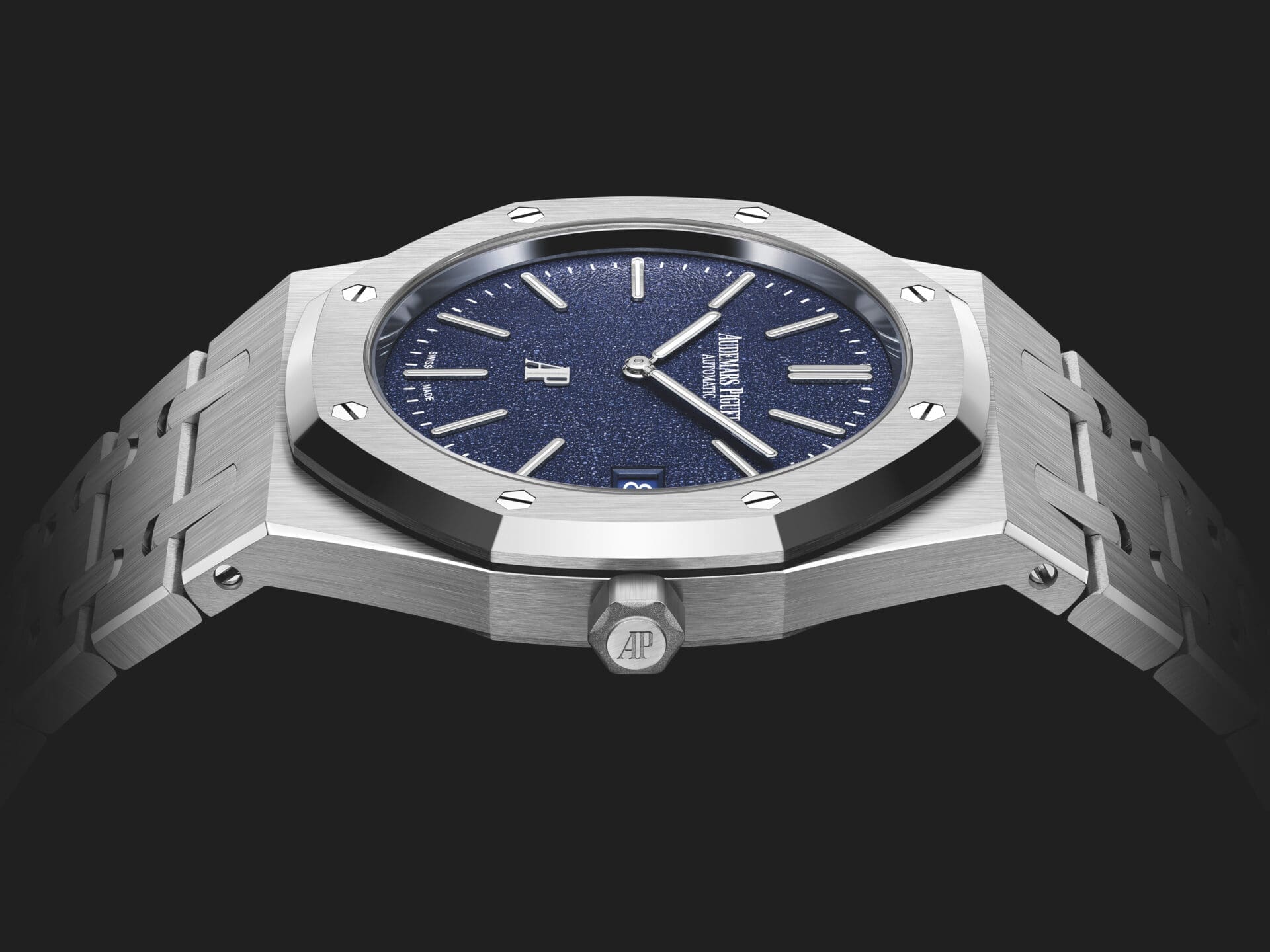
By the late 1990s the Royal Oak had moved to a slightly larger 39mm case (the Jumbo silhouette), and AP enlarged the dial squares to ~1.0mm: Grande Tapisserie. The proportions match the larger case better and read as visibly different on the wrist. Modern Royal Oak 15500 and 15510 references all use Grande Tapisserie. The Petite version survives on certain 33mm and 36mm Royal Oak references.
"It's the texture that distinguishes a Royal Oak across the room. The case shape is famous, but the dial is what your eye actually reads first."- Audemars Piguet design commentary on the Tapisserie process
The 1993 Royal Oak Offshore introduced a third variant: Mega Tapisserie, with squares around 1.5mm. The Offshore was 42mm at launch (controversially large for AP at the time); the larger texture matched the bigger case. All three variants, Petite, Grande, Mega, remain in production across the catalogue today.
Manufacturing is more complex than it looks. Each dial begins as a solid brass blank. The pyramid pattern is stamped using a hardened steel die under high pressure, historically pantograph-driven, today predominantly CNC-coordinated. The dial is then galvanised: copper-plated to even the surface, then PVD-coloured for the final hue (blue, grey, white, salmon, green, etc.). Indices and printed text are added last. AP keeps the entire process in-house at the Le Brassus manufacture; the dial-stamping department is a meaningful part of what differentiates them from établisseurs.







Comments 1