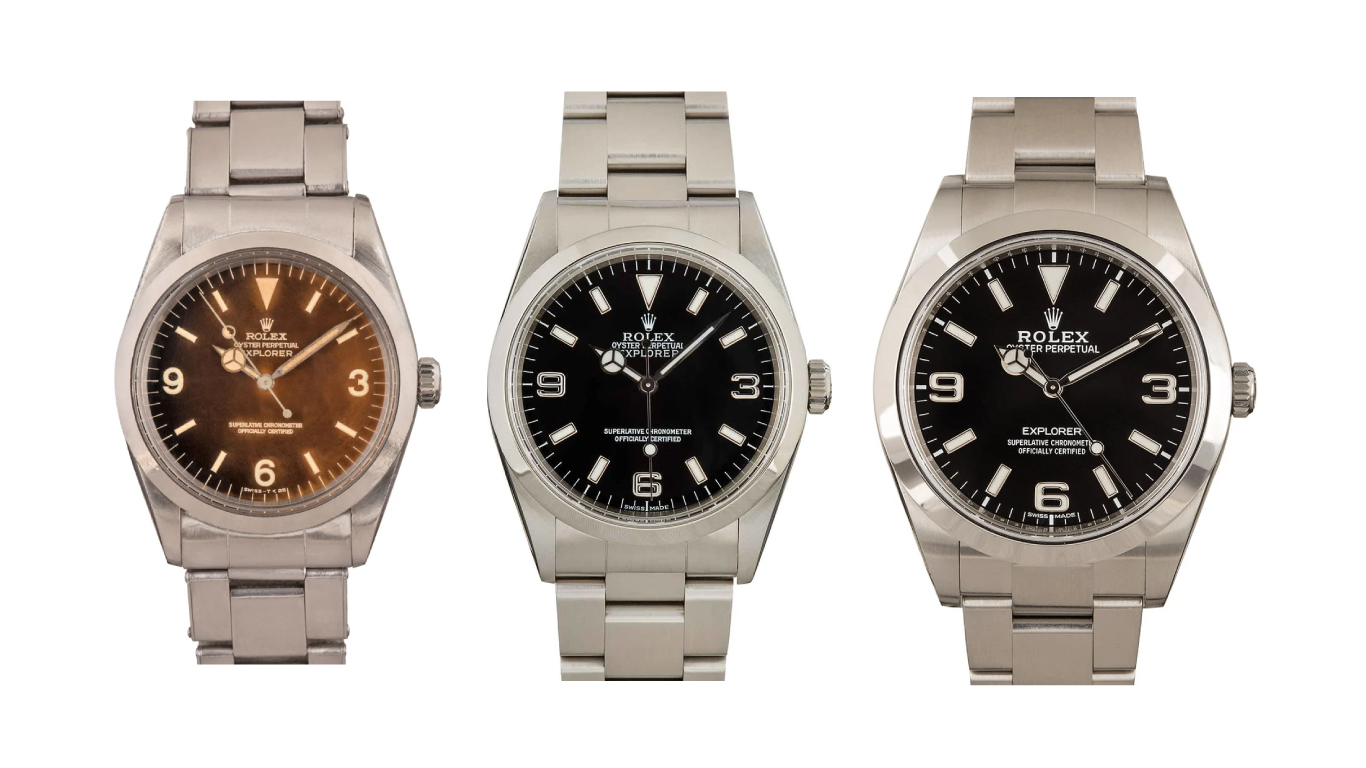
Ask any Rolex collector how they think about buying pre-owned and you will get one number out of them very quickly. Not the model. Not the year. The digit count. Four, five or six. That single detail sorts every Submariner, GMT-Master, Explorer, Datejust and Daytona into one of three eras, and each era comes with a completely different watch on the wrist. Different crystal, different bezel, different lume, different bracelet, different movement, sometimes a different feel entirely. This is the guide we wish someone had handed us the first time we shopped for a Rolex.
The rule in one sentence
Rolex added a digit to its reference numbers every time the technology got a major update.
- 4 digits (1954 to late 1980s): acrylic crystals, aluminium bezel inserts, tritium lume, riveted or folded bracelets, no crown guards on many early sports refs, movements from the cal. 15xx family.
- 5 digits (1977 to 2000): sapphire crystals arrive, aluminium bezels stay, tritium lume becomes LumiNova around 1998, solid-link Oyster bracelets, cal. 30xx family movements.
- 6 digits (2000 to today): Cerachrom ceramic bezels arrive from 2005, Chromalight lume, solid-link Oyster with solid end-links and Glidelock clasps, thicker "maxi" case profile, cal. 31xx then cal. 32xx family movements.
The transition years overlap, and there are always exceptions (the Explorer 1016 ran alongside the 14270, the Daytona went through a longer weird phase), but that framework covers 95% of the Rolex catalogue.
4-digit references: the vintage era
The most-loved 4-digit references are the ones that defined the sports Rolex canon: the Submariner 5513 (1962 to 1989), the GMT-Master 1675 (1959 to 1980), the Explorer 1016 (1963 to 1989), the Explorer II 1655 "Freccione" (1971 to 1985), the Datejust 1601 (1959 to 1977) and the manual-wind Daytona 6263 (1970 to 1988).
What sets them apart on the wrist:
- Acrylic (plexiglass) crystal. Domed, softer, scratches with a fingernail. Also warmer visually and cheaper to polish out. When you look at a 5513 in the sun and see that slight optical distortion, that is why.
- Aluminium bezel insert. The colour fades. That is the whole game. A well-aged 1675 with a faded Pepsi bezel is more valuable than a mint one, because the fade is character that cannot be manufactured.
- Tritium lume. Marked "T Swiss T" or similar on the dial. Tritium ages into cream, custard, mustard, sometimes chocolate. Every collector has an opinion about which colour is "correct".
- Slimmer case profile. Most sports refs are still 40mm on paper but they wear noticeably smaller: thinner shoulders, smaller crown, shorter lugs. If your wrist is 6.5" or less, a 4-digit Sub often fits better than the 6-digit does.
- Riveted (early) or folded-link Oyster bracelet. Rattles like a bracelet from the 60s should. Hollow end-links on almost every ref.
- No crown guards on some. The pre-1959 "big crown" Submariners and the Explorer I have naked crowns. Design purism, less protection.
- Manual-wind or early cal. 15xx auto movements. Serviceable, but parts are harder to source and service intervals matter more.
The pitch: character, patina, real vintage watchmaking, small-wrist friendliness. The cost: originality anxiety (redials, replacement bezels, service hands), higher service bills, and prices that have gone from "sensible" to "eye-watering" in the last five years. A no-stories 5513 with a straight-Sub dial and a nice fade is €18,000 to €30,000 today, up from €7,000 to €10,000 in 2018.
5-digit references: the sweet-spot era
If you spend any time on collector forums you will notice a pattern: when a Rolex enthusiast says "you should buy a" and lists a specific reference, that reference is almost always a 5-digit. There is a reason for that.
Iconic 5-digit references: Submariner 16610 and Submariner 16610LV "Kermit" (1988 to 2010), GMT-Master II 16710 (1989 to 2007), Explorer I 14270 (1989 to 2001), Explorer II 16570 (1989 to 2011), Datejust 16233 and 16234 (1988 to 2005), Daytona 16520 (Zenith, 1988 to 2000) and 16520-successor 116520 (in-house cal. 4130, borderline 6-digit).
What you actually get:
- Sapphire crystal. Introduced on the Datejust 16000 in 1977 and rolled out across the line by the mid 80s. Scratch-resistant, flat rather than domed. This is the biggest single quality-of-life upgrade over 4-digit.
- Aluminium bezel still. The bezel still fades. Late 90s Kermit inserts, early Pepsi 16710 inserts and warm-brown "root beer" 16713s all have that vintage-vibe fade without the vintage-Rolex price.
- Tritium then LumiNova. Refs made before ~1998 have tritium and can develop that lovely aged cream; ~1998 onward the dial says "Swiss Made" and uses LumiNova (no radioactive decay, so it stays white).
- Solid-link Oyster bracelet, hollow end-links early, solid end-links from ~2003. Rattles less, wears heavier, still with the classic 20mm taper.
- Cal. 30xx family: cal. 3035, cal. 3075, cal. 3135. These are the movements that made Rolex Rolex on modern service standards. Cal. 3135 in particular ran for 32 years across every date-bearing sports Rolex; parts availability is excellent and every watchmaker knows it.
- 40mm across the sports line, still slim-ish. The 16610 Sub is 40mm x 12.5mm. Comfortable. Modern-looking-but-not-shouty.
The pitch: the daily-driver vintage flavour without the daily-driver vintage anxiety. You get the aluminium bezel, the classic proportions, sometimes even the tritium patina, but with sapphire crystal, a solid modern movement and modern water resistance. Prices moved sharply during 2020-2022 (a clean 16610 went from €5,500 to €9,500), have stabilised since, and 16610 / 14270 / 16570 remain the strongest value-for-money entry into an iconic sports Rolex.
6-digit references: the modern era
From roughly 2000 Rolex started adding a digit to signal the shift to in-house-designed everything: ceramic bezels, a heavier case, a redesigned bracelet, a redesigned movement family. The 6-digit era is the Rolex you buy at an authorised dealer today.
Key 6-digit references: Submariner 116610LN / 116610LV (2010 to 2020) and current Submariner 126610LN / 126610LV, GMT-Master II 116710 / 116710BLNR "Batman" / 116719BLRO then current 126710BLNR and 126710BLRO "Pepsi", Explorer I 214270 (2010 to 2021) and current 124270 (36mm) and 224270 (40mm), Explorer II 216570 (2011 to 2021) and current 226570, Daytona 116500LN (2016 to 2023) and current 126500LN.
What changes:
- Cerachrom ceramic bezel. First on the 2005 GMT-Master II 116718LN in gold, then across sports refs from 2007 onward. Does not fade, scratches only ceramic-on-ceramic, and Rolex figured out how to two-tone-fire a single ceramic ring (Batman blue/black, Pepsi red/blue) which nobody else can currently do at scale.
- Chromalight lume. Introduced in 2008. Glows blue rather than green, and stays lit for hours. Whitest markers on the dial in daylight of any of the three eras.
- Solid end-links and Glidelock clasp. First on the 2008 Deepsea, then across the sports line. Glidelock lets you fine-adjust the bracelet in 2mm steps up to 20mm without any tools. Wet-wrist expansion, cold-wrist contraction: solved. Easylink extension on other refs adds 5mm on the fly.
- "Maxi" case. Same 40mm diameter (or 41mm on the recent Sub / GMT) but thicker shoulders and lugs, a slightly larger crown, and 3mm more thickness. Reads modern and substantial; some collectors love it, some think it lost the elegance of the 5-digit era.
- Cal. 31xx then cal. 32xx. Cal. 3235 (2015) doubled the power reserve to 70 hours, added the Chronergy escapement, and improved shock resistance. Cal. 3255 does the same for Day-Date. Cal. 3285 (GMT) adds a proper GMT complication. Cal. 4131 (Daytona 2023) added a rotor bearing that eliminates a common failure point on cal. 4130. Every single movement upgrade is a real, measurable improvement.
- Rehaut engraving with serial number (from ~2005). Serial moved from between the lugs to the inner bezel ring. Rolex ROLEX ROLEX ROLEX around the rehaut, with the serial at 6 o'clock. Micro-anti-counterfeiting detail that also happens to look cool.
The pitch: the least-compromise version of every sports Rolex, on a bracelet that fits any wrist any season, with a warranty if you buy new. The cost: the maxi case is bigger, ceramic does not fade so nothing ever "ages" visually, and secondary-market prices are still elevated relative to retail for the hardest-to-get refs (Batman, Pepsi, Daytona).
The head-to-head: what actually changed
| 4-digit | 5-digit | 6-digit | |
|---|---|---|---|
| Era | 1954 to late 80s | 1977 to 2000 | 2000 to today |
| Crystal | Acrylic (plexi) | Sapphire (flat) | Sapphire (flat) |
| Bezel | Aluminium | Aluminium | Cerachrom (ceramic) |
| Lume | Tritium (T Swiss T) | Tritium then LumiNova (~1998) | Super-LumiNova then Chromalight |
| Bracelet | Riveted or folded, hollow ends | Solid links, hollow then solid ends | Solid links, solid ends, Glidelock / Easylink |
| Movement family | Cal. 15xx | Cal. 30xx (3035, 3135) | Cal. 31xx then 32xx |
| Power reserve (sports) | ~48h | ~48h | 70h (cal. 32xx) |
| Case profile | Slim, smaller crown | Medium, classic | Maxi (thicker shoulders, larger crown) |
| Serial location | Between lugs at 6 | Between lugs at 6 | Rehaut at 6 (2005+) |
| Water resistance (Sub) | 200m | 300m | 300m |
Which one fits you
Three real personas.
You want a Rolex that feels like a Rolex from the era it came from. You accept that a 60-year-old watch is a 60-year-old watch, you like the acrylic dome, you want the tritium patina, and you plan to service it every five to seven years by a Rolex-experienced watchmaker. Go 4-digit. Buy from a specialist dealer with a papered example, or from a private seller with full documentation. Expect to pay a premium for originality. Never buy a "restored" dial unless you know what you are doing.
You want one Rolex to wear every day for the next 20 years, and you want it to look and feel classic. Go 5-digit. A 16610 Sub, a 16710 GMT, a 14270 or 16570 Explorer, or a Datejust 16234 will serve you for the rest of your life on a €300 service every 8-10 years. This is the sweet-spot answer for most buyers who ask us. You get sapphire crystal, a solid modern movement, the classic 40mm proportions, and if you buy pre-LumiNova (before 1998), a real tritium dial that will age with you.
You want the current Rolex, with the current warranty, at retail if possible. Go 6-digit, and go through an AD. The Cerachrom bezel will look identical in 30 years, the Chromalight lume will still glow bright, and the cal. 32xx movement is genuinely better than anything Rolex has ever built. The wait for a Sub or GMT at retail is real (12-36 months at most European ADs), but the pre-owned market has softened since 2022 and a 126610LN or 126710BLNR now trades within 10-15% of retail rather than 40-60% over.
The money check (mid-2026)
- 4-digit Submariner 5513: €18,000 to €30,000 depending on originality and dial (meters-first / feet-first / gilt).
- 4-digit GMT-Master 1675 Pepsi: €15,000 to €25,000 depending on fade and originality.
- 4-digit Explorer 1016: €18,000 to €32,000. The 1016 has quietly been one of the fastest-appreciating vintage Rolex refs.
- 5-digit Submariner 16610: €8,500 to €12,000. Late tritium (1993-1997) at the top of the range.
- 5-digit GMT-Master II 16710 Pepsi: €14,000 to €22,000.
- 5-digit Explorer I 14270: €5,500 to €7,500. Widely considered the best-value modern Rolex.
- 5-digit Explorer II 16570 white "Polar": €7,500 to €10,000.
- 6-digit Submariner 116610LN: €12,000 to €16,000 pre-owned (discontinued 2020).
- 6-digit Submariner 126610LN: €10,500 retail (€13,000 to €14,500 grey).
- 6-digit GMT-Master II 126710BLRO (Pepsi): €11,000 retail (€16,500 to €19,000 grey).
- 6-digit Daytona 126500LN: €15,900 retail (€30,000+ grey; still allocation-only).
The one-line summary
4-digit for the collector who wants a proper vintage watch and enjoys the maintenance ritual. 5-digit for the enthusiast who wants one no-compromise daily driver for life. 6-digit for the buyer who wants the current watch, at retail, with the warranty. All three are correct answers. The wrong answer is buying a 6-digit expecting vintage warmth, or a 4-digit expecting a modern watch.
Comments
No comments yet, be the first to weigh in.