The best-selling luxury watch brand in 2026 is Rolex, at USD 13.5 billion in retail sales. Cartier is second at USD 4.0 billion. Omega is third at USD 3.4 billion, followed by Audemars Piguet (USD 3.1B) and Patek Philippe (USD 2.7B). Rolex is more than three times bigger than the number-two brand. Source: Morgan Stanley × LuxeConsult, Ninth Annual Swiss Watcher, February 2026.
Every February, Morgan Stanley and the Swiss consultancy LuxeConsult publish what is, for anyone in the watch business, the report. The ninth edition landed on 18 February 2026, covers the 2025 calendar year, and confirms two things every collector already suspected: Rolex is uncatchable, and the industry below it is consolidating fast.
Here’s the full top 20 by retail value, and underneath, what actually moved.
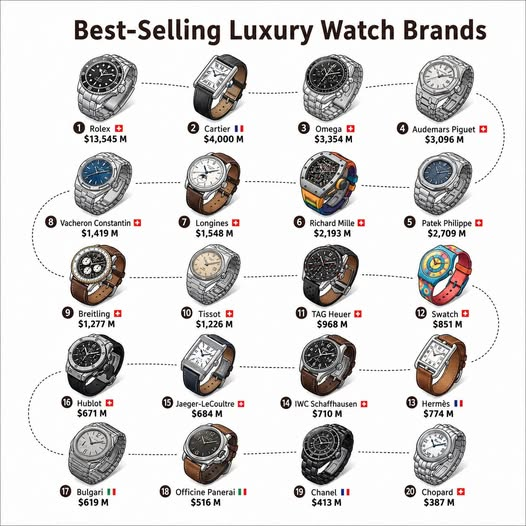
Retail value, USD millions. Source: Morgan Stanley × LuxeConsult, Ninth Annual Swiss Watcher (February 2026), as compiled by Professional Watches. Gold-bordered cards: only six brands clear the CHF 1B wholesale mark.
Quick note on the methodology before we keep going. The numbers above are retail-value estimates in USD, which is how most consumer-facing infographics present the ranking. The official Morgan Stanley report quotes wholesale turnover in CHF, which produces a slightly different order at the top (more on that in a moment). Both views are correct, they just answer different questions. Retail value tells you what the brand sells to the public; wholesale turnover tells you what the brand actually books on its income statement.
The Rolex monopoly that 2025 confirmed
Rolex finished 2025 with CHF 11 billion in wholesale turnover, a 32.9% share of the entire Swiss watch industry. To put that in perspective: Rolex alone is bigger than every brand from number 2 to number 7 combined. The brand produced roughly 1.15 million watches at an average wholesale price north of CHF 14,000, which itself reflects a 6% price bump applied through the year.
The number that should really get your attention is the gap. Cartier sits at number two with CHF 3.488 billion, a 9% industry share. That makes Rolex more than triple the size of the next-largest watch brand on the planet. The last time a single brand dominated a luxury category this hard was Hermès in leather goods, and even Hermès doesn’t lead Louis Vuitton by 3x.
AP overtakes Omega: the symbolic shift of 2025
This is the headline trade in the ranking. On wholesale turnover, the new top five reads Rolex, Cartier, Audemars Piguet, Patek Philippe, Omega, with AP at CHF 2.6 billion (+9% growth) and Patek at roughly CHF 2.5 billion. Omega slipped two spots from number 3 to number 5 with CHF 2.2 billion of wholesale.
The infographic above keeps Omega in third on retail-value because Omega’s pricing moved up sharply through 2025 (the new Speedmaster Caliber 321 Constellation series, the Aqua Terra Worldtimer, and Calibre 39 dressy refresh all pushed average retail up). The wholesale figure is the brand’s booking; the retail figure is what those bookings look like once dealers add their margin and the Bienne family-restaurant table prices the Worldtimer at CHF 12,400.
Read either way, the message is the same: AP is now selling more watch than Omega is, by value. That’s a category-defining shift. Twenty years ago, Omega outsold AP roughly five-to-one. The Royal Oak waitlist plus AP’s production discipline (the brand caps output at roughly 50,000 pieces annually) has eaten an extraordinary share of the high-end market that Omega used to own.
Tudor in, Panerai out
The other notable change at the bottom of the table is Tudor entering the top 20 for the first time in the report’s history, displacing Officine Panerai. Tudor’s Black Bay 58, Pelagos, Royal, and now the BB54 have built a brand-within-Rolex-Wilsdorf that operates at a different price tier (CHF 3,500-6,500) than its parent. Tudor’s growth in 2025 was driven by the Pelagos 39 mid-cycle refresh and a much more aggressive run of limited editions through the brand’s direct boutiques.
Panerai’s decline is less surprising. The brand has been losing share since 2018, hurt by an oversaturated Luminor catalogue and slow uptake of the eSteel and Submersible Elux lines. Richemont (Panerai’s parent group) has been quietly repositioning the brand toward limited-production high-tech materials, but the volume play has not landed with collectors the way the early-2000s Luminor PAM00005 wave did.
Only six brands now do more than CHF 1 billion
This is the consolidation story. In 2025 only six brands cleared the billion-franc wholesale mark: Rolex, Cartier, Audemars Piguet, Patek Philippe, Omega, and Richard Mille. Longines, the historic seventh-billion brand, slipped to CHF 920 million, narrowly losing its place in that club. Everything from rank 7 downward now lives in mid-tier territory.
The bigger structural fact: the top 4 brands now control 55% of total industry sales, up from 52.4% a year earlier. The four largest privately-owned brands (Rolex, Patek Philippe, Audemars Piguet, Richard Mille) sit at 49.1% market share, up 220 basis points year-on-year and 1,240 basis points versus 2019. In plain language: when you cut out the publicly-traded groups (Swatch Group, Richemont, LVMH), four families and a foundation own half of the Swiss watch industry.
Where the profit actually sits
Sales rankings are interesting but profit rankings are more revealing. Morgan Stanley estimates the same top-4 privately-owned brands capture roughly 76% of the industry’s total profit pool, at an aggregate operating margin near 33%. By contrast, the listed groups (Swatch, Richemont, LVMH) operate at much lower margins because they carry volume brands, multi-brand distribution networks, retail real estate, and corporate overhead.
What this means: a CHF 1 booked at Rolex or Patek is worth somewhere between 5 and 10 times more (in profit terms) than a CHF 1 booked at Tissot or TAG Heuer. The mid-tier brands are running on much thinner margins, often single-digit, and they’re the ones that suffer first when Swiss exports drop.
The industry got smaller, the top got bigger
Total Swiss watch exports in 2025 came in at CHF 24.4 billion, down 1.7% from 2024. Unit volume fell harder: 14.6 million watches shipped, a multi-decade low, down 4.8% year-on-year. So the industry is smaller, both in units and in value.
But underneath that softness is the polarization that has been quietly running for a decade. Watches priced above CHF 50,000 now represent 37% of total export value and 89% of all growth, while accounting for just 1.4% of units shipped. The middle is dying. The bottom is dying faster. The top is the only place the industry is genuinely growing.
That’s why the top-20 ranking matters more in 2026 than it did five years ago. A CHF 50K-plus watch sale is now nine times more important to industry growth than the unit count would suggest. And the brands that play almost exclusively in that segment (Patek, AP, Richard Mille, Vacheron, plus the high end of Rolex and Cartier) are the ones eating the market.
What this means if you collect
Three takeaways for a collector reading this in 2026.
- Production discipline is the moat. The brands that kept output flat or cut it (Rolex, Patek, AP) are extending their lead. The brands that chased volume to defend market share (Omega, TAG Heuer, IWC, Longines) have lost ground. Secondary-market value follows production discipline, not marketing budget.
- The mid-tier squeeze is real. If a brand sells most of its volume at CHF 5,000-15,000 and isn’t one of the major group flagships, the next five years are going to be hard. Watch the marketing budgets at Longines, IWC, JLC, and Hublot for the early warning signs.
- Tudor is the value-tier brand to watch. Entering the top 20 with a much younger buyer base and a controlled production run is a strong structural position. The Black Bay 58 is now a category-defining watch in a way the original Black Bay never quite was.
The 2026 report is the cleanest snapshot yet of where the luxury watch industry actually sits: a private-family oligarchy at the top, a public-group middle struggling for relevance, and a vintage-style value brand that just elbowed its way in. If you’re wondering which way the next decade goes, it’s already going.
Comments
No comments yet, be the first to weigh in.