The Seiko SKX007 is the watch that started more mechanical watch collections than any other single reference in the last 30 years. It's not the most beautiful diver ever built. It's not the most refined movement. It doesn't have a hand-wind, doesn't have hacking seconds, doesn't have a sapphire crystal. And yet if you ask 100 serious collectors what their first "real" mechanical watch was, at least a third of them will say SKX007. Some will say SKX009 with the Pepsi bezel. A few will say SKX013 (the 37mm little brother). The point is the same: this was the watch that got a generation into watches.

It's been seven years since Seiko discontinued the SKX line in mid-2019, long enough to write a proper look back. So here we go: what it was, why it worked, what it costs now, and why it still matters.
The setup: 1996, and a diver's diver at a beater's price
Seiko launched the SKX line in 1996 as the successor to the 7002, which itself replaced the 6309, which replaced the 6105 (worn by Martin Sheen in Apocalypse Now), which came out of the original 62MAS from 1965. That's a genuinely long tool-watch pedigree, and the SKX inherited all of it: 200m water resistance, unidirectional dive bezel, day-date at 3, crown at 4, ISO 6425 dive-watch certification.
The reference numbers get complicated fast, so here's the short version:
- SKX007: 42.5mm case, matte black dial, black bezel. The default. The best-seller.
- SKX009: Same case, deep blue dial, red-and-blue "Pepsi" bezel. The one everyone Instagrams.
- SKX013: 37mm compact variant of the 007. The choice for smaller wrists.
- SKX011: Orange dial with black bezel. Polarising then, collectible now.
- SKX173 / SKX175: North American variants of 007 and 009 with slightly different dial printing.
- SKX779 / SKX781: The "Monster" derivatives with the aggressive fanged bezel.
The J vs K question that split the community
Every SKX has a suffix after the reference: J means Japan Domestic Market (assembled in Japan), K means international (assembled in Singapore or Malaysia). Same case, same movement, same water resistance. Different dial text and, on paper, slightly different quality control.
The J-version prints "MADE IN JAPAN" and "21 JEWELS" on the dial. The K doesn't. On the more premium J-market pieces the day/date aperture has a subtle bevel. That's basically the entire difference. Every experienced collector will tell you the J is not meaningfully better than the K on the wrist. The collector market disagrees anyway: J-market SKX007s currently trade at roughly 20-40% premium over K-market equivalents. Both are correct positions. Both will keep existing.
Specs, and why they aged surprisingly well
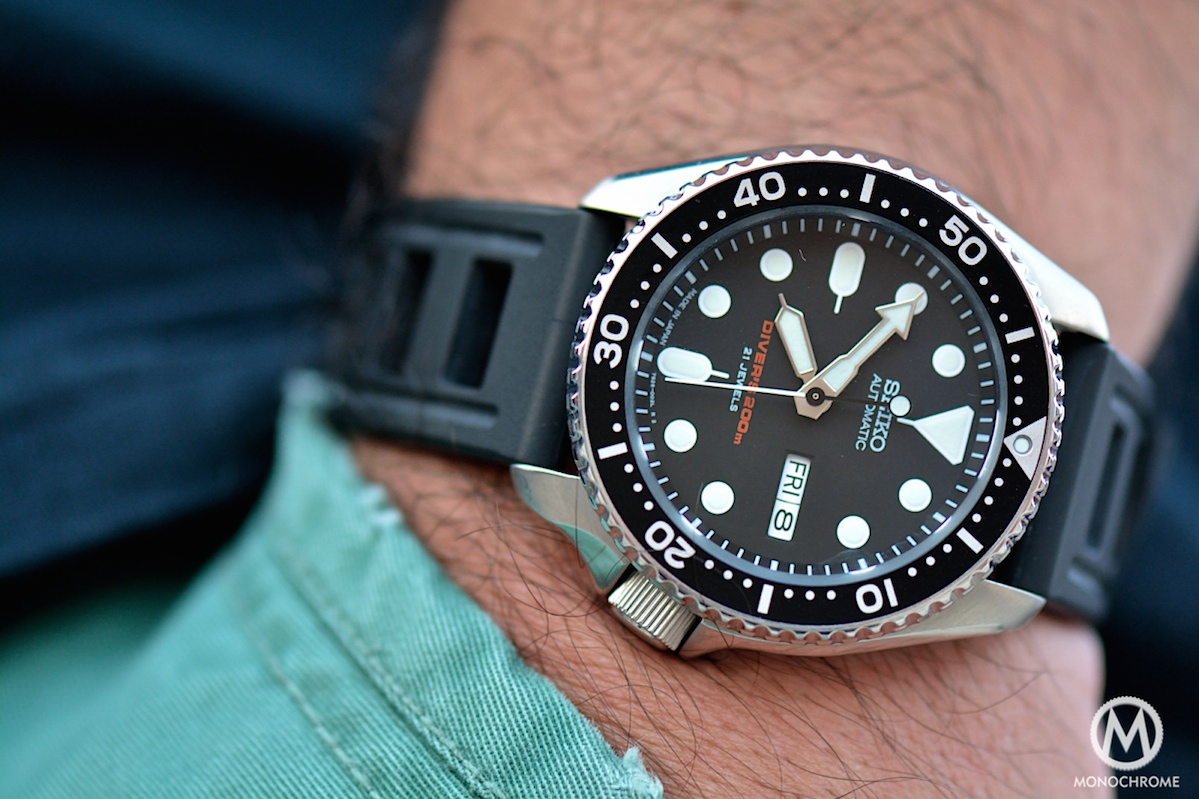
The dimensions, for the record:
- Case width: 42.5mm (measured 8 to 2)
- Bezel width: around 41mm
- Lug-to-lug: 45-46mm (this is the key number - it wears smaller than the width implies)
- Thickness: 13.25mm
- Lug width: 22mm (a huge advantage - any strap fits)
- Water resistance: 200m, screw-down crown, ISO 6425
- Weight: around 80g on the bracelet
- Crystal: flat Hardlex (Seiko's proprietary mineral crystal, scratches easily)
The 7S26: a movement with a mixed reputation and a great real-world record

The Seiko 7S26 caliber inside the SKX is the movement enthusiast forums love to complain about. On the spec sheet it looks weak: 21 jewels, 3Hz beat rate (21,600 vph), 41-hour power reserve, no hacking seconds, no manual winding, factory accuracy tolerance quoted at a very wide -20 to +40 seconds per day.
Now the real world. The 7S26 uses Seiko's Magic Lever bi-directional automatic winding system, which pulls energy into the mainspring with ridiculous efficiency. In practice most 7S26 examples run within +/- 10 seconds per day out of the box, and many owners report +3 to +8 seconds per day over multi-year timekeeping logs. Reddit threads with six-year owners consistently say the same thing: it just keeps working. No servicing, no problems, just keeps ticking.
The non-hacking, no-hand-wind design is annoying if you're setting the time precisely. It's a non-event for a beater dive watch you throw on in the morning. The movement was designed for durability first and refinement never, and it delivered on the first spec every single time.
Why it became a classic
Five things came together on this watch that don't usually come together at any price point, let alone under €230.
- Actually-certified dive spec. ISO 6425 isn't a marketing flourish. It's the international standard that requires 200m depth performance, shock resistance, thermal shock resistance, and readability underwater. Most dive watches under €1k in 1996 were not ISO certified. The SKX was.
- Proven bloodline. The 6105 was worn in Vietnam. The 6309 was the standard diver of spear-fishing crews around the world in the 1980s. The SKX inherited the mechanical DNA of watches that had been to war and back. Buyers felt that.
- The 22mm lug width. This might sound trivial. It isn't. 22mm is the most common aftermarket strap width in the world. Every NATO, tropic, isofrane, ISOfrane, rubber, canvas, and leather strap made in the last 30 years fits an SKX. That opened up a modification and strap-swap ecosystem no other dive watch platform has matched.
- The mod ecosystem. Because the SKX case, dial size, hand size and movement are all standardised across the reference family, aftermarket makers (Yobokies, Dagaz, Namoki, Crystaltimes, endless others) built out a market for replacement dials, hands, chapter rings, bezels, sapphire crystals, and case-back conversions. You could turn an SKX007 into a Submariner tribute, an Explorer tribute, a Rolex 1655 tribute, or something completely custom, for under €275 of parts. It became the platform for people learning to work on watches.
- Robert Redford wore an SKX009 in All Is Lost. The 2013 J.C. Chandor survival-at-sea film has Redford's character wearing an SKX009 on a blue NATO. That single piece of casting locked the watch into the enthusiast imagination in a way no ad campaign could have.
What it costs now
Seiko discontinued the SKX line in mid-2019. The market response was immediate: prices jumped roughly 30-40% within the first 12 months, then stabilised, then quietly kept climbing. Here's roughly where the market sits mid-2026:
- SKX007K (international): €300-500 depending on condition and whether it comes with box and papers.
- SKX007J (Japan): €600-850. Full sets with box, papers, and unused bracelet touch four figures.
- SKX009J (Pepsi): Roughly 10% premium over the 007J. Pepsi collectibility is a real thing.
- SKX013 (37mm): €400-600. Rising faster than the 007 because supply was always lower.
- SKX011 (orange): €500-750. Cult status locked in.
WatchCharts tracks the SKX007 at roughly €315 median as of mid-2026, with the model up 23.8% over five years and 8.3% over the last twelve months. It is not a fast-mover but it is a steady grower.
The successor question, and why it doesn't quite land
Seiko replaced the SKX line with the Seiko 5 SKX Style (the SRPD family, sometimes called the 5KX) at a lower price point. On paper it's an upgrade: 4R36 movement with hacking and hand-winding, updated case finishing. In practice it makes three critical compromises: water resistance drops from 200m to 100m, the crown is no longer screw-down, and the exhibition caseback replaces the solid steel one. It's a Seiko 5 (dress-sport line) shaped like a diver, not a diver.
Collectors noticed instantly. The 5KX sells fine but the original SKX secondary market kept climbing anyway, because the 5KX doesn't do the one thing the SKX did: it's not ISO 6425 rated. If you want that stamp on a Seiko today you're looking at the Prospex line, which starts around €900 and climbs fast.
Where the SKX sits in 2026
The strange truth about the SKX is that it was a better watch in retrospect than it felt in period. When you paid €200 for one in 2005 it was "just a Seiko". When you look at what €400-800 buys you in 2026, the SKX007 is still one of the best objective values on the market. ISO 6425 certified. 200m of real dive spec. A movement that's proven itself over 30 years of continuous production. A modification ecosystem that means you can genuinely make it your own. And a design language that reads as classic tool watch without being derivative of anyone.
The right way to own an SKX now is honest. Buy a K-market example for the money, put it on a nice tropic strap or a beads-of-rice bracelet, wear it every day for a year, and stop caring about servicing intervals until you have to. That's exactly the way this watch was designed to be owned. Anything else is over-thinking it.
If you missed the SKX era, the good news is the market is still liquid, K-market examples are still findable at reasonable money, and the design has not aged. If you owned one and traded it away, you're in good company (most of us did that at least once), and you can buy it back for less than a decent night out costs a week's worth of a Rolex service. The SKX007 remains, seven years after discontinuation, one of the great value-for-money mechanical watches ever produced.
Nice one, Seiko. Now bring it back.
Comments
No comments yet, be the first to weigh in.