
Omega
Seamaster Aqua Terra 38
220.10.38 · 38mm · 150m
Master Chronometer go-anywhere watch. 150m water resistance.
Two go-anywhere everyday automatics, with the same Swatch-Group manufacturer fingerprint. Aqua Terra is €5,800 Master Chronometer; PRX is €695 with Powermatic 80 and an integrated bracelet that broke the category open.
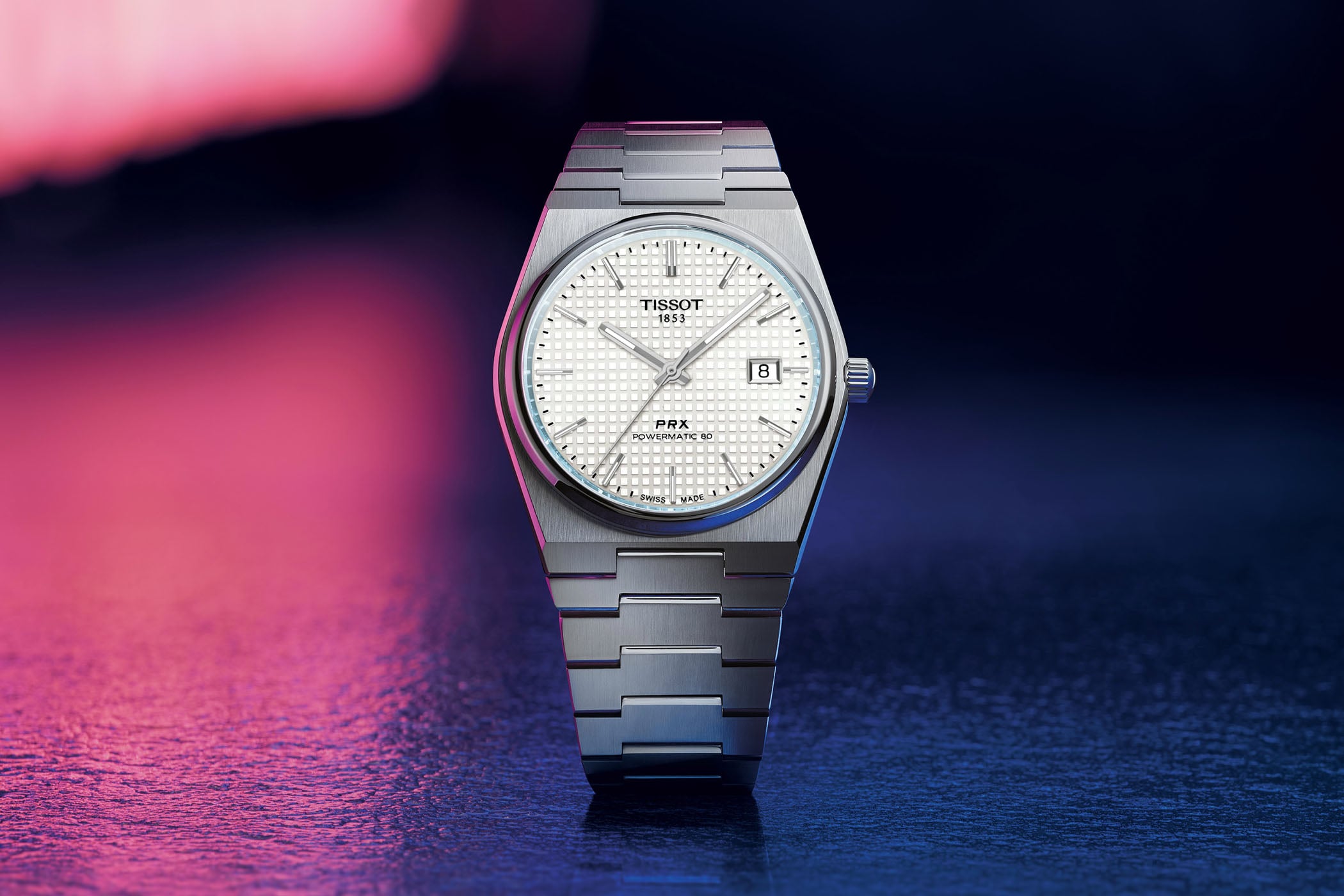
Omega and Tissot sit at the top and bottom of Swatch Group's mechanical-watch ladder. Both share movement engineering DNA: the Tissot Powermatic 80 is an ETA C07-derived movement with silicon balance spring and 80-hour reserve. The Omega Aqua Terra runs the co-axial METAS Master Chronometer Cal. 8800.
The brief is similar: 38-40mm steel sport watch, 100-150m water resistance, daily-wear positioning, mechanical automatic. The price gap is 8x. The PRX broke the under-€700 integrated-bracelet category open in 2021; the Aqua Terra remains the reference point for €5K-tier Swiss versatile-sport.
| Attribute | Omega Seamaster Aqua Terra 38 | Tissot PRX Powermatic 80 |
|---|---|---|
| Reference | 220.10.38 | T137 |
| Case diameter | 38mm × 12.4mm | 40mm × 10.4mm |
| Case material | Stainless steel | Stainless steel |
| Bezel | Smooth fixed | Smooth tonneau (integrated) |
| Bracelet | Three-link Oyster-style | Integrated tapered |
| Movement | Cal. 8800 (METAS Master Chronometer) | Powermatic 80 (ETA C07-derived) |
| Beat rate | 25,200 vph (3.5 Hz) | 21,600 vph (3 Hz) |
| Reserve | 55 hours | 80 hours |
| Hairspring | Si14 silicon | Nivachron |
| Antimagnetic | 15,000 gauss (METAS) | Standard |
| Water resistance | 150m | 100m |
| Retail price | ~€5,800 | ~€695 |
The Aqua Terra's €5,800 buys: METAS Master Chronometer certification (an industry-leading antimagnetic and accuracy standard), in-house co-axial Cal. 8800, 150m water resistance, hand-finishing on case and dial, sapphire caseback, premium bracelet quality. The Tissot's €695 gives you a different proposition: silicon hairspring at the lowest mechanical-watch price tier, the same Swatch movement architecture in a less-finished form, and an integrated bracelet that nobody else priced this aggressively.
The Aqua Terra's Cal. 8800 is METAS-certified, accurate to ±5 seconds/day across temperatures, and antimagnetic to 15,000 gauss. Service interval ~10 years. The Powermatic 80 is COSC-grade in spec but not certified, with 80h reserve and silicon balance spring at this price tier. Different watch-buying cultures: spec-buyer vs precision-buyer.
The PRX's integrated bracelet is its signature: case and bracelet are one design, no spring bars, taper from lug-width to clasp-width. The Aqua Terra wears a more-traditional three-link bracelet with spring bars (some references on rubber). On the wrist, the PRX feels more "luxury sport" silhouette; the Aqua Terra reads as "premium dress-sport." The PRX hits the Genta-style integrated-bracelet brief at €695.
If you want a spec-leading everyday Swiss automatic: Aqua Terra. METAS, co-axial, antimagnetic, ten-year service interval. €5,800 is fair for the engineering.
If you want a genuinely-good integrated-bracelet sport at the entry tier: PRX 40 205. €695 retail is not a typo. Silicon hairspring, 80h reserve, integrated bracelet.
PRX is the entry-tier answer; Aqua Terra is the destination. Many buyers buy a PRX first, fall in love with the integrated-bracelet silhouette, and upgrade upward (often to Aqua Terra, sometimes to Royal Oak / Nautilus).
Question, suggestion, or just want to say hi? Drop a note.
Comments 2