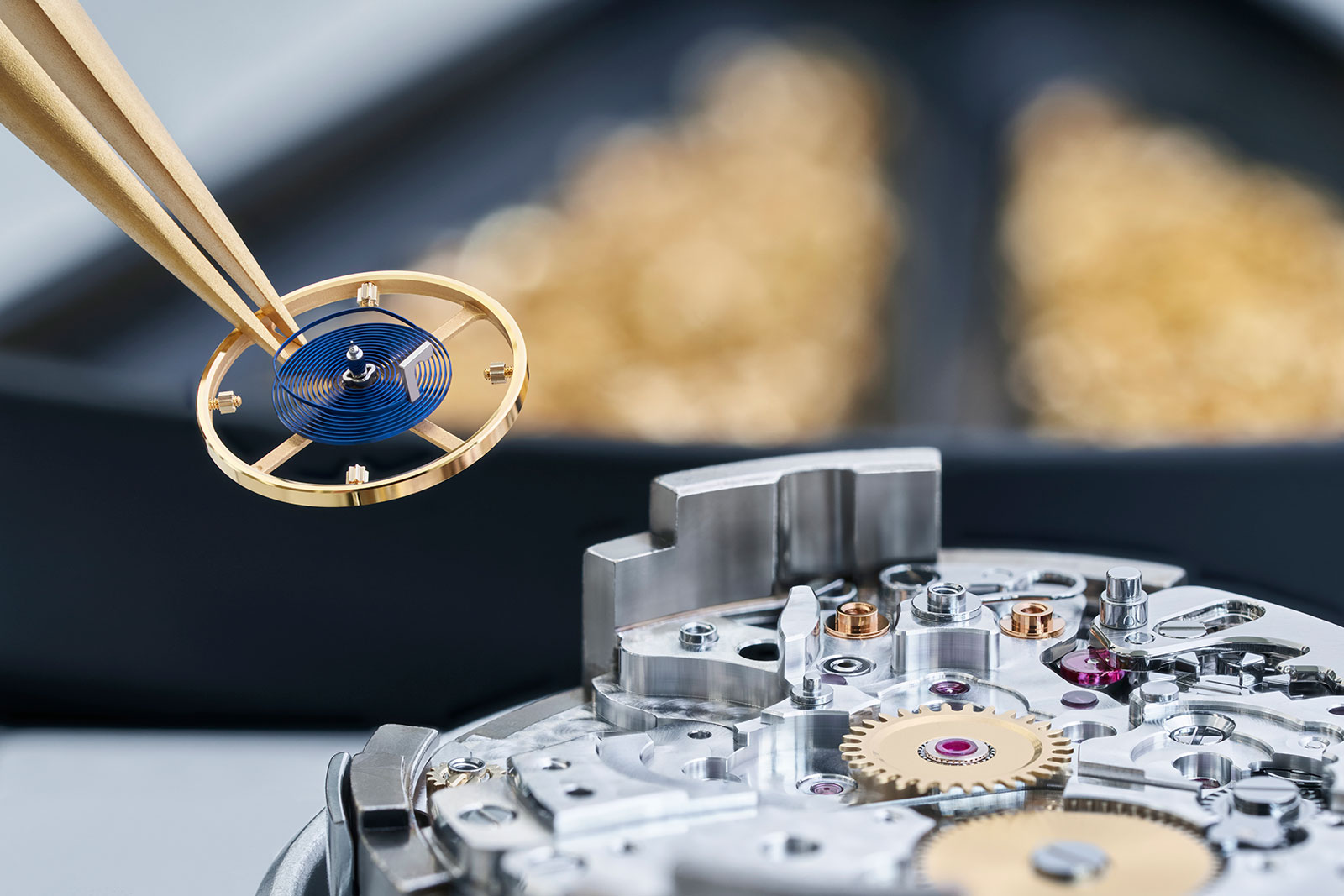
A mechanical watch's hairspring is the tiny coiled spring that controls the balance wheel; it is the component that determines a watch's rate. Conventional hairsprings are steel alloys (Nivarox, Spiron, Elinvar, Glucydur) that have been refined over a century to balance hardness, elasticity, and temperature stability. The fundamental limitations: steel is ferromagnetic (a 60-gauss field will visibly degrade rate); steel has measurable thermal expansion (rate drifts with temperature); and the round-cross-section geometry of conventionally drawn steel wire limits isochronism (rate consistency across amplitudes).
Monocrystalline silicon as a hairspring material was first explored in academic research in the 1990s; the material has unique properties: completely non-magnetic, extremely low thermal expansion coefficient (with appropriate doping to make it nearly flat), and manufacturable via DRIE (the same Deep Reactive Ion Etching process used for MEMS and microchip production). The DRIE process etches silicon wafers in 3D with photolithographic precision, allowing complex variable-cross-section profiles that improve isochronism in ways conventional drawn steel wire cannot.
"Steel is a 19th-century answer. Silicon is a 21st-century answer. Magnetism, temperature, isochronism, the silicon hairspring solves all three at once."- Watchmaker on silicon hairspring adoption
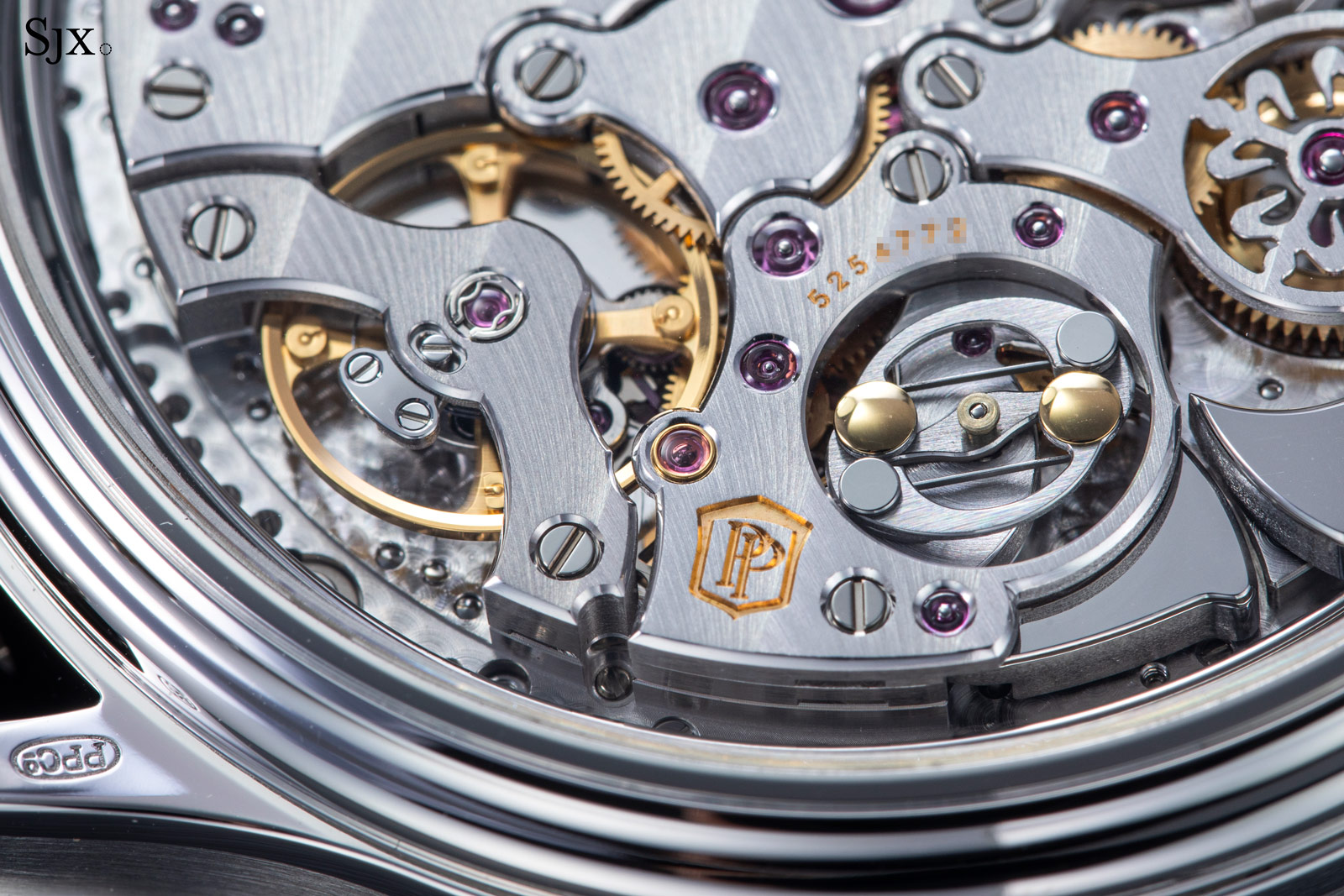
The first commercial silicon component in a watch was the silicon escape wheel in the Ulysse Nardin Freak in 2001; the silicon hairspring followed shortly after. Patek Philippe introduced the Spiromax silicon hairspring in 2005 in the Cal. 215 PS family; the technology has spread across the Patek catalogue including the modern Cal. 240 and Cal. 324 families. Breguet's Breguet Overcoil silicon balance appears in many modern Tradition references; Audemars Piguet uses silicon hairsprings in selected calibres including the Royal Oak Code 11.59 family.
Omega's use of silicon is the most operationally significant: the Master Chronometer programme launched in 2015 requires 15,000-gauss magnetic resistance, only achievable with silicon hairspring + non-magnetic component selection throughout. The silicon hairspring (combined with non-magnetic anchor/escape wheel parts and titanium / copper-beryllium escapement) means the entire balance system is passive against magnetic fields. A Master Chronometer Omega will run through MRI-machine fields without rate degradation; conventional steel-hairspring watches require Faraday-cage internal soft-iron shielding (Rolex Milgauss, IWC Ingenieur) to achieve even 1,000-gauss resistance.
The practical advantages for owners: magnetic resistance (no need to demagnetise after exposure to phones, laptops, MRI machines, or magnetic clasps); stable rate over temperature (the watch keeps the same rate on a hot wrist in summer and a cold wrist in winter); longer service intervals (the hairspring itself does not require lubrication and does not degrade); and better isochronism (rate is more consistent across power-reserve levels). The downsides: silicon is brittle (a hard impact can shatter the hairspring; conventional steel deforms but holds), and repair requires factory-spec spare parts (independent watchmakers cannot manufacture silicon hairsprings; brand service network is required).
Silicon hairsprings have not yet displaced steel at the volume tier. ETA 2824, Sellita SW200, and the great majority of mid-tier movements still use steel-alloy hairsprings (Nivarox-FAR Glucydur, Nivachron, Spiron). Silicon is currently economically restricted to premium and haute-horlogerie tier; the manufacturing complexity (semiconductor-grade silicon, DRIE etching, batch process) and per-spring cost prevent volume adoption at the entry tier. Industry watchers expect this to shift as DRIE economics improve; by 2030 silicon hairsprings may be standard at the mid-tier as well.



Comments 2