What it is and why it matters
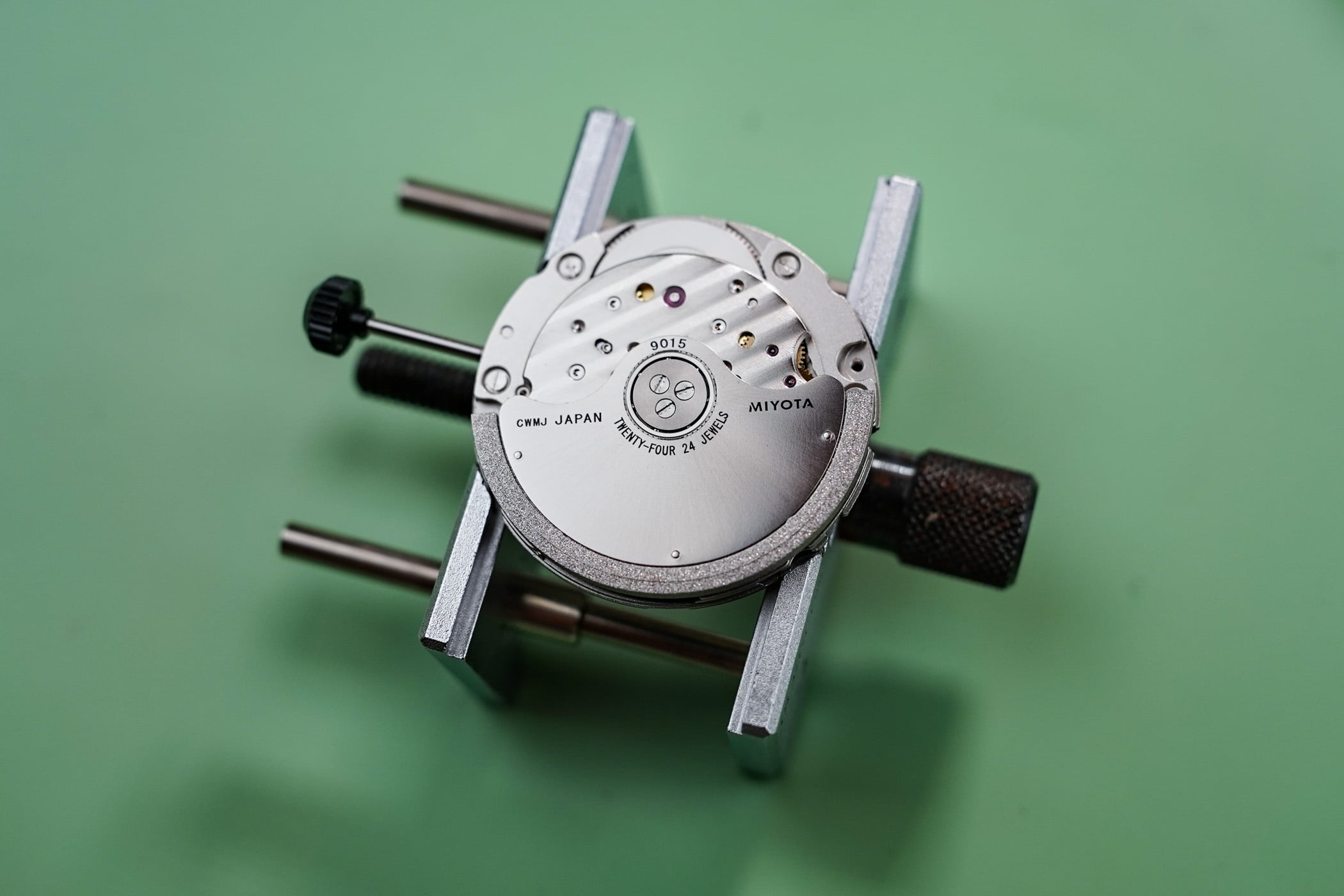
Miyota is the movement-manufacturing subsidiary of Citizen Watch Co. (Japan), the world's largest watch group. The 9015 launched in 2009 as the flagship of the Miyota Premium 9-Series, designed to compete directly with the ETA 2892-A2 on size, frequency, and feature set. Within five years it had become the de-facto standard for the microbrand industry, then quietly worked its way into Tudor, Oris, and Bulova catalogues as well. By 2026 it is the most-used Japanese mechanical movement in mid-tier Western watch brands by a wide margin.
Why microbrands chose it
Three reasons. Cost: a 9015 lands at CHF 80-150 in modest quantities, where an ETA 2892-A2 (when available) is CHF 250-400 and a Sellita SW300 is CHF 150-220. For a microbrand making 1,000-5,000 watches a year, the 9015 is the difference between a CHF 600 retail price and a CHF 900 retail price. Availability: when ETA restricted external sales between 2002 and 2020, Miyota stayed open to anyone with a purchase order; the 9015 became the only viable thin automatic for new entrants. Feature parity: hacking, manual winding, 4 Hz, 3.9 mm thick (vs 2892-A2's 3.6 mm), 28,800 vph; spec-for-spec the 9015 reads almost identically to the 2892 except for slightly less polish.
What is different from the 2892
Three things. Rotor noise: the 9015's rotor sits on a single ball bearing and is famously audible; you can hear it spin if you put the watch to your ear. Some buyers love it ("you can feel the watch alive"); others hate it. Date wheel orientation: the 9015 has the date wheel set further from the dial face, which leaves a small visible recess between the dial cutout and the date number on most case designs. Microbrands often add an extra dial layer or a cyclops to mask it. Decoration: factory-finished 9015s have minimal decoration (machined bridges, basic perlage); a Top-grade 2892 has Geneva stripes and blued screws. None of these affect timekeeping, just the look through a display caseback.
Accuracy and behaviour
Out of the box, a 9015 is rated -10 to +30 seconds per day, which sounds bad but is loose tolerance similar to a Standard-grade ETA 2824. In practice, well-handled 9015s settle in at +5 to +15 sec/day after wear-in, and a competent watchmaker can regulate one to ±5 sec/day in five minutes on a Witschi machine. Some microbrands (Christopher Ward, Halios, Farer) regulate every 9015 they ship, getting them down to ±3 sec/day. Tudor in the Black Bay 36 (pre-MT5612) regulated to chronometer-grade specs without COSC certification. The 9015 is capable of chronometer accuracy; it just is not factory-tuned to it.
Watches it powers
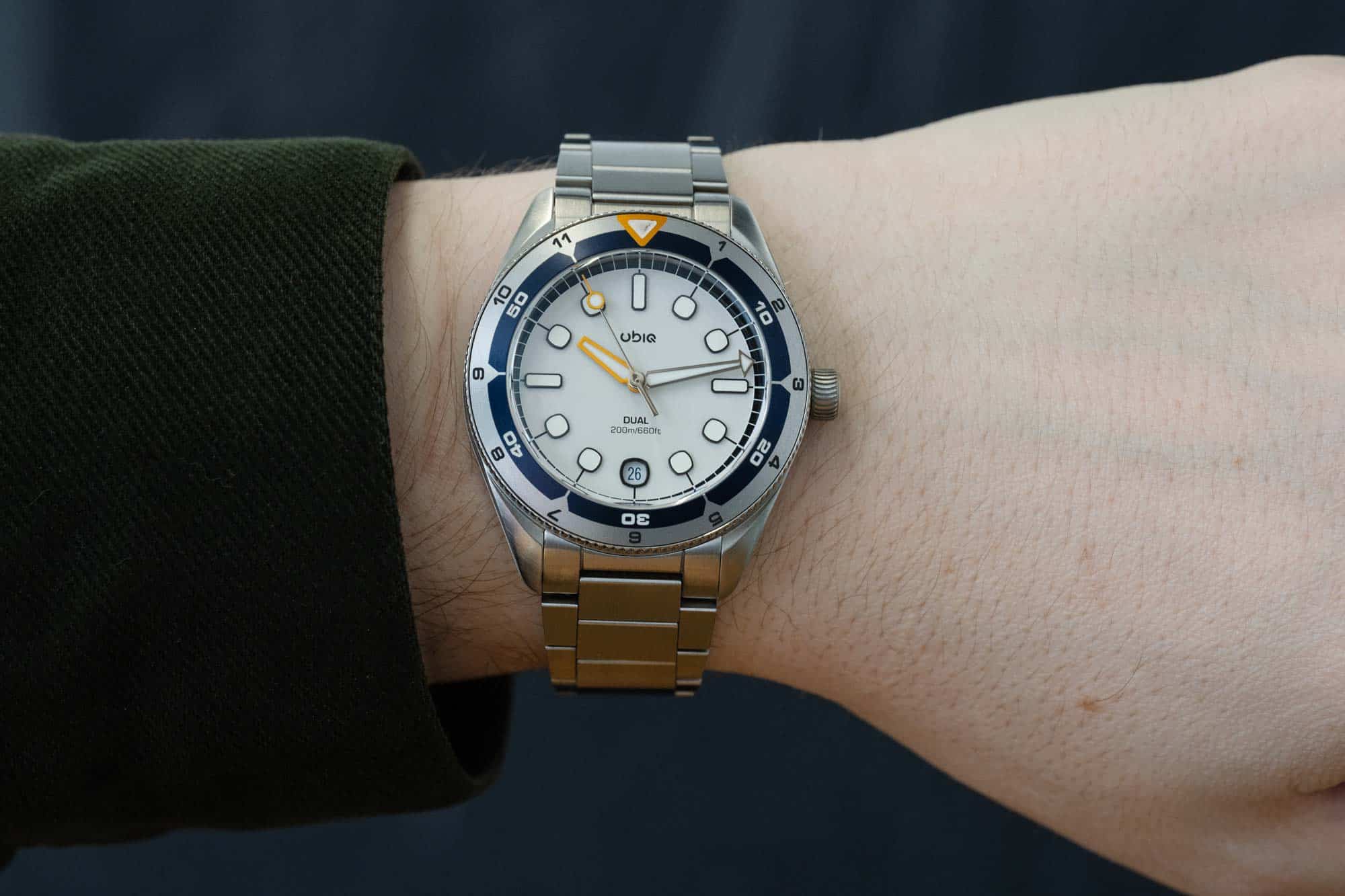
Christopher Ward C60 Trident (pre-CW SH21 in-house), Halios Seaforth / Universa / Fairwind, Lorier Falcon / Hyperion, Farer Universal, Magrette Moana Pacific, Borealis Cascais, Oris (some entry refs, e.g. ProDiver pre-Cal 400), Tudor Black Bay 36/41 (pre-2016 MT5612), Bulova Hack Watch. If you bought a sub-CHF 1,500 microbrand mechanical between 2012 and 2024 and it is not Swiss-only, statistically it is probably running a 9015. The slimmer Miyota 9039 (no date) is in dressier pieces; the 9120 adds a date at 6 o'clock; the 9130 adds a 24-hour subdial.
Service notes
The 9015 is not officially serviceable in the same sense as Swiss movements. Miyota's factory position is that 9-series movements are throwaway; if it fails, you swap the whole movement (cost: CHF 100-200 for the part). Many independent watchmakers do service them anyway: clean, oil, regulate, replace mainspring. Cost: CHF 150-250, faster turnaround than a Swiss service, no factory warranty. For a CHF 800 microbrand watch, a swap-and-replace at CHF 250 is competitive with a CHF 500 Swiss service. Magnetism vulnerability: the steel hairspring can pick up rate gain from common magnetic sources; demagnetising is the first thing to try if a 9015 suddenly runs +30 sec/day fast.

Comments
No comments yet, be the first to weigh in.