What it is and why it matters
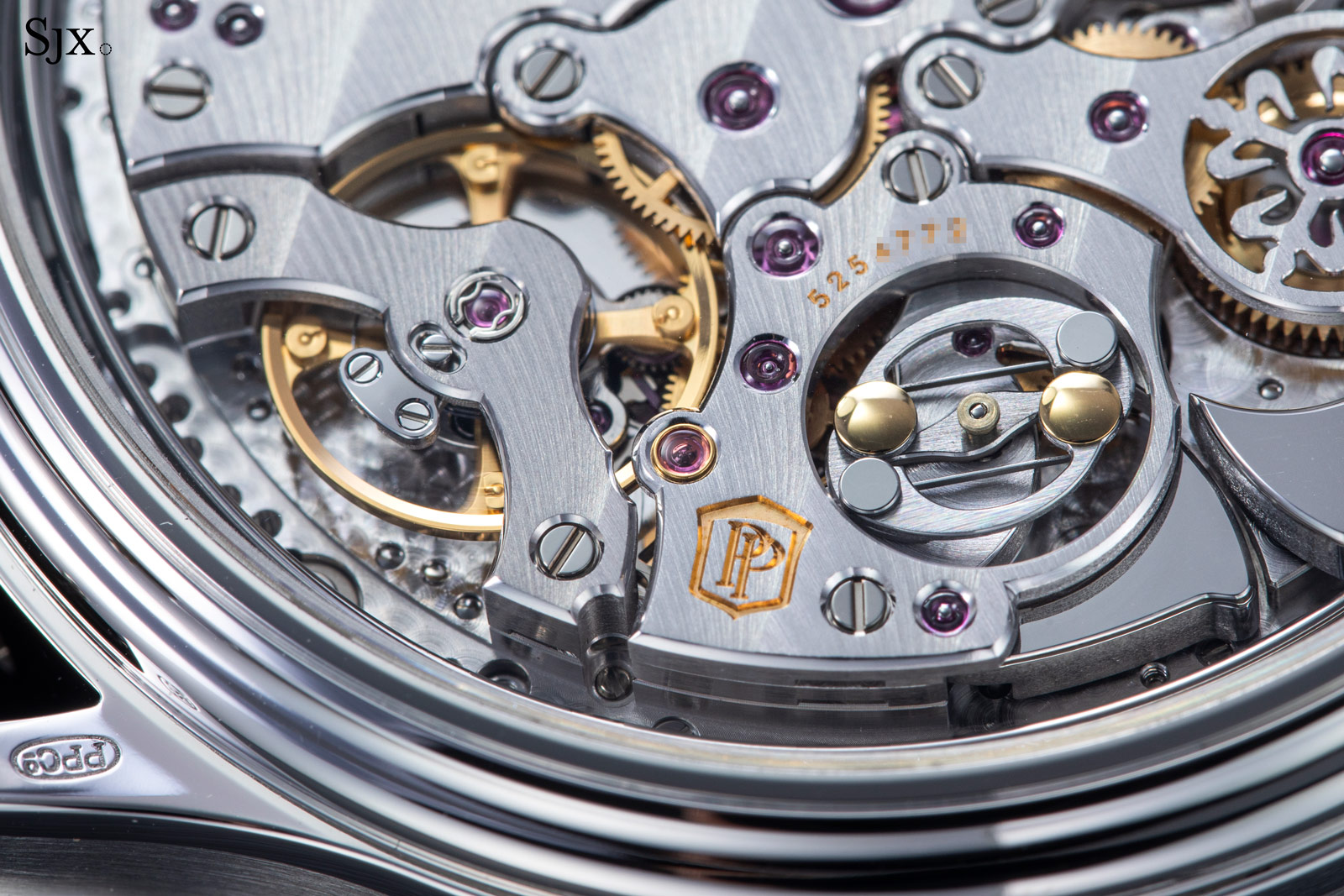
The Patek Philippe Caliber 240 is the ultra-thin automatic microrotor caliber that Patek Philippe released in 1977 as the in-house successor to the Cal. 350 and the Cal. 28-255 family. The defining characteristic is the 22-karat gold microrotor recessed flush into the back of the movement plate rather than mounted on a top bridge. The result is a movement that is just 2.4 mm thin in its base time-only form, allowing Patek to build automatic watches at thicknesses previously possible only with hand-wound calibers. The Cal. 240 has remained in production essentially unchanged for 47 years and powers a remarkable proportion of the modern Patek catalogue.
The microrotor concept
The microrotor concept was not Patek's invention. Universal Genève had launched a microrotor caliber (the Cal. 215) in 1955, and Bühler Buren had followed in 1957. The Universal microrotor stayed in production through the 1970s but was never serialised at scale; Buren's caliber was bought into the modular Cal. 11 chronograph in the late 1960s. Patek's decision in 1977 was to take the microrotor concept and engineer it for haute-horlogerie production at meaningful volume. The Cal. 240 was the first microrotor caliber that any major Swiss manufacturer committed to as a primary architecture across its catalogue.
Mechanical specification
Mechanically the 240 is conservative-by-design. It runs at 21,600 vph (3 Hz), slower than most contemporary calibers, with 27 jewels (in the base configuration) and a single barrel feeding a ~48-hour power reserve. The chosen 3 Hz beat rate keeps amplitude high and reduces wear on the small components needed to hit 2.4 mm thin. The microrotor sits in a circular cutout in the back of the plate and turns on a precision pivot above a single jewel; the unidirectional winding system feeds the barrel via a reverser wheel. Total thickness 2.4 mm is the base time-only specification; complication-equipped variants run from 2.7 mm (small seconds) to 5.0 mm (perpetual calendar with retrograde date).
The family of derivatives
The Cal. 240's career is in its family of derivatives. Patek has built more than 25 distinct variants on the 240 platform over the decades. Major ones: the 240 PS (small seconds, hand-wound time-only conversion); the 240 Q (perpetual calendar; the engine of the legendary Calatrava 3940 from 1985 onward); the 240 SQU (skeletonised version, in continuous production since the early 1980s); the 240 LU CL (moonphase + retrograde date); the 240/154 (chronograph, Nautilus 5712); the 240 HU (world time, the engine of the Patek World Time Calatrava 5110, 5130, 5230 and Nautilus 5990); the 240 Q SI (perpetual calendar with silicon Pulsomax escapement, 2008+).
Watches that have used it
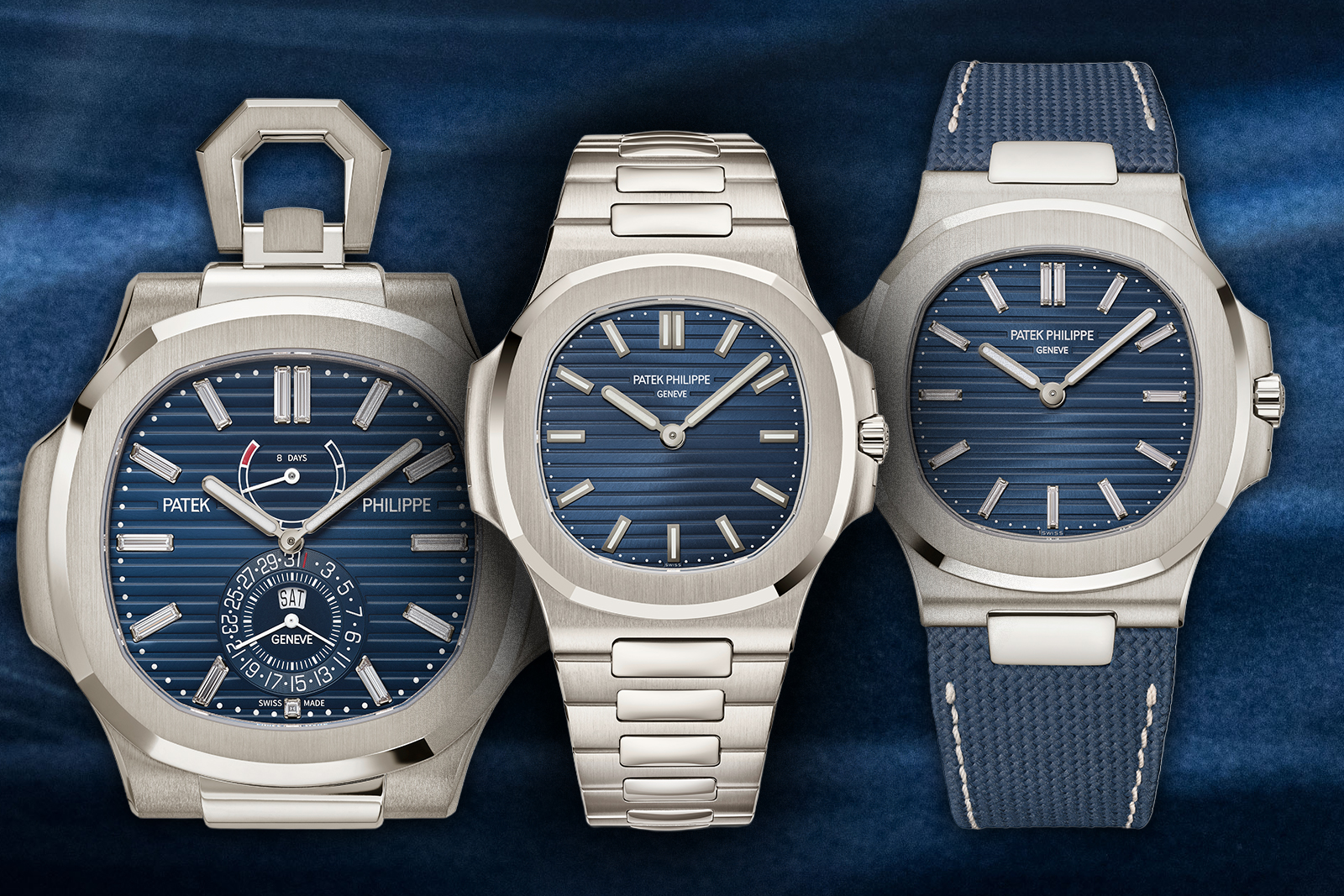
The 240 has powered some of the most important Patek references of the modern era. The Calatrava ref. 3940 (1985-2007) carried the 240 Q across its 22-year run; over those 22 years it became the reference perpetual calendar in modern watchmaking, defining the Patek Philippe complication identity. The Nautilus 3712 (2005-06) and Nautilus 5712 (2006-present) integrated the 240 with moonphase, power reserve, and date retrograde. The Aquanaut 5167 (2007-present) and Aquanaut 5167A Travel Time use the 240/188 dual-time configuration. The 240 HU world time caliber powers the Calatrava 5110 (1999-2010), the 5130 (2007-2016), and the modern 5230G (2016-present).
Modern refinements and the 47-year story
In the 21st century the Cal. 240 has been refined gradually rather than replaced. The Patek Philippe Seal certification (2009) applied to all 240 production from that date onward; the Pulsomax silicon escapement was added to selected 240 variants from 2008; the Spiromax silicon hairspring followed in 2006. The 22-karat gold microrotor remains the visual signature; the 2.4 mm base thickness has not been beaten in a serial Swiss automatic caliber even in 2024. The Cal. 240 is, after the Rolex Cal. 3135, probably the most-copied design template in modern Swiss watchmaking; nearly every contemporary microrotor caliber in the Swiss industry traces a design lineage to or competes against the 240.


Comments
No comments yet, be the first to weigh in.