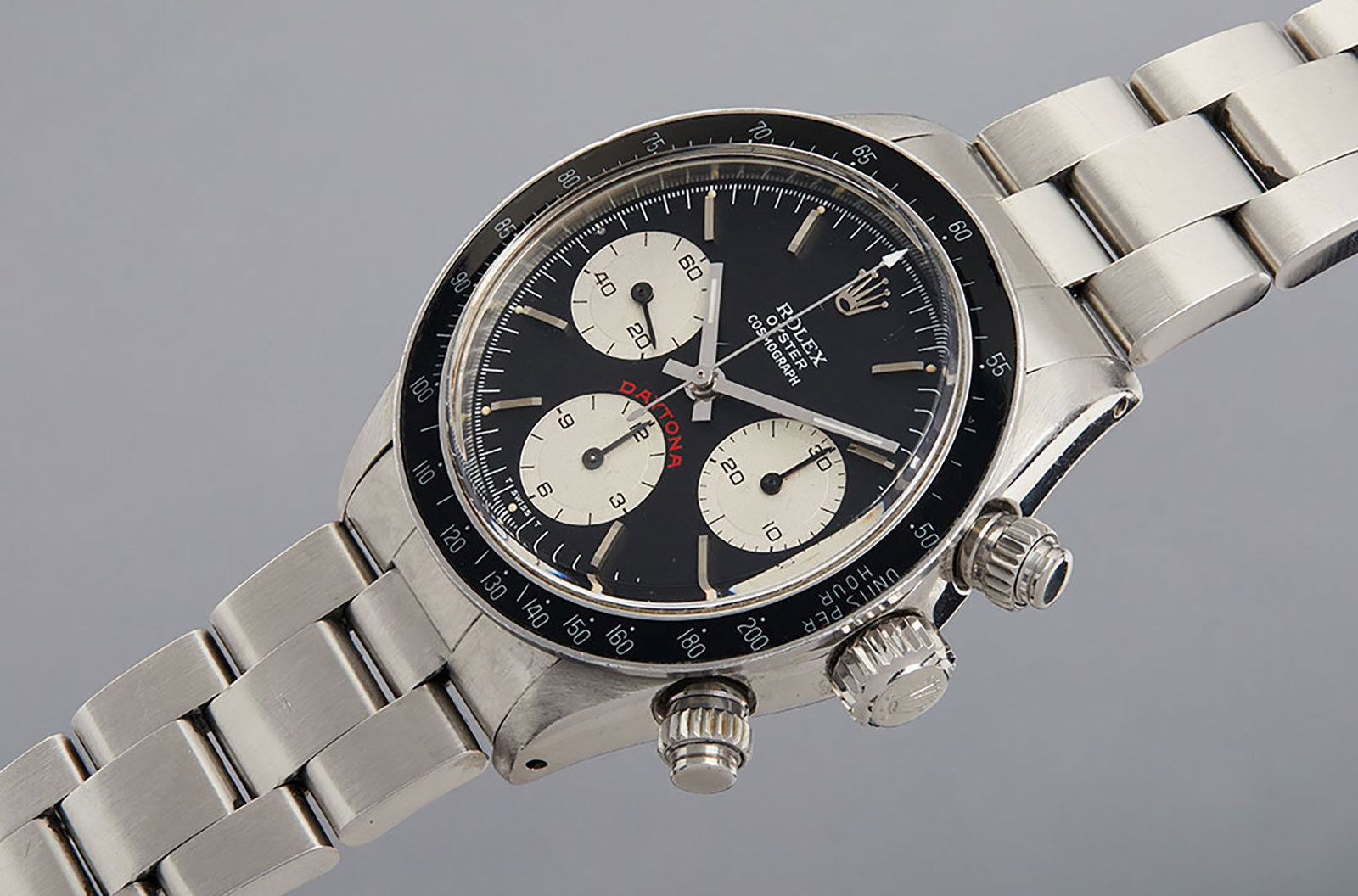
The Cosmograph Daytona originally launched in 1963 as reference 6239 (and the parallel 6241 with black acrylic bezel insert), with pump-style chronograph pushers and the Valjoux 72 manual chronograph movement. The 6239/6241 references ran until 1969 and produced the rare "exotic dial" variant later named the Paul Newman dial: contrasting sub-counters, square hour markers, Art Deco serif numerals.
Pump pushers were not waterproof: water under pressure could ingress around the chronograph activation buttons. By the late 1960s Rolex's sport-watch positioning increasingly emphasised water resistance (Submariner, Sea-Dweller); the Daytona's pump pushers were a marketing weak point. The redesign launched in 1971 introduced two key changes: screw-down chronograph pushers (engraved with the Daytona name and torque-screwable into the case for sealed waterproofing) and an upgraded Valjoux 727 calibre, mechanically the same as the 72 but tuned to 21,600 vph (vs 18,000 vph) for finer chronograph time resolution.
"In 1985 you could walk into a Rolex AD in Geneva and pick a 6263 from a tray of six. They sat in dealer cases for months."- Veteran watch retailer on the pre-1988 Daytona market
The new architecture was launched in two parallel references: 6263 with a black acrylic bezel insert printed with a tachymeter scale (the visual successor to the 6241), and 6265 with a polished steel bezel with the tachymeter scale engraved directly on the metal (the successor to the 6239). Mechanically and dimensionally the two were identical: 37 mm steel case, screw-down crown, screw-down chronograph pushers, plastic crystal, Valjoux 727 manual chronograph. Yellow-gold variants of both followed (6263 yellow gold = "Big Red" nickname for some red-Daytona-text dial variants; 6265 yellow gold).
The 6263/6265 era is the canonical vintage Daytona collecting period. Multiple "Mark" dial variations are recognised (Mark I, II, III, IV) corresponding to subtle font, lume, and printing differences across the production run. Singer S.A. in Geneva was Rolex's primary dial supplier for the Daytona through this period; "Singer dial" Daytonas (with the Singer maker's mark on the dial reverse, only visible on disassembly) are the canonical vintage collector targets. The exotic-dial variants in the 6263 and 6265 (the panda and reverse-panda configurations carried over from the 6239 era) are the "Paul Newman" 6263 and 6265 references that command the highest auction prices.
Production volume through the 17-year run was approximately 20,000-30,000 units total across both references, in steel, gold, and a small handful of platinum special editions. The Daytona was famously a slow-selling reference for Rolex through the 1970s and early 1980s, often sitting in dealer cases for months; this is the era when retail allocation queues did not exist. By the early 1980s Rolex had begun planning the automatic replacement; the 16520 launched 1988 with the El Primero-based Cal. 4030. The 6263/6265 references were discontinued in 1988; production stopped in early 1989 as remaining inventory shipped.
Modern auction performance reflects the historical importance: a clean steel 6263 in original condition trades at USD 60,000-200,000; the 6265 steel at USD 80,000-250,000; Paul Newman dial 6263 / 6265 at USD 250,000-1,500,000+; rare gold "Big Red" variants at USD 200,000-500,000+. The October 2017 Phillips sale of Paul Newman's personal 6239 at USD 17.8M re-rated the entire 1968-88 vintage Daytona market; pre-2017 baseline prices have approximately tripled across the population, with the strongest premiums on Mark dial-recognised exotic variants.


Comments 1