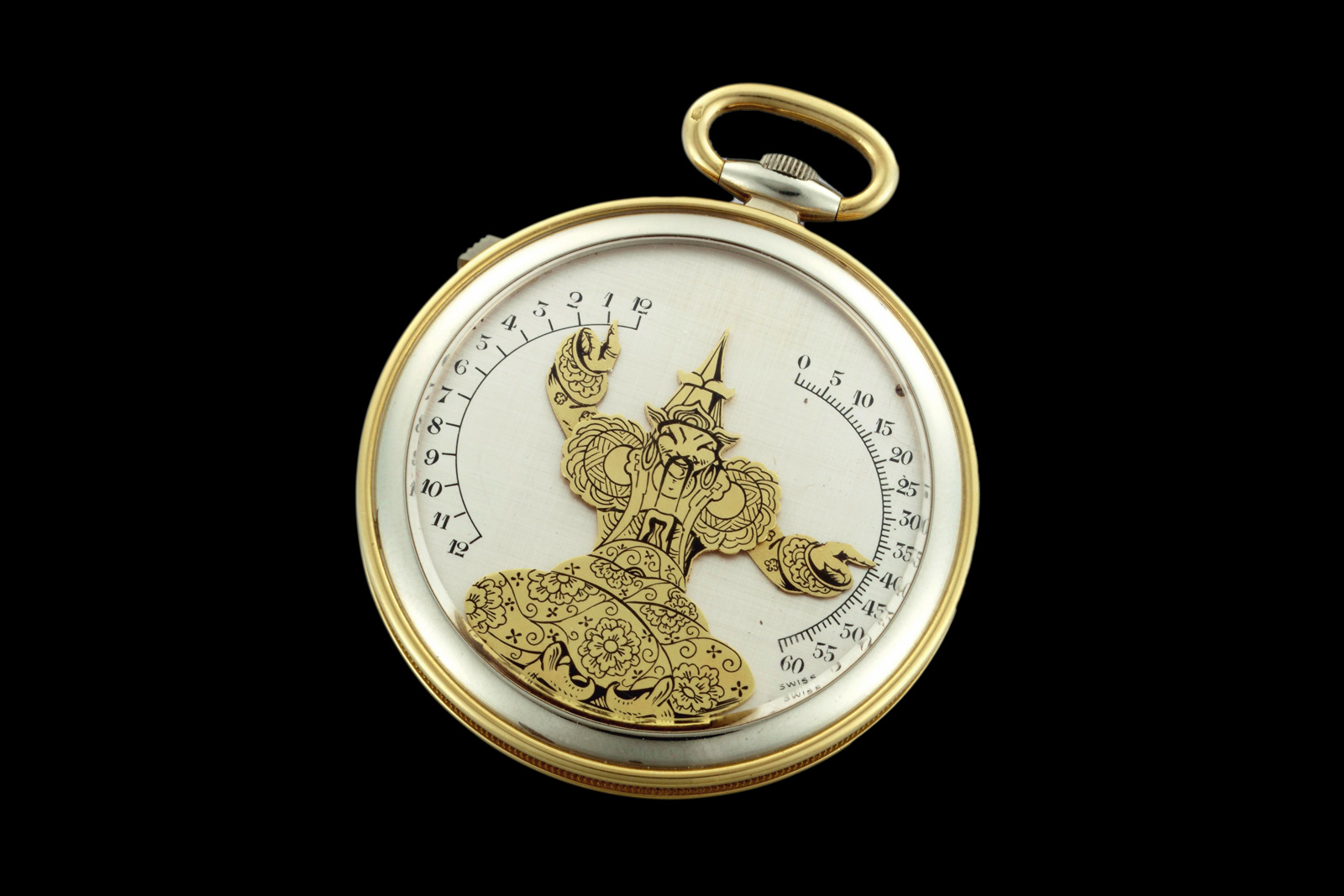
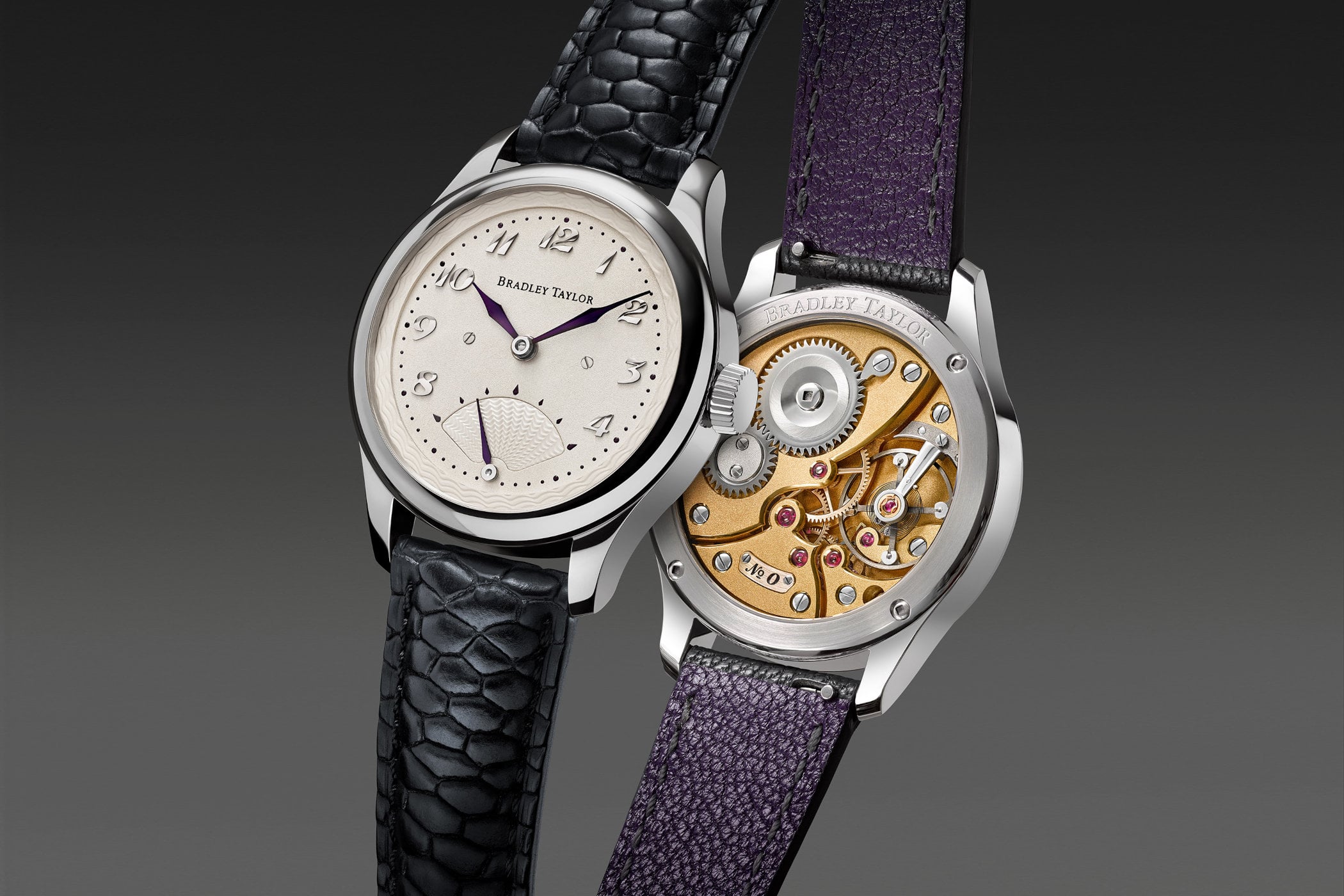
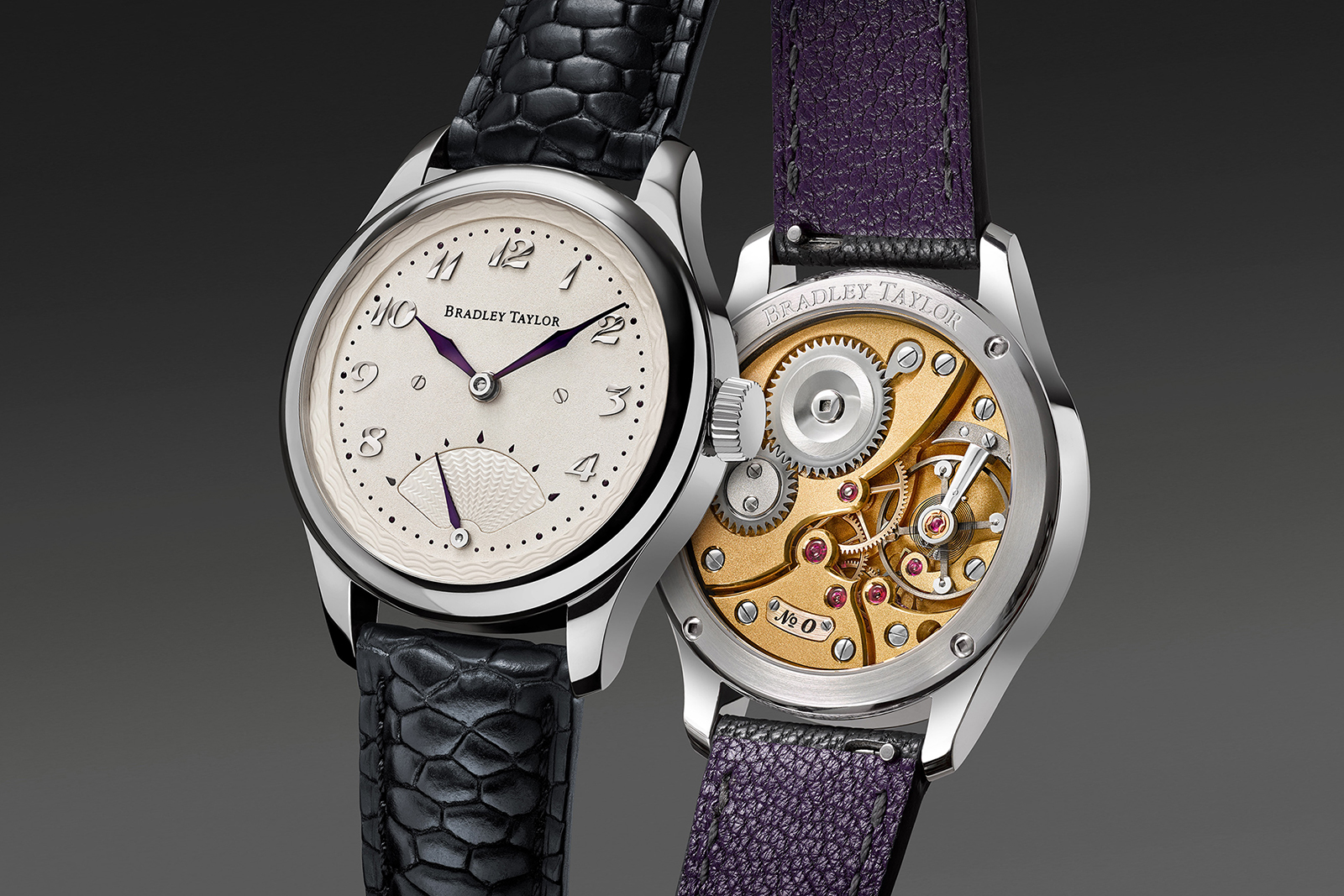
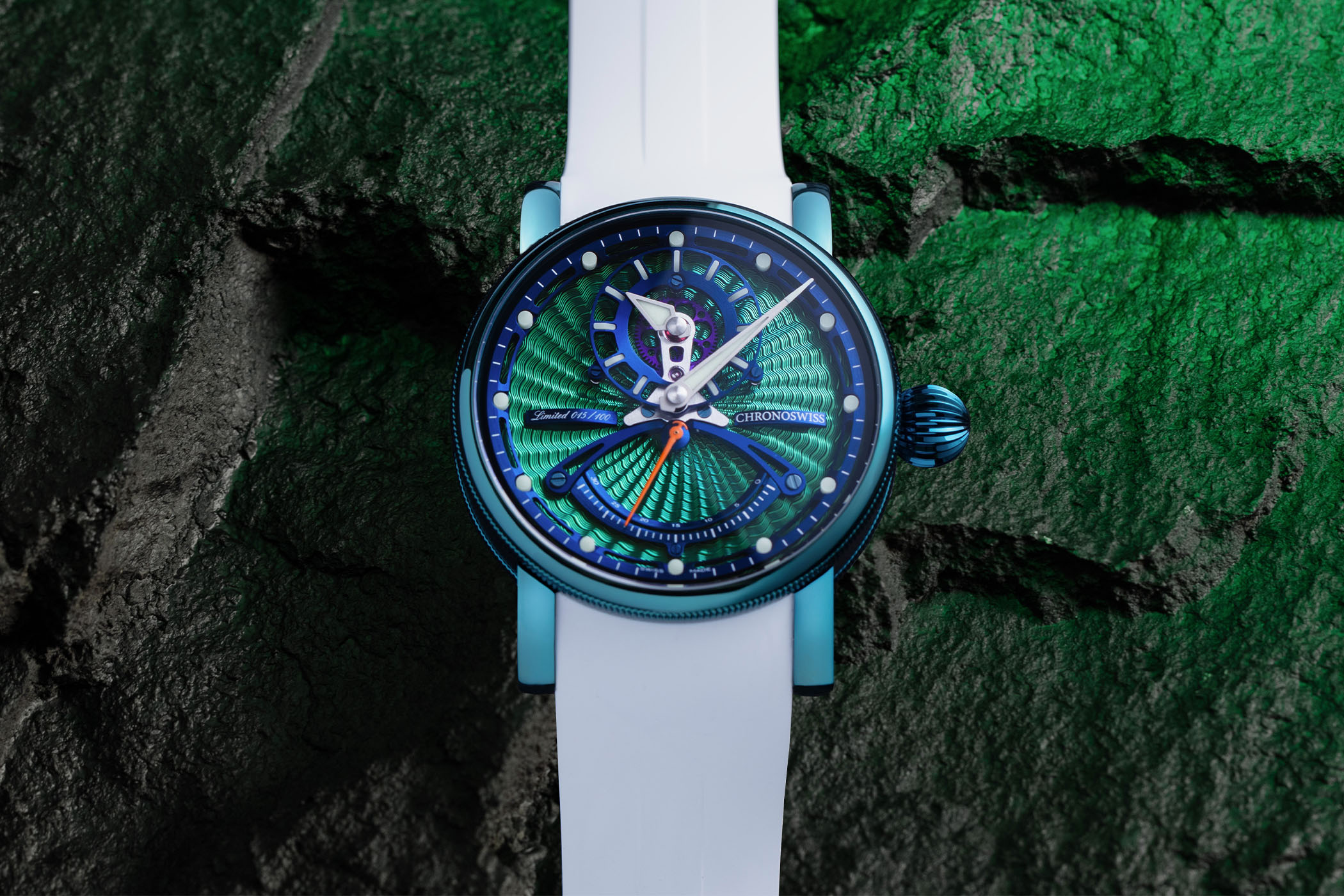
A retrograde display is a watch complication in which a hand travels along an arc-shaped scale, typically a 90°, 180°, or 270° fan, rather than a full 360° circle. When the hand reaches the end of the arc, it "jumps" instantaneously back to the starting position and resumes counting. The result is a visually distinctive display: instead of a smoothly-rotating hand the dial shows a hand that traverses an arc, snaps back to zero, and starts again. The retrograde behaviour can be applied to seconds, minutes, date, day of week, week of year, or perpetual-calendar leap-year cycles; the most common modern uses are date (31-day arc) and seconds (60-second arc).
The mechanism is essentially a spring-loaded "snail cam". The hand sits on a pivot driven by a small wheel; the wheel's rotation is geared to the indicated unit (seconds, date, etc.). As the wheel rotates the cam profile pulls the hand progressively across its arc. At the end of the cam profile a steep "drop" releases the hand, and a return spring snaps it back to the starting position; the cam profile then begins driving the hand forward again. The mechanical addition is small (a cam, a return spring, a hand pivot with limited travel), but the execution must be precise so that the snap-back is crisp without rebounding and the cam-end transition lands exactly on the starting position.
"A normal hand goes around. A retrograde hand goes across, jumps back, and goes across again. Once you have watched it snap, you understand why the complication has stayed in production for 250 years."- Watchmaking design commentary
The earliest retrograde displays appeared on 18th-century pocket watches, primarily as perpetual-calendar week-of-month indicators (the date hand would travel 1 to 31, then snap back at the end of the month, with the cam reset by the calendar mechanism). Abraham-Louis Breguet incorporated retrograde displays in several of his most complex pocket-watch references; the No. 160 Marie Antoinette includes retrograde indicators alongside its other complications. Through the 19th and early 20th century the retrograde was a standard tool in haute-horlogerie pocket watches, particularly for grand-complication pieces.
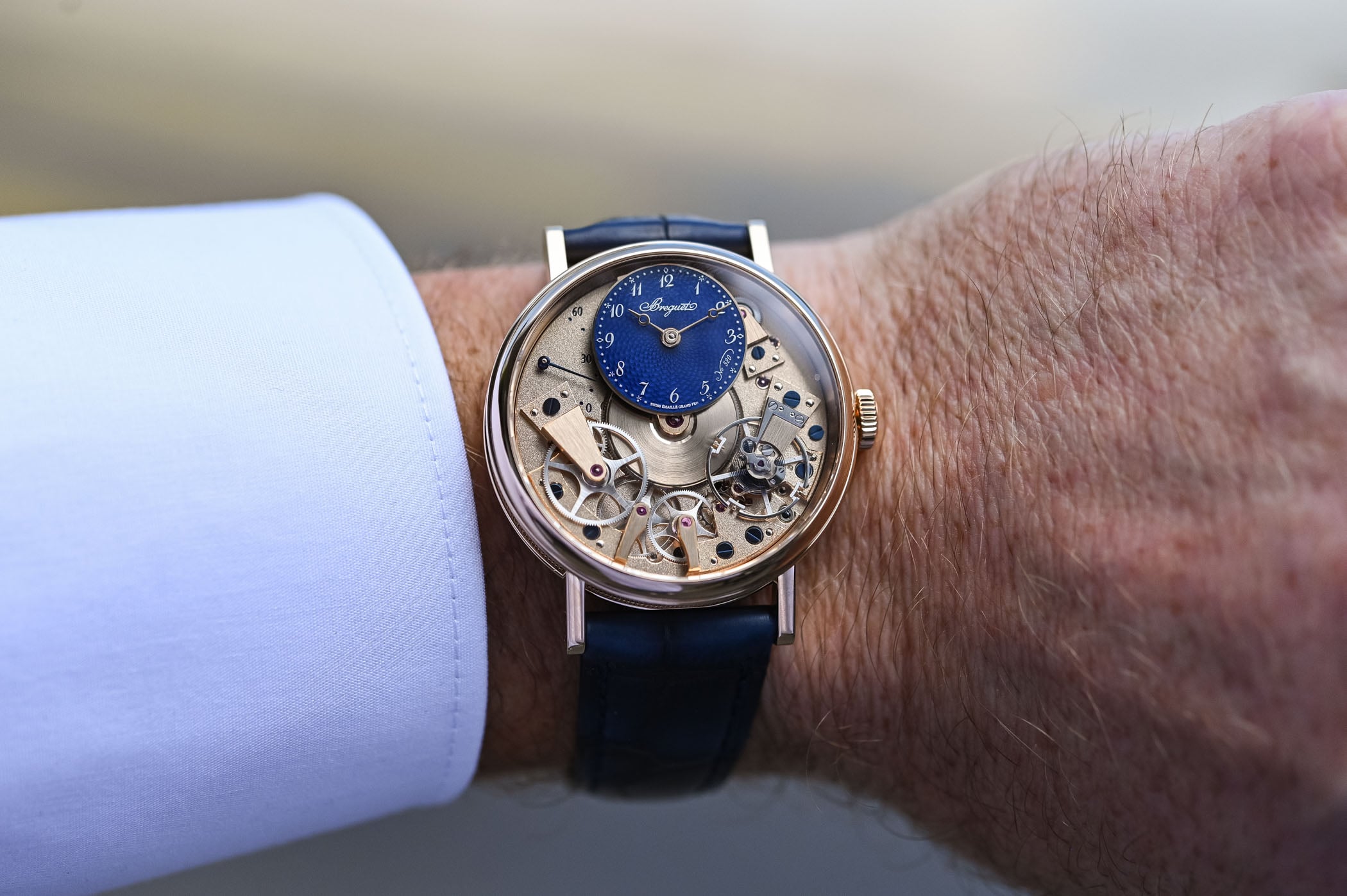
In wristwatch form, retrograde displays remained rare through most of the 20th century, then became a signature complication for several brands from the 1990s onwards. Breguet's ref. 7137 Classique with retrograde date and moon phase is one of the most-photographed modern Breguet references. Maurice Lacroix's Masterpiece series uses retrograde extensively (date, day, second). AP's Royal Oak Concept Tourbillon uses retrograde minutes. Patek Philippe's ref. 5235 Annual Calendar Regulator combines retrograde and regulator dial; the ref. 5004 rattrapante perpetual uses retrograde leap-year indication.
Specific modern retrograde subcategories:
, Retrograde seconds: 60-second arc, dramatic visual sweep with snap-back every minute. Examples: Maurice Lacroix Masterpiece Seconde Mystérieuse, Vincent Calabrese Spatio.
, Retrograde date: 31-day arc, snap-back at month end. Examples: Breguet ref. 7137, Maurice Lacroix Pontos S Calendar, Patek 5235.
, Retrograde day of week: 7-day arc. Examples: Maurice Lacroix Masterpiece, Vincent Calabrese Astrolabium.
, Retrograde week of year: 52-week arc, snap-back at year end. Rare, used on selected perpetual calendars.
, Retrograde leap-year indicator: 4-position arc, snap-back every 4 years. Found on certain perpetual calendar references.
For collectors, a retrograde display signals "haute-horlogerie complication aesthetic"; the visual movement is one of the most engaging in mechanical watchmaking. Pricing varies significantly by execution. Maurice Lacroix Masterpiece retrograde references at ~CHF 5,000-15,000; Breguet ref. 7137 at CHF 28,000+; Patek 5235 at CHF 45,000+; high-end retrograde tourbillons at six figures. The retrograde's commercial sweet spot has been the upper-mid haute-horlogerie tier, where the complication adds visible mechanical interest at moderate cost increase over a standard reference.




Comments 1