The Westminster chime is the four-bar melody played at the quarter hour by the Great Clock of Westminster at the British Houses of Parliament, the bell-tower commonly known as Big Ben. The melody itself is older than the clock: it comes from George Frideric Handel's aria "I Know That My Redeemer Liveth" in the oratorio Messiah (composed 1741). The four-note sequence (E-G♯-F♯-B descending and ascending) was first set as a clock chime at Great St Mary's, the University Church of Cambridge, around 1793; the Cambridge clock's sequence was copied for the new Westminster clock when it was installed in 1859, and the worldwide association with London became permanent.
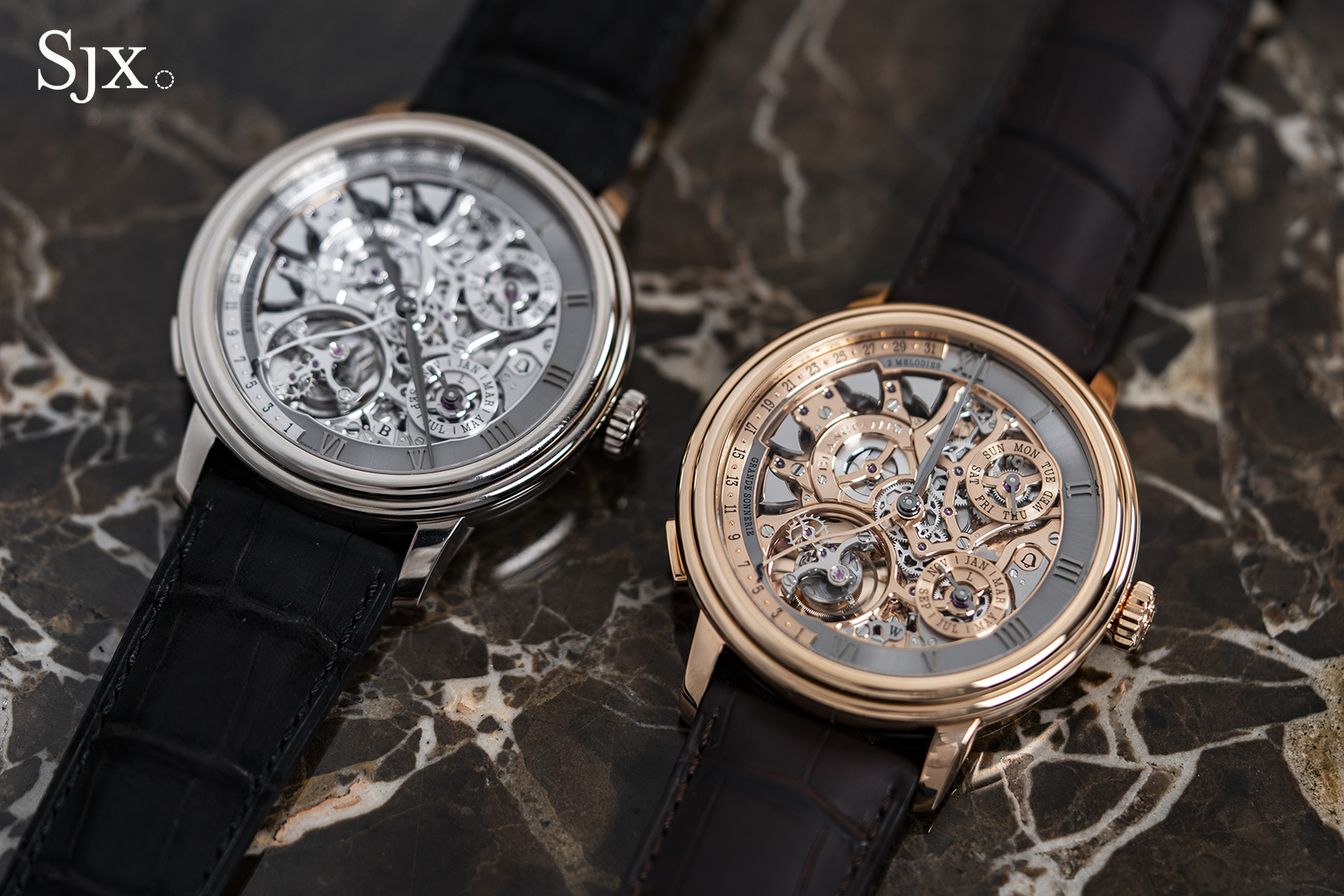
In wristwatch form the Westminster chime is the highest grade of mechanical repeater. A standard minute repeater uses two hammers and two gongs: one strikes the hours on a low gong (e.g. 11 strikes at 11 o'clock); the other alternates with the first to strike the quarter hours; the first then strikes the minutes past the quarter on the high gong. The Westminster requires four gongs tuned to E, G♯, F♯, and B, and four hammers driven by a more complex camshaft, to play the proper Westminster melody at each quarter (with one repetition at the first quarter, two at the half, three at the third quarter, and four full sequences at the hour, exactly as Big Ben does).
"A standard repeater tells you the time. A Westminster reminds you of London."- Watchmaking commentary on the Westminster chime
The Westminster mechanism's technical complexity is significant. Four gongs must be tuned individually with absolute pitch precision; the gong wires must not interfere acoustically with each other; and the camshaft driving the four hammers must coordinate the melody timing across 16 hammer strikes per quarter at the hour. The mechanism typically occupies 40-50% of the back of a wristwatch movement; only large-case watches (40+ mm) can house it. Manufacturing tolerances on the gong assembly are tighter than on a standard repeater: the difference between a beautiful Westminster wristwatch and a flat one is acoustically obvious to anyone who has heard both.
The first wristwatch with a Westminster chime was the Patek Philippe ref. 1415, a unique piece commissioned in 1932. Patek's subsequent Westminster pieces, the ref. 2419 (1939, unique), the ref. 3974 (1989), the ref. 5106 (Sky Moon, 2002), the ref. 5104P (2003), the ref. 5074 (2009), and the ref. 5208P (2011), are produced in series of perhaps 5-10 pieces per year at six- to seven-figure prices. The most famous Westminster Patek is the Sky Moon Tourbillon ref. 5002 (2001), which combined Westminster chime with a tourbillon, perpetual calendar, sidereal time, and moon phase in a 42 mm two-faced case.
Outside Patek the Westminster chime appears in a handful of haute-horlogerie pieces. Audemars Piguet's Royal Oak Concept Supersonnerie (2014) and the Code 11.59 Universelle RD#4 (2023) feature acoustic-chamber-amplified Westminster mechanisms with patented gong-mounting systems that improve the watch's chime volume by 8-10 decibels over a conventional repeater. Jaeger-LeCoultre's Hybris Mechanica à Grande Sonnerie (2009) carries the Westminster as part of a triple-axis tourbillon + minute repeater + grande sonnerie complex. Independent watchmaker Kari Voutilainen has built a small number of Westminster pieces by hand. Breguet, Vacheron Constantin, and Franck Muller have produced Westminster wristwatches in single-digit quantities.
For collectors, a Westminster wristwatch is one of the technical pinnacles of mechanical watchmaking. The combination of acoustic excellence (the chime must sound musical, not mechanical), mechanical complexity (four-hammer coordination across 16 strikes per hour), and case acoustics (the case design must amplify rather than dampen the chime) makes a properly-executed Westminster piece a feat of multidisciplinary engineering. Total annual production worldwide is probably under 30 pieces; cumulative production since 1932 is in the low hundreds. A Westminster wristwatch in good condition is one of the most expensive single-complication wristwatches a collector can own; six-figure starting prices and seven-figure prices for the high-end Patek references are standard.
Comments 2