Pulsomax and Spiromax are the two silicon mechanical-watch components developed by Patek Philippe in collaboration with the CSEM (Centre Suisse d'Électronique et de Microtechnique) and the Swiss research consortium that, in the early 2000s, jointly investigated silicon as a watchmaking material. The two components address different parts of the Swiss lever escapement: Spiromax is the silicon balance spring, introduced in 2006; Pulsomax is the silicon escape wheel and pallet fork, introduced in 2008. Together they modernise the lever architecture at Patek without replacing it.
Silicon as a watchmaking material was investigated jointly by Patek Philippe, Audemars Piguet, and the Swatch Group through the early 2000s under the CSEM consortium. The properties that make silicon attractive: extremely lightweight (low rotational inertia for the escape wheel), fully antimagnetic (no rate effect from magnetic fields), dimensionally stable across temperature (no thermal coefficient), and most importantly self-lubricating at the impulse face (silicon-on-silicon contact has very low friction without lubricant). Manufacturing uses deep reactive ion etching (DRIE) on a silicon wafer; the parts are produced by photolithographic processes borrowed from semiconductor manufacturing, allowing tolerances and shapes that traditional milling cannot achieve.
"Silicon is not a new escapement. It is the same Swiss lever, with new materials. Patek did not change the architecture; they changed the metal."- Watchmaking commentary on the Pulsomax architectural choice
The Spiromax hairspring launched in 2006 in the Patek Philippe ref. 5350R Annual Calendar. The geometry is a flat silicon spiral with a patented terminal curve (the "Patek Philippe Spiromax Curve") that improves concentric breathing, the radial uniformity of the spring's expansion and contraction during oscillation. A traditional Breguet overcoil hairspring requires hand-shaping by a master watchmaker to achieve concentric breathing; the Spiromax silicon version is mass-producible to the same isochronism specification because the photolithography defines the curve geometrically rather than by hand. The Spiromax is also fully antimagnetic; the steel hairspring it replaces was the most magnetic-vulnerable component in a typical watch.
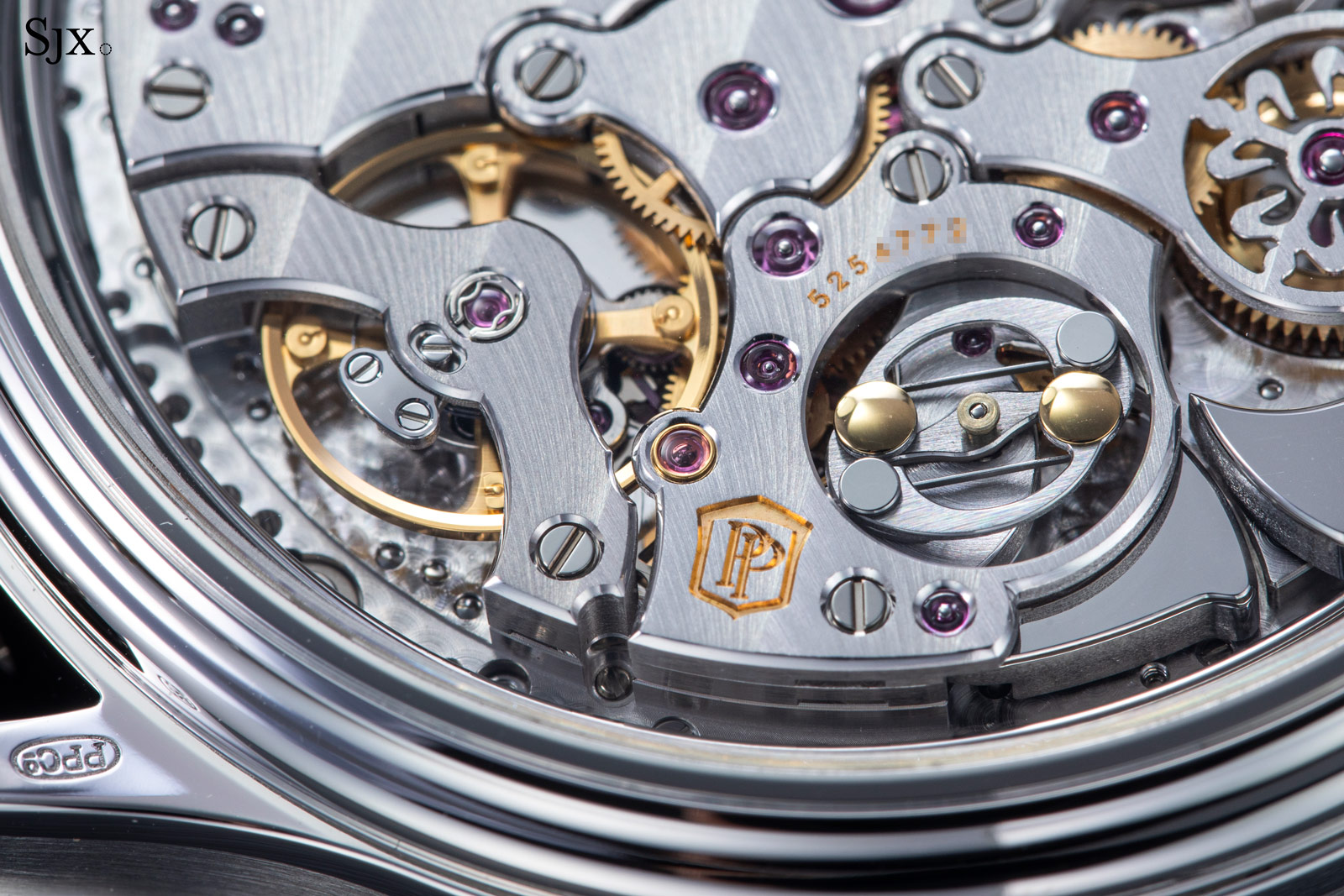
The Pulsomax escapement launched in 2008 in the Patek Philippe ref. 5550P Advanced Research Annual Calendar. It is a Swiss lever escapement (not a new architecture) with the escape wheel and pallet fork made from silicon. The benefits: ~15% efficiency improvement from lower-friction silicon-on-silicon impulse, ~50% lower mass for the escape wheel (reduced inertia and faster start-up after stopping), and no lubrication required at the impulse face. The shape of the escape-wheel teeth is also different from a traditional Swiss lever; the Pulsomax uses a slightly modified tooth profile that takes advantage of silicon's manufacturability. The visual difference under a loupe is unmistakable: silicon parts are matte grey-blue, with the characteristic etched-edge appearance of photolithographic manufacturing.
Outside Patek the parallel developments are Audemars Piguet's "Cosc" silicon work, the Omega "Si14" silicon hairspring (used across the Master Chronometer family), and Rolex's Syloxi silicon hairspring (used on selected ladies' Rolex references but not the core sport catalogue, which uses the metal Parachrom). The four programmes (Patek's Pulsomax/Spiromax, AP's, Omega's Si14, Rolex's Syloxi) are technically similar but commercially distinct; the patents are held separately and the silicon manufacturing supply chain (CSEM, Sigatec, the Swatch Group's in-house silicon production) is partially shared. Roughly 1 million silicon balance springs are now produced annually across the Swiss industry, with Omega and Patek as the two largest users.
The Patek-specific positioning of Pulsomax/Spiromax is as a demonstration that the Swiss lever architecture remains competitive against the co-axial. Where Omega's strategic answer to lubrication-related rate drift is the geometric change to a radial-impulse escapement, Patek's answer is the material change to silicon components. Both achieve similar service-interval extensions (5-10 years between intervention rather than 3-5 years for traditional steel-on-ruby Swiss lever); both achieve full antimagnetism. The Pulsomax/Spiromax pair is the technical reason a modern Patek Calatrava with a steel-cased silicon-equipped Cal. 215 PS will keep chronometer rate through a decade of normal wear without service, comparable to a co-axial Master Chronometer Omega.

Comments 2