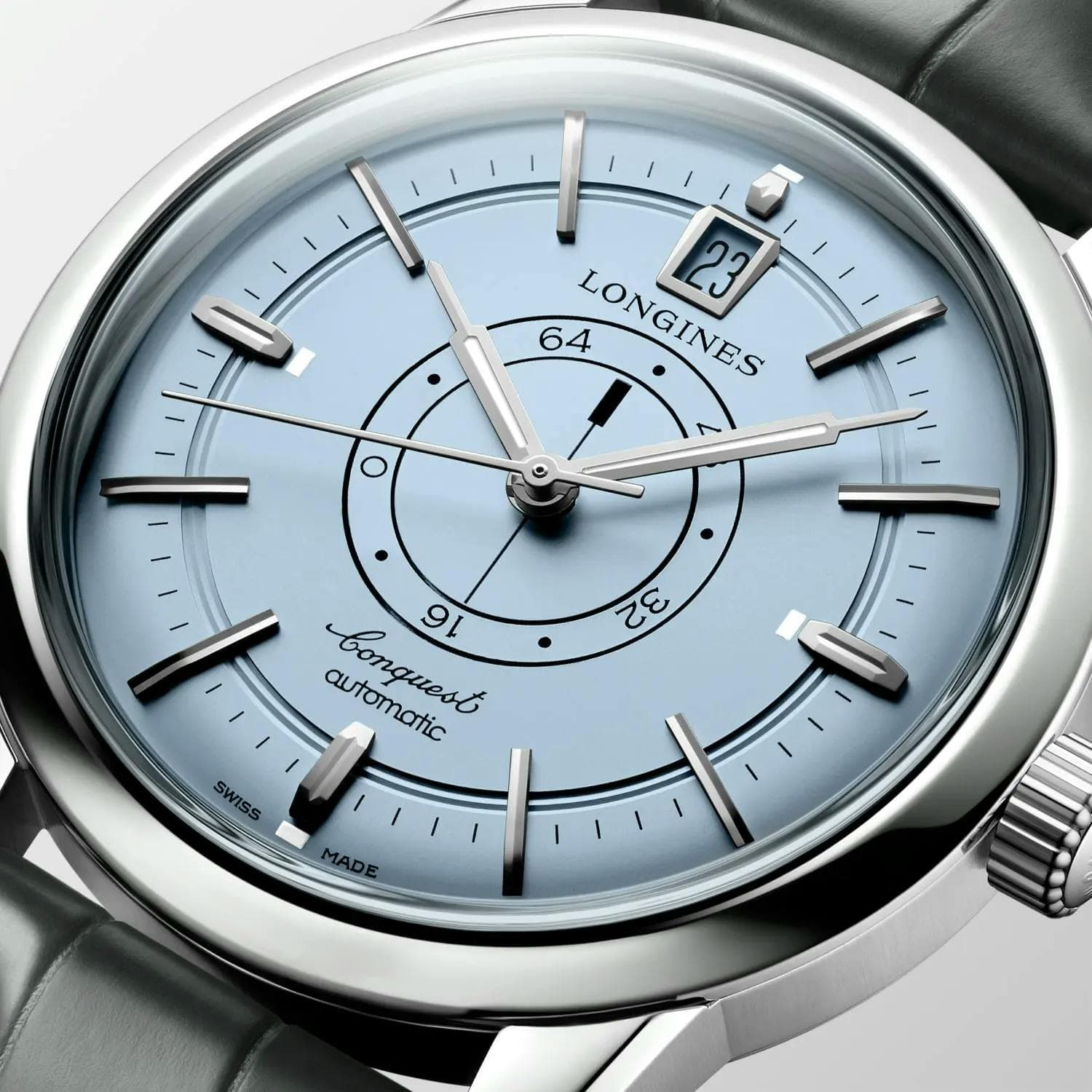
Longines is quietly one of the most interesting mid-priced brands right now, and the piece that best proves it is the Conquest Heritage Central Power Reserve. It arrived in 2024 as a re-edition of a 1959 original, kept the strange, brilliant idea of showing the mainspring's remaining energy on a rotating disc in the middle of the dial, and paired it with a modern silicon-hairspring movement that shrugs off magnetism. This week it gets the update everyone was waiting for: a light blue opaline dial.
What is new
The case, movement, and layout are unchanged. Longines is doing exactly what most enthusiasts want a brand to do with a good design: leave the good bits alone and give us a new dial.
- Dial: Light blue opaline, sunburst brushed, with a matching light-blue date disc at 12 o'clock. The date wheel colour-match is the small thing that separates this from a lazy refresh.
- Central power reserve indicator: Two concentric rotating discs at the centre show hours of energy remaining. When the watch is fully wound the disc reads "72", ticking down as the mainspring depletes. It is the single most distinctive detail on the watch and the reason to buy this over any of the other Conquest Heritage variants.
- Applied indices + dauphine hands: Polished steel batons, straight dauphine hands, no faux patina, no crowded typography. The dial reads clean at arm's length.
- Reference: L1.648.4.92.2 (also written L16484922) on the light-blue configuration.
Specs, in one glance
- Case: 38mm × 12.30mm stainless steel, brushed and polished.
- Water resistance: 5 bar (50m). Enough for washing hands and swimming. Not a diver.
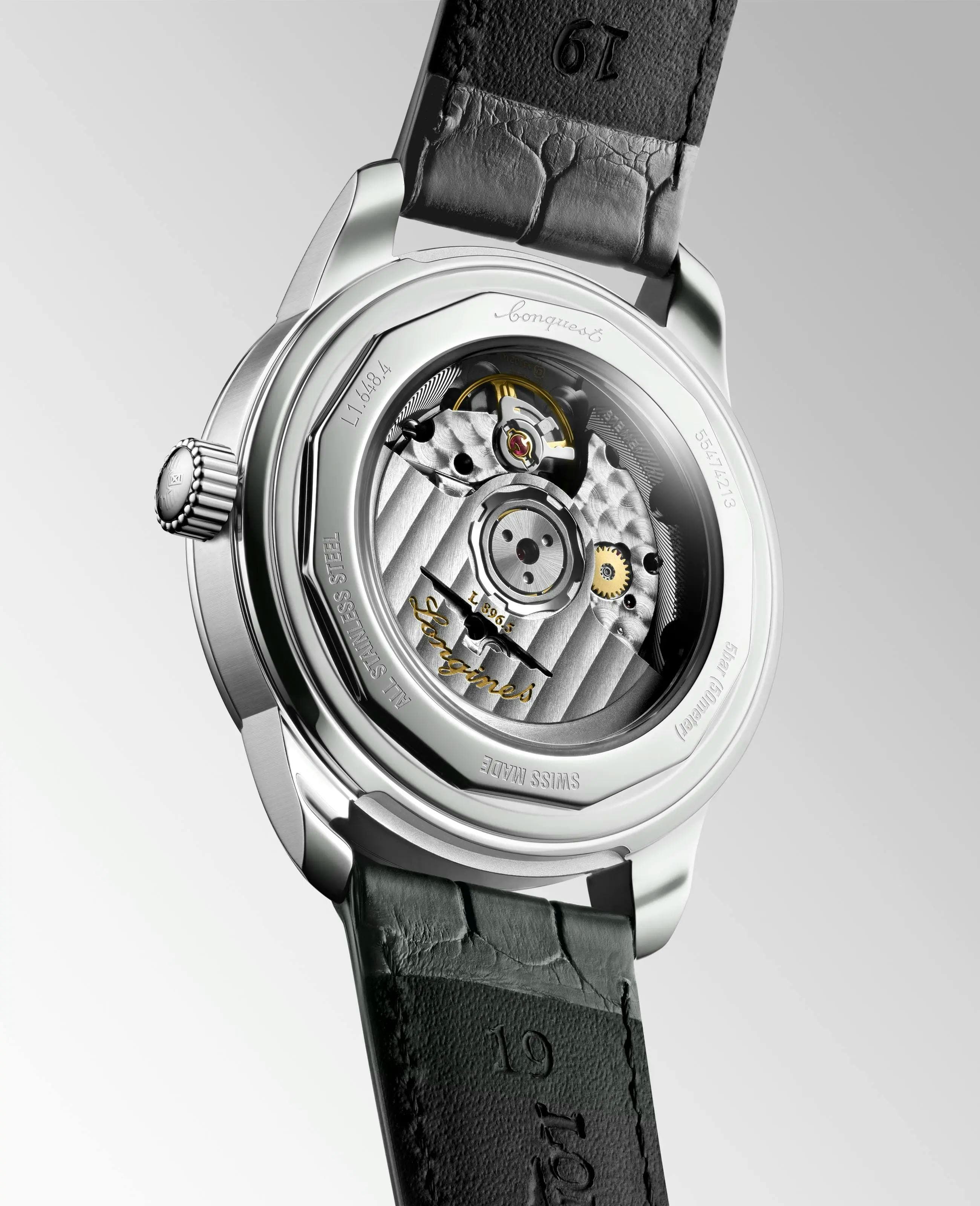
- Crystal: Sapphire, multi-layer AR coating both sides. Sapphire caseback so you can watch the movement work.
- Movement: Longines calibre L896.5, exclusive to Longines, self-winding, 25,200 vph.
- Power reserve: 72 hours, shown on the dial itself.
- Hairspring: Monocrystalline silicon. Magnetism becomes a non-issue.
- Strap options: Alligator leather with folding buckle, or the five-link Conquest bracelet.
- Price: €3,950 on the alligator strap, €4,050 on the bracelet. Longines EU pricing runs at parity or slightly under.
Why the central power reserve is the point
Most power-reserve indicators live on a small subdial at 9 or 3 o'clock, or on the caseback. Longines puts theirs in the middle of the dial, using two concentric rotating discs. The outer disc shows the reserve number, the inner disc rotates to point at it. It looks weird for about ten seconds and then it looks obviously correct: your dial now shows time and how much watch is left before you have to wind it. Zero clutter, zero hidden information, and a real conversation piece on the wrist.
This is the sort of complication a brand like Longines is uniquely positioned to ship. Anyone above it in the hierarchy (Grand Seiko, JLC) will not touch the layout because it does not fit their design language. Anyone below it does not have the movement development to build the discs properly. Longines has an in-house-adjacent calibre (L896.5 is built by ETA to Longines specification, exclusive to the brand, and finished + regulated in-house), and the freedom to do a nostalgic dial that reads modern rather than costume-y.
How the light blue reads vs the earlier colours
The Conquest Heritage Central Power Reserve arrived in 2024 with three dials: opaline ivory, anthracite, and green. Ivory was the safe conservative choice, anthracite was the professional grown-up, green was the collector piece. The light blue slots in as the everyday summer dial: bright enough to pop on the wrist, restrained enough to work under a shirt cuff, and complementary to both steel and warmer metal watches in the same collection.
What matters here is that Longines used opaline, not just paint. Opaline dials read differently at different angles because the surface catches light the way brushed metal does but softer. In direct light the dial is a proper mid-blue; in shadow it goes almost pale grey. This is the same trick that makes the Grand Seiko SBGA211 "Snowflake" so photogenic; Longines does the diet version of it well.
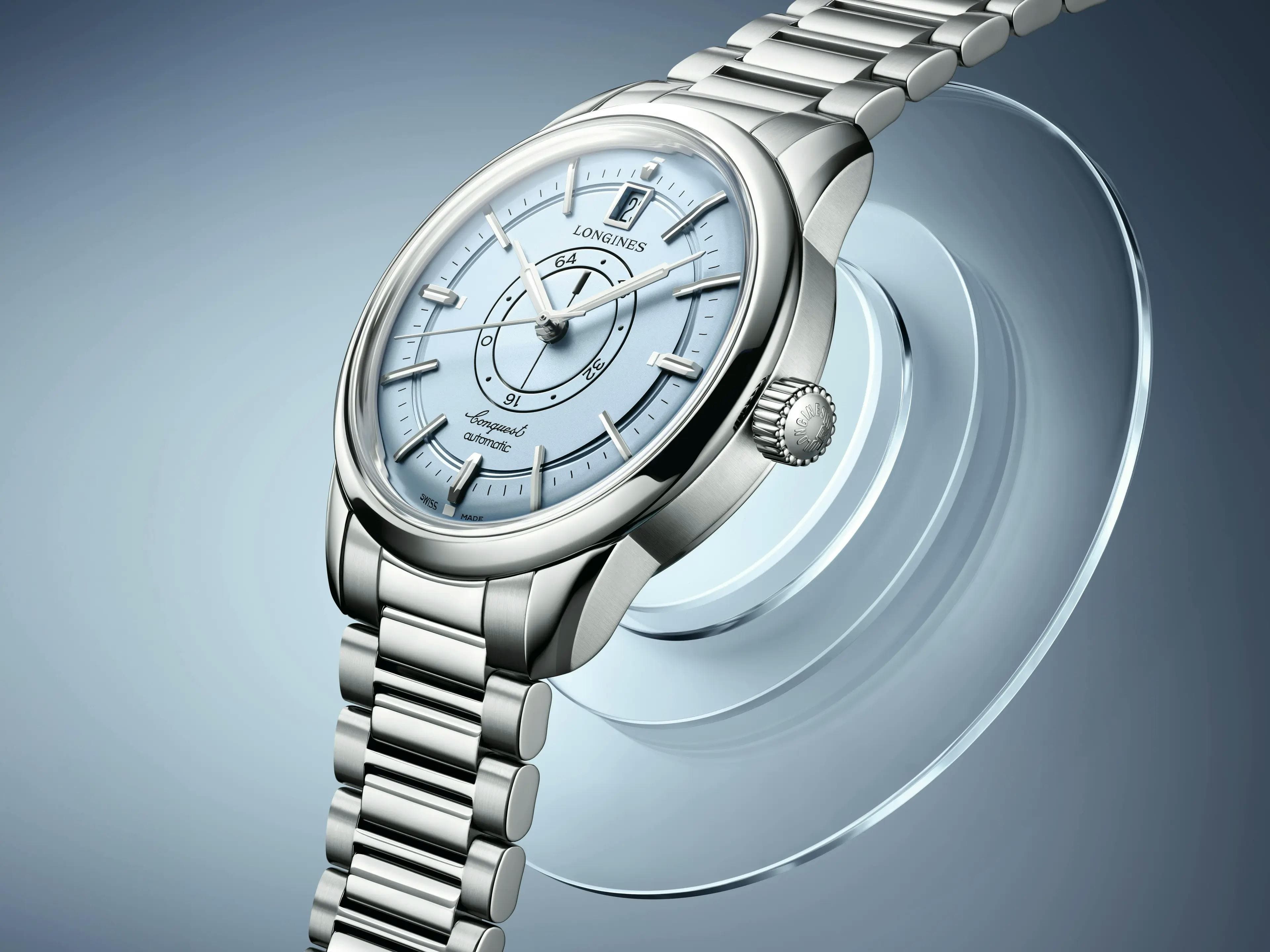
At €3,950 you are paying for: an exclusive-to-Longines automatic movement, a silicon hairspring, a 72-hour reserve, a genuinely rare central-disc complication, sapphire on both sides, and an opaline dial. That is the same money as an entry Tudor Ranger and €460 cheaper than a Grand Seiko SBGX259 quartz. It is not the cheapest way to buy a Swiss automatic, but it is one of the best-value ways to buy an actually-interesting mechanical dial at retail in 2026.
Who this is for
- You already own the sensible dive watch and the sensible chrono, and you want a dress-adjacent piece with visible personality.
- You like the idea of a central power-reserve indicator more than a moonphase or a small-seconds subdial.
- You care about magnetism (silicon hairspring), but not enough to spend Chronomètre-money on it.
- You want blue-dial versatility without going Nautilus 5711 route or paying JLC Master Ultra Thin money.
The verdict
The light blue Conquest Heritage Central Power Reserve is a dial refresh, not a new watch. That is not a criticism. The base watch was already the most interesting thing in Longines' modern catalogue, so getting a new dial on it is exactly what the collection needed. Ivory and anthracite are for people who own it every day. Green is for the specific collector. Light blue is the one that fits a Saturday shirt and a Monday meeting equally well, and at €3,950 there is not much else in the segment doing anything nearly as clever with a dial. Buy this before the resale market notices.
Comments
No comments yet, be the first to weigh in.